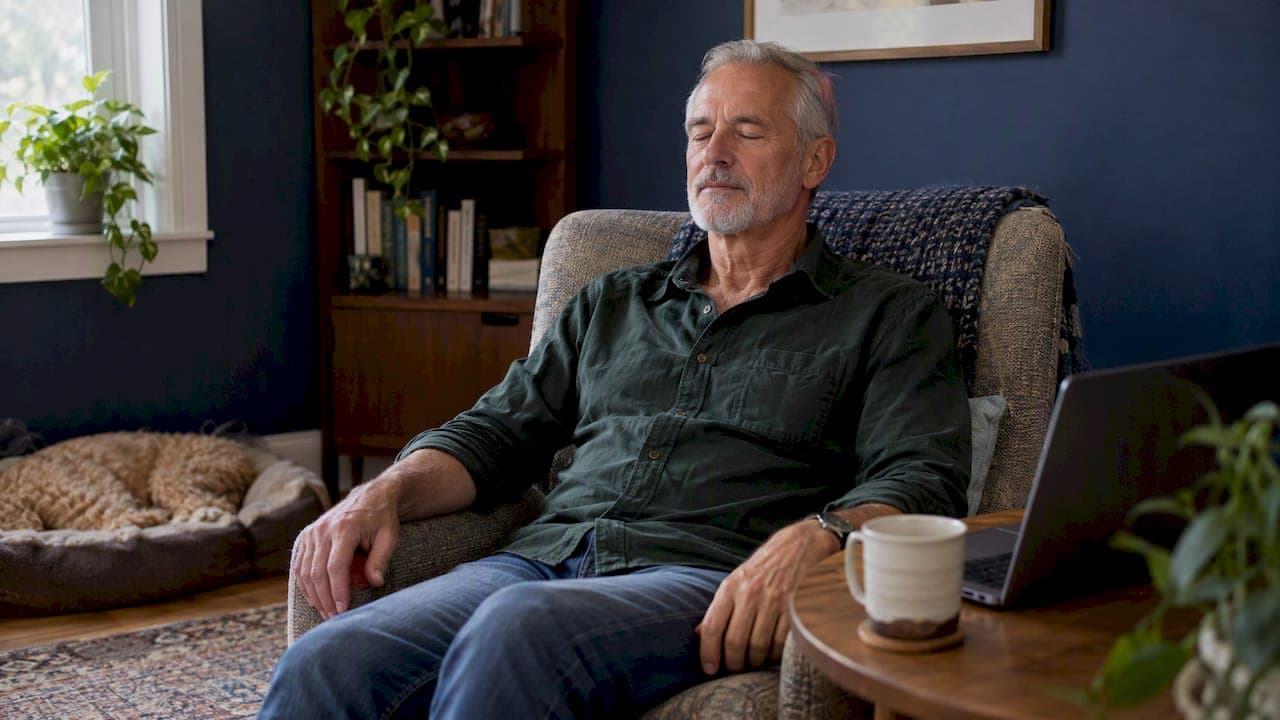
It is 2 a.m. and your presentation is at 10. Your chest is tight, your stomach is turning, and your mind is replaying the worst version of tomorrow. Nothing has happened yet. Your body is reacting anyway. Hypnosis for anticipatory anxiety targets exactly this: the gap between a future event and your body's alarm response to it. It does so by teaching your subconscious mind and nervous system a calmer response to the thing you are dreading.
This guide explains what is going on in your body, what the research says about hypnosis, what happens in a session, and how to tell whether it fits you.
TL;DR
- Anticipatory anxiety is worry about a future event, often with physical tension. It can start hours, days or weeks before.
- Hypnosis uses focused attention and suggestion to calm the alarm response. You stay aware and in control the whole time.
- Research is positive for procedural, medical and performance anxiety. Study quality varies, and hypnosis tends to work best alongside other care.
- A typical session moves through induction, deepening, suggestions and emergence. Most people remember all of it.
- Work with a trained practitioner. Tell them about any other anxiety treatment you are getting.
Table of Contents
- The dread that shows up before the event
- Why telling yourself to calm down does not work
- How hypnosis works on that automatic response
- What the research says
- What a session looks like
- Practicing at home between sessions
- Staying safe with hypnosis
- What to realistically expect
- Working with us
- FAQ
- Sources
The dread that shows up before the event
You know the pattern. A flight next Thursday, and by Monday you are checking the weather. A medical scan on the calendar, and you cannot eat the morning of. A family dinner, a job interview, a dentist appointment. The event itself is often fine. The days before it are the hard part.
The American Psychological Association defines anticipatory anxiety as worry about an upcoming event because of the possibility of a negative outcome, often with physical signs of tension. Psychologists describe it as a response to a perceived future threat. It can bring on hyperventilation and stomach distress, and it often pushes people to avoid the situation to dodge the discomfort.
It is also usually a symptom rather than a stand-alone condition. Medical News Today notes that it is tied to other anxiety disorders, such as social anxiety disorder, and that people may feel it for hours, days, weeks or months before an event.
That last point matters. If you have felt this way for weeks before a single appointment, nothing is wrong with your willpower. Your brain is doing a job it was built to do, and it is doing it at the wrong time.
Why telling yourself to calm down does not work
Here is the mechanism, in plain terms.
Your brain does not sort threats by calendar. When you picture the meeting, the needle or the plane taking off, the same alarm circuitry that responds to real danger starts firing. That is the fight-or-flight response. Heart rate climbs. Breathing gets shallow and fast. Muscles tighten. Digestion slows, which is why your stomach hurts.
This happens below conscious thought. The part of you that knows the meeting is safe is not the part running the alarm. So logic arrives, the body ignores it, and you end up more frustrated and more anxious.
Then avoidance kicks in. You cancel, reschedule or find a reason not to go. You feel relief for an hour. Your subconscious learns a lesson: the alarm was right, the thing was dangerous, and escaping fixed it. The next time, the alarm is louder.
Anyone who has tried to think their way out of this has run into the same wall. The pattern lives in automatic responses, so the work has to reach automatic responses.
How hypnosis works on that automatic response
Clinical hypnosis is a state of focused attention and deep relaxation. In that state, you are more open to suggestion and to mental rehearsal. The International Society for Hypnosis describes it as a collaborative tool that supports concentration and adaptive learning. It is not mind control or passive submission.
For anticipatory anxiety, a session usually does three things:
- Slows the body down. Guided relaxation and breathing lower physical arousal, so your nervous system gets practice at a calm baseline.
- Rehearses the event calmly. You imagine the situation while staying relaxed. The brain pairs the cue (the flight, the meeting) with steadiness instead of alarm.
- Adds suggestions for safety and calm. Those suggestions are worded around what you want to feel, and they are built from your own triggers.
The same society reports that suggestions for safety and calmness can interrupt escalating cycles of fear and help reduce both felt anxiety and physiological markers such as cortisol and heart rate.
That is the fight-or-flight loop being interrupted at the level where it runs. You are not arguing with the fear. You are giving the part of you that runs the alarm a new reference experience.
What the research says
You deserve a straight read of the evidence, so here it is.
Procedural and medical anxiety. A review by Hammond for the U.S. National Library of Medicine suggests self-hypnosis is a cost-effective and safe tool for state anxiety before medical procedures, surgery or tests. That is anticipatory anxiety in its most classic form.
Anxiety in general. A 2019 meta-analysis in the International Journal of Clinical and Experimental Hypnosis found that the average person receiving hypnosis reduced anxiety symptoms more than about 79% of control participants by the end of treatment.
Pairing with other care. The same meta-analysis concluded that hypnosis appears to work better for anxiety when combined with other psychological interventions than when used alone. The International Society for Hypnosis likewise says hypnosis functions best when integrated into broader, evidence-based care. Read that as good news: hypnosis slots in next to therapy, medication your doctor prescribes, or skills like paced breathing.
Where the evidence is strongest. The Society's 2026 overview says the evidence is strongest for procedural, medical and performance anxiety, and that research on anticipatory anxiety is positive. It also notes that study quality varies, with small samples, inconsistent methods and little long-term follow-up.
Dental settings. Results for dental anxiety are promising but mixed. A 2022 systematic review in PMC found that studies differ widely in method, and some show small effects. If dental visits are your trigger, the hypnosis for dental anxiety approach is worth reading about, and our own piece on dental anxiety hypnosis covers when a script is enough and when a clinician helps more.
Chronic anxiety disorders. A 2016 review concluded that evidence for hypnosis in chronic anxiety disorders is still limited and called for more rigorously controlled trials. If your dread is part of a broader pattern, see our guide to generalized anxiety hypnosis.
The fair summary: hypnosis has a solid fit with event-linked, anticipatory fear, and research keeps improving. It is one strong tool inside a bigger plan.

What a session looks like
Most people expect a swinging watch. The reality is closer to a guided conversation followed by a guided relaxation.
The Cleveland Clinic describes four stages: induction, deepening, suggestions and emergence. You stay in control, you choose to take part, and most people remember everything afterward.
Here is how that typically plays out for anticipatory anxiety in our online sessions over Zoom.
Before the trance: mapping the fear
We start by talking. What is the event? When does the dread begin? Where do you feel it first: throat, chest, stomach? What do you picture? What do you do to avoid it? The specifics shape everything that follows. Someone afraid of flying needs different suggestions than someone who dreads a quarterly review.
Induction and deepening
You get comfortable, usually in a chair at home, and follow my voice. Breathing slows. Your attention narrows. Your muscles release. This part is the physical opposite of fight-or-flight, and your body knows how to do it. Deepening simply extends that calm.
Suggestions and rehearsal
Once you are settled, we rehearse the event. You see yourself walking into the room, sitting down in the seat, hearing the announcement, with your body staying level. We use guided imagery and NLP techniques to attach calm responses to the cues that used to trigger alarm. The wording is built from what you told me earlier.
Emergence
I bring you back gradually. You will feel awake, usually relaxed, and aware of what happened. Then we talk through what you noticed and plan what to practice before the event.
The online format has a real advantage here. You are in your own space, the place where the 2 a.m. dread often hits, so the calm gets linked to your real environment. If you wonder whether it works through a screen, read our piece on being hypnotized online.
Practicing at home between sessions
Sessions give you the skill. Practice keeps it sharp. The U.S. Department of Veterans Affairs notes that self-hypnosis can be a portable, effective skill, often supported by recordings you can repeat for personal concerns.
A simple routine for the days before an event:
- Pick a time. Ten minutes, same time daily, starting a week before the event if you can.
- Settle your body. Sit with your feet on the floor. Breathe in through your nose for four counts, out for six. The longer exhale cues your body to slow down.
- Relax in order. Move from forehead to jaw to shoulders to hands to legs, letting each area soften.
- Rehearse the event. Picture the first two minutes in detail, with your body calm. Stay with it until your breathing stays slow.
- Use a calm cue. Pair a slow breath with a word or a hand pressed against your thigh. Use it at the real event.
- Come back. Count up from one to five and open your eyes.
If recalling the event brings up strong emotion, stop and breathe. Do not try to dig into old memories on your own. The VA warns that hypnosis used to work through past events can bring up strong emotional reactions and false memories. Rehearsing a future event is a different task, but if old material surfaces, that is a good moment to bring in a trained practitioner.
Our perspective
Most people who come to us have already tried to reason with their anxiety. They have lists, breathing apps and good intentions. What they have not had is a way to reach the part of the mind that sets off the alarm before a flight, a test result or a hard conversation.
We work with that part directly. In session, we slow the nervous system first, then rehearse the feared situation while the body stays calm. We use clinical hypnotherapy, guided imagery and NLP, and every session is built around your specific trigger, not a generic script.
Our aim is a lasting change in how your subconscious responds, not a coping trick you have to white-knuckle. We also welcome clients who are working with a therapist or doctor. Hypnotherapy fits well next to other care, and the research supports that pairing.
Kirk
Staying safe with hypnosis
Hypnosis is generally safe when done by a trained professional. The Cleveland Clinic says this applies when it is performed by a trained, licensed healthcare professional with additional hypnosis training, and it lists rare side effects: dizziness, drowsiness, headaches and, in some cases, increased anxiety. These usually pass quickly. Tell your practitioner if you feel any of them, so the pacing can be adjusted. Our guides to hypnosis safety and side effects and screening go into more detail.
A few practical points:
- Tell your doctor or therapist. If you take anxiety medication or see a mental health professional, let them know you are adding hypnotherapy. Do not change any prescribed medication on your own.
- Seek medical or psychiatric care first if your anxiety comes with panic attacks, trouble functioning at work or home, or thoughts of harming yourself. In the U.S., you can call or text 988 at any time to reach the Suicide and Crisis Lifeline.
- Rule out physical causes. Racing heart or chest tightness deserves a check with your physician, especially if it is new.
If your dread centers on a particular situation, these related guides may help: performance anxiety, health anxiety and cancer-related anxiety.
What to realistically expect
The honest timeline: many people notice they feel calmer during the session itself. The bigger shift is when the event comes and your body does not jump to alarm the way it used to. That usually builds with repetition, through more than one session and with practice between them.
What tends to help most:
- Starting before the event rather than the night before.
- Naming one specific situation to work on first.
- Practicing the calm cue daily.
- Combining sessions with other care you already trust.
Not everyone responds the same way. Responsiveness varies from person to person, which our article on whether everyone can be hypnotized explains.
Working with us
We offer online hypnotherapy for anxiety with Kirk Hoffman, a Certified Clinical Hypnotherapist, over Zoom, for clients across the United States. Sessions are personalized to your trigger and use clinical hypnotherapy and NLP to address the subconscious pattern behind the dread. You can start with a free consultation to talk through what you are facing.
See the details on our online hypnotherapy for anxiety page.
If your anxiety also shows up in other areas, our services page lists everything we offer.
FAQ
Can hypnosis stop anticipatory anxiety completely?
No practitioner can promise a total end to anxiety, and your results depend on you and your situation. Research is positive for event-linked anxiety, and many people find the physical alarm much quieter after sessions and practice. Hypnosis tends to work best alongside other care.
How many sessions does it take?
It depends on how long the pattern has been running and how many situations trigger it. A single clear trigger, like one upcoming procedure, may need fewer sessions than a pattern that appears across many parts of life. We talk through a plan after hearing your history in a consultation.
Will I lose control or say something I do not want to?
No. The Cleveland Clinic describes hypnosis as an active process where you remain in control of your thoughts, and most people remember everything afterward. You can open your eyes and end it whenever you choose.
Is online hypnosis as good as in person?
The core of a session is guided attention, relaxation and suggestion, which you can do through a video call. Many clients like being at home, where their anxiety usually hits. You need a quiet room, a stable connection and about an hour.
Can I use a recording instead of a clinician?
Recordings can support your practice. The VA notes that recordings help people repeat self-hypnosis for personal concerns. A clinician adds something a recording cannot: suggestions built around your exact trigger, and adjustments as you respond.
Sources
- APA Dictionary of Psychology: anticipatory anxiety
- APA Monitor: Understanding anticipatory anxiety
- Medical News Today: Anticipatory anxiety
- International Society for Hypnosis: Hypnosis in the Treatment of Anxiety Disorders
- Hammond: Hypnosis in the treatment of anxiety- and stress-related disorders
- The Efficacy of Hypnosis as a Treatment for Anxiety: A Meta-Analysis
- Efficacy of Hypnosis on Dental Anxiety and Phobia: A Systematic Review
- Hypnosis for anxiety and phobic disorders: A review
- Cleveland Clinic: Hypnosis
- U.S. Department of Veterans Affairs: Clinical Hypnosis