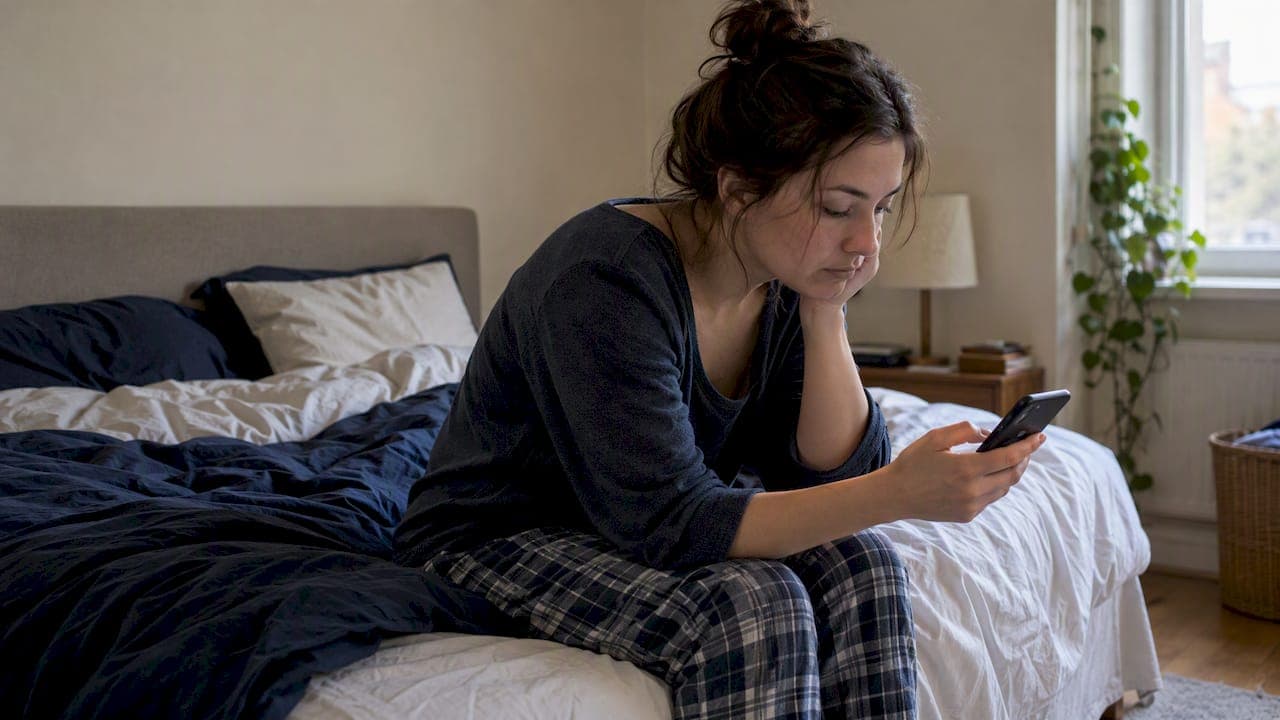
You wake up. Before you open your eyes, your chest is tight, your heart is pounding, and your mind is already listing everything that could go wrong today. Nothing has happened yet. Your body has simply decided the day is a threat.
Hypnosis can help with this. It works on the automatic alarm response your body fires at waking, not just on the worry thoughts that follow. It is not a cure on its own, and it works best with steady sleep habits and, for some people, other care. This guide explains what is happening, what the research supports, and what a first session with a clinical hypnotherapist looks like.
We use a simple structure here. It is Problem, Agitate, Solution (PAS): name the problem, show what it costs you, then lay out the way through.
TL;DR
- Morning anxiety is often a body event first. Your stress hormones naturally rise after waking, and an anxious nervous system can read that rise as danger.
- A 2019 meta-analysis found hypnosis reduced anxiety more than most control treatments, and the gap grew at follow-up.
- A May 2026 study found that one guided hypnotic session lowered morning cortisol response and heart rate over the following week.
- Hypnosis works best alongside good sleep habits and, when needed, therapy. It does not replace care for anxiety that is persistent or disrupts your life.
- A first session online over Zoom is a conversation, then a guided relaxation. You stay aware and in control throughout.
Table of Contents
- The problem: your day starts in fight-or-flight
- What it costs you
- Why hypnosis fits this particular problem
- The solution: what we do with morning anxiety
- What a first online session looks like
- Is it only morning anxiety? When to look further
- Our perspective
- Work with us on your mornings
- FAQ
- Sources
The problem: your day starts in fight-or-flight
Picture the specific moment. The alarm goes off, or you wake a few minutes before it. Your stomach drops. Your jaw is clenched. You check your phone and feel your pulse in your throat. You haven't made a decision, answered an email or had a bad thought you can name. The feeling is already there.
That is not weakness or bad character. It is physiology. The National Institute of Mental Health notes that anxiety can show up in the body as a rapid heart rate, sweating or chest pain. The NIMH describes anxiety disorders as more than worry. They involve the body's fight-or-flight response.
What happens in the first hour after waking
Your body releases cortisol in a burst shortly after you wake. Researchers call it the cortisol awakening response. In most people it is a helpful push that gets you out of bed. In a person whose nervous system is already on alert, the same push can feel like the start of an emergency.
The Scientific Reports study measured exactly this window. It tracked the cortisol awakening response and heart rate between 6 a.m. and 9 a.m. in daily life. So morning anxiety is not just in your head, and it is not only in your head either. It lives in the loop between your subconscious threat detector and your body.
The subconscious part
Your subconscious mind runs on learned associations. If mornings have repeatedly meant deadlines, conflict, a hard commute or a long stretch of dread, your brain files "waking up" under "danger." It then fires the alarm automatically, before your thinking mind is even online. You can't argue with a reflex by reasoning with it at 6 a.m.

This is why positive thinking often fails here. You are trying to talk a body down using the part of the brain that is not yet in charge.
What it costs you
Morning anxiety rarely stays in the morning. It tends to feed on itself.
- You dread bedtime because you know what comes after sleep.
- You sleep lighter, which makes the next morning worse. A review in Sleep Medicine Reviews reports that sleep disturbances, particularly insomnia, affect about 50% of people with anxiety, and that too little sleep can start or worsen anxiety.
- You reach for coffee on an already jumpy system, or skip breakfast because your stomach is in knots.
- You start the workday already drained, so small problems feel large.
After weeks of this, many people begin to fear the fear itself. That fear of the sensation is what keeps the loop running.
Why hypnosis fits this particular problem
Hypnosis is a state of focused attention and deep relaxation, paired with suggestions. The APA Dictionary of Psychology defines hypnotherapy as the use of hypnosis in psychological treatment, aimed at relieving symptoms and modifying behavior patterns.
The field does not agree on whether hypnosis is a special trance state or an ordinary mix of attention and expectation. The APA Handbook of Clinical Hypnosis describes that divide. For you, the practical point is the same under either model: the work happens through relaxed focus and carefully chosen suggestions.
What the research shows
Here is where the evidence stands, without hype.
- Anxiety in general. A 2019 meta-analysis of 15 studies found people receiving hypnosis improved more than about 79% of control participants by the end of treatment. At long-term follow-up, that rose to 84%.
- The morning window specifically. In the May 2026 study of 80 participants, a single guided session built around safety suggestions reduced the cortisol awakening response and morning heart rate in the following week, compared with a control group. It is one study, so treat it as promising, not settled.
- The limits. A 2024 meta-analytic review found hypnosis is best supported for medical procedures and chronic pain. For anxiety, results vary. The largest effects in mental health settings came when hypnosis was combined with other psychological methods.
So the honest summary is this. Hypnosis is a reasonable, non-invasive tool for anxiety, and it has an early, specific signal for morning stress. It is strongest as part of a plan.
The solution: what we do with morning anxiety
A good plan has three layers: steady sleep, a calmer alarm response, and a way to catch the spiral in the first minutes of the day.
Layer 1: stabilize the sleep
No mental technique fully overcomes a scrambled sleep schedule. The VA's self-help workbook for anxiety uses the SLEEP rule:
- Set a regular bedtime.
- Limit use of the bedroom to sleep.
- Exit the bedroom if you are not asleep in 15 to 20 minutes.
- Eliminate naps.
- Put your feet on the floor at the same time every morning.
We ask clients to start this alongside hypnosis, not after it. It gives the nervous system a predictable rhythm to settle into.
Layer 2: retrain the alarm response
This is the core of the hypnosis work. In a relaxed, focused state, your subconscious is more open to new associations. In sessions, we pair the waking-up moment with safety cues your body can learn, such as slow exhalation, a heavy warm sensation in the limbs and a specific mental image of a place that feels secure. The aim is for waking to start meaning "safe" instead of "brace."
The 2026 study used a similar principle, with hypnotic safety suggestions delivered in one session. We build on the same idea over several sessions, tailored to what your mornings actually involve. Is it the work you face? A relationship? A vague dread with no clear object? Each leads to different suggestions.
We also use guided imagery, which many clients find easy to practice between sessions. If that interests you, our piece on guided imagery for anxiety explains how to try five to ten minutes and when to stop.

Layer 3: a two-minute waking routine
Before the first session, you can try this. It is not hypnosis. It is a way to interrupt the loop.
- Keep your eyes closed for the first ten seconds. Notice where the tension sits.
- Breathe in for four counts, out for six. The longer exhale tells the body it is safe to slow down.
- Name the sensation plainly: "My body is releasing cortisol. This is a reflex, not a fact."
- Put your feet on the floor. Feel the floor.
- Delay the phone for ten minutes.
This will not erase morning anxiety. It gives you a small win while the deeper retraining happens.
What a first online session looks like
Many first-timers worry about losing control. You will not. You hear everything, you can open your eyes at any time, and you cannot be made to do anything against your will. We cover this fully in our guide on whether hypnosis is safe.
Here is the flow of a typical session over Zoom:
- Conversation (first part). We talk about your mornings. When do you wake? What do you feel, and where? What do you think about first? This shapes the suggestions.
- Induction. You sit or recline somewhere comfortable. We guide your breathing and attention until your body relaxes.
- Suggestion work. While you are deeply relaxed, we introduce the safety cues and new associations for waking.
- Return. We bring you back to full alertness and talk about what you noticed.
- Practice. You leave with a short routine for the next few mornings.
You may wonder whether this works through a screen. Many people find it does, since they are at home and already comfortable. Our article on being hypnotized online goes into this.
Is it only morning anxiety? When to look further
Morning anxiety can be a sign of something wider. If your anxiety is persistent, feels uncontrollable or interferes with work, relationships or sleep, the NIMH is clear that tools like meditation or hypnosis do not replace comprehensive care. Talk to a licensed physician or a licensed mental health professional.
See a doctor promptly in these situations:
- Chest pain, a racing heart or shortness of breath that you have not had checked. Anxiety can cause them, but so can heart and thyroid conditions, and a doctor should rule those out.
- Repeated, unexpected panic attacks. The NIMH panic disorder page says treatment typically involves psychotherapy, medication or both, and describes cognitive behavioral therapy (CBT) as the gold standard psychotherapy. Hypnotic techniques can supplement that care.
- Thoughts of harming yourself. Call or text 988, the Suicide and Crisis Lifeline, right away.
If you already take anxiety medication, do not change or stop it because of hypnosis. Any change goes through your prescriber.
The same principles apply to other fear triggers too. Dental fear is a common one, and this clinic-tested guide to easing dental anxiety shows how calming techniques are used in a real appointment. If your anxiety is broader, our guide to generalized anxiety and hypnosis may fit better.
Our perspective
We see the same pattern again and again. Someone arrives having tried willpower, apps and recordings. They say the anxiety hits before they are even awake enough to fight it. They are right. By the time the thinking mind arrives, the body has been braced for minutes.
So we work at the level where the pattern was learned: the subconscious association between waking and danger. Clinical hypnotherapy with NLP and guided imagery lets us speak to that level directly. We do not promise a cure on day one. We do expect to give you a clear tool and a changed sense of your mornings within the first few sessions, and we adjust from there.
We also keep it honest. Hypnosis is one piece. Sleep matters. Medical checks matter. If your symptoms say you need a doctor or a therapist, we will tell you.
— Kirk
Work with us on your mornings
Hypnotic Transformations offers online clinical hypnotherapy for anxiety with Certified Clinical Hypnotherapist Kirk Hoffman, over Zoom, for clients across the United States. Read about online hypnotherapy for anxiety or book an appointment to talk about your mornings.
FAQ
Why am I so anxious right when I wake up?
Your body naturally releases cortisol soon after waking. If your nervous system is already on high alert, that normal rise can register as danger and set off a racing heart and dread. Poor sleep and stress the day before make it stronger.
Can one hypnosis session help with morning anxiety?
There is early evidence that it can. In the 2026 study, a single session reduced the morning cortisol response and heart rate over the next week. That was a research setting with 80 participants, so most people will need more than one session, plus steady sleep habits.
Are free hypnosis recordings enough?
Some people find them calming, and they cost nothing. A recording cannot ask about your specific mornings or adjust its suggestions. If anxiety keeps returning, a session with a clinician tailors the work to you.
Is hypnosis safe if I have panic attacks?
Hypnosis is generally a gentle, relaxing process, and you stay aware throughout. If you have frequent, unexpected panic attacks, see a doctor or licensed mental health professional first, and treat hypnosis as a supplement to that care. Our guide on hypnosis safety covers what to ask.
Sources
- The Efficacy of Hypnosis as a Treatment for Anxiety: A Meta-Analysis (PubMed)
- Meta-analysis, International Journal of Clinical and Experimental Hypnosis
- Hypnotic safety suggestions reduce cortisol awakening response and morning heart rate (Scientific Reports)
- 2024 meta-analytic review of hypnosis (PMC)
- NIMH: Panic Disorder
- NIMH: Anxiety Disorders
- Sleep and anxiety: From mechanisms to interventions (ScienceDirect)
- VA self-help workbook: Calming Tools to Manage Anxiety
- APA Dictionary of Psychology: hypnotherapy
- APA Handbook of Clinical Hypnosis