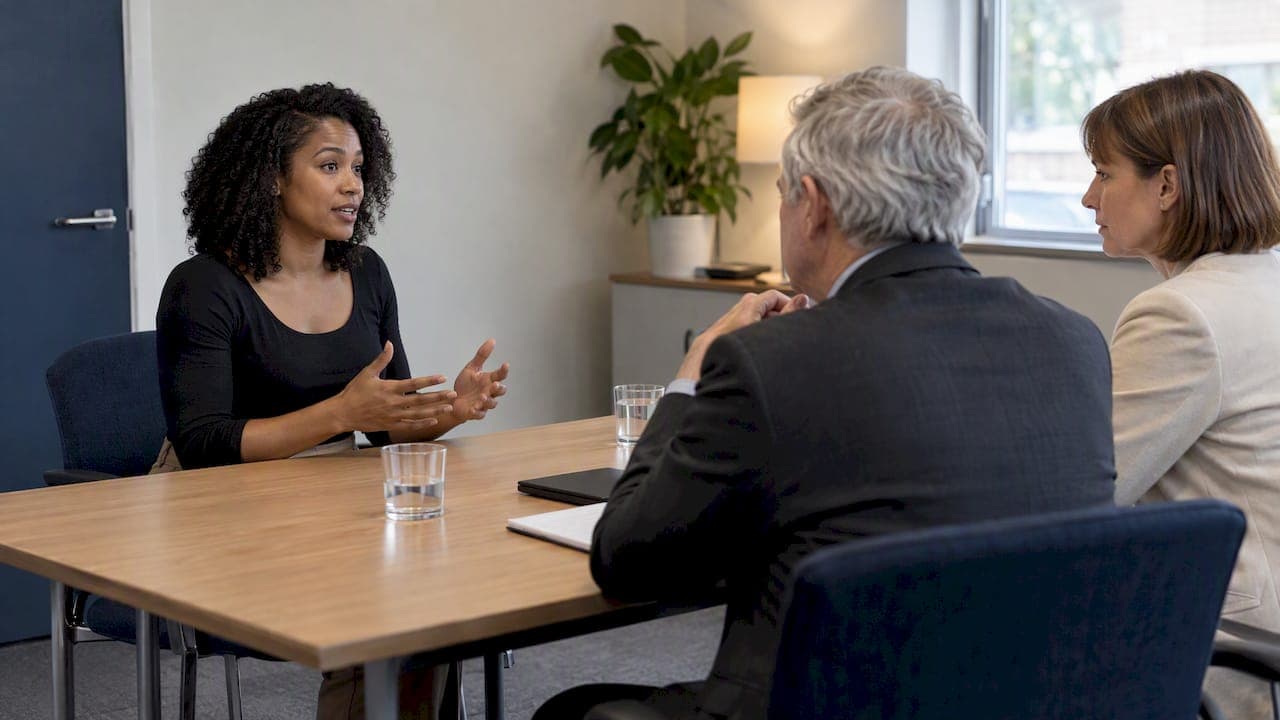
You walk in prepared. Then the interviewer asks a simple question, your heart jumps, your mouth goes dry, and the answer you rehearsed 40 times is gone. Hypnosis can help with this, because it works on the part of you that reacts before you can think. It is not a replacement for practice, and it does not work for everyone. Used with real interview preparation, it can teach your body to stay calmer when the questions start.
TL;DR
- Interview anxiety is a fight-or-flight response to being judged. It shows up as a racing heart, a shaky voice and a blank mind.
- Clinical hypnosis uses guided relaxation and focused attention. You stay aware and in control the whole time.
- A 2019 meta-analysis found hypnosis reduced anxiety more than control conditions, and it worked better when combined with other psychological methods.
- Hypnosis works best next to mock interviews and question practice, not in place of them.
- Evidence is promising but not complete, and there is no fixed number of sessions that works for everyone.
Table of Contents
- The moment your mind goes blank
- Why it gets worse the more you care
- What hypnosis actually is, and what it is not
- What the research says
- What a session looks like
- Pair it with real preparation
- A self-hypnosis routine you can start tonight
- Is it safe?
- How many sessions, and how long it lasts
- Our view: why we treat the reaction, not just the nerves
- Working with Kirk Hoffman online
- Frequently asked questions
- Sources
The moment your mind goes blank
Picture the exact moment. The panel asks, "Tell us about a time you handled conflict." You know the story. You have told it to a friend. But now your chest is tight, your hands are shaking, and your voice sounds thinner than usual.
This is not a lack of intelligence or preparation. Researchers who study this describe interviews as high-stakes social situations where you must show competence while being evaluated. Anxiety in that setting pulls attention toward threats and toward yourself, which leaves less attention for building your answer.
The same research lists the symptoms you probably know well: a fast heartbeat, sweaty palms, trembling hands and a quivering voice. Interview anxiety has cognitive, behavioral and physiological parts, and it can hurt how you perform.
So you have three things happening at once:
- Thoughts: "They can tell I'm nervous. I'm going to blow this."
- Body: pounding heart, shallow breathing, tight throat.
- Behavior: rushing, going quiet, avoiding eye contact, or talking in circles.
The second one is where hypnosis has the most to offer.
Why it gets worse the more you care
The interview you want most is usually the one that goes worst. That is not bad luck. It is how your nervous system sorts danger.
Your brain does not separate a hostile crowd from a hiring manager with a clipboard. When it reads "I am being judged and the outcome matters," it can switch on the fight-or-flight response. Adrenaline rises. Your heart speeds up. Blood moves toward your large muscles. Thinking and word-finding, which need calm, get less support.
Then it feeds itself. You notice your heart pounding. You think, "This is going badly." That thought tells your brain the threat is real, and the body ramps up again.
Many people also carry memory patterns from earlier moments: a bad interview, a teacher who humiliated you, a boss who dismissed you. Your subconscious mind stores those as rules, such as "When people evaluate me, I get hurt." The rule fires in under a second, before you can talk yourself out of it.
That is why "just relax" and "just be confident" fail. You are asking the thinking part of your mind to overrule a reaction that does not run through it.
What hypnosis actually is, and what it is not
Clinical hypnosis is not stage hypnosis. In clinical hypnosis, people in trance do not lose control. You will not bark like a dog or say something you do not want to say.
What happens instead is simpler. Hypnosis commonly uses guided relaxation, focused attention and suggestions, and people generally stay aware and in control. It feels like the state just before sleep, or like being absorbed in a good book. You hear everything. You can open your eyes. You can stop.
In that focused, relaxed state, a hypnotherapist can guide you through imagery and suggestions. A Cleveland Clinic psychotherapist describes this as an interactive process with guided imagery and retained awareness. The aim is to help you notice stress patterns and build calmer, more confident responses.
For interview anxiety, that usually means this: you rehearse the interview in your mind while your body is relaxed. Your nervous system gets repeated practice at meeting the scene without the alarm. Over time, the cue "someone is evaluating me" can become linked with a steadier state.
What the research says
Here is the honest picture.
A 2019 meta-analysis of hypnosis for anxiety found that the average person receiving hypnosis had a bigger drop in anxiety than people in control groups. The effect tended to be stronger when hypnosis was combined with other psychological treatment rather than used alone.
That fits what clinicians report. A paper on hypnosis for anxiety disorders argues that because anxiety is complex, hypnosis works best when it is blended into other evidence-based approaches such as CBT.
Now the limits. The VA's Health Services Research and Development office notes that studies of hypnosis often have small samples and uneven quality, so results need careful reading. The VA's own evidence map rates the evidence for hypnosis and anxiety in cancer patients as low confidence, though it describes the approach as safe. And Cleveland Clinic says evidence for many benefits is still incomplete and hypnosis may not help everyone.
Note what is missing: I could not point you to a large trial of hypnosis for job interviews specifically. The case for it rests on research into anxiety in general, plus how the interview response works. Treat it as a reasonable tool with promising support, not a guarantee.
What a session looks like
If you have never done this, the unknown is often scarier than the hypnosis. Here is the usual shape.
1. A conversation first. The first clinical hypnosis session typically starts with a talk about your goals and concerns, and the clinician builds a plan from that. For interview anxiety, we would ask what happens in your body, which part of the interview hits hardest (the first question, the panel, the silence after you answer), and what you tell yourself in that moment.
2. Screening. A good clinician asks about your health history before starting. Our guide to five screening questions for hypnotherapy contraindications explains what we check and why.
3. Induction. You are guided to relax your body and narrow your focus, often with slow breathing and a calm voice. Sessions usually last around an hour.
4. Rehearsal and suggestion. While you are relaxed, you go through the interview in your imagination: the waiting room, the handshake, the first question, the hard question. You practice staying steady at each point. Techniques like NLP anchoring can tie a calm physical cue, such as pressing thumb and finger together, to that steady state.
5. Coming back. You return to normal awareness, talk through what you noticed, and plan your next steps.
All of this can be done on video. If you wonder whether it works through a screen, read how clinician-led online hypnosis for anxiety works.

Pair it with real preparation
Hypnosis will not write your answers. It lowers the alarm so the preparation you did can actually come out.
The National Career Development Association's case guidance treats interview anxiety alongside concrete preparation. Counselors should cover first impressions, likely questions and attire while also addressing anxious thoughts and feelings. The same guidance recommends role-playing interviews and practicing relaxation such as deep breathing, muscle relaxation and meditation before, during and after the interview.
A workable plan looks like this:
- Two weeks out: Write your top eight stories (conflict, failure, leadership, a deadline). Practice questions matched to the job you want, and record yourself.
- One week out: Do a mock interview with a friend or coach. NCDA suggests recording role-plays on video to review posture, open body position and engagement.
- Hypnosis sessions: Schedule them early enough that you can practice the calm response several times before the day, not the night before.
- Day of: Use your breathing and your anchor in the car and in the waiting room.
If your fear reaches beyond interviews into speaking, auditions or any moment of being watched, our article on clinician plans for performance anxiety covers the wider pattern.
A self-hypnosis routine you can start tonight
Hypnosis is also a skill you can take home. The VA describes clinical hypnosis as a self-management tool that can be taught to patients to use on their own, in many settings outside the clinic.
Try this for about ten minutes a day in the week before your interview:
- Sit somewhere quiet. Feet flat, hands loose.
- Breathe in through your nose for four counts. Breathe out for six. The longer exhale tells your nervous system it is safe to slow down. If you want a short guide, this five-minute breathwork routine is a good place to begin.
- Relax your body from forehead to feet. Notice jaw, shoulders, hands.
- Picture the interview in detail. See the room. Hear the chair. Notice the smells and sounds. Slowly picture yourself breathing evenly while you hear the first question.
- Watch your body stay steady. Say to yourself, "I can think clearly here."
- Press your thumb and finger together at the calmest moment. That is your anchor.
- Count up from one to five and open your eyes.
On the day, press the anchor and take three slow exhales before you walk in.
One caution. Cleveland Clinic says self-hypnosis should not replace psychological or medical treatment. If you have schizophrenia, a dissociative disorder, a seizure or other neurological condition, PTSD, recent significant trauma or extreme emotional distress, talk with a healthcare professional or licensed practitioner before you try it.
Is it safe?
For most people, yes. The VA describes clinical hypnosis as safe, with rare minor side effects such as drowsiness, headache or dizziness. Cleveland Clinic says it is generally low-risk when delivered by a trained, certified therapist.
The same VA document notes that working through past events can sometimes create false memories or strong emotional reactions. That is one reason we keep interview work focused on the present response and the future rehearsal, and why screening matters.
If the idea of "going under" worries you, read why you cannot get stuck in hypnosis. For a wider look at risk, see what anxiety sufferers should know about hypnosis safety and our notes on side effects and screening.
When should you see a licensed mental health professional first or alongside hypnosis? If your anxiety spreads into most of your life, you have panic attacks, you cannot sleep for days, or you feel hopeless, a licensed therapist or your doctor should be part of your care. Interview nerves can be the visible part of a bigger anxiety pattern. Our guide on generalized anxiety and hypnosis explains how to tell the difference.
How many sessions, and how long it lasts
Nobody can honestly give you a number up front. Cleveland Clinic says there is no fixed number of hypnotherapy sessions. Some people need only a few, others need longer, and the plan changes with your progress and feedback.
What affects it:
- How long you have had the reaction. A fear that began last month often moves faster than one you have carried for 15 years.
- How much time you have. A single interview next week calls for a focused plan. An open-ended job search lets you build more slowly.
- How much you practice between sessions.
- Whether other anxiety is in the picture.
The goal is a reaction that stays steady across interviews, not one lucky day. That comes from repetition, which is why the home practice matters.
Our view: why we treat the reaction, not just the nerves
We are Hypnotic Transformations, and this is how we think about interview fear.
Most advice on interview anxiety starts with the thoughts: reframe, power pose, think positive. Those can help. But when someone sits down in my Zoom room and says their mind goes blank, the story is nearly always about the body first. The heart speeds up, the breath goes high in the chest, and the thinking brain loses its footing.
So we work at the level where that response lives. In a session, we use clinical hypnosis, guided imagery and NLP to rehearse the scene while your nervous system is calm. The aim is to teach your subconscious mind a new rule about being evaluated: this is safe enough to think in.
We also tell clients plainly what hypnosis cannot do. It cannot make you the best candidate. It will not replace knowing your stories or practicing your answers. We ask people to do both.
And if what we hear suggests you need a licensed therapist or a medical check, we say so. A good fit matters more than a booked session.
— Kirk
Working with Kirk Hoffman online
Hypnotic Transformations offers online clinical hypnotherapy by Zoom with Certified Clinical Hypnotherapist Kirk Hoffman, for clients across the United States. Sessions address anxiety at the level of the subconscious mind and the stress response, using clinical hypnosis, guided imagery and NLP. You can do it from your own quiet room, which also means you can practice in the space where you will take your video interviews.
If interview anxiety is the part of your life you want to change, start with our online hypnotherapy for anxiety page, or look at the full list of services. We offer free consultations, so you can ask your questions before you commit to anything.
Frequently asked questions
Can hypnosis really help with a fear of job interviews?
It can help for many people. A meta-analysis of hypnosis for anxiety found bigger reductions in anxiety than in control groups. Evidence specific to interviews is thin, and it does not help everyone, so think of it as one tool alongside practice.
Will I lose control or say something embarrassing?
No. In clinical hypnosis you stay aware and can end the session at any time. It is very different from stage shows, which are built for entertainment.
Is a recording enough, or do I need a live session?
A recording can help you practice a routine between sessions. A live session lets the clinician screen you, ask about your specific triggers and adjust the plan. If you have panic, trauma or other significant mental health concerns, live guidance with a professional is the safer start.
Should I try hypnosis the night before an interview?
It is better to start earlier. Your nervous system learns through repetition, so several practices over days or weeks give you more than one session at the last minute. If your interview is tomorrow, slow breathing and a short self-hypnosis practice are reasonable, and a longer plan can wait for the next one.
Does insurance cover hypnosis for anxiety?
Coverage varies. One documented case is the VA, where clinical hypnosis is covered in the medical benefits package when the care team decides it is clinically necessary. For private insurance, ask your plan directly.
Sources
- Does interview anxiety predict job performance and does it…
- Expanding conceptual understanding of interview anxiety
- The Efficacy of Hypnosis as a Treatment for Anxiety: A Meta-Analysis
- VA Whole Health: Clinical Hypnosis
- VA: Clinical Hypnosis (PDF)
- VA HSR&D: Guided Imagery, Biofeedback, and Hypnosis
- Cleveland Clinic: How Hypnotherapy Eases Anxiety
- Cleveland Clinic: Hypnosis, What It Is, How It Works, Benefits & Risks
- Cleveland Clinic: What Is Self-Hypnosis and How Do I Do It?
- Using Hypnosis in the Treatment of Anxiety Disorders: Pros and Cons
- NCDA: interview anxiety case guidance
- NCDA: Best Practices for Undergraduate Psychology Career Planning
- NCDA: Seeing Beyond Eye Contact