
Hypnotherapy is a clinical technique that uses guided, focused relaxation to shift attention away from fear and toward a calmer, more controlled mental state. For cancer patients, that shift matters. A meta-analysis of 20 studies found that hypnosis produced significant immediate reductions in cancer-related anxiety, with effects that held up months after treatment ended. This is not a fringe wellness trend. It is a recognized, non-pharmacological option that major cancer institutions, including MD Anderson Cancer Center, now recommend as part of integrative care.
Here is what the research confirms about hypnotherapy for cancer anxiety:
- Hypnosis reduces anxiety significantly compared to standard care alone, with both immediate and sustained effects
- Therapist-led sessions consistently outperform self-hypnosis audio recordings
- Clinical reviews show a favorable benefit-to-harm profile, with no reported side effects from properly conducted sessions
- Hypnotherapy works best as an adjunct to conventional cancer treatment, not a replacement
- Patients remain fully conscious and in control throughout every session
Why cancer patients turn to hypnotherapy
A cancer diagnosis activates the nervous system's fight-or-flight response in a way that does not simply switch off between appointments. Patients often describe a persistent background hum of dread: fear of procedures, fear of pain, fear of what comes next. Standard pharmacological options for anxiety carry their own side effects, and many patients are already managing a complex medication schedule.
Hypnotherapy offers a different path. It works at the level of the subconscious mind, where habitual fear responses are stored, rather than just addressing surface symptoms. Patients who engage with it regularly report better emotional regulation during scans, infusions, and difficult conversations with their care teams.
Common reasons cancer patients seek hypnotherapy include:
- Procedure-related anxiety (needle phobia, MRI claustrophobia, pre-surgical fear)
- Persistent stress and emotional distress between treatment sessions
- Difficulty sleeping due to racing thoughts and anticipatory worry
- Pain perception, where hypnosis can shift how the brain processes discomfort
- Fatigue and emotional exhaustion that standard care does not fully address
- A desire for a coping tool they can use actively, rather than passively waiting for medication to work
- Wanting to feel some sense of control during a period when so much feels out of their hands
That last point tends to be underestimated. Cancer treatment strips away a lot of agency. Hypnotherapy gives it back, at least in part, by teaching patients to direct their own attention and calm their own nervous systems.
What actually happens during a hypnotherapy session for cancer anxiety
A session does not look like stage hypnosis. There is no swinging watch, no one clucking like a chicken. What actually happens is closer to a very focused, guided relaxation, where the therapist helps you narrow your attention and quiet the noise that keeps the fight-or-flight response running.

Sessions are personalized. A trained hypnotherapist working with cancer patients will ask about your specific fears, your treatment schedule, and what situations trigger the most distress. That intake shapes everything that follows. Generic scripts pulled from an audio library cannot do this, which is one reason tailored therapist sessions consistently outperform pre-recorded approaches.
A typical session moves through these stages:
- Induction: The therapist guides you into a deeply relaxed state using slow, directed breathing and verbal cues. You remain aware throughout.
- Deepening: Attention narrows further, reducing external distractions and quieting the mental chatter that feeds anxiety.
- Therapeutic work: Guided imagery, mental rehearsal, and suggestion techniques address your specific stressors. For cancer patients, this might mean rehearsing a calm response to an upcoming procedure or reframing pain signals.
- Emergence: The therapist guides you back to full alert awareness. Most patients report feeling noticeably calmer and more clear-headed afterward.
- Debrief: You discuss what worked, what felt difficult, and what to practice before the next session.
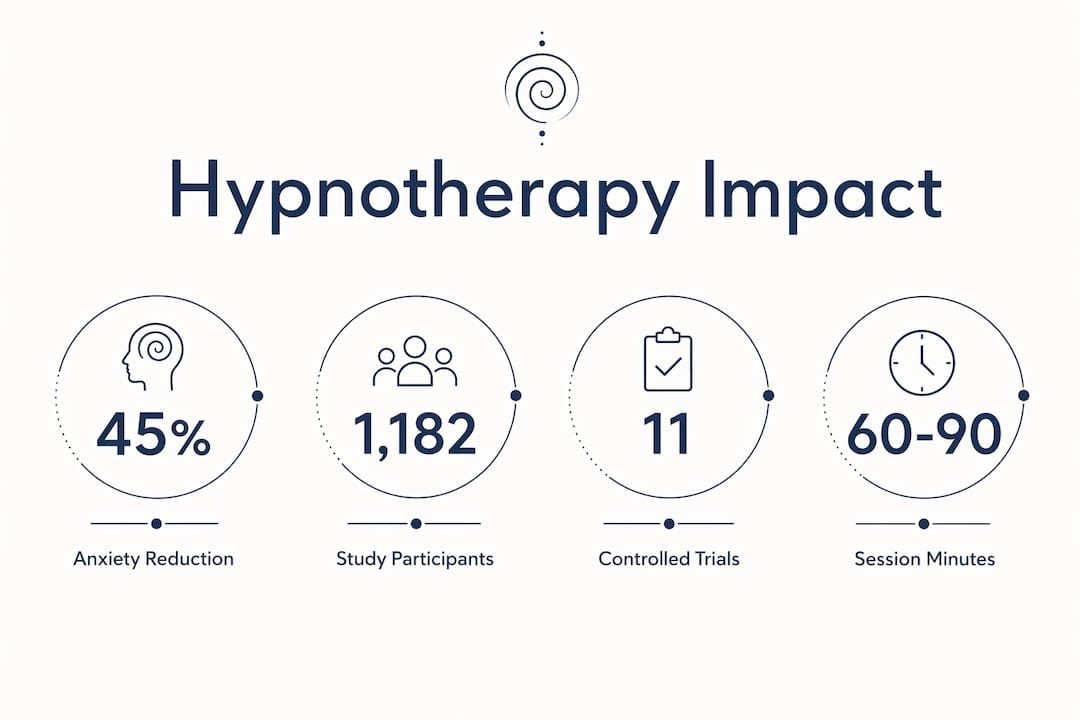
Sessions typically run around an hour to an hour and a half. Most patients need multiple sessions to build the skill and see consistent results, though some report meaningful relief after the first or second appointment.
What the research actually shows about hypnosis for cancer-related anxiety
The evidence base here is stronger than most people realize. A meta-analysis published in a peer-reviewed oncology journal synthesized 20 studies and found that hypnosis produced a statistically significant immediate effect on anxiety in cancer patients, with effect sizes ranging from Hedges' g of 0.70 to 1.41. The sustained effect, measured after treatment ended, ranged from 0.61 to 2.77. Those are not trivial numbers in clinical psychology terms.
Key finding: Therapist-delivered hypnosis was significantly more effective than self-hypnosis across the studies reviewed, particularly for pediatric cancer patients and those facing procedure-related stress.
A separate systematic review of controlled trials examining 11 studies with 1,182 participants found that hypnosis-related anxiety and pain decreased significantly compared to usual treatment. The participants were primarily adults aged 48–58, and pain was measured using validated scales including the Visual Analog Scale and the Hospital Anxiety and Depression Scale.
Clinical reviews also note that hypnosis guided by a trained professional carries a favorable benefit-to-harm ratio, with no side effects reported compared to pharmacological alternatives. Integrative oncology guidelines now view hypnosis as a promising tool for anxiety relief, though researchers acknowledge that small sample sizes and the individualized nature of therapy make it difficult to standardize as a universal protocol.
Current limitations in the research include:
- Many studies use small sample sizes, limiting generalizability
- Blinding patients in hypnosis trials is methodologically difficult because patients are consciously aware during sessions
- Study populations vary widely, making cross-trial comparisons complex
- More large-scale randomized controlled trials are needed before hypnotherapy becomes standard care across all cancer types
None of these limitations negate the existing evidence. They simply mean the field is still building the kind of large-scale trial data that would satisfy the most conservative clinical thresholds.
Who benefits most, and who should proceed carefully
Hypnotherapy is not the right fit for every patient, and a qualified practitioner will tell you that upfront.
Patients who tend to benefit most include:
- Adults and children experiencing procedure-related anxiety (pre-surgical fear, needle phobia, scan anxiety)
- Patients with hematologic cancers, where the research shows particularly strong effect sizes
- Those who are willing to practice focus and concentration skills between sessions
- Patients seeking a non-pharmacological option to complement their existing treatment plan
- Caregivers managing secondary anxiety related to a loved one's diagnosis
Hypnotherapy requires active participation. Patients who approach it passively, expecting to be "fixed" without engaging, tend to see weaker results. The process is collaborative, requiring the patient to learn and practice mental focus skills.
Situations where caution or consultation is warranted:
- Active psychosis or severe dissociative disorders, where altered states of consciousness carry additional risk
- Patients who are deeply skeptical or unwilling to engage, since resistance significantly reduces effectiveness
- Anyone whose oncology team has not been informed, since hypnotherapy should be integrated into, not substituted for, the broader care plan
- Patients seeking hypnotherapy as a replacement for psychiatric medication without medical supervision
The National Cancer Institute notes that treatment of significant distress and anxiety should be personalized and ideally a joint decision between the patient and their healthcare provider. That principle applies directly here.

What hypnotherapy costs and how to access it in the United States
Hypnotherapy sessions in the United States typically cost varying amounts per session depending on the practitioner's credentials, location, and whether sessions are conducted in person or online. Packages of multiple sessions often reduce the per-session cost.
Most health insurance plans do not cover hypnotherapy, meaning patients pay out of pocket. Some flexible spending accounts (FSAs) and health savings accounts (HSAs) may reimburse hypnotherapy costs when a licensed healthcare provider recommends it as part of a treatment plan. Checking with your benefits administrator before booking is worth the five-minute call.
Practical considerations for accessing care:
- Online/telehealth sessions have made hypnotherapy significantly more accessible. Patients can work with a qualified practitioner from home, which matters when treatment-related fatigue makes travel difficult.
- Cancer center integrative programs at major institutions sometimes offer hypnotherapy as part of a broader supportive care program, occasionally at reduced cost.
- Credentials to look for include Certified Clinical Hypnotherapist (CCHt), board certification through the American Council of Hypnotist Examiners (ACHE), or licensure as a mental health professional with specialized hypnotherapy training.
- Ask specifically whether the practitioner has experience working with oncology patients. General anxiety hypnotherapy and cancer-specific hypnotherapy involve different stressors and require different therapeutic approaches.
- Free consultations are common among reputable practitioners and give you a chance to assess fit before committing to a package.
Clinical hypnotherapist insights on working with cancer anxiety
One of the most persistent myths about hypnosis is that the therapist takes control and the patient becomes a passive subject. The opposite is true. Patients retain full conscious awareness throughout every session and can exit the relaxed state at any point. What hypnotherapy actually does is teach patients to direct their own attention more deliberately, which is a skill with real applications outside the therapy room.
MD Anderson Cancer Center describes hypnotherapy as an active coping skill, not a passive state. Patients who get the most from it tend to practice the focus techniques between sessions, applying them during blood draws, waiting room anxiety, or the 3 AM spiral of worst-case thinking.
The difference between a qualified clinical hypnotherapist and a generic audio recording comes down to personalization. A recording cannot ask you what specifically terrifies you about your next scan. A trained therapist can, and that specificity is what makes the therapeutic suggestion land rather than slide off.
Key practitioner insights for getting the most from sessions:
- Come to sessions with a specific fear or situation in mind, not a vague request to "feel less anxious"
- Be honest about what is not working. A good therapist adjusts the approach based on your feedback.
- Expect the first session to feel unfamiliar. The relaxed state feels different from sleep and different from ordinary waking awareness. That takes some getting used to.
- Practice the techniques your therapist teaches between appointments. The nervous system learns through repetition, not single exposures.
Pro Tip: Ask any prospective hypnotherapist directly: "Have you worked with patients going through active cancer treatment?" Their answer, and how they answer it, tells you more than their credentials alone.
Hypnotictransformations offers online hypnotherapy for anxiety via Zoom with Kirk Hoffman, a Certified Clinical Hypnotherapist. Sessions use NLP, guided imagery, and advanced hypnotic techniques tailored to each patient's specific fears and stressors. For cancer patients managing anxiety between treatments, the telehealth format means no travel, no waiting rooms, and no added stress on difficult days.
If you are ready to address the anxiety at its source rather than just manage it session to session, you can book a free consultation with Kirk Hoffman to discuss whether hypnotherapy fits your current treatment plan.
Key Takeaways
Hypnotherapy reduces cancer-related anxiety through therapist-guided focus techniques that calm the nervous system, with clinical research confirming both immediate and sustained effects.
| Point | Details |
|---|---|
| Research-backed anxiety relief | A meta-analysis of 20 studies found significant immediate and sustained anxiety reductions in cancer patients using hypnosis. |
| Therapist-led sessions work best | Therapist-delivered hypnosis consistently outperforms self-hypnosis, particularly for procedure-related stress. |
| No reported side effects | Clinical reviews confirm hypnosis guided by a trained professional carries a favorable benefit-to-harm ratio with no adverse effects. |
| Active patient participation required | Hypnotherapy is a collaborative skill-building process; patients who practice focus techniques between sessions see stronger results. |
| Accessible via telehealth | Online sessions remove travel barriers, making hypnotherapy practical for patients managing treatment fatigue. |