
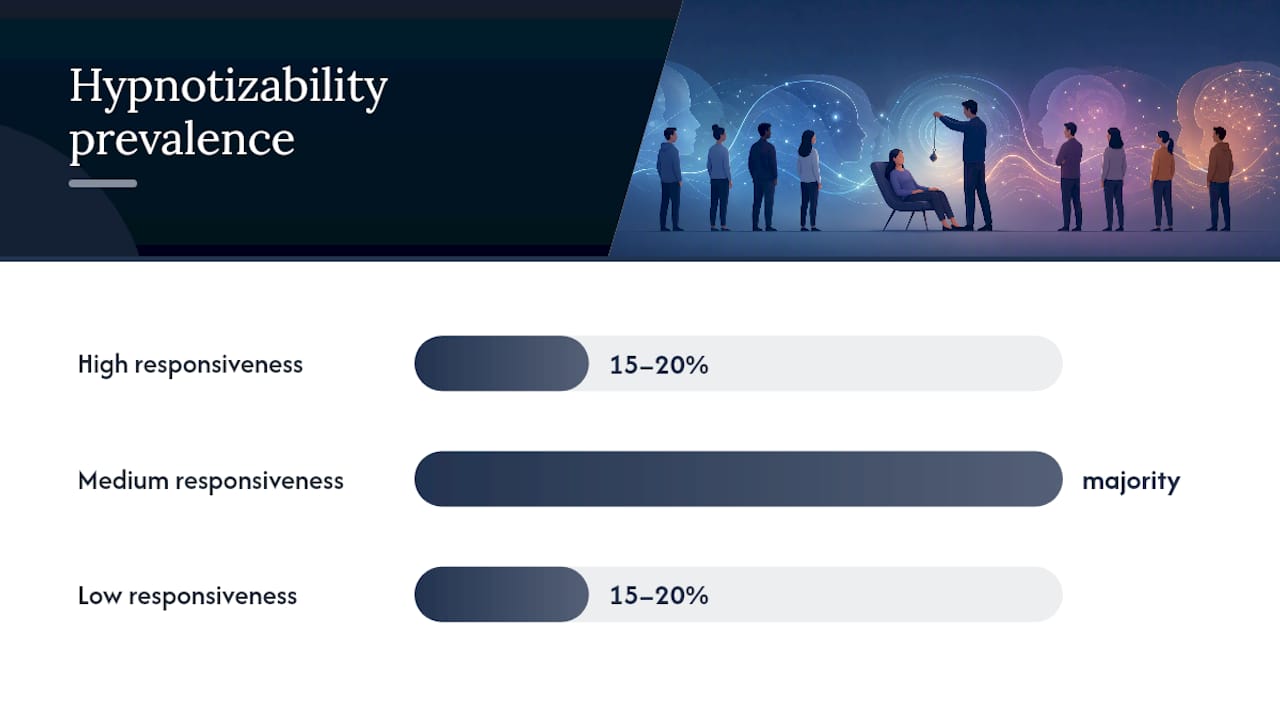
Not everyone can be hypnotized to the same degree, and that's not a failure of willpower or intelligence. Research consistently shows that hypnotic responsiveness falls on a spectrum. Roughly 15–20% of people score high on standardized hypnotizability measures, a similar percentage score low, and the majority land somewhere in the middle. If you're dealing with anxiety and wondering whether hypnotherapy could actually help you, where you fall on that spectrum matters — but it's rarely the whole story.
Key Takeaways
| Point | Details |
|---|---|
| Responsiveness is a spectrum | About 15–20% score high, 60–70% medium, and 15–20% low on standardized scales. |
| Neural traits play a role | fMRI research links executive-control and salience network connectivity to hypnotizability. |
| Barriers are often addressable | Fear of control loss, poor rapport, and wrong induction style suppress response more than fixed biology. |
| Hypnosis is always voluntary | Suggestions only work if acceptable to you; you cannot be hypnotized against your will. |
| Hypnotictransformations offers tailored sessions | Kirk Hoffman adapts induction methods to each client's responsiveness profile for anxiety and fear-based concerns. |
Table of Contents
- What hypnotizability means and how researchers measure it
- What neuroscience tells us about who responds to hypnosis
- Why hypnosis might not work for a given person
- Can you be hypnotized against your will?
- How to improve your chances of responding to hypnosis
- What hypnotizability means for your therapy and when to see a clinician
- What I've seen working with anxious clients
- Clinical hypnotherapy for anxiety, available online nationwide
- Sources
What hypnotizability means and how researchers measure it
Hypnotizability refers to how readily a person enters a hypnotic state and responds to suggestions given during that state. It's not about gullibility. Researchers measure it through standardized behavioral tests where a trained administrator delivers a scripted induction and scores how many suggestions the subject responds to.
The two most widely used instruments are the Stanford Hypnotic Susceptibility Scale (SHSS) and the Harvard Group Scale of Hypnotic Susceptibility (HGSHS). The Stanford scale is administered individually and scores responses to 12 standardized suggestions. The Harvard scale works with groups and is often used in research settings for efficiency. Both measure hypnotizability as a stable, quantifiable trait rather than a mood or momentary state.
Here's how the three responsiveness bands typically break down in clinical and research contexts:
| Responsiveness Level | Approximate Prevalence | What It Looks Like in a Session |
|---|---|---|
| High | 15–20% of adults | Vivid imagery, strong ideomotor responses, full absorption in suggestions |
| Medium | The majority of adults | Partial responses, relaxation achieved, moderate suggestion uptake |
| Low | 15–20% of adults | Minimal behavioral response, difficulty sustaining focused attention |
Medium responsiveness is the norm. Most people who walk into a clinical hypnotherapy session will experience real relaxation and some degree of suggestion uptake, even if they never reach the dramatic states associated with stage hypnosis.
Pro Tip: If you've tried hypnosis once and felt "nothing happened," you may have been working with a low-fit induction style, not a low-fit nervous system. Responsiveness is partly technique-dependent.
What neuroscience tells us about who responds to hypnosis
The most cited neuroimaging evidence comes from a Stanford study published in the Archives of General Psychiatry. Researchers compared brain activity in 12 high-hypnotizable and 12 low-hypnotizable adults using fMRI. They found measurable differences in functional connectivity between the executive-control network and the salience network — specifically, altered co-activation of the left dorsolateral prefrontal cortex and the dorsal anterior cingulate cortex. These are regions involved in focused attention, conflict monitoring, and the ability to suspend critical evaluation.
The sample was small, so these findings are preliminary mechanistic evidence, not definitive biomarkers. Still, they point to something clinically useful: hypnotizability appears to be a neural trait, not just a personality preference.
Key takeaways from the research base:
- Cognitive style predicts hypnotic responsiveness better than broad personality traits like extraversion or neuroticism
- The ability to absorb attention and suspend analytical evaluation is more predictive than general suggestibility
- Responsiveness tends to be relatively stable across sessions for a given individual, though not perfectly fixed
- The default mode network, which governs self-referential thinking, also shows altered activity during hypnosis in high-responders
- Neural differences are associated with hypnotizability, but they don't make it immutable
For someone with anxiety, this matters. The hypervigilant nervous system that keeps you scanning for threats is the same system that can interfere with hypnotic absorption. That's not a disqualifier. It's a starting point.
Why hypnosis might not work for a given person
Nonresponse has multiple causes, and most of them are addressable. Before concluding that hypnosis won't work for you, it's worth knowing what actually blocks it.
Psychological barriers are the most common. Fear of losing control, distrust of the therapist, or expecting to "go under" like a movie character all activate the sympathetic nervous system. When the fight-or-flight response is running, the nervous system stays vigilant. Hypnosis requires the opposite: parasympathetic activation, reduced cortical monitoring, and a willingness to follow suggestion. Misconceptions about mind control create exactly the physiological state that prevents hypnotic shifts.
Attention and cognitive factors also play a role. People who struggle to sustain focused attention, whether from ADHD, chronic stress, or executive-function differences, may find standard inductions harder to follow. This doesn't mean hypnosis is off the table. It means the induction method needs to match the person.
Medical and medication factors can reduce responsiveness. Certain neurological conditions, severe traumatic brain injury, significant cognitive impairment, and some sedating medications can all interfere. If you're on a medication that affects attention or arousal, mention it before your first session.
Situational issues are underappreciated. Poor therapist-client rapport, an induction style that doesn't suit the individual, environmental distractions, and a rushed session structure can all suppress response in someone who would otherwise do well.
| Barrier Type | Common Examples | What Can Help |
|---|---|---|
| Psychological | Fear of control loss, distrust, wrong expectations | Pre-session education, myth correction |
| Cognitive/Attentional | ADHD, chronic stress, executive-function gaps | Tailored induction, shorter focused segments |
| Medical/Medication | Neurological conditions, sedating medications | Medical review before starting |
| Situational | Poor rapport, wrong technique, distractions | Therapist matching, session environment check |
If you have a neurological condition or are managing a psychiatric diagnosis, get medical clearance before starting hypnotherapy. Hypnosis is not a substitute for psychiatric care, and a good clinician will tell you that directly.
Can you be hypnotized against your will?
No. Hypnosis is voluntary. You cannot be hypnotized against your will, and suggestions only take effect if they are acceptable to you. This is not a legal disclaimer. It reflects how the nervous system actually works.
Hypnosis functions as a collaborative process, much like coached self-hypnosis, where the therapist guides and the client chooses to follow. The moment a suggestion conflicts with your core values or feels threatening, your nervous system exits the state. You can open your eyes and stop at any time.
Clinicians follow clear ethical boundaries: they cannot compel actions that violate a client's values, and they do not use hypnosis to extract information or override decision-making. The difference between hypnosis and mind control is not subtle. One requires your active participation. The other is fiction.
Quick answers to common concerns:
- Will I reveal secrets? No. You retain full awareness and can choose not to answer anything.
- Can I get "stuck" in hypnosis? No. You can return to full alertness whenever you choose.
- Will I do things I'd normally refuse? No. Suggestions that conflict with your values are simply rejected.
- Is it the same as sleep? No. Brain activity during hypnosis is distinct from sleep; you remain aware throughout.
How to improve your chances of responding to hypnosis
Responsiveness is not completely fixed. Training and tailored approaches can increase hypnotic responsiveness in some people, and there are concrete steps you can take before and during sessions.
- Correct your expectations before the first session. Read or watch accurate clinical descriptions of hypnosis. The more your mental model matches what actually happens, the less your nervous system will resist.
- Get enough sleep the night before. Fatigue reduces attentional capacity, which directly limits hypnotic absorption.
- Review your medications with your doctor. Some medications affect arousal and attention in ways that matter for hypnotic response.
- Practice focused attention daily. Spend 10 minutes each day on a single-point focus exercise, such as following your breath or holding a visual image. This trains the attentional capacity that hypnosis relies on.
- Try self-hypnosis exercises between sessions. Repeated practice builds familiarity with the hypnotic state and reduces the novelty-driven vigilance that blocks first-time responders.
- Tell your therapist what imagery feels natural to you. A beach scene may relax one person and bore another. Specific, personally resonant imagery produces stronger responses.
- Ask your therapist to pace the induction to your breathing. Synchronized pacing activates the parasympathetic nervous system faster than a scripted countdown.
Pro Tip: The single biggest predictor of improved responsiveness across sessions is expectancy. If you genuinely expect to respond, your nervous system cooperates. Spend five minutes before each session reminding yourself why you want this to work.
What hypnotizability means for your therapy and when to see a clinician
A skilled clinician doesn't wait to see if you're "hypnotizable" and then decide whether to proceed. They assess your responsiveness during the first session and adjust from there. Induction methods, suggestion styles, and session pacing are all variables the therapist controls. What you bring is attention, willingness, and honest communication.
For anxiety treatment, clinical hypnotherapy typically targets the subconscious patterns that keep the nervous system in a threat-detection loop. A session might use guided imagery to rehearse calm responses, direct suggestion to interrupt automatic fear reactions, or regression techniques to address the original conditioning. The specific method depends on your responsiveness profile.
What to look for in a clinical hypnotherapist:
- Certification from a recognized body such as the American Society of Clinical Hypnosis (ASCH) or the National Board for Certified Clinical Hypnotherapists (NBCCH)
- Training in evidence-based modalities alongside hypnosis (NLP, CBT integration, or trauma-informed approaches)
- Willingness to explain their assessment process and adapt technique to your response
- Clear boundaries around what hypnotherapy can and cannot treat
Seek medical or psychiatric evaluation first if you are managing active psychosis, severe dissociative disorder, or untreated major depression. Hypnotherapy works best as part of a broader care plan in those cases, not as a standalone intervention. Addressing misconceptions and building rapport often improves outcomes even for low-hypnotizable clients, so don't rule it out without a proper assessment.
Research suggests that cognitive style and specific neural processes predict hypnotic responsiveness more reliably than personality type, which means a good clinician focuses on how you process attention and imagery, not on whether you seem like "the type."
What I've seen working with anxious clients
The framing I use with every new client follows a PAS structure: identify the specific fear response first, show how it's maintained by subconscious patterns, then present hypnotherapy as the mechanism that addresses those patterns directly rather than managing them from the outside.
The biggest mistake I see in the field is labeling someone "non-hypnotizable" after one session. That label can become a self-fulfilling prediction. In practice, most clients who "didn't respond" in session one were running a vigilance response the entire time. The nervous system was doing exactly what anxiety trains it to do: stay alert, stay in control, don't let your guard down. My first focus with anxiety clients is almost always the fear of the process itself, not the presenting problem. Once the nervous system understands that hypnosis doesn't require surrender, absorption follows naturally.
Clinical hypnotherapy for anxiety, available online nationwide
If you're dealing with anxiety, panic, or fear-based thinking and want to know whether hypnotherapy is a fit for you, Hypnotictransformations offers online clinical hypnotherapy sessions via Zoom, led by Certified Clinical Hypnotherapist Kirk Hoffman. Sessions address the subconscious patterns driving anxiety, phobias, and panic responses using NLP, guided imagery, and advanced hypnotic modalities, not surface-level symptom management.
Before your first session, you'll have a free consultation to discuss your responsiveness concerns, your history with anxiety, and what to expect. Kirk tailors induction methods to each client's cognitive style, so low initial responsiveness is a starting point, not a barrier. Outcomes vary based on individual responsiveness and engagement, and Kirk will be direct with you about what hypnotherapy can realistically address. To schedule your consultation and ask about session structure, visit the services page or go directly to book an appointment.
Sources
- Not getting sleepy? Research explains why hypnosis doesn't work for all
- Clinical review describing hypnosis as a collaborative self-regulation process
- Review article on hypnosis mechanisms and predictors
- Myths and Misconceptions About Hypnosis and Suggestion: Separating Fact and Fiction
- Hypnosis | Better Health Channel