
Yes, hypnotherapy can help with health anxiety. A 2019 meta-analysis of 17 trials found that people treated with hypnosis achieved greater anxiety reduction than 84% of participants in control groups. Both Mayo Clinic and Cleveland Clinic recommend it as a complementary tool alongside CBT, not a replacement for medical care.
Your immediate next steps:
- Rule out any new or unexplained physical symptoms with your primary care provider first
- Consider pairing hypnotherapy with CBT for the strongest combined effect
- Book a free consultation or try one guided session before committing to a full course
Pro Tip: If you have been to the doctor and nothing physical was found, that is actually the clearest signal that hypnotherapy is worth trying. The problem is in how your nervous system is interpreting normal body sensations, and that is exactly what hypnotherapy targets.
Table of Contents
- What is hypnotherapy and how does it work for anxiety?
- What does the research actually say?
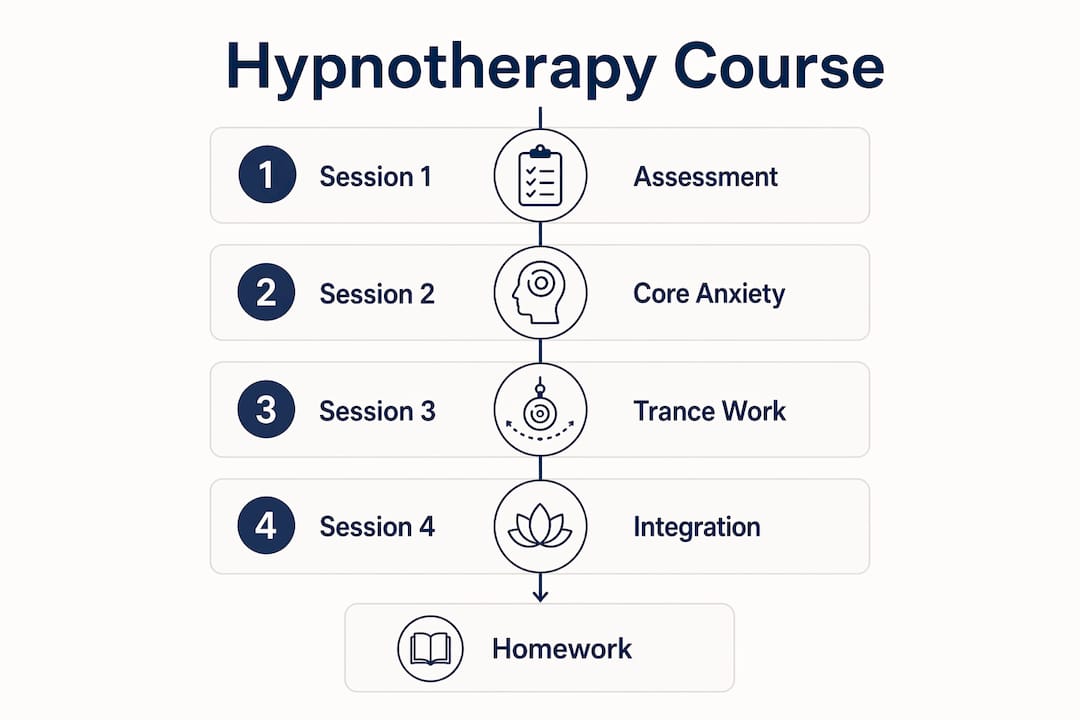
- What does a hypnotherapy course for health anxiety look like?
- When is hypnotherapy safe, and when should you see a doctor first?
- How does hypnotherapy fit with CBT and other treatments?
- Who tends to benefit, and what outcomes are realistic?
- How to choose a safe, effective hypnotherapist in the United States
- Short self-help tools to try right now
- What to do next, based on where you are right now
- Key Takeaways
- What I see in clients who actually get better
- Hypnotictransformations: online hypnotherapy for health anxiety via Zoom
- Useful sources and further reading
What is hypnotherapy and how does it work for anxiety?
Hypnotherapy is a clinically guided state of focused attention and reduced peripheral awareness. In that state, the subconscious mind becomes more open to suggestion, which is what makes it useful for anxiety. You are not asleep. You are not unconscious. You are simply less defended, which means the patterns driving your anxiety are easier to reach and change.

For health anxiety specifically, the mechanism matters. Your nervous system has learned to treat normal body sensations as threats. A slightly elevated heartbeat triggers a cascade: attention narrows, fight-or-flight activates, and you start scanning your body for more evidence of danger. Hypnotherapy interrupts that cycle at the subconscious level, before the conscious mind has a chance to rationalize the fear back into place.
Common techniques used in sessions include:
- Guided imagery: Replacing catastrophic mental pictures with neutral or calming ones
- Direct suggestion: Planting specific post-hypnotic responses to body sensations
- Trance induction: Progressive relaxation that shifts the nervous system from sympathetic to parasympathetic dominance
- Anchoring: A post-hypnotic cue (a breath, a word, a touch) that the client can use outside sessions to interrupt panic
Hypnotherapy does not diagnose medical conditions and does not replace your doctor. It works on the psychological and physiological response to perceived threat, not on the underlying physical body. That distinction is important, and any competent clinician will make it clear from the first session.
What does the research actually say?
The strongest single piece of evidence is the Valentine et al. meta-analysis of 17 controlled trials. Across those trials, people who received hypnosis reduced their anxiety more than 84% of control-group participants. That is a large effect for a psychological intervention.
84% of control-group participants showed less anxiety reduction than those who received hypnosis treatment, across 17 controlled trials.
A 2024 Frontiers in Psychology review added a physiological dimension: hypnosis appears to reduce sympathetic nervous system activation and increase parasympathetic tone. For someone with health anxiety, that matters practically. Lower sympathetic activation means fewer false-alarm signals from the body, which means fewer triggers for the checking and reassurance-seeking cycle.
How clinical evidence maps to a real session plan
| Research finding | What it means in practice |
|---|---|
| Hypnosis produced greater anxiety reduction than controls in the majority of trials | Sets realistic expectation: most people improve, not all achieve full remission |
| Hypnosis more effective combined with CBT | Clinicians often run CBT and hypnotherapy in parallel or sequence |
| Physiological effects on autonomic tone | Sessions include breathing-based induction to directly shift nervous system state |
| Typical trial lengths of 4–6 sessions | A standard course runs 4–6 weekly sessions, each 50–60 minutes |
A clinician translates this into a treatment plan by:
- Assessing baseline anxiety severity and specific triggers (body scanning, symptom checking, reassurance-seeking)
- Setting measurable goals: reduced checking frequency, improved tolerance of uncertainty, lower subjective distress ratings
- Selecting techniques matched to the client's presentation
- Reviewing progress at session 3 and adjusting the approach if needed
What does a hypnotherapy course for health anxiety look like?
Most people have no idea what actually happens in a session. Here is the practical reality.

Intake and assessment come first. Before any hypnosis, the clinician takes a medical history, identifies your specific anxiety triggers, and screens for contraindications. This is not optional paperwork. It shapes every technique used.
Session structure follows a consistent arc:
- Induction: Guided relaxation that shifts the body out of fight-or-flight, typically using breath focus and progressive muscle relaxation
- Focused work: Suggestion, imagery, or cognitive reframing delivered while you are in the hypnotic state
- Reorientation: Gradual return to full alertness, with a brief debrief
- Post-session planning: Homework assigned for the week ahead
Timeline and format follow Anxiety UK guidance on clinical practice: 4–6 sessions, each running 50–60 minutes, typically spaced one week apart. Sessions are available via Zoom, which removes the barrier of geography entirely.
| Session | Focus |
|---|---|
| 1 | Intake, baseline assessment, first induction |
| 2 | Identifying core anxiety triggers, introducing suggestion |
| 3 | Progress review, deepening techniques |
| 4–5 | Targeted work on reassurance-seeking and body scanning |
| 6 | Consolidation, relapse prevention, self-hypnosis training |
Between sessions, clients typically use recorded audio tracks, practice a short daily breathing or grounding exercise, and work on reducing one reassurance-seeking behavior per week.
Pro Tip: Record a voice memo immediately after each session describing what you noticed. Clients who track their responses between sessions tend to progress faster because they arrive at the next appointment with specific material to work on.
When is hypnotherapy safe, and when should you see a doctor first?
Hypnotherapy is low-risk for most adults. The most common side effects are temporary drowsiness after a session and occasionally vivid imagery or emotional responses during induction. Both are normal and resolve quickly.
That said, there are situations where hypnotherapy should wait:
- New or unexplained physical symptoms that have not been medically evaluated. NHS clinical guidance is explicit: rule out medical causes before pursuing psychological treatment
- Active psychosis or dissociative disorders where an altered state of consciousness could be destabilizing
- Active suicidal ideation requiring immediate psychiatric assessment, not outpatient hypnotherapy
- Severe untreated depression where the priority is stabilization first
A responsible clinician screens for all of these before the first session and has a clear referral plan if any emerge during treatment.
If you are mid-course and a new physical symptom appears, pause and see your primary care provider. A good hypnotherapist will support that decision, not discourage it. Coordination between your hypnotherapist, GP, and any mental health providers is standard practice, not an exception.
How does hypnotherapy fit with CBT and other treatments?
Health anxiety responds best to a combination of approaches. No single method covers every dimension of the problem.
| Approach | Primary mechanism | Best for |
|---|---|---|
| CBT | Restructuring dysfunctional beliefs about symptoms | Core cognitive patterns, reassurance-seeking habits |
| Exposure therapy | Graduated tolerance of feared sensations | Avoidance behaviors, intolerance of uncertainty |
| Hypnotherapy | Subconscious suggestion, autonomic regulation | Physiological arousal, attention narrowing, body scanning |
| Psychiatric medication (SSRIs/SNRIs) | Neurochemical regulation | Severe cases, comorbid depression or OCD |
ADAA clinical guidance identifies CBT as the most effective first-line psychological treatment for health anxiety. Hypnotherapy works best as a complement to that foundation, not a replacement for it.
Where hypnotherapy adds the most value:
- Reducing the physiological arousal that makes CBT homework harder to complete
- Shifting attention away from body scanning during the session itself
- Supporting exposure work by lowering baseline anxiety before a client attempts a feared task
- Helping clients who have tried CBT but struggle to apply it under acute anxiety
When medication is part of the picture, hypnotherapy can support the process of tapering by building the client's tolerance for uncertainty and physical sensations. This should always be coordinated with the prescribing physician.
Who tends to benefit, and what outcomes are realistic?
People who respond well to hypnotherapy for health anxiety typically share a few characteristics. They have high intolerance of uncertainty. They engage in compulsive body checking or symptom Googling. Their anxiety focuses on interpreting normal sensations as signs of serious illness. These are exactly the patterns that hypnotherapy targets at the subconscious level.
Realistic outcomes across a 4–6 session course include:
- Reduced frequency and intensity of body-scanning episodes
- Improved ability to tolerate physical sensations without immediately seeking reassurance
- Lower baseline physiological arousal between anxiety episodes
- Greater confidence in managing acute anxiety without checking behaviors
What hypnotherapy does not do: it does not guarantee full remission, and it does not work equally well for everyone. Clients who combine it with active behavioral work between sessions consistently see better results than those who treat it as a passive experience.
Pro Tip: The single best predictor of outcome is whether you practice the assigned homework. One session per week is not enough on its own. The subconscious patterns driving health anxiety were built through repetition, and they change through repetition too.
How to choose a safe, effective hypnotherapist in the United States
Credentials matter more than testimonials. Here is what to look for and what to ask.
Essential credentials:
- Certified Clinical Hypnotherapist (CCHt) designation from a recognized body such as the American Council of Hypnotist Examiners (ACHE) or the National Guild of Hypnotists (NGH)
- Clinical training in anxiety disorders, not just general hypnotherapy certification
- State licensure in a related mental health field (psychology, counseling, social work) if the clinician also provides psychotherapy
Questions to ask during a consultation:
- What techniques do you use specifically for health anxiety?
- How do you coordinate with my primary care provider or therapist?
- What does your safety screening process look like?
- What happens if I disclose a new medical symptom during treatment?
- What is your cancellation and refund policy?
Red flags to watch for:
- Promises of a cure or guaranteed results
- No intake or screening process before the first session
- Resistance to coordinating with your medical team
- Vague answers about techniques or training
Cost considerations:
| Session type | Typical US cost range |
|---|---|
| Free initial consultation | Offered by many telehealth providers |
Hypnotherapy is not typically covered by health insurance in the United States, though some FSA and HSA accounts may cover it when prescribed by a physician. Confirm directly with your provider.
Short self-help tools to try right now
These scripts are not a substitute for clinical sessions, but they can interrupt an acute anxiety episode and reduce body scanning in the moment.
One-minute grounding script
- Stop what you are doing and sit down
- Name five things you can see in the room
- Take one slow breath in for four counts, hold for four, out for six
- Say to yourself: "This sensation is uncomfortable. It is not dangerous."
- Repeat the breath cycle twice more, then return to what you were doing
Guided imagery for catastrophic interpretation
- Close your eyes and notice the physical sensation that is worrying you
- Imagine the sensation as a color or shape, not as a diagnosis
- Breathe into that shape and watch it slowly change or dissolve
- Replace the image with a neutral, calm scene you know well
- Open your eyes after 60 seconds
Reassurance-reduction sequence
- Identify one reassurance behavior you performed today (Googling symptoms, checking your pulse, asking someone for reassurance)
- Delay the next instance of that behavior by 10 minutes
- During the delay, use the grounding script above
- Extend the delay by 5 minutes each day
Pro Tip: Recorded hypnosis tracks can be useful between sessions, but use them as a supplement, not a replacement for live clinical work. If a track causes distress or increases anxiety rather than reducing it, stop and contact your clinician.
What to do next, based on where you are right now
If your health worry is new or mild:
- See your primary care provider to rule out a physical cause
- Try the grounding script above for one week
- Book a single consultation with a clinical hypnotherapist to assess fit
If health anxiety has been ongoing for months:
- Book a 4–6 session hypnotherapy package and coordinate with your GP
- Ask your hypnotherapist about combining sessions with CBT
- Use between-session recordings and homework consistently
- Schedule a free consultation to discuss your specific pattern before committing
If symptoms are severe or you are in crisis:
- Contact your primary care provider or a psychiatrist immediately
- Call or text 988 (Suicide and Crisis Lifeline) if you are experiencing suicidal thoughts
- Hypnotherapy is not appropriate as the first intervention in a psychiatric crisis
Key Takeaways
Hypnotherapy for health anxiety has solid clinical backing and works best when combined with CBT and medical clearance from a primary care provider.
| Point | Details |
|---|---|
| Evidence base | A 2019 meta-analysis found hypnosis outperformed controls in most participants across several trials. |
| Best combined | Mayo Clinic and Cleveland Clinic both recommend hypnotherapy alongside CBT, not as a standalone treatment. |
| Session format | Expect 4–6 weekly sessions, each 50–60 minutes, available via Zoom for US clients. |
| Safety first | Rule out new physical symptoms with a doctor before starting; hypnotherapy is not appropriate during active psychosis or crisis. |
| Hypnotictransformations | Kirk Hoffman, CCHt offers online hypnotherapy for health anxiety via Zoom, with free consultations and session packages. |
What I see in clients who actually get better
(Framework: PAS — Problem, Agitate, Solve)
The problem I see most often is not the health anxiety itself. It is the exhaustion that comes from years of fighting it. A client comes in having already done the doctor visits, the blood tests, the reassurance conversations with family. Nothing was found. They felt briefly relieved, then the next symptom appeared and the cycle started over.
That is the agitation phase, and it is brutal. The nervous system has been trained to treat uncertainty as danger. Every normal heartbeat, every muscle twitch, every moment of fatigue becomes evidence of something catastrophic. The checking behavior that was supposed to provide relief has become its own source of anxiety.
What actually shifts this is not willpower or positive thinking. It is working directly with the subconscious patterns that are running the threat-detection loop. In sessions, we use induction to bring the nervous system out of sympathetic overdrive, then use direct suggestion and imagery to retrain how the mind interprets body sensations. By session 3, most clients report that the gap between sensation and panic has widened. By session 5 or 6, many are using the anchoring techniques on their own, without prompting.
Progress is measurable. I track checking frequency, reassurance-seeking episodes, and subjective distress ratings at every session. When those numbers move, clients feel it before they can articulate it. I also coordinate with primary care providers and therapists when clients are in concurrent treatment, because the behavioral work in CBT and the subconscious work in hypnotherapy reinforce each other in ways that neither does alone.
Hypnotictransformations: online hypnotherapy for health anxiety via Zoom
If you have read this far and recognized your own pattern in these pages, the clearest next step is a conversation, not a commitment.
Kirk Hoffman, CCHt offers online hypnotherapy for anxiety via Zoom, available to clients across the United States. Sessions run 50–60 minutes. Packages of 4–6 sessions are available, as are single-session options for people who want to assess fit before committing to a course. A free initial consultation is included so you can ask questions, describe your specific pattern, and decide whether this approach makes sense for your situation.
There is no in-person requirement, no long waitlist, and no pressure to commit to more sessions than you need. If you are already working with a therapist or physician, Kirk coordinates with your existing care team. To schedule your first appointment, visit the appointments page and book directly.
Useful sources and further reading
The following sources were cited in this article. Each one contributes something specific.
| Source | What it contributes |
|---|---|
| Valentine et al. meta-analysis (PubMed) | Primary evidence: 84% anxiety reduction vs. controls across 17 trials |
| Frontiers in Psychology review | Physiological mechanism: autonomic regulation and sympathetic/parasympathetic effects |
| Mayo Clinic: Hypnosis | Clinical recommendation: hypnotherapy as complementary tool alongside CBT |
| Cleveland Clinic | Mechanism and practitioner standards: increased suggestibility, certified practitioners |
| NHS: Health Anxiety | Clinical protocol: rule out medical causes, reduce reassurance-seeking |
| ADAA: Health Anxiety | CBT as first-line treatment; behavioral targets for health anxiety |
| Anxiety UK | Session format guidance: 4–6 sessions, 50–60 minutes, telehealth delivery |
This article is general information, not medical or psychological advice. Confirm current clinical guidelines and treatment options with your primary care provider or a licensed mental health professional for your specific situation.