
Hypnosis is safe for most healthy adults, and the side effects it does cause are usually mild and short. Mayo Clinic, Cleveland Clinic, and WebMD all list the same small set of reactions: dizziness, drowsiness, headache, nausea, a brief spike in anxiety, or a rough night's sleep. Serious harm is uncommon. The exceptions are specific: people with active psychosis, hallucinations, or certain substance use issues need medical clearance before a session.
TL;DR:
- Most side effects, such as dizziness, drowsiness, headache, nausea, and brief emotional spikes, typically last only a few hours and are mild.
- Serious risks like false memories, worsening psychosis, or adverse reactions under influence are rare but require careful screening and professional oversight.
- Individuals with active psychosis, hallucinations, certain seizure disorders, or uncontrolled substance use should avoid hypnosis or seek medical clearance beforehand.
- A qualified clinician will tailor induction and emergence pacing, conduct thorough screening, and provide post-session follow-up to ensure safety.
- Proper preparation, such as avoiding alcohol and drugs before sessions and having clear goals, can significantly reduce the risk of adverse effects.
Table of Contents
- What Happens During Hypnosis (and Why Side Effects Show Up)
- Common Side Effects of Hypnosis and How Long They Last
- Rare but Serious Risks Worth Understanding
- Who Should Not Get Hypnotized
- How to Reduce Risk and Choose a Safe Practitioner
- Recovery Timeline and When to Call for Help
- How Anxiety Clients Get Screened Before a Session
- The Real Safety Question Most People Skip
- A Safer Way to Try Hypnotherapy for Anxiety
- Where This Article's Information Comes From
- Sources
- FAQ
What Happens During Hypnosis (and Why Side Effects Show Up)
Hypnosis is a state of focused attention where your mind becomes more open to suggestion. That's it. It's not sleep, and it's not losing control of your body. A trained clinician guides you into that state (induction), works with you there, then brings you back out (emergence). Hypnotherapy is simply that process applied to a specific goal: calming a fear response, breaking a habit, or shifting a belief that's been running in the background.
Most side effects trace back to those two transition points, induction and emergence, not to the working phase in between. Your nervous system drops into deep relaxation fairly fast, then has to come back up to full alertness. That shift is where dizziness and grogginess usually start.
A few things worth knowing before your first session:
- You remain aware and able to speak, move, or stop the session at any time.
- You cannot be made to act against your own values or will, even in a deep trance state.
- Suggestibility varies person to person. Some people drop in quickly, others take more sessions to fully relax.
- A skilled clinician paces both induction and emergence to reduce abrupt physical reactions.
WebMD confirms hypnosis is not mind control. You stay the one making the decisions. That single fact clears up most of the fear people bring into a first session, especially anxiety clients who worry about losing control of their own reactions.
Common Side Effects of Hypnosis and How Long They Last
Here's the actual list of hypnosis side effects that shows up across major medical sources, and what tends to cause each one.
- Dizziness or lightheadedness. Coming out of deep relaxation too fast can leave you unsteady for a minute or two. Stay seated after your session ends until it passes.
- Drowsiness and fatigue. Your body just spent some time in a state close to the edge of sleep. Skip driving or operating machinery for some time afterward, and give yourself room to rest if you can.
- Headache or head pressure. Usually tied to muscle tension releasing in the face, jaw, or scalp. Water and a few minutes of quiet usually resolve it.
- Nausea. Less common, but it happens, particularly if the session involved visualizing something emotionally intense. If it doesn't settle within an hour, that's worth mentioning to your clinician before your next session.
- A short-term rise in anxiety or strong emotion. Surfacing a fear memory or a suppressed feeling can trigger tears or a racing heart before it settles. Tell your therapist in the moment; a trained clinician will slow down and ground you before moving forward.
- Sleep changes. Some people report a night or two of lighter sleep, or unusually vivid dreams, after processing something emotionally loaded.
Mayo Clinic and Cleveland Clinic both describe these reactions as typically mild and short-lived, often clearing up within hours, sometimes lasting into the next day. Pro Tip: Keep a glass of water nearby during online sessions. Dehydration makes both dizziness and headache worse, and it's the easiest variable to control.
If any of these linger past a day or two, that's the signal to call your clinician, not to wait it out.
Rare but Serious Risks Worth Understanding
The side effects above cover the vast majority of hypnosis experiences. A smaller set of risks matters less often but carries more weight when it does happen.
- False memories. Leading questions or directive memory-recovery techniques can unintentionally plant a false memory rather than recover a real one. This is the single biggest reason hypnosis should never be the primary tool for reconstructing detailed trauma history.
- Worsening of psychosis, hallucinations, or dissociation. In people with certain psychiatric conditions, the relaxed, suggestible state hypnosis creates can intensify symptoms rather than ease them.
- Interactions with substance use. Being under the influence of alcohol or recreational drugs during a session changes how the nervous system responds to induction, and it can mask or amplify a bad reaction.
- Emotional flooding during trauma work. Where trauma is the treatment target, clinicians increasingly favor trauma-focused CBT over hypnosis alone, because hypnosis can trigger a strong emotional release faster than a client is ready to process it.
A trained clinician screens for these risks before session one, not during it. That screening is the actual safeguard, not luck.
Who Should Not Get Hypnotized
Hypnosis isn't right for everyone, and a responsible clinician will say so upfront rather than take your money anyway. WebMD lists active psychosis, hallucinations, or delusions as a clear contraindication, since the suggestible state can worsen those symptoms rather than calm them.
- Active psychotic disorders or current hallucinations. Hypnosis increases suggestibility, which can intensify symptoms already disconnected from reality.
- Uncontrolled substance use, or being under the influence at the time of a session. Both distort how the nervous system responds and make it harder for a clinician to guide you safely.
- Certain seizure disorders. If you have a history of seizures, talk to a neurologist before booking hypnotherapy. Some induction techniques involve rhythmic language or visual focus that warrants a medical opinion first.
- Severe, unprocessed trauma. If your fear response is rooted in a specific traumatic event that hasn't been addressed in trauma-informed therapy, that work often needs to happen there first, or alongside hypnotherapy, not instead of it.
None of this means hypnotherapy is fragile or unreliable for the average anxious adult. It means the same thing any responsible medical service means: a screening step exists because some people need a different first step.
How to Reduce Risk and Choose a Safe Practitioner
The side effects that matter most are the ones you can actually prevent, and most prevention comes down to who you choose and how prepared you are going in.
-
Ask about credentials directly. A Certified Clinical Hypnotherapist with specific experience in anxiety and fear based conditions is a different level of training than a weekend-certificate hobbyist.
-
Expect a real intake process. A proper screening covers mental health history, substance use, seizure history, and current medications before any induction happens.
-
Confirm pacing. Ask how the clinician handles induction and emergence, and whether they check in with you afterward rather than ending the call the moment the session's done.
-
Prepare your body beforehand. Sleep the night before, eat something light, skip alcohol, and avoid recreational drugs for at least 24 hours. A stable nervous system responds more predictably.
-
Know when hypnosis isn't the first tool. If you're working through a specific traumatic event, ask whether your clinician recommends pairing hypnotherapy with trauma-informed talk therapy. A practical guide to vetting a therapist's qualifications covers questions worth asking any mental health provider, hypnotherapist or otherwise.
Pro Tip: Write down your goal for the session in one sentence before you log on. "I want to stop my hands shaking before I speak in meetings" gives a clinician something concrete to pace the whole session around, instead of a vague sense of "fix my anxiety."
Recovery Timeline and When to Call for Help
Most hypnosis side effects clear up fast. Dizziness usually fades within a few minutes of sitting up. Drowsiness can linger 15 to 30 minutes, sometimes longer if the session ran deep. Headache and mild nausea typically resolve within a few hours, often faster with water and rest.
Here's where the line sits between normal recovery and something worth a phone call:
- Call your hypnotherapist if: anxiety stays elevated for more than a day, dizziness persists past a few hours, or a headache doesn't ease with rest and water.
- Seek urgent medical care if: you experience new suicidal thoughts, psychotic symptoms (hallucinations, delusions), or severe dissociation that doesn't lift after the session ends.
- Before any follow-up visit, jot down a rough timeline: what you felt, when it started, and when (or if) it stopped. That detail helps your clinician adjust pacing for next time.
None of this is common. But knowing the difference between "give it an hour" and "call someone now" is the whole point of understanding hypnosis side effects before you book a session, not after.
How Anxiety Clients Get Screened Before a Session
Every anxiety client who books with me goes through an intake conversation before we do any hypnosis work. I ask about current mental health diagnoses, medications, substance use, and whether panic or fear symptoms have ever tipped into something more severe, like dissociation or psychotic symptoms. That screening isn't a formality. It's how I decide whether standard hypnotherapy is the right first step or whether someone needs a referral instead.
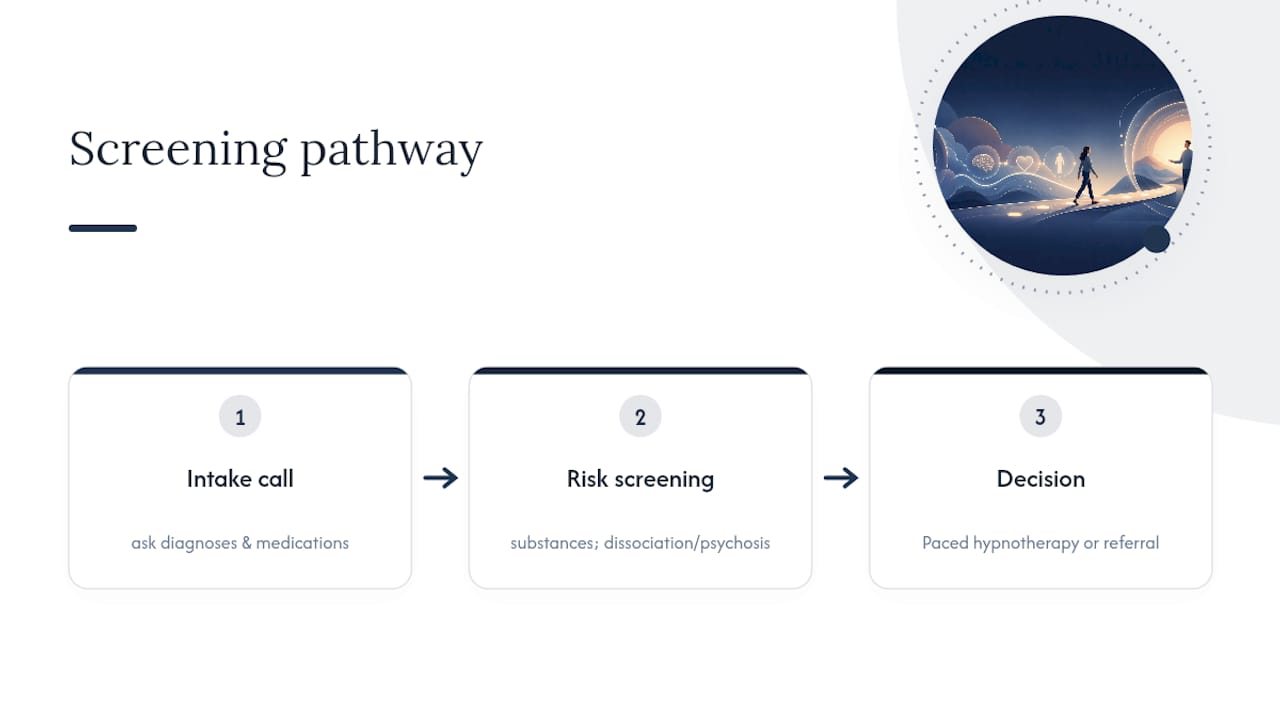
Online sessions get paced deliberately. Induction is slower for a first-time client than a returning one, and emergence always includes a grounding check before the call ends, not just a countdown. Nervous systems respond better to gradual pacing at both ends of a session than to an abrupt in-and-out.
Aftercare matters too. Clients get a short follow-up note after each session and a clear way to reach me if something feels off later that day. You can see how sessions are structured on the anxiety hypnotherapy services page.
The Real Safety Question Most People Skip
Most of what gets written about hypnosis safety focuses on the wrong worry. People ask whether they'll "lose control." That's almost never the actual risk. The real risk is a clinician skipping the screening step, moving too fast through induction, or using leading questions during trauma work and accidentally planting a memory instead of resolving one.
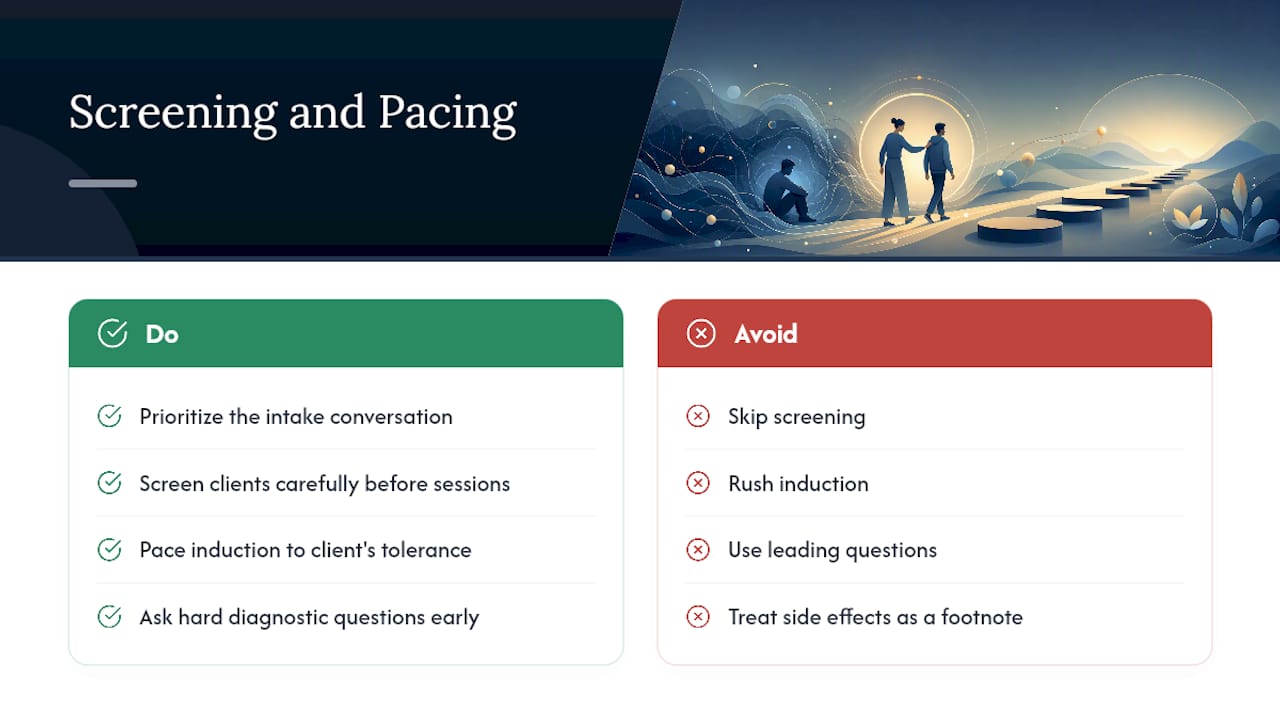
Conventional advice treats hypnosis side effects as a footnote, a quick disclaimer before the sales pitch. That's backwards for anxiety work specifically, because anxious nervous systems are already primed to overreact to unfamiliar physical sensations. A wave of dizziness that a calm person shrugs off can spike panic in someone whose fight-or-flight response is already sensitive. The clinician's job isn't just inducing relaxation. It's pacing that induction so the body doesn't mistake relaxation for another threat.
If you're anxious about anxiety treatment itself, that's not irrational, it's exactly the population that benefits most from a clinician who screens carefully and paces deliberately. Prioritize the intake conversation over the promised outcome. A therapist who asks hard questions before session one is doing the actual safety work.
— Kirk
A Safer Way to Try Hypnotherapy for Anxiety
Hypnotic Transformations offers online hypnotherapy for anxiety with Certified Clinical Hypnotherapist Kirk Hoffman, built around the exact screening and pacing practices described above rather than a one-size-fits-all script.
Every new client goes through a real intake conversation before any induction work begins, covering mental health history, current medications, and the specific fear or panic pattern driving the anxiety. Sessions are paced deliberately at both induction and emergence, with follow-up contact afterward so nothing gets left unmonitored. If your anxiety involves a specific phobia, panic attacks, or fear-based thinking that's been running the show for years, this is built around that exact problem, not a general relaxation session repackaged with a new label. Start with a free consultation through the online hypnotherapy for anxiety page, or book directly through the appointments page to get a session on the calendar this week.
Where This Article's Information Comes From
The side effects, contraindications, and safety guidance above draw on three major medical sources:
- Mayo Clinic's overview of hypnosis, covering typical side effects and false memory risk.
- Cleveland Clinic's guide to hypnosis, covering how it works and common reactions.
- WebMD's hypnotherapy overview, covering contraindications and client control during sessions.
This article is general information, not a substitute for advice from a qualified doctor. Consult a qualified healthcare professional about your own circumstances before acting on anything here.
Sources
FAQ
Is hypnosis used to treat anxiety disorders?
Yes. Hypnotherapy is commonly used alongside or instead of other treatments to reduce anxiety symptoms, phobias, and panic responses by working directly with the subconscious patterns driving the fear reaction.
How long can a person stay hypnotized?
A typical hypnotherapy session runs 30 minutes, and a clinician always guides you back to full alertness (emergence) before the session ends. There's no risk of staying "stuck" in a hypnotic state.
Who should not get hypnotized?
People with active psychosis, hallucinations, or delusions, those under the influence of alcohol or drugs, and anyone with certain seizure disorders should get medical clearance before trying hypnosis.
What are the three things hypnosis cannot do?
Hypnosis cannot make you act against your own will or values, cannot force you to reveal information you want to keep private, and cannot guarantee a perfectly accurate memory recovery, since suggestive techniques can unintentionally create false memories.