
Hypnosis can meaningfully reduce generalized anxiety symptoms, and the clinical evidence supports using it as a standalone tool or alongside cognitive-behavioral therapy (CBT). A meta-analysis of 17 trials reported a mean weighted effect size of 0.79 at end of treatment, rising to 0.99 at longest follow-up. That is a clinically significant reduction, not a marginal one. Here are three things you can do right now:
- Try a guided 10-minute self-hypnosis session using the script in this article, once today and once before bed.
- Track your anxiety symptoms for 2–4 weeks using a simple 0–10 daily rating so you have real data on what is changing.
- Consult a licensed clinician if your anxiety is severe, interfering with work or relationships, or accompanied by depression.
Safety note: If you are experiencing suicidal ideation, psychosis, or a manic episode, hypnosis is not the right first step. Coordinate with your prescribing psychiatrist or treating clinician before starting any hypnotherapy. Hypnotictransformations provides online clinical hypnotherapy for anxiety and can coordinate care with your existing treatment team.
Key Takeaways
Hypnosis produces large, clinically meaningful reductions in anxiety symptoms, with the strongest outcomes when combined with CBT and consistent between-session practice.
| Point | Details |
|---|---|
| Effect size is large | A meta-analysis of 17 trials found an effect size of 0.79 at end of treatment and 0.99 at longest follow-up. |
| Mechanism is physiological | Hypnosis reduces sympathetic activation and increases parasympathetic tone, lowering heart rate, muscle tension, and cortisol-driven arousal. |
| Self-hypnosis works for daily management | A 10–20 minute daily practice with a post-hypnotic anchor can reduce acute anxiety; track symptoms for 2–4 weeks to measure change. |
| Clinical care fits moderate to severe GAD | A 6–12 session CBT-hypnotherapy course with a credentialed clinician produces more durable outcomes than self-practice alone. |
| Hypnotictransformations | Kirk Hoffman CCHt offers online clinical hypnotherapy for anxiety nationwide, with free consultations and coordination with existing treatment teams. |
Table of Contents
- What does the research show about hypnosis for anxiety and GAD?
- How does hypnosis reduce anxiety in the body and brain?
- What is the difference between hypnosis, hypnotherapy, and self-hypnosis?
- How to practice self-hypnosis for generalized anxiety: a step-by-step guide
- How clinical hypnotherapy treats GAD: CBT integration and what to expect
- Is hypnosis safe for anxiety, and what are the contraindications?
- How do you choose a qualified hypnotherapist in the United States?
- How Hypnotictransformations treats generalized anxiety: clinical approach and what to expect
- A clinician's note on what actually moves the needle
- Ready to work with a clinical hypnotherapist for anxiety?
- Sources
What does the research show about hypnosis for anxiety and GAD?
The evidence is stronger than most people expect, though not without limits. The most rigorous synthesis to date is a meta-analysis of 17 randomized and controlled trials that screened 399 records and found a mean weighted effect size of 0.79 at end of active treatment and 0.99 at longest follow-up. An effect size above 0.8 is generally classified as large in psychological research, meaning participants receiving hypnosis showed substantially greater anxiety reduction than control groups. The effect grew over time rather than fading, which is unusual and clinically encouraging.
A PMC narrative review corroborated these findings from a physiological angle, concluding that hypnosis and hypnotherapy reduce anxiety and can lower sympathetic nervous system activation while increasing parasympathetic tone. The authors noted measurable cardiovascular benefits and called for more neurophysiological study to map the mechanisms precisely.
A Stanford Lane Medical Library summary of the evidence reinforces the clinical case for weaving hypnotherapy into standard anxiety care pathways rather than treating it as a fringe add-on.
| Finding | Value | Source |
|---|---|---|
| Effect size at end of treatment | 0.79 (large) | Meta-analysis, 17 trials |
| Effect size at longest follow-up | 0.99 (large) | Meta-analysis, 17 trials |
| Trials screened for inclusion | 399 records | Meta-analysis |
| Effect when combined with other therapies | Larger than hypnosis alone | Meta-analysis |
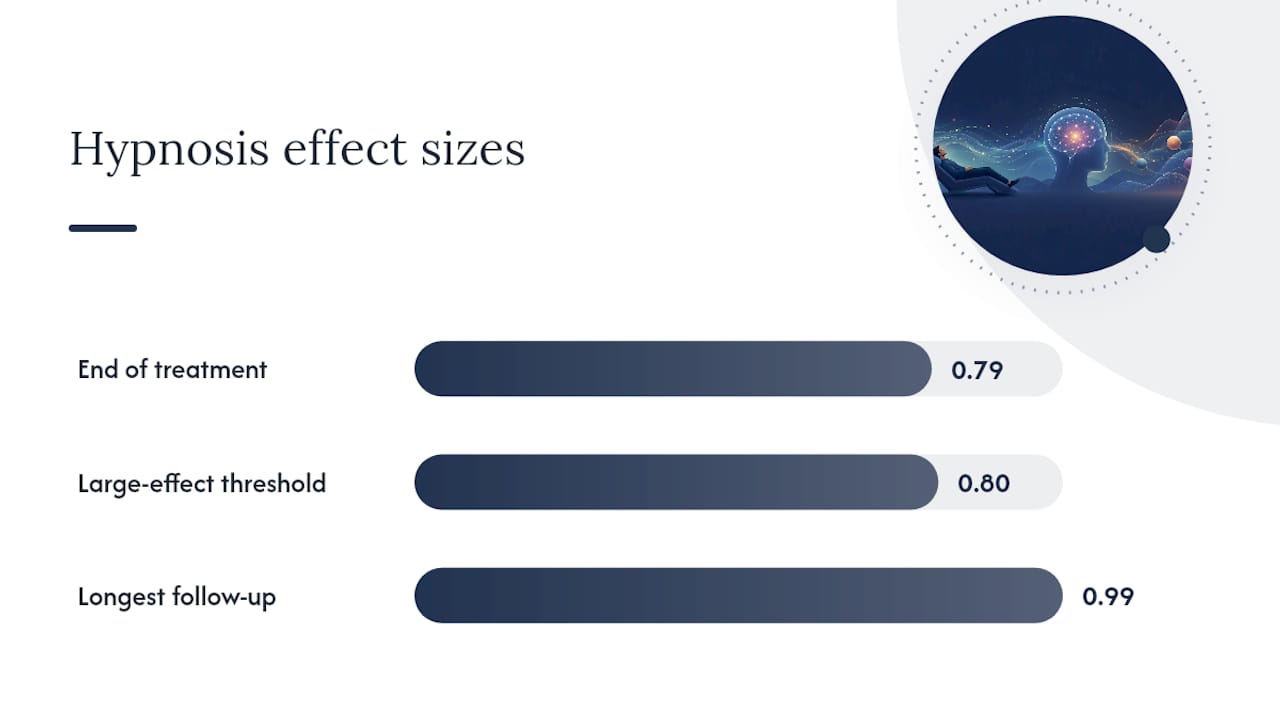
What an effect size of 0.79 means in practice: if your baseline anxiety sits at a 7 out of 10, a large effect size suggests a reduction to roughly the 4–5 range, enough to shift daily functioning noticeably. Combined with CBT, the effect grows further.
Limits of the current evidence
The research base is promising but not airtight. Key limitations include:
- Small sample sizes in most individual trials
- Significant heterogeneity in hypnosis protocols across studies, making direct comparisons difficult
- Short follow-up periods in many trials (weeks rather than months or years)
- Risk of publication bias, since positive results are more likely to be published
- Limited head-to-head trials comparing hypnosis directly to first-line treatments like SSRIs or CBT alone
These gaps do not undermine the evidence. They mean you should treat hypnosis as a well-supported adjunct rather than a guaranteed cure, and track your own response carefully.
How does hypnosis reduce anxiety in the body and brain?
Hypnosis works on anxiety through a measurable physiological pathway, not through suggestion alone. The core mechanism is a shift in autonomic nervous system (ANS) balance: hypnosis reduces sympathetic activation (the fight-or-flight branch) and increases parasympathetic tone (the rest-and-digest branch). The PMC clinical review documents this directly and links it to reduced cardiovascular risk markers in anxious patients.

In plain terms: your heart rate slows, your breathing deepens, your muscles release tension, and the cortisol-driven alarm signal quiets. These are not metaphors. They are measurable changes in heart rate variability, skin conductance, and respiratory rate that researchers have recorded during and after hypnotic induction.
Beyond the ANS, hypnosis addresses anxiety through several overlapping pathways:
- Guided imagery and affect reprocessing: The brain processes vivid imagined scenarios similarly to real ones. A detailed mental image of calm and safety activates the same parasympathetic circuits as actually being in that environment.
- Relaxation response: Slow, focused breathing during induction triggers the vagus nerve, which directly dials down the sympathetic alarm system.
- Post-hypnotic anchoring: A physical cue (pressing two fingers together, for example) gets paired with the calm state during the session. After enough repetitions, the cue alone can interrupt a worry spiral in daily life.
- Interrupting perseverative worry: GAD is characterized by repetitive, looping thought patterns. Hypnotic suggestion can disrupt the automatic quality of those loops by introducing new associative pathways at the subconscious level.
Cognitive-behavioral hypnotherapy adds a fifth layer: it uses imagery and suggestion to strengthen the behavioral experiments and cognitive restructuring that CBT already relies on, essentially making those techniques more potent by delivering them in a state of heightened receptivity.
What is the difference between hypnosis, hypnotherapy, and self-hypnosis?
Hypnosis is the state itself: a focused, relaxed condition of heightened suggestibility in which the critical, analytical mind steps back and the subconscious becomes more receptive to new associations. It is not sleep and not unconsciousness.
Clinical hypnotherapy is the therapeutic application of that state by a trained clinician. The clinician conducts an intake, screens for contraindications, designs individualized suggestions, and integrates hypnosis with other evidence-based methods such as CBT. This is what clinical literature describes as a facilitative intervention that can be woven into diverse psychotherapeutic orientations.
Self-hypnosis is a learnable skill in which you guide yourself into the hypnotic state using a script, audio recording, or memorized protocol. It is appropriate for daily symptom management and between-session reinforcement, but it does not replace clinical assessment or treatment planning.
Which approach fits your situation:
- Self-hypnosis: mild to moderate anxiety, daily stress management, reinforcing skills learned in clinical sessions, or initial exploration before committing to professional care
- Clinical hypnotherapy: moderate to severe GAD, treatment-resistant anxiety, comorbid depression or OCD, or any case where a safety screening and individualized treatment plan are warranted
- CBT-hypnotherapy integration: the strongest evidence-supported option for GAD, combining structured cognitive and behavioral techniques with hypnotic delivery
A note on credentials in the United States: the title "hypnotherapist" is not uniformly regulated across all states. A Certified Clinical Hypnotherapist (CCHt) credential from an accredited body, or a licensed mental health professional (LCSW, psychologist, licensed counselor) who has completed formal hypnotherapy training, offers the strongest assurance of clinical competence. Unregulated certificates from weekend workshops are not equivalent.
How to practice self-hypnosis for generalized anxiety: a step-by-step guide
A consistent self-hypnosis practice can reduce acute anxious arousal and build a reliable coping skill over time. Randomized trials in clinical settings show that sessions as short as 10–20 minutes can lower state anxiety measures meaningfully. The protocol below is designed for GAD-style anxiety: the chronic, diffuse worry that does not attach to one specific trigger.
Step-by-step instructions
-
Set up your environment. Choose a quiet room where you will not be interrupted for 15–20 minutes. Dim the lights. Sit in a comfortable chair with your feet flat on the floor, or lie down if you are confident you will not fall asleep.
-
Set an intention. Before closing your eyes, say to yourself: "I am going to guide my nervous system into a calm, safe state. My subconscious is open to new patterns."
-
Begin the induction. Close your eyes. Take three slow breaths: inhale for four counts, hold for two, exhale for six. With each exhale, let your shoulders drop a little further.
-
Deepen the state. Imagine a staircase with ten steps. With each step you descend, count down from ten to one and let your body feel heavier and more relaxed. By step one, you are in a deeply calm, focused state.
-
Deliver your suggestions. Use the sample script below, or speak your own version slowly and with conviction.
-
Anchor the state. At the deepest point of calm, gently press your thumb and index finger together. Hold for five seconds. This is your anchor. Repeat it twice more during the session.
-
Emerge slowly. Count up from one to five. Tell yourself: "At five, I will open my eyes feeling calm, clear, and grounded." Open your eyes on five.
Sample script for GAD (200–250 words)
"As I breathe out, I feel my body releasing tension it no longer needs. My nervous system is settling. The fight-or-flight alarm that has been running in the background is quieting now, because I am safe in this moment.
I imagine a place where I feel completely at ease. It might be a forest path, a quiet beach, or a room I love. I notice the details: the temperature of the air, the sounds around me, the feeling of the ground beneath my feet. My brain is treating this as real, and my body is responding accordingly. My heart rate is steady. My breathing is slow and deep.
I speak directly to my subconscious mind now: anxiety has been trying to protect me, but I no longer need that level of alarm. I am capable of handling uncertainty. I can feel uncomfortable and still move forward. My nervous system learns a new default: calm, grounded, present.
I press my thumb and index finger together and feel this calm state anchor into my body. Whenever I use this cue, my nervous system will remember this feeling and return here quickly.
I am building a new pattern. Each time I practice this, the pathway gets stronger."
Pro Tip: Practice this script twice daily for two weeks and log your 0–10 anxiety rating before and after each session. Most people notice a measurable shift within 7–10 days. If imagery feels flat, add more sensory detail: a specific smell, the texture of a surface, the sound of water. The more vivid the scene, the stronger the parasympathetic response.

For additional breathing and relaxation techniques that pair well with this practice, see mindfulness exercises for anxiety that complement the self-hypnosis routine above.
How clinical hypnotherapy treats GAD: CBT integration and what to expect
Cognitive-behavioral hypnotherapy is the most evidence-supported clinical model for anxiety disorders, appearing at least as effective as CBT or behavior therapy alone in available studies. The integration works because CBT provides the cognitive and behavioral framework while hypnosis deepens receptivity to the interventions, making restructured thoughts and new behavioral patterns easier to consolidate at the subconscious level.
A typical course of treatment begins with an intake session covering anxiety history, current symptoms, medication, and any contraindications. The clinician then introduces hypnotic induction in session two or three, calibrating depth and imagery to the individual. From session four onward, the work becomes more specific: identifying the core worry themes driving GAD, using guided imagery to reprocess the emotional charge attached to those themes, and building post-hypnotic cues the client can use between sessions.
Most clinicians working with GAD plan for 6–12 weekly sessions, with the first measurable symptom reduction typically appearing by sessions three to five. Progress markers include reduced frequency of worry episodes, improved sleep onset, lower physiological arousal in triggering situations, and the client's own 0–10 symptom ratings. Between-session homework, usually a daily self-hypnosis practice using a recorded or scripted version of the in-session work, is what separates short-term relief from durable change.
To illustrate what this looks like in practice: a client presenting with chronic health-focused worry and difficulty sleeping might spend the first three sessions learning induction and identifying the specific thought loops driving nighttime anxiety. By session six, they are using a post-hypnotic anchor to interrupt the worry loop before it escalates, and sleep onset has shortened from 90 minutes to under 30. By session ten, the anchor works reliably without the full induction. That kind of progression is typical when the client practices consistently between sessions.
Authoritative clinical overviews place hypnosis within broader evidence-based treatment pathways for anxiety disorders, reinforcing its role as a legitimate adjunct rather than an alternative to standard care. For cases involving comorbid OCD, see the hypnotherapy for OCD and anxiety clinical overview for additional protocol considerations.
Is hypnosis safe for anxiety, and what are the contraindications?
Hypnosis is low-risk for most adults with anxiety. Serious adverse events in clinical trials are rare, and the intervention carries no pharmacological side effects. That said, clear contraindications exist and must be screened before starting any hypnotherapy.
Do not begin hypnotherapy without psychiatric coordination if you have:
- Active suicidal ideation or a recent suicide attempt
- Current psychotic symptoms (hallucinations, delusions, disorganized thinking)
- Uncontrolled bipolar mania
- A diagnosed dissociative disorder (dissociative identity disorder, depersonalization disorder)
- Severe untreated PTSD with active flashbacks
For these presentations, hypnosis is not contraindicated forever, but it requires a clinician with specific training in trauma-informed and stabilization-first approaches, and explicit sign-off from the treating psychiatrist.
Medication coordination matters. If you are taking benzodiazepines, SSRIs, SNRIs, or antipsychotics, tell your hypnotherapist before the first session. Hypnosis does not interact pharmacologically with these medications, but the clinician needs to know your baseline arousal level and any sedation effects that might affect induction depth or session pacing. Never adjust or discontinue psychiatric medication to "try hypnosis instead" without your prescriber's guidance.
Evidence limitations, restated briefly: the trials supporting hypnosis for GAD are real but mostly small. Protocols vary widely across studies, follow-up periods are often short, and publication bias likely inflates the published effect sizes to some degree. The evidence supports cautious optimism, not certainty. Hypnosis works best as part of a broader treatment plan, not as a replacement for it. The broader clinical literature on anxiety treatment pathways consistently frames hypnosis as adjunctive, and that framing is accurate.
How do you choose a qualified hypnotherapist in the United States?
Choose a clinician with a clinical hypnotherapy credential from an accredited body, documented experience treating anxiety disorders specifically, and a clear protocol for coordinating with prescribing clinicians. Those three criteria filter out the majority of unqualified practitioners.
What credentials actually mean in practice: a Certified Clinical Hypnotherapist (CCHt) designation from the American Council of Hypnotist Examiners (ACHE) or the National Board for Certified Clinical Hypnotherapists (NBCCH) indicates formal training in clinical protocols. A licensed mental health professional (licensed clinical social worker, licensed professional counselor, psychologist) who has completed accredited hypnotherapy training offers the strongest combination of mental health competence and hypnotic technique. A certificate from a weekend seminar with no underlying mental health license is not equivalent, regardless of how it is marketed.
Questions to ask a prospective hypnotherapist:
- What is your specific training in clinical hypnotherapy, and which certifying body issued your credential?
- How many clients with GAD or anxiety disorders have you treated, and what does a typical course of treatment look like?
- Do you coordinate with prescribing clinicians or therapists when a client is already in treatment?
- What is your safety protocol if a client discloses suicidal ideation or a psychiatric emergency during a session?
- How many sessions do you typically recommend, and what is your fee structure?
Red flags that should end the conversation:
- Promises of a "cure" in a fixed number of sessions, regardless of severity
- No intake screening or health history questions before the first session
- No safety plan or referral protocol for high-risk presentations
- Resistance to coordinating with your existing treatment team
- Claims that hypnosis alone can replace psychiatric medication or CBT
For health-focused anxiety specifically, the hypnotherapy for health anxiety clinical guide covers additional screening considerations worth reviewing before your first appointment.
How Hypnotictransformations treats generalized anxiety: clinical approach and what to expect
This section follows a PAS (Problem, Agitation, Solution) structure.
The problem with most anxiety treatment is that it addresses the conscious mind. You learn to identify cognitive distortions, challenge them, breathe through the panic. That works, to a point. But the fight-or-flight response does not live in your prefrontal cortex. It lives in the subconscious patterns that fire before you have time to think. Managing symptoms at the surface level leaves those patterns intact.
That is the gap Hypnotictransformations addresses directly. Kirk Hoffman, Certified Clinical Hypnotherapist, works with clients via Zoom to reach the subconscious patterns driving chronic anxiety, not just the symptoms those patterns produce. Sessions use NLP techniques for anxiety, guided imagery, and advanced hypnotic modalities to interrupt the automatic alarm response and install new, calmer defaults at the level where the response originates.
What the clinical approach includes:
- A thorough intake covering anxiety history, current symptoms, medications, and treatment goals
- Individualized induction and suggestion protocols calibrated to your specific worry patterns
- NLP for anxiety techniques including anchoring, submodality work, and timeline reprocessing
- Between-session audio recordings and self-hypnosis practice to reinforce in-session work
- Coordination with your existing treatment team when applicable
Sessions are conducted online via Zoom, making them accessible nationwide. Single sessions and multi-session packages are available. A free initial consultation lets you ask questions, describe your situation, and determine whether clinical hypnotherapy is the right fit before committing to a full course of treatment.
Clients working through anxiety disorder hypnosis with Hypnotictransformations typically report reduced worry frequency and improved sleep within the first three to five sessions, with more durable changes consolidating over a 6–10 session course. Results depend on consistency of between-session practice and the severity of the presenting anxiety.
A clinician's note on what actually moves the needle
The research on hypnosis for generalized anxiety is solid enough to act on. An effect size of 0.79 at end of treatment, growing to 0.99 at follow-up, is not a marginal finding. What the published trials cannot fully capture is the variable that separates clients who sustain their gains from those who plateau: the quality and consistency of between-session practice.
Most people who try self-hypnosis once or twice and conclude it "didn't work" are making the same mistake as someone who goes to the gym twice and decides exercise is ineffective. The subconscious mind learns through repetition. The post-hypnotic anchor you build in session three is not functional after one rehearsal. It becomes functional after twenty. That is not a failure of the technique. It is how procedural learning works in the nervous system.
The single most underused tool in anxiety hypnosis is multi-sensory imagery. Clients who build their calm anchor around a vague, flat mental image get a weaker response than clients who populate that image with specific sensory detail: the smell of pine, the temperature of the air, the sound of water moving. The brain's threat-detection system responds to sensory specificity. A rich, detailed calm scene activates the parasympathetic system more reliably than a generic one.
Practical tip: After each self-hypnosis session, spend 60 seconds immediately afterward pressing your anchor cue and recalling the most vivid sensory detail from your calm scene. Do this before you open your eyes. That brief rehearsal at the edge of the hypnotic state is when the association consolidates most efficiently.
Ready to work with a clinical hypnotherapist for anxiety?
Chronic anxiety that has not responded fully to breathing exercises, mindfulness, or talk therapy alone may be rooted in subconscious patterns that surface-level techniques cannot reach. Hypnotictransformations offers online clinical hypnotherapy for anxiety via Zoom, led by Certified Clinical Hypnotherapist Kirk Hoffman, available to clients nationwide.
The process starts with a free consultation: roughly 30 minutes, no obligation, and a chance to describe your anxiety in detail and ask questions about the approach. From there, single sessions and multi-session packages are available depending on your goals and the severity of your symptoms. Kirk coordinates with prescribing clinicians and existing therapists when relevant, so you are not choosing between hypnotherapy and your current care.
To book your free consultation or review session and package options, visit the Hypnotictransformations anxiety services page. If you are ready to schedule directly, the appointments page has current availability.
Sources
- “Close your eyes and relax”: the role of hypnosis in reducing anxiety, and its implications for the prevention of cardiovascular diseases - PMC
- THE EFFICACY OF HYPNOSIS AS A TREATMENT FOR ANXIETY: A META-ANALYSIS
- Cognitive hypnotherapy for anxiety disorders
- Hypnosis as a treatment for anxiety (older clinical review)
- Ncbi
- Hypnosis for Anxiety Relief: Scientific Evidence Supporting ...
- Pubmed
This article is general information, not a substitute for advice from a qualified doctor. Consult a qualified healthcare professional about your own circumstances before acting on anything here.