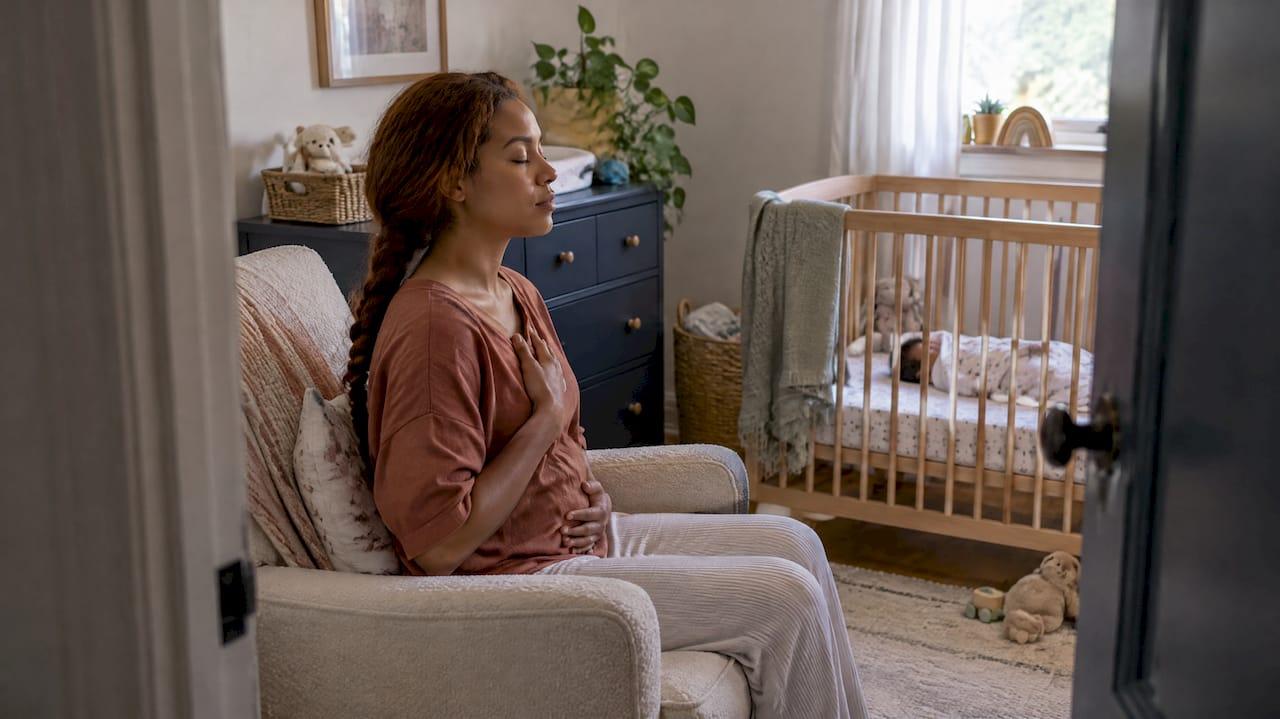
It is 2 a.m. The baby is asleep. You are not. You are standing over the crib checking that she is still breathing, and your heart is pounding as if something terrible is about to happen. If that sounds familiar, you are probably searching for something that works, and hypnosis has come up.
Here is the short answer. Hypnosis can teach your nervous system to calm down on cue, and some early research suggests it may lower anxiety around pregnancy and birth. It is not a proven stand-alone treatment for postpartum anxiety, and it should never replace a medical evaluation. This guide explains how it works, where the evidence stops, and how to decide.
This article follows the PAS framework: Problem, Agitate, Solution. First we name what is happening in your body. Then we look at what happens if it keeps running. Then we cover what hypnosis can realistically offer.
TL;DR
- Postpartum anxiety is persistent, hard-to-control worry that can start during pregnancy, right after birth, or months later. It is common, and it is treatable.
- Hypnosis works on the relaxation response. A therapist guides you into a focused, calm state, then helps you link that state to a cue you can use alone.
- The research is promising but thin. Studies are small, and results are mixed. Hypnosis is best treated as a support, not a cure.
- See a doctor or midwife first, especially if symptoms last beyond two to three weeks, get worse, or interfere with daily life.
- If you ever have thoughts of harming yourself or your baby, call or text 988 or go to an emergency room right away.
Table of Contents
- The problem: your alarm system will not switch off
- The cost of waiting it out
- The solution: what hypnosis actually does
- What the research shows, and where it stops
- Is hypnosis safe after childbirth?
- When to get professional help now
- A clinician's view
- Working with us
- How to decide: a simple checklist
- FAQ
- Sources
The problem: your alarm system will not switch off
Postpartum anxiety is not the same as being a nervous new parent. It is persistent, excessive worry and fear after having a baby, often with tension, sleep problems, or panic attacks. Many parents describe it in very specific pictures:
- Replaying the moment the baby could have slipped in the bath.
- Lying awake listening for breathing, even when the monitor shows she is fine.
- Feeling dread when someone else holds the baby.
- Racing heart and tight chest while the baby feeds.
- Being unable to sleep when the baby sleeps, because your mind will not stop.
These are not character flaws. They are your fight-or-flight response doing its job at the wrong time. After birth, your hormones shift sharply, your sleep is broken, and your brain is tuned to detect threats to a helpless infant. The amygdala, the part of the brain that flags danger, becomes extremely sensitive. Your body then releases adrenaline and cortisol in response to thoughts, not to real danger.
The timing surprises people. According to Cleveland Clinic, postpartum anxiety can start during pregnancy or, more typically, right after birth, and symptoms may begin when a baby is several months old. If you are wondering whether anxiety at three months counts, it can.
How it differs from baby blues and postpartum depression
Baby blues bring mood swings and weepiness in the first two to three weeks and usually fade within days or weeks. According to Children's Hospital of Philadelphia, a perinatal mood or anxiety disorder may be present when those symptoms last beyond two to three weeks, worsen, or interfere with everyday living.
Anxiety and depression overlap. Both can cause poor sleep, trouble relaxing, and irritability. The distinction matters because a Harvard Health article notes that people with postpartum anxiety may not respond as well to some depression treatments, such as interpersonal psychotherapy or bupropion. A clinician who can tell them apart is worth finding before you choose any approach.
The cost of waiting it out
Most parents with postpartum anxiety try to push through. They tell themselves it is normal, that everyone is tired, that it will pass once the baby sleeps through the night.
Sometimes it does. When it does not, the pattern tightens. You sleep badly because you are anxious. You are anxious because you sleep badly. You avoid situations that spike your fear, like leaving the house or letting a partner take a night shift. Each avoidance teaches your subconscious mind that the fear was justified, because nothing bad happened while you were guarding against it.

That loop is the part hypnosis aims at. Your subconscious mind runs automatic responses: the jolt of panic when the baby coughs, the image of something going wrong. You cannot reason your way out of those in the moment, because they fire before conscious thought arrives. This is why many parents say, "I know I'm being irrational, and I still can't stop."
There is also a practical cost. Anxiety that goes untreated drains the energy you need for feeding, bonding, and recovery. If you are reading this at night and recognize yourself, you are not behind. You are at the right point to act.
The solution: what hypnosis actually does
Hypnosis is a state of focused attention and deep relaxation. You are awake and aware throughout. You cannot be made to do anything against your will, and you cannot get stuck in it.
In plain terms, a session works like this:
- Settling the body. The therapist guides your breathing and muscle relaxation. This activates the parasympathetic side of your nervous system, the "rest and digest" side that counters fight-or-flight.
- Narrowing attention. With distractions reduced, you become more open to suggestion and imagery.
- Working with the pattern. The therapist uses guided imagery, suggestion, and techniques such as NLP to change how your mind responds to specific triggers, like the 2 a.m. checking urge.
- Anchoring a cue. You learn to bring back the calm state with a word, breath, or small gesture.
That last step has research behind it. The National Center for Complementary and Integrative Health explains that self-hypnosis programs teach people to produce the relaxation response when prompted by a phrase or nonverbal cue. The same source says these techniques need practice, and frequent use is more likely to help. Expect to practice a few minutes a day. One session will not rewire months of vigilance.
What a first session might cover
A good first session starts with talking, not trance. The therapist asks when the anxiety began, what triggers it, what you have tried, and what medications you take. You also answer screening questions about trauma history and other mental health conditions. We explain why those questions matter in our piece on five screening questions for hypnotherapy contraindications.
Then you practice a short induction. You keep your eyes closed, listen, and notice your breathing slow. Most people leave knowing what the relaxed state feels like in their body, which is the starting point for everything after it.
What the research shows, and where it stops
This is the section most hypnosis websites skip. The evidence is real but limited.
A small positive study. In a quasi-experimental study, women who received hypnosis during pregnancy (at weeks 16, 20, 28, and 36) had significantly lower anxiety and depression scores at two months postpartum than a group receiving routine care. It was not a randomized trial, and the hypnosis began before birth.
A mixed randomized trial. The SHIP trial in the United Kingdom found that brief third-trimester self-hypnosis training did not significantly reduce epidural use or most psychological outcomes. Participants did report lower actual-versus-expected fear and anxiety two weeks after birth.
Reviews call for more data. Cochrane reviewers say some randomized trials suggest mind-body methods such as hypnotherapy may help manage anxiety in pregnancy or early postpartum, but small samples and design limits hold the evidence back. A separate Cochrane review found insufficient evidence on whether hypnosis prevents postnatal depression.
What does that add up to?
- Hypnosis is a reasonable, low-risk option to explore for anxiety symptoms.
- It is not proven to treat postpartum anxiety disorder on its own.
- Most of the studies look at hypnosis before birth, not after it.
- Anyone promising a guaranteed outcome is going beyond the evidence.
If you want the broader picture on how clinical hypnosis performs for ongoing worry, see our evidence-based guide to generalized anxiety hypnosis.
Is hypnosis safe after childbirth?
For most healthy people, yes. The NCCIH notes that relaxation techniques, including self-hypnosis, are generally safe for healthy individuals. It also notes rare reports of increased anxiety or intrusive thoughts in people with certain psychiatric conditions or a history of trauma.
That is why screening matters. If your anxiety is tied to a traumatic birth, a good practitioner moves slowly, avoids pushing you into painful memories, and may suggest working with a trauma-informed therapist at the same time. Our articles on hypnosis side effects and screening and whether hypnosis is safe for anxiety sufferers go deeper on this. If trauma is part of your story, read about safe regression work and its red flags before agreeing to any technique that revisits memories.
Using hypnosis with other care
Hypnosis can sit alongside therapy and medication. It should not replace them without your doctor's input. Two practical rules:
- Tell every provider what you are doing. The NCCIH advises that you inform your health care providers about complementary approaches so your care stays coordinated.
- Get the diagnosis right first. ACOG recommends screening for bipolar disorder before starting medication for anxiety or depression, because antidepressants alone can worsen mood symptoms in bipolar disorder. That is a decision for your prescriber, and it is another reason to see a medical professional early.
People also look at supplements. If that is you, read the evidence on magnesium and anxiety and ask your doctor or midwife before adding anything, especially if you are breastfeeding.
When to get professional help now
Hypnosis is a good fit for mild to moderate anxiety, or as a support next to treatment. It is the wrong first step in these situations:
- You have thoughts of harming yourself or your baby. Call or text 988, or go to the nearest emergency room.
- You feel confused, hear or see things others do not, or have not slept for days and feel unlike yourself. Seek emergency care.
- Your symptoms have lasted past two to three weeks after birth, are getting worse, or are getting in the way of caring for yourself or the baby. Call your OB-GYN, midwife, or primary care provider this week.
- You are having panic attacks, can't eat, or can't sleep even when the baby is asleep. Tell your provider, and ask about a perinatal mental health referral.
For support from someone who understands pregnancy and postpartum, the National Maternal Mental Health Hotline offers free, confidential help by call or text at 1-833-TLC-MAMA (1-833-852-6262), any time. Its own FAQ states it is not a crisis line, so use 988 in an emergency.
Needing help does not mean you are failing. It means your nervous system has been on high alert for too long.
A clinician's view
We see the same pattern again and again in anxious adults. The mind is not broken. It learned a protective response, and it keeps running that response long after it stopped being useful. Postpartum anxiety is a very sharp version of that, because the stakes feel enormous.
Our approach to anxiety is to work with the subconscious pattern and the body together. First we teach your nervous system what calm feels like. Then we use that state to change what a trigger means. A thought like "something will happen to the baby" stops carrying a jolt of adrenaline. You still care deeply. Your body just stops treating every moment as an emergency.
We are also honest about limits. Hypnosis is not a substitute for medical care, and we ask clients about health history, medications, and trauma before any session. If your symptoms point to a condition that needs a doctor first, we will say so and send you there. Hypnosis works best as one part of a plan that includes your care team.
— Kirk
Working with us
We offer online hypnotherapy for anxiety through Zoom sessions with Kirk Hoffman, a Certified Clinical Hypnotherapist. You can join from your couch while the baby naps, with no commute or childcare arrangements. Sessions are available to clients across the United States, and we offer a free consultation so you can ask questions before you commit. You can book an appointment here.
If you want to see how online sessions work first, read our guide on whether you can be hypnotized online.
How to decide: a simple checklist
Ask yourself these questions before booking anything:
- Have I told my OB-GYN, midwife, or primary care provider how I feel?
- Are my symptoms mild to moderate, with no thoughts of harming myself or my baby?
- Am I ready to practice for a few minutes most days?
- Does the practitioner screen for health history and trauma before starting?
- Does the practitioner avoid promising a cure?
If you answered yes to all five, hypnosis may be a sensible addition. If you answered no to the first or second, start with your provider.
FAQ
Is it normal to have postpartum anxiety three months after giving birth?
Yes, it can be. Postpartum anxiety may start right after birth or appear when the baby is several months old. If worry is constant, hard to control, or affecting your sleep and daily life, tell your provider rather than waiting for it to pass.
Can hypnosis cure postpartum anxiety?
No one can promise that. Hypnosis can teach you to trigger the relaxation response and may help lower anxiety, but the research is limited by small studies and mixed results. Treat it as a support alongside medical care.
Is hypnosis safe if I had a traumatic birth?
Usually it can be, with the right screening and pace. Rare reports exist of increased anxiety or intrusive thoughts in people with trauma histories. Choose a practitioner who asks about trauma first, and consider working with a trauma-informed therapist as well.
Can I use hypnosis with medication or therapy?
Often yes, but tell every provider involved. Your prescriber should know about any complementary approach you use. Do not stop or change medication because of hypnosis without talking to your doctor.
Should I try a free recording instead of a session?
Recordings can help you practice relaxation between appointments. They cannot screen your health history or adjust to your specific triggers. If your anxiety is severe or long-lasting, see a health care provider first.
Sources
- Postpartum Anxiety: Symptoms, Diagnosis & Treatment, Cleveland Clinic
- Resource Hub for Postpartum Anxiety, MGH Center for Women's Mental Health
- Perinatal or Postpartum Mood and Anxiety Disorders, Children's Hospital of Philadelphia
- Postpartum anxiety is invisible, but common and treatable, Harvard Health
- Relaxation Techniques, NCCIH
- The Effectiveness of Hypnosis Intervention in Alleviating Postpartum Psychological Symptoms, American Journal of Clinical Hypnosis
- Self-hypnosis for intrapartum pain management, BJOG
- Mind-body interventions during pregnancy, Cochrane
- Hypnosis during pregnancy, childbirth, and the postnatal period, Cochrane
- Patient Screening, ACOG
- Magnesium for Anxiety: What the Evidence Actually Shows
- National Maternal Mental Health Hotline FAQ, HRSA