
Regression hypnotherapy uses guided hypnosis to help you access memories or earlier emotional states connected to a current fear or anxiety pattern, then works with your subconscious mind to reframe how that material affects you now. Clinicians use it most often for phobias, anxiety, and trauma-related symptoms. It is not fringe, but it is not a memory-recovery tool either, and it requires a practitioner trained to avoid planting false memories.
TL;DR:
- Practitioners should use open-ended questions and non-leading language to reduce the risk of planting false memories during regression sessions.
- Regression hypnotherapy is most effective for clients with clear, identified trauma or specific phobias, often seeing improvement within a few sessions.
- It is unsuitable for individuals with active psychosis, severe dissociation, unstable suicidal ideation, or other conditions requiring psychiatric treatment.
- The overall success depends heavily on the practitioner's trauma-informed training and adherence to safety protocols.
- Sessions typically last 60 to 90 minutes, with a 15 to 25-minute regression phase, and require careful screening and clear informed consent.
Table of Contents
- What Counts as Regression Hypnotherapy?
- How a Regression Session Actually Works
- Techniques Used in Regression Work
- Where Regression Hypnotherapy Is Actually Used
- The Real Risks: False Memories and When to Say No
- How to Choose a Practitioner You Can Trust
- What a Regression Session Actually Feels Like
- Who Should Lead This Work, and When to Refer Out
- What Regression Hypnotherapy Actually Delivers
- Ready to Address the Root of Your Anxiety?
- Sources
What Counts as Regression Hypnotherapy?
The term covers a few distinct approaches, and mixing them up is where a lot of confusion starts.
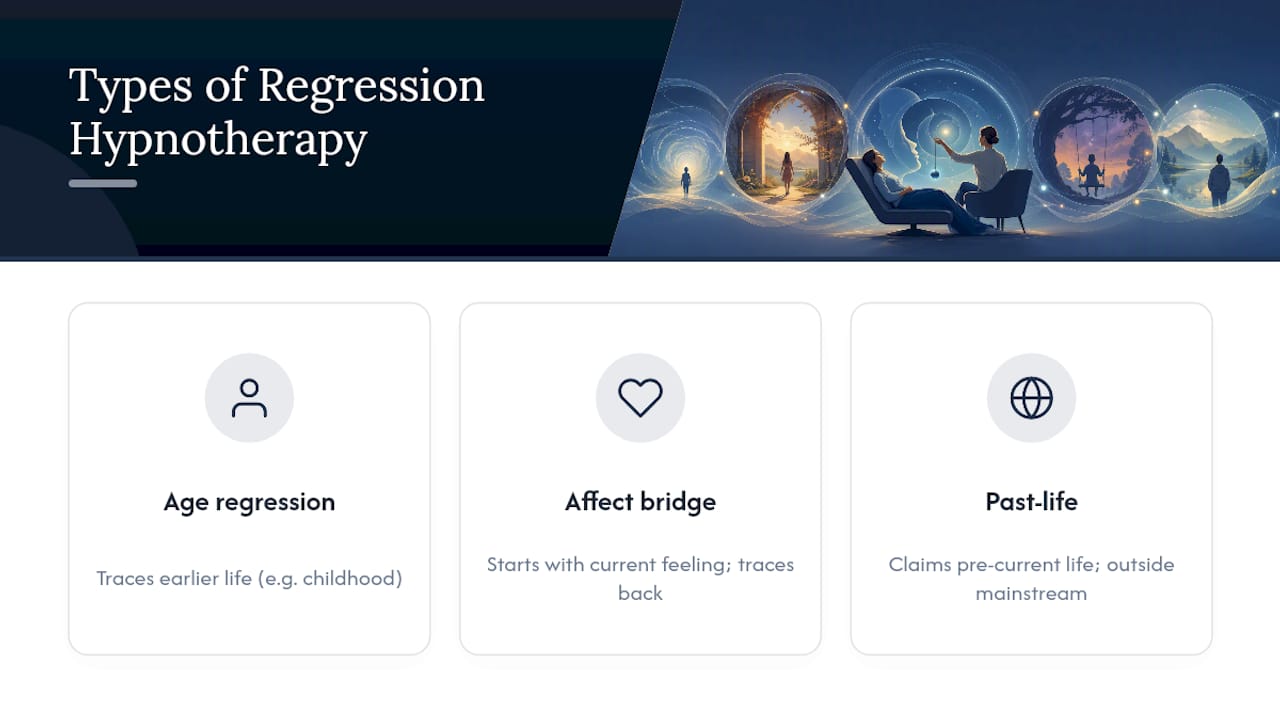
Age regression guides you back to an earlier point in your own life, usually childhood, to locate the first moment a fear pattern took hold. Affect bridge work starts with the feeling you have right now (chest tightness before a presentation, for example) and traces that sensation backward through memory until an earlier, related moment surfaces. Past-life regression claims to access experiences before your current life. Clinical hypnotherapists focused on anxiety and phobia work rely almost entirely on the first two. Past-life work sits outside mainstream clinical practice, and resource pages addressing hypnotic regression caution that vivid material recalled under hypnosis does not confirm anything as historical fact, whether it points to age six or a supposed past life.
Terms you will see used loosely: hypnotic regression, memory regression, subconscious mind therapy, past life regression therapy. Most refer to the same core technique with different framing.
How a Regression Session Actually Works
A responsible session follows a structure, not a script. The five-phase model that most trained hypnotherapists use looks like this:
- Assessment. Your hypnotherapist screens for suitability, asks about your history, and rules out conditions where regression is not appropriate.
- Informed consent. You get a plain explanation that hypnosis increases suggestibility and that recalled material is subjective, not verified fact.
- Induction and deepening. Progressive relaxation or focused attention brings your nervous system out of a hypervigilant state and into a calmer, more receptive one.
- Exploration and reframing. Using open-ended prompts, the hypnotherapist helps you locate the earlier emotional root and works with your subconscious mind to change how that memory drives your present-day fight-or-flight response.
- Return and integration. You come back to full alertness gradually, and the session ends with grounding and a brief debrief.
Pro Tip: Ask your practitioner directly how they handle unclear or fragmented memories during exploration. A well-trained clinician will describe a nonleading method, such as the affect bridge, rather than a fixed script that tells you what you should be remembering.
Techniques Used in Regression Work
A session is built from a small set of specific tools, and knowing them helps you tell a careful practitioner from a careless one.
- Age regression procedure: paced, gradual movement backward through memory, checked frequently for your comfort and stability.
- Affect bridge: starting from a present physical sensation and following it to its earliest associated memory, a technique detailed by practice guidance for hypnotherapists as a way to reduce leading prompts.
- Guided imagery and sensory recall: using sight, sound, and touch cues to make recalled scenes feel vivid enough to work with therapeutically.
- Narrative reframing: helping you retell the memory with a different emotional ending, which supports cognitive restructuring rather than just reliving distress.
The critical distinction is scripted prompts versus open-ended questions. A practitioner who asks "what do you notice now?" is working safely. One who asks "was there a man in a blue coat?" is planting details, not uncovering them.
Where Regression Hypnotherapy Is Actually Used
Regression work shows up most in treatment for phobias, anxiety disorders, trauma-related symptoms, depression, and habit change such as smoking or overeating tied to an emotional trigger, as detailed in how to create therapy treatment plans for trauma and anxiety.
An integrative review covering 241 primary studies published between 2015 and 2025 found hypnotic age regression used clinically across trauma, PTSD, anxiety disorders, and depression, pointing to memory reconsolidation and cognitive restructuring as the likely mechanisms behind reported improvement.
That is a meaningful body of evidence, but it is not a blank check. Most clients see change over a handful of sessions, not one, and outcomes vary with the skill of the practitioner and the specificity of the presenting problem. A public speaking phobia with a clear onset tends to respond faster than generalized anxiety with no single root event. If your anxiety runs alongside depression, hypnotherapy targeting both together tends to move at a similarly gradual pace.
The Real Risks: False Memories and When to Say No
Hypnosis genuinely increases suggestibility, and that is the honest reason regression carries more scrutiny than standard talk therapy. Experimental research on hypnosis and memory shows hypnotized participants report more false memories than non-hypnotized controls, and warning people beforehand reduces but does not eliminate the effect. That is not a reason to avoid regression altogether. It is a reason to insist on a practitioner who uses nonleading language and treats recalled material as emotionally real without claiming it is factually verified.

Certain presentations make regression inappropriate outright. Clinical guidance on trauma interventions lists active psychosis, severe dissociation, and unstable suicidal ideation as situations requiring referral to a psychiatrist or specialized trauma clinician instead.
Safeguards worth expecting from any practitioner:
- Screening questions before any regression work begins, not after.
- Trauma-informed pacing that checks in frequently rather than pushing toward a dramatic memory.
- Open-ended, nonleading questions throughout exploration.
- A named referral pathway for anything outside their scope.
Pro Tip: If a practitioner promises to "uncover" a specific traumatic event before the session even starts, that is a leading frame, not a clinical one. Walk away.
How to Choose a Practitioner You Can Trust
Vetting a hypnotherapist for regression work takes more scrutiny than picking one for general relaxation coaching, because the stakes of a mishandled session are higher.
- Ask about specific regression training, not just general hypnosis certification. A consumer guide reviewing regression approaches notes that generic hypnosis credentials alone don't guarantee competence in trauma-sensitive regression technique.
- Ask how they structure informed consent. They should explain suggestibility and the subjective nature of recalled memories before you ever begin.
- Ask what their contraindication checklist looks like. A practitioner who cannot name conditions they would refuse to treat has not thought this through.
- Ask about their emergency plan. What happens if a session brings up more distress than expected? Is there a follow-up call, a grounding protocol, a referral list?
- Verify credentials directly. Look up their certifying body rather than taking a website claim at face value.
Red flags include vague answers about training, pressure to book multiple sessions upfront, and any suggestion that they already know what your memory will reveal before you've said a word.
What a Regression Session Actually Feels Like
Most sessions run 60 to 90 minutes, with the regression portion itself lasting maybe 15 to 25 minutes inside that window. You stay seated or reclined, eyes closed, fully able to speak and move.
- Early relaxation often brings a heavy, warm feeling in your limbs as your nervous system shifts out of alert mode.
- Recalled material can feel surprisingly vivid, sometimes with real emotion including tears, though many sessions are calmer than people expect.
- A short debrief follows every regression, covering grounding and a brief safety check to confirm you feel stable before ending the call.
- Afterward, journaling what came up and doing a short check-in the next day helps consolidate whatever shifted.
You are conscious and in control the entire time. Nothing about the process resembles the stage-hypnosis image most people carry into their first session.
Who Should Lead This Work, and When to Refer Out
Regression hypnotherapy calls for a practitioner trained specifically in trauma-sensitive technique, not general relaxation work. Kirk Hoffman, a Certified Clinical Hypnotherapist, works with clients on anxiety, phobias, and subconscious patterns tied to fear responses, using structured induction, affect-bridge work, and cognitive reframing rather than scripted memory recovery.
Low-to-moderate clinical anxiety, specific phobias, and stress-driven habit patterns fall squarely within this scope. Active psychosis, unmanaged bipolar disorder, severe dissociative conditions, and acute suicidal crisis do not, and any responsible hypnotherapist will say so directly and point you toward a psychiatrist or trauma specialist instead. If your anxiety centers on a specific situation like public speaking, targeted phobia work is often the more direct route.
What Regression Hypnotherapy Actually Delivers
The evidence base here is better than skeptics assume and thinner than enthusiasts claim. Two hundred forty one studies pointing toward memory reconsolidation as a working mechanism is a real signal, not proof that regression fixes anxiety in every case. Where the conventional advice fails people is in treating regression as either miraculous or fraudulent. It is neither. It is a technique with a mechanism, a risk profile, and a skill floor that matters more than most marketing admits.
The single biggest predictor of a good outcome isn't the technique itself. It's whether the practitioner asks open, nonleading questions instead of feeding you a narrative. A hypnotherapist who says "tell me what you notice" is doing careful work. One who says "I think we'll find something around age seven" before you've even started is doing the opposite, regardless of how many certificates hang on their wall.
If you're weighing regression against staying with talk therapy alone, prioritize the practitioner's training in trauma-informed technique over the specific label of the method. A skilled clinician using age regression carefully will outperform an undertrained one running any "advanced" technique with a fancier name.
— Kirk
Ready to Address the Root of Your Anxiety?
If you've read this far, you already understand something most people looking into hypnotherapy skip past: regression work only helps when the practitioner runs it carefully, checks for contraindications, and never leads you toward a memory. That is exactly how sessions with Hypnotictransformations are structured. Kirk Hoffman, a Certified Clinical Hypnotherapist, works with clients dealing with anxiety, phobias, and fear-based thinking through personalized online sessions conducted over Zoom, using affect-bridge work, guided imagery, and cognitive reframing rather than one-size-fits-all scripts.
Sessions are available nationwide, so location never limits access to care. If anxiety, panic, or a specific phobia has been running your decisions for longer than you'd like, book a session focused on anxiety relief or review the full range of available hypnotherapy services to find the right starting point.
This article is general information, not a substitute for advice from a qualified doctor. Consult a qualified healthcare professional about your own circumstances before acting on anything here.
Sources
- Integrative review: hypnosis and regression interventions (2015-2025)
- Regression in Hypnotherapy: Theory, Technique, and Responsible Practice
- Research on hypnosis and false memory formation