
Hypnotherapy for anxiety and depression produces real, measurable results. Clinical research shows it reduces symptoms at a level comparable to cognitive behavioral therapy for subclinical anxiety and depression, with those improvements holding up at a 12-month follow-up. It works by guiding you into a focused, relaxed state where your subconscious becomes more receptive to new patterns of thought, effectively interrupting the nervous system loops that keep anxiety and depression locked in place.
Here is what the evidence supports:
- Hypnotherapy produces durable symptom reductions in anxiety and depression, comparable to CBT outcomes at 12 months
- It is generally safe with minor, temporary side effects in a small number of cases
- Group hypnosis protocols have shown results even in people who did not respond to medication
- It works best as part of an integrated plan, often alongside CBT or mindfulness
- You stay fully conscious and in control throughout every session
How hypnotherapy works to manage anxiety and depression
Hypnotherapy guides you into a state of focused concentration, not sleep, not unconsciousness. The Royal College of Psychiatrists describes hypnosis as a state of heightened attention that makes you more open to constructive suggestions, without the critical resistance that usually blocks them. Think of it as quieting the part of your brain that argues with every new idea long enough to let a better pattern take root.
Once you are in that state, a trained hypnotherapist can redirect your attention away from anxiety triggers or depressive thought loops toward neutral or positive alternatives. Your nervous system responds to this shift. The fight-or-flight response, which fires constantly in people with chronic anxiety, begins to downregulate. Heart rate variability can improve, which research links to measurable reductions in depression symptoms.
Hypnotherapy rarely operates in isolation. Combining it with CBT or mindfulness addresses both the cognitive patterns and the physiological stress response at the same time. A Baylor University study found that pairing mindfulness with hypnotherapy produced better stress management outcomes than either approach alone.

| Mechanism | What it does |
|---|---|
| Focused concentration state | Reduces critical resistance, making the subconscious more receptive |
| Attention redirection | Shifts focus away from anxiety triggers and depressive rumination |
| Nervous system regulation | Lowers fight-or-flight activation, calms physiological stress response |
| Suggestion integration | Installs new thought patterns at the subconscious level |
| CBT or mindfulness pairing | Addresses cognitive and physiological aspects simultaneously |
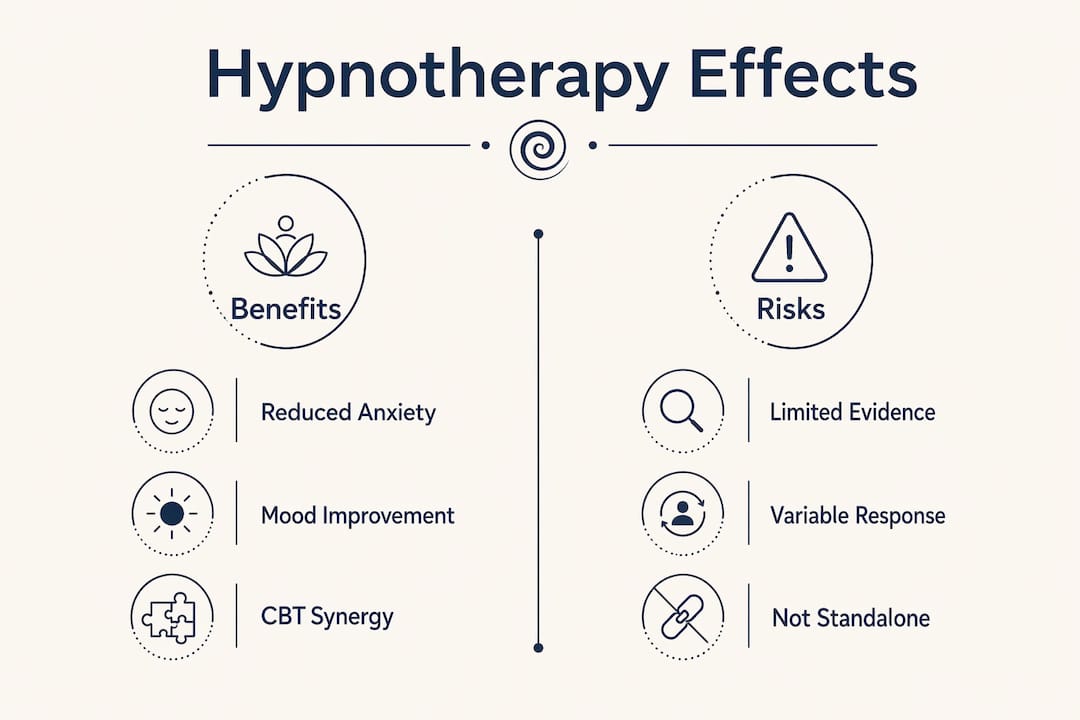
Benefits of hypnotherapy for anxiety and depression
The case for hypnotherapy goes beyond symptom relief during sessions. Studies tracking patients over time show that improvements in subclinical anxiety and depression hold up well after treatment ends, which separates it from approaches that require continuous use to maintain results.
Key benefits include:
- Durable symptom reduction. Clinical follow-up data shows improvements maintained at 12 months, not just immediately post-treatment.
- Non-invasive and low-risk. No pharmacological side effects, no dependency risk, and no recovery time between sessions.
- Improved emotional regulation. Hypnotherapy helps you recognize and interrupt the thought patterns that escalate anxiety before they trigger a full stress response.
- Reduced somatic symptoms. Physical manifestations of anxiety, such as muscle tension, rapid heartbeat, and shallow breathing, respond to the nervous system calming that hypnotherapy produces.
- Effective for medication-resistant cases. Group hypnosis protocols have shown significant distress reduction in outpatients who did not respond to medication.
- Accessible online. Sessions via video call remove geographic and scheduling barriers, making consistent treatment more realistic for most adults.
- Self-awareness gains. Clients often report a clearer understanding of their own triggers and thought cycles after a course of sessions.
Pro Tip: If you have tried talk therapy and felt like you were covering the same ground without real change, hypnotherapy works differently. It targets the subconscious patterns driving the behavior, not just the conscious narrative around it.
Risks and limitations of hypnotherapy
Hypnotherapy is one of the lower-risk interventions available for anxiety and depression. The Cleveland Clinic notes that side effects are minor and transient, typically limited to temporary dizziness, mild headache, or a brief uptick in anxiety immediately after a session. These pass quickly and do not occur in most people.
That said, hypnotherapy is not appropriate for everyone without professional guidance:
- People with certain psychiatric conditions, including psychosis or dissociative disorders, should only pursue hypnotherapy under close clinical supervision.
- It requires your active participation. Passive attendance across sessions produces limited results.
- It is not a single-session fix. Consistent engagement over multiple sessions is what drives lasting change.
- If you see no meaningful improvement after a full, consistent course of treatment, the Cleveland Clinic recommends considering alternative approaches rather than continuing indefinitely.
- For moderate to severe depression or anxiety disorders, hypnotherapy works best as part of a broader treatment plan rather than a standalone replacement for medication or structured psychotherapy.
The fear that a hypnotherapist can make you do things against your will is not supported by how hypnosis actually works. You remain conscious and in control throughout, choosing which suggestions to accept. No reputable clinical hypnotherapist operates otherwise.
What experts say about hypnotherapy for anxiety and depression
The professional consensus has shifted noticeably in recent years. Major clinical bodies no longer treat hypnotherapy as fringe. They treat it as a legitimate, evidence-supported option for specific conditions, including anxiety and depression.
The Cleveland Clinic endorses hypnotherapy as a low-risk complementary therapy, noting that meaningful benefits occur regardless of how deeply hypnotizable a person is. That matters because a common concern among first-time clients is whether they are "hypnotizable enough." The research says that concern is largely unfounded.

Clinical studies comparing hypnotherapy directly to CBT for subclinical anxiety and depression found comparable effectiveness, with both approaches producing improvements that held at the 12-month mark. Hypnotherapy also shows results in altering heart rate variability, a physiological marker tied to mood regulation, placing it alongside interpersonal therapy and CBT in terms of measurable impact on depression.
The consistent expert recommendation is integration. Hypnotherapy paired with CBT or mindfulness addresses the problem at multiple levels simultaneously, which is why practitioners who specialize in anxiety and depression typically do not offer hypnotherapy in a vacuum.
How to find and select a qualified hypnotherapist
Credentials matter more in hypnotherapy than in many fields because the term is not uniformly regulated across all U.S. states. Anyone can call themselves a hypnotherapist without clinical training. Here is what to verify before booking:
- Clinical certification. Look for a Certified Clinical Hypnotherapist (CCHt) or equivalent credential from a recognized body. This signals formal training in therapeutic applications, not just stage hypnosis techniques.
- Specialty in anxiety and depression. A practitioner who works primarily with these conditions will have a more refined set of techniques than a generalist.
- Transparent approach. Ask directly which techniques they use, whether they integrate CBT or NLP, and how they measure progress across sessions.
- Session structure clarity. A qualified practitioner will explain what each session involves, how many sessions are typically needed, and what outcomes are realistic for your specific situation.
- Free initial consultation. Many reputable practitioners offer a no-cost first call. Use it to assess fit, ask about their experience with anxiety and depression specifically, and gauge whether their communication style works for you.
- Professional affiliations. Membership in organizations like the American Society of Clinical Hypnosis (ASCH) or the National Guild of Hypnotists (NGH) indicates a commitment to professional standards.
The Royal College of Psychiatrists emphasizes that tailoring suggestions to the individual is what separates effective hypnotherapy from generic scripts. Ask any prospective therapist how they customize their approach to your specific anxiety or depressive patterns.
Pro Tip: Online hypnotherapy via Zoom is now a fully viable option. It removes the commute barrier and lets you work from a space where you already feel comfortable, which can actually improve receptivity during sessions.
What to expect during hypnotherapy sessions for anxiety and depression
Most structured hypnotherapy programs for anxiety and depression run across multiple weekly sessions, with progress monitored and techniques adjusted as symptoms shift. You will not see the full picture after one appointment.
A typical session follows this structure:
- Initial consultation. Your therapist assesses your specific anxiety or depression symptoms, identifies triggers, and establishes baseline measures for tracking progress.
- Guided relaxation. Each session opens with a process that slows your breathing, relaxes muscle tension, and moves you into the focused concentration state where suggestions land more effectively.
- Targeted suggestion work. The therapist introduces specific suggestions designed around your patterns, not a generic script. For anxiety, this often involves redirecting attention from threat-focused thinking to a calmer, more realistic appraisal of situations.
- Conscious awareness throughout. You hear everything, remember the session, and can stop at any point. The Cleveland Clinic confirms that clients choose which suggestions to accept.
- Progress review. Your therapist checks in on symptom changes between sessions and adjusts the approach based on what is and is not shifting.
- Between-session practice. Practicing relaxation techniques outside of formal sessions reinforces the nervous system changes initiated during treatment.
Early improvements often appear mid-way through a treatment program, with the most durable changes consolidating toward the end and in the weeks following. Maintenance sessions after the initial program help sustain those gains over time. If you are ready to get started, you can book a session with Hypnotictransformations to begin the assessment process.
Is Hypnotictransformations right for you?
Hypnotictransformations offers online hypnotherapy for anxiety led by Kirk Hoffman, a Certified Clinical Hypnotherapist. Sessions run via Zoom and address the subconscious patterns driving anxiety, fear-based thinking, and depression, using techniques including NLP, guided imagery, and advanced hypnotic modalities. The focus is on the root cause, not symptom management. If you have been managing anxiety or depression with tools that treat the surface, this is a different approach. A free consultation is available to assess fit before any commitment.
Key Takeaways
Hypnotherapy produces clinically validated reductions in anxiety and depression symptoms, with improvements comparable to CBT and maintained at 12 months in follow-up studies.
| Point | Details |
|---|---|
| Comparable to CBT | Research shows hypnotherapy matches CBT outcomes for subclinical anxiety and depression at 12-month follow-up. |
| Low risk profile | Side effects are minor and temporary; you remain conscious and in control throughout every session. |
| Works best integrated | Pairing hypnotherapy with CBT or mindfulness addresses both cognitive patterns and physiological stress responses. |
| Credentials matter | Seek a Certified Clinical Hypnotherapist with specific experience in anxiety and depression, not a generalist. |
| Consistency drives results | Multiple sessions with active participation produce lasting change; hypnotherapy is not a one-time intervention. |