
In a hypnotherapy session you stay awake and aware while a clinician guides you into a focused, relaxed state to calm your nervous system and rehearse new responses to fear or anxiety. You are never unconscious and never lose control. A typical session runs through four stages: intake, induction, suggestion, and emergence, usually inside a single 30 to 90 minute appointment.
TL;DR:
- Hypnotherapy involves a cooperative process that uses verbal suggestions and imagery to help manage anxiety, phobias, pain, and habit change, with no loss of consciousness.
- A typical session includes intake and consent, induction to narrow attention, suggestion work tailored to your goals, and brief reorientation, often lasting 30 to 90 minutes.
- Hypnotic effects are supported by measurable changes in nervous system activity and brain regions, which help reduce sympathetic arousal linked to anxiety.
- Effectiveness is strongest for pain and procedure-related anxiety, especially when combined with self-hypnosis practice between sessions; results for generalized anxiety are more mixed.
- Choosing a qualified therapist involves verifying credentials like Certified Clinical Hypnotherapist, asking about their experience with anxiety, and ensuring a thorough intake process.
Table of Contents
- What Is Hypnotherapy, and What Is It Not?
- What Happens Step by Step in a Hypnotherapy Session?
- How Does Hypnosis Actually Work in the Brain and Body?
- Does Hypnotherapy Actually Work, and Who Benefits Most?
- How Long Does a Hypnotherapy Session Take, and How Many Do I Need?
- How Do You Choose a Qualified Hypnotherapist?
- How Kirk Hoffman Runs a First Anxiety-Focused Session
- What Most Explainers Get Wrong About Hypnotherapy
- Ready to Start? Here's How Sessions Work
- Sources
What Is Hypnotherapy, and What Is It Not?
Clinical hypnotherapy is a cooperative process. A trained practitioner uses verbal repetition and imagery to narrow your attention and relax your body, which makes you more open to specific, therapeutic suggestions, according to the Mayo Clinic. That is the whole mechanism. No swinging watch, no loss of memory, no puppet strings.
Stage hypnosis is entertainment built on volunteers who want to perform. Clinical work is the opposite: quiet, private, and goal-directed. You remain aware of the room, and most people remember the entire session afterward, the Mayo Clinic notes.
Real clinical uses include:
- Generalized anxiety and panic symptoms
- Specific phobias (flying, needles, public speaking)
- Smoking cessation and other habit change
- Pain management and procedure-related anxiety before surgery or dental work
- Weight management tied to eating behaviors
What Happens Step by Step in a Hypnotherapy Session?
1. Intake and consent. Before anything resembling trance begins, your clinician asks about your goals, medical history, and any diagnoses that need special care. This is also where informed consent happens: you learn what the process involves and confirm you're comfortable proceeding. The Royal College of Psychiatrists describes this groundwork as standard practice before any induction begins.
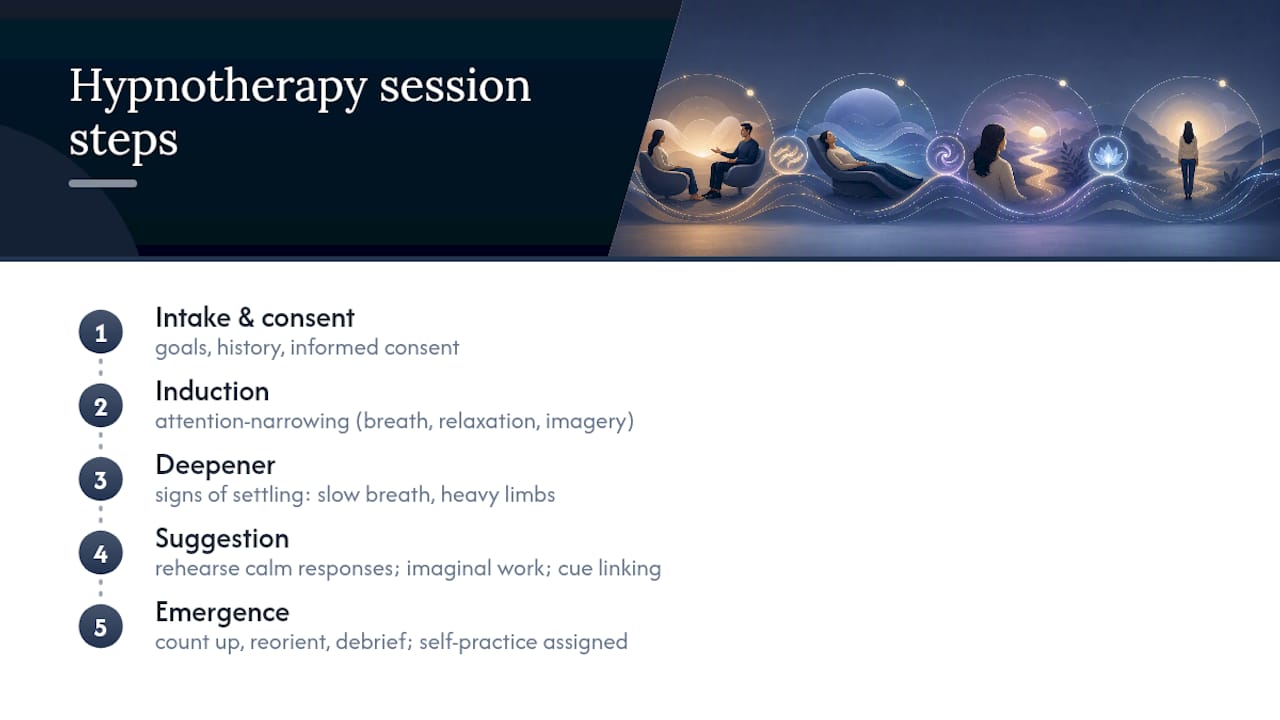
2. Induction. This is the part people picture when they hear "hypnosis." It's simply a structured way to narrow attention. Common methods include slow breathing counts, progressive muscle relaxation, or guided imagery like picturing yourself walking down a staircase. None of these are magic. They're attention-narrowing tools, similar to what a meditation teacher uses, just aimed at a specific therapeutic target.

3. The deepener. Your clinician watches for signs that you've settled into the state: slower breathing, heavier limbs, less eye movement, a sense of time slipping. Clients often describe this as similar to the drowsy minute before sleep, fully aware but very still.
4. Suggestion. This is where the actual work happens. Depending on your goal, suggestions might involve rehearsing a calm response to a trigger (walking into a work meeting without a racing heart), imagining a feared situation from a safe distance, or linking a physical cue, like touching your thumb and forefinger, to a feeling of calm you can trigger later. A typical anxiety-focused script might move from "notice your breath slowing" to "picture the elevator door opening, and feel your shoulders stay loose" to "you can return to this calm anytime you press your fingers together."
5. Emergence. The clinician counts you back up, reorients you to the room, and does a brief debrief: what did you notice, what felt strongest. Many clinicians assign a short self-hypnosis practice to repeat at home, which extends the effect between sessions.
Pro Tip: If you catch yourself thinking "am I doing this right" during induction, that thought itself is a sign you're aware and in control, not a sign you're failing to relax.
How Does Hypnosis Actually Work in the Brain and Body?
Narrowing your attention does something specific: it reduces the internal self-monitoring that normally filters what you experience. That's why an imagined scene can feel vivid, and why a suggested change in perception can feel real rather than performed.
The nervous system effects are measurable, not theoretical. Research on hypnosis and autonomic function links the hypnotic state to reduced sympathetic activity and increased parasympathetic tone, the branch of your nervous system that slows heart rate and eases muscle tension. That shift matters directly for anxiety, since anxiety is largely a sympathetic, fight-or-flight state. Lowering that activation, even briefly, gives your body practice at the calm state you're trying to build.
Neuroimaging backs this up at the brain level. Suggested experiences during hypnosis activate similar brain regions to the ones that fire during the real experience, according to a review published through PMC. If you're guided to imagine your hand going numb, sensory regions tied to actual numbness show activity changes. That's the physiological basis for why hypnotic suggestion can shift pain perception and fear response, not just mood.
One more factor shapes outcomes: hypnotizability. It's a stable trait, distributed like a bell curve across the population, not a binary switch some people have and others lack, per the same PMC review. Clinicians adjust technique to match your responsiveness rather than assuming one induction style fits everyone. Someone highly responsive might shift into a deep state in ninety seconds; someone less responsive might need a longer, more repetitive induction to get the same benefit.
Does Hypnotherapy Actually Work, and Who Benefits Most?
The evidence is strongest for a specific pair of problems: pain and procedure-related anxiety. A 20-year meta-analytic review found mostly positive effects for clinical hypnosis across mental and physical health outcomes, with more than half of the measured effects reaching at least a medium size, and the largest gains showing up for pain and pre-procedure anxiety.
For generalized anxiety and phobias specifically, results are still positive but more mixed when hypnosis is used completely alone. The Royal College of Psychiatrists points out that hypnotherapy tends to work best paired with other approaches like cognitive behavioral therapy, rather than as a stand-alone fix for deep-rooted anxiety patterns.
A few groups need extra screening before starting:
- People with active psychosis or severe dissociative symptoms
- Those with unstable personality disorders
- Anyone whose anxiety is tied to an undiagnosed medical condition that needs separate evaluation first
Serious adverse events are rare. The same Frontiers review notes that non-serious effects, like temporary drowsiness, mild headache, or brief emotional discomfort during a session, do occur but at low frequency.
How Long Does a Hypnotherapy Session Take, and How Many Do I Need?
Session length runs 10 to 90 minutes, depending on the goal and technique. A single pre-surgery session for procedure anxiety might run short and focused. Ongoing anxiety work usually runs longer per session and repeats weekly.
- Single-issue procedure support: often one to three sessions
- Generalized anxiety or phobias: typically four to eight sessions, sometimes more
- Habit change (smoking, eating patterns): commonly three to six sessions with home practice between them
Durability depends heavily on what you do between appointments. Clients who practice self-hypnosis between sessions tend to hold their gains longer, since it gives the body repeated practice downregulating sympathetic arousal outside the therapy room, a pattern the Frontiers review connects to more durable outcomes.
How Do You Choose a Qualified Hypnotherapist?
Credentials matter more here than in almost any other wellness field, because "hypnotherapist" isn't a tightly regulated title everywhere. Look specifically for a Certified Clinical Hypnotherapist (CCHt) designation, and ask about clinical training beyond a weekend certificate.
Before booking, ask these questions directly:
- What is your experience treating anxiety or phobias specifically, not general wellness coaching?
- What does a typical session structure look like, and how many sessions do you recommend before reassessing?
- Which techniques do you use, suggestion therapy, regression, Ericksonian approaches, and why for my situation?
- How do you handle intake, consent, and confidentiality of session records?
- What happens if I don't respond well to an induction style, do you adjust?
A professional intake always includes a real conversation about your history and explicit consent before any induction starts. Walk away from anyone who skips that step, promises guaranteed results in one session for a long-standing issue, or frames the process as something done "to" you rather than with you. For a deeper look at how clinicians define the practice, see this breakdown of clinical hypnotherapy's medical definition.
How Kirk Hoffman Runs a First Anxiety-Focused Session
Every first session starts with intake, not induction. Kirk Hoffman spends real time understanding what specifically triggers your anxiety, whether it's a physical sensation, a social situation, or a recurring thought pattern, before choosing an induction style suited to how you respond. Suggestions are built around your actual triggers, not a generic script, and every client leaves with a short self-hypnosis exercise to practice at home.
Online sessions run over Zoom, and clients consistently report the same thing during the session: heavier limbs, slower breathing, and a quieting of the mental chatter that usually accompanies anxiety. Afterward, many notice their shoulders have dropped from where they were holding tension for hours.
What Most Explainers Get Wrong About Hypnotherapy
Most articles on this topic either oversell hypnotherapy as a one-session cure or undersell it as a parlor trick with no real mechanism. Both miss the actual evidence. The nervous system data is specific: hypnosis measurably shifts you toward parasympathetic dominance, and that shift is the entire reason it helps with anxiety. It's not belief, it's physiology.
Where conventional advice falls short is the framing that hypnotherapy works alone, in isolation, disconnected from everything else. The research doesn't support that. The strongest outcomes come from pairing hypnotherapy with practiced self-hypnosis between sessions, and often alongside other treatment when anxiety is long-standing rather than situational.
If you're weighing whether to try this, prioritize the clinician's screening process over the promise of a fast fix. A practitioner who asks detailed intake questions and explains what your specific induction will look like is doing the work correctly. One who skips straight to "you'll feel amazing after one session" is selling something other than clinical care.
— Kirk
Ready to Start? Here's How Sessions Work
Hypnotic Transformations offers online hypnotherapy for anxiety, smoking cessation, and weight management, built around the same intake-first approach described above: your triggers get identified before any induction begins.
Booking starts with a free consultation, where you talk through your goals and ask any of the questions covered in the section above before committing to anything. Sessions run over Zoom, so location isn't a barrier, and most clients schedule their first full session within the same week as their consult. If anxiety is your main concern, the online hypnotherapy for anxiety page walks through session structure and what to expect at booking. For habit change goals, the smoking cessation program and weight management sessions follow a similar intake-to-suggestion format tailored to those goals. Book your free consultation to find out which structure fits your situation.
Sources
- Hypnosis — Mayo Clinic
- Meta-analytic evidence on the efficacy of hypnosis for mental and somatic health issues: a 20-year perspective — Frontiers in Psychology
- Hypnosis and hypnotherapy — Royal College of Psychiatrists
- What is hypnosis and how might it work? — PMC (NIH)
This article is general information, not a substitute for advice from a qualified doctor. Consult a qualified healthcare professional about your own circumstances before acting on anything here.