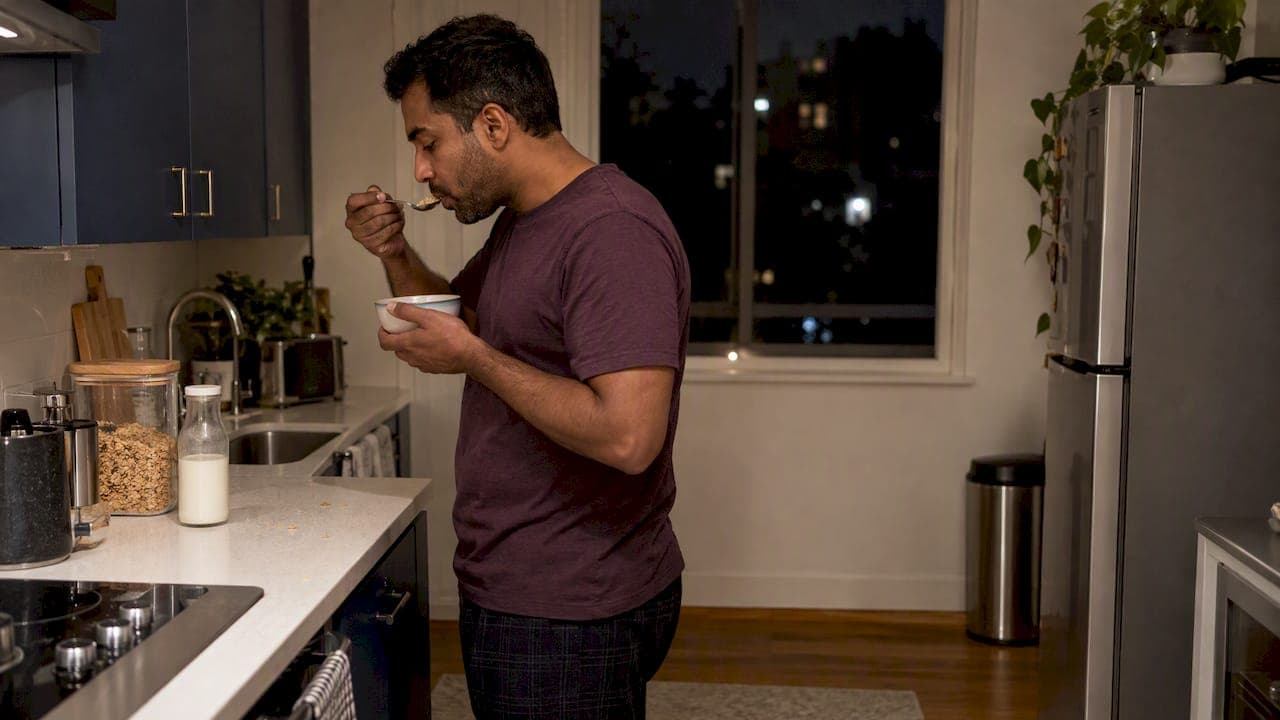
It is 11 p.m. The house is quiet. You said you were done eating hours ago, yet you are standing at the open fridge, eating something you do not even want. Tomorrow you will promise yourself it will not happen again. Hypnosis for late-night eating targets the part of you that runs this loop, the automatic, stress-driven part, and the research behind it is encouraging but not unlimited. This guide explains what happens, what the studies show, and when a doctor should be your first call.
TL;DR
- Late-night eating is often a learned stress response. Your nervous system has linked the evening, the kitchen and food with relief.
- Hypnosis works with that automatic habit through suggestion and rehearsal. Trials show changes in eating impulsivity and eating intentions, mostly in adults with obesity or healthy adults.
- Eating a large share of your daily calories after dinner, trouble falling asleep and waking to eat can point to night eating syndrome. See a doctor for that.
- Self-hypnosis recordings are safe for most people, but they are not right for everyone. Check the safety list below first.
- Online clinical hypnotherapy can fit alongside medical care, not replace it.
Table of Contents
- The 11 p.m. kitchen scene
- Why your nervous system keeps sending you to the fridge
- Ordinary night snacking or night eating syndrome?
- What the research says about hypnosis and eating
- How hypnotherapy works on a night-eating pattern
- What a first online session looks like
- Can you hypnotize yourself to stop overeating?
- What to eat when the craving hits
- When to see a doctor first
- Perspective
- Work with us on the evening pattern
- FAQ
- Sources
The 11 p.m. kitchen scene
Most people who search for this describe the same thing. Dinner was fine. The evening was fine. Then somewhere between 9 and midnight, a pull starts. Cereal, crackers, ice cream, whatever is closest. You eat fast, or you eat without tasting. Afterward comes the guilt, and sometimes a racing mind that makes sleep harder.
If you also deal with anxiety, panic or fear-based thinking, the pattern often feels even less like a choice. You know what you want to do. Your body does something else.
That gap is the point. This is rarely a problem of knowledge. You already know that eating at midnight does not help. What you need is a way to change the response that fires before the thinking part of your brain gets a vote.
Why your nervous system keeps sending you to the fridge
Here is how we explain it to clients. During the day you are busy. Your attention is on work, kids, traffic, messages. At night the distractions stop. Whatever you held down all day, worry, tension, a fight, a to-do list, finally gets room.
Your body reads that tension as a mild threat. The fight-or-flight response stays switched on, even when nothing is chasing you. Your heart rate stays up. Your mind scans. And your subconscious has learned something useful from past nights: eating calms this down, at least for a few minutes. Chewing, swallowing and sugar all give the nervous system a quick signal of comfort.
Do that a few dozen times and it becomes automatic. The subconscious mind runs habits that you repeat often enough. It does not weigh pros and cons. It fires the routine it has learned. That is why willpower at 11 p.m. feels so thin. You are asking the thinking part of your brain to overrule a script that was written by repetition and emotion.
Three things commonly feed the loop:
- Stress that has nowhere to go. The evening is the first quiet moment, so food becomes the off switch.
- A day of under-eating or skipped meals. Your body then pushes hard at night. We cover this in the food section below.
- Cue stacking. The couch, the TV, the kitchen light and the time of day all become triggers for the same behavior.
The good news is that a learned pattern can be unlearned. That is the part hypnosis is built for.
Ordinary night snacking or night eating syndrome?
Before you pick any approach, it helps to know what you are dealing with. Occasional evening snacking is common. Night eating syndrome (NES) is a recognized eating pattern with specific features.
According to a 2010 review in the Journal of Primary Care and Community Health, NES has three core features: evening overeating or nocturnal eating, trouble falling asleep at the start of the night, and waking up during the night. The same paper notes that when a person also has trouble falling asleep, eating 25% to 50% of daily calories after the evening meal would most likely signal NES. It also says mood and stress should be assessed.
A different condition, sleep-related eating disorder (SRED), is a parasomnia. People eat in a semi-conscious state or while sleepwalking, sometimes unusual foods or nonfood items, according to the same review. If you find food wrappers in the morning and have no memory of eating, that is a sleep medicine question first.
A quick self-check:
| What you notice | What it may point to | Who to talk to |
|---|---|---|
| You snack after dinner a few nights a week, fully awake, usually when stressed or bored | A learned habit or emotional eating pattern | A hypnotherapist, therapist or dietitian |
| Most of your eating happens after dinner, you struggle to fall asleep, and you wake to eat | Possible night eating syndrome | Your doctor, then possibly a behavioral psychologist |
| You eat while half asleep and do not remember it | Possible sleep-related eating disorder | A sleep medicine doctor |
This table is for orientation only. It is not a diagnosis. A doctor can tell you which row fits.
What the research says about hypnosis and eating
Let's be specific about what the studies do and do not show. None of them studied late-night eating alone, so we are drawing from the closest evidence.
Food impulsivity. A 2022 randomized controlled trial in The American Journal of Clinical Nutrition followed adults with obesity and high disinhibition scores, meaning they tended to eat in response to cues rather than hunger. After 8 months, the hypnosis group improved on disinhibition, susceptibility to hunger and BMI compared with a control group. The researchers linked the effect of Ericksonian hypnosis to patient involvement, therapist conviction and the quality of the relationship between patient and therapist.
Eating intentions. A 2021 randomized trial in healthy adults tested two kinds of hypnotic suggestion, Cognitive Rehearsal and Memory Substitution. Both shifted people's intentions around high-calorie foods. Cognitive rehearsal means mentally practicing a new response. That is the same skill you would use to practice what you do at 10:45 p.m. instead of opening the pantry.
Cravings in general. A 2020 systematic review and meta-analysis found that psychological interventions aimed at food craving have a small positive effect on food intake. The strongest evidence for lowering the felt craving came from cognitive strategies such as reappraisal, suppression and distraction. Reappraisal means changing what a craving means to you. Hypnotherapy often uses it in a relaxed state.
The honest limits. Marianne Barabasz's review of hypnotherapy for eating disorders points out that results are mixed, partly because of how patient traits interact with hypnotic responsiveness and partly because many studies have design limits. So we do not promise an outcome. We say that hypnosis has a reasonable research base for changing eating impulses and intentions, and that results vary from person to person.

How hypnotherapy works on a night-eating pattern
Hypnosis is a focused, relaxed state in which you stay aware and in control. In that state, your mind is more open to new suggestions and to mental rehearsal. For late-night eating, a clinical session usually has these parts.
Finding the trigger
We start by asking what actually happens. What time does the pull start? What were you feeling ten minutes earlier? Is it tension in the chest, a racing mind, loneliness, or a fear about tomorrow? Specific answers matter. "I just snack" is too vague to work with. "I get a tight stomach at 9:30 after I check email" is something we can use.
Calming the alarm
In the relaxed state, we lower the body's stress response first. Slow breathing and guided imagery signal safety to the nervous system. When the alarm is quieter, food loses its job as the off switch.
Rewriting the script
Next comes the habit itself. We use suggestion and rehearsal. You picture the evening cue, the couch, the kitchen light, and you practice a different response with your body feeling calm. Techniques from NLP, like changing how an image or sensation is represented in your mind, can weaken the grip of a craving. This mirrors what the trials above tested: rehearsal of a new response and substitution of an old memory or association.
Practicing between sessions
Between sessions you practice a short routine. Many clients use a two-minute evening reset: a few slow breaths, one sentence they have chosen, and a drink of water before deciding about food. Small, repeatable steps work better than big promises.
If your late-night eating is tied to anxious or emotional triggers, our article on hypnotherapy for emotional eating walks through an eight-session structure. For anxiety-driven eating in particular, see mindful eating hypnosis. If the pull is mostly toward sweets, breaking sugar cravings with hypnosis covers that angle.
What a first online session looks like
Many first-timers with anxiety worry about losing control. That fear is common and understandable. Hypnosis is not sleep and it is not mind control. You can hear everything, you can open your eyes, and you can end it at any moment. Our guide on why you can't be stuck in hypnosis answers the most frequent fears, and is hypnosis safe covers the safety basics.
A typical online session over Zoom goes like this:
- Conversation. You describe your evening pattern, your sleep, your stress and your eating through the day.
- Screening. We ask a few health questions to make sure hypnosis is a good fit. Our piece on screening questions for hypnotherapy contraindications explains what we look for.
- Relaxation and hypnosis. You sit or recline somewhere comfortable and private. Camera on, headphones helpful.
- Practice plan. You leave with a short routine to use at night.
Sessions happen from your home, which suits this problem well. Your living room is where the habit lives, so it is a natural place to start changing it.
Can you hypnotize yourself to stop overeating?
Yes, you can try. Cleveland Clinic says self-hypnosis is safe for most people to attempt without supervision, as long as you use recordings or scripts from reliable sources and check with a healthcare professional or licensed practitioner about whether it is right for you.
The same source lists groups for whom it is not appropriate: people with schizophrenia, dissociative disorders, a history of seizures, or extreme emotional distress. Its guidance also names recent significant trauma and PTSD as reasons to consult a professional first. And it says self-hypnosis should not replace medical or psychological treatment.
Two practical safety rules:
- Never practice while driving or in any situation that needs your full alertness, as Kaiser Permanente advises.
- Do not use a recording in bed if you have a habit of eating in your sleep. Talk to a doctor first.
When does a clinician add something a recording cannot? A recording is the same for everyone. A session starts with your triggers, your words and your body's signals, and it changes as you do. Our article on self versus clinician hypnosis for self-sabotage compares how many sessions each route may take.
What to eat when the craving hits
Hypnosis works better when your body is not running on empty. A late-night pull is sometimes plain hunger from a day of under-eating. The 2010 review cited above notes that health professionals may encourage regular meals earlier in the day and more protein, and that a dietitian can help with this.
A simple pattern to test for two weeks:
- Eat breakfast and lunch at set times, with protein at each.
- Make dinner a real meal, not a grab-and-go snack.
- Decide in advance what a planned evening snack is, if you want one. A plate, a seat, no screen.
If you do want something at night, pick food that fills you up rather than something you can eat endlessly from the bag. This list of healthy snack options that keep you full gives ideas to stock. A planned snack eaten calmly at the table is a different event from a stress raid on the pantry, and your subconscious learns the difference.
A few other small steps help the habit loosen:
- Dim the lights in the evening, and keep a regular bedtime. A rested nervous system is quieter.
- Brush your teeth after your planned snack. It is a clear end signal.
- Write down the feeling before you eat. Even one word gives your thinking brain a seat at the table.
When to see a doctor first
Hypnosis can sit alongside medical care. It should not stand in for it. See your doctor soon if:
- You eat a large share of your daily food after dinner and also struggle to fall asleep or wake up to eat.
- You eat while asleep or find signs of it in the morning.
- Your eating feels out of control in other ways, such as binge episodes, purging or severe restriction.
- You have strong anxiety, panic, or low mood that has not been assessed.
Primary care doctors are encouraged to ask about nighttime eating in patients who struggle with their weight, according to the 2010 primary care review. The same paper says referral to a behavioral psychologist may be appropriate for persistent nighttime eating.
One point matters for anyone who eats in a sleep-like state. A review of sleep-related eating disorders reported that hypnotherapy, psychotherapy and behavioral techniques have not been demonstrated to work for that specific condition. If that is you, start with a sleep specialist. For night eating syndrome, a 2025 review describes sertraline as promising for symptoms and notes that psychosocial approaches such as progressive muscle relaxation may help modify eating behavior. Medication is a decision for you and your physician.
If you are in crisis or worried about an eating disorder, call or text 988 in the US, or contact an eating disorder helpline.
Good hypnotherapy also checks itself. The Royal College of Psychiatrists advises that a therapist should regularly review whether hypnotherapy is working and change the approach if it is not. It also says patients should work toward coping on their own rather than depending on it. We agree with both points. A good plan has an end.
Perspective
When someone books a session about late-night eating, the first thing they usually tell me is that they feel ashamed. They think they lack discipline. I see something else. I see a nervous system that learned to use food as a way to calm down, and a subconscious mind that repeats what has worked before.
That is why I do not start with food rules. I start with what your body feels at 9:30 p.m. and what you are afraid of at that hour. When the alarm in the body settles, the pull toward the kitchen often loses its urgency. Then we rehearse a new response in the relaxed state, with your own triggers, until it feels familiar.
I work as a clinical hypnotherapist, and I use clinical hypnotherapy and NLP techniques in online sessions for clients across the United States. I am clear with clients about one thing. If your pattern looks like night eating syndrome or involves eating in your sleep, a doctor comes first, and I am glad to work alongside that care.
Kirk
Work with us on the evening pattern
If you want a person, not a recording, to help you change the evening loop, we offer online hypnotherapy sessions over Zoom with Kirk Hoffman, a Certified Clinical Hypnotherapist. Our sessions are designed to address the subconscious pattern behind the habit, including the anxiety that often drives it. You can read about online hypnotherapy for weight loss or online hypnotherapy for anxiety, or see all of our services.
We offer free consultations, so you can ask your questions before you decide anything.
FAQ
How do I stop late-night eating when it feels like an addiction?
Start by looking at what happens before the urge, not just the food. Eat regular meals with protein during the day, plan any evening snack, and practice a short calming routine before you decide. If the urge feels compulsive or comes with poor sleep, talk to your doctor, and consider hypnotherapy to work on the automatic part of the habit.
Can hypnosis stop me from eating at night?
Hypnosis cannot force you to do anything. It can help you practice a new response to the cue, and trials show shifts in food impulsivity and eating intentions. Results differ between people, and hypnosis is not shown to help with sleep-related eating disorder, so a medical check is wise if you eat while half asleep.
Can I hypnotize myself to stop overeating?
Yes, many people try it with recordings from reliable sources. Cleveland Clinic says it is safe for most people, but not for those with conditions such as schizophrenia, dissociative disorders, seizure history or extreme distress. Check with a professional first if any of those apply, and never practice while driving.
What should I eat when I have late-night cravings?
Look at your day first. Regular meals earlier and more protein may reduce the evening pull. If you want something at night, plan it, put it on a plate and eat it sitting down. A dietitian can tailor this to your needs.
How many hypnotherapy sessions does it take?
It depends on your triggers and how long the pattern has run. Good practice is to review progress regularly and adjust the plan if it is not working. Ask your hypnotherapist how they will measure change, for example nights per week without the urge.
Sources
- Identification and Treatment of Eating Disorders in the Primary Care Setting, Journal of Primary Care and Community Health (2010)
- Hypnosis reduces food impulsivity in patients with obesity, The American Journal of Clinical Nutrition (2022)
- Eating Behavior: Choice or Reconstruction of Past Experience, randomized clinical trial (2021)
- Laboratory-based interventions targeting food craving: a systematic review and meta-analysis (2020)
- Efficacy of hypnotherapy in the treatment of eating disorders, Barabasz (2007)
- What Is Self-Hypnosis and How Do I Do It? Cleveland Clinic (2023)
- Hypnosis, Kaiser Permanente Health Encyclopedia
- Sleep-Related Eating Disorders review
- Pharmacological and psychosocial interventions for night eating syndrome (2025)
- Hypnosis and hypnotherapy, Royal College of Psychiatrists
- Healthy snack options that keep you full