
Hypnotherapy for emotional eating can reduce stress-driven and cue-driven eating when it's delivered as a structured program, not a one-time session. The strongest trial data shows meaningful drops in food-related disinhibition after eight sessions plus daily self-hypnosis practice over several months. Results build gradually. Think of it as retraining an automatic response, not flipping a switch.
TL;DR:
- Hypnotherapy can significantly reduce disinhibition scores, with the most robust evidence showing improvements after eight sessions plus daily practice.
- The therapy targets the cue-emotion-reward loop by teaching relaxation, reframing triggers, rehearsing alternative responses, and building calming anchors.
- Structured programs often follow an eight-session protocol paired with self-hypnosis, focusing on identifying triggers, practicing responses, and tracking progress with specific behavioral markers.
- Benefits are most notable for stress, boredom, or habit-driven eating, whereas those with binge episodes or eating disorders need medical evaluation before starting hypnotherapy.
- Results typically develop over months, with full automatic responses emerging after consistent practice, emphasizing the importance of realistic expectations and ongoing self-hypnosis.
Table of Contents
- How Hypnotherapy for Emotional Eating Interrupts the Cue-Emotion-Reward Loop
- What Does the Clinical Evidence Actually Show?
- What Does a Hypnotherapy Program for Emotional Eating Look Like?
- How Do You Build a Daily Self-Hypnosis Practice?
- Who Benefits Most, and When Should You See a Specialist Instead?
- What Should You Ask Before Choosing a Hypnotherapist?
- What Timeline Should You Expect for Improvement?
- Are There Risks or Reasons Hypnotherapy Might Not Be Right for You?
- How Does Hypnotherapy Compare With Other Treatments for Emotional Eating?
- What Do People Get Wrong About Hypnotherapy for Emotional Eating?
- A Clinician's View on Where Hypnotherapy Fits
- Ready to Change Your Relationship With Food?
- Sources
How Hypnotherapy for Emotional Eating Interrupts the Cue-Emotion-Reward Loop
Emotional eating usually follows a predictable pattern: a trigger appears (a fight with your partner, a stressful email, a lonely evening), a wave of emotion hits, and the brain reaches for food to blunt it fast. Clinicians call this the cue-emotion-reward loop. Food becomes the fastest available tool for regulating a nervous system that's already in a mild fight-or-flight state. The eating isn't about hunger. It's about shutting off discomfort quickly.
"Disinhibition" is the clinical term for the loss of control that shows up when stress overrides your normal eating restraint. It's the gap between "I planned to have one serving" and "I ate the rest of the box standing at the counter." Hypnotherapy targets that exact gap.
A typical session uses a few connected techniques:
- Induction: guiding you into a relaxed, focused state where the nervous system shifts out of alert mode.
- Suggestion: offering specific, direct language that reframes the trigger (a stressful moment, a craving spike) as a cue for a different response.
- Rehearsal: mentally practicing the new response, such as pausing and breathing instead of opening the fridge, until it starts to feel familiar.
- Calming anchors: short physical or mental cues, like a hand gesture or a breath pattern, built during sessions and reused in daily life to trigger a similar calm quickly.
The rationale is straightforward. Repeated rehearsal, done in a relaxed brain state, builds new automatic responses the same way repeated stress built the old ones. A narrative review of hypnosis and mindfulness for weight-related behavior found this kind of practice improves food awareness and reduces cravings, especially when paired with other therapies.
Pro Tip: The anchor only works if you practice it when you're calm, not just when you're craving. Build the response before you need it, the same way you'd practice a fire drill before an actual fire.
What Does the Clinical Evidence Actually Show?
The best trial on this topic is the HYPNODIET study, a randomized controlled trial testing Ericksonian hypnosis plus self-hypnosis training against standard nutritional education alone. At eight months, disinhibition scores normalized in a substantial majority of the hypnosis group compared with a small minority of controls, a mean between-group difference of 4.2 points (95% CI: 2.8 to 5.5, P < 0.001), according to the HYPNODIET randomized controlled clinical trial. Participants also saw secondary improvements in improvements in susceptibility to hunger and BMI at follow-up.
An older but longer trial adds context. An 18-month randomized trial comparing hypnotherapy for stress reduction with dietary advice found the hypnotherapy group lost a modest 3.8 kg more than the dietary advice group by the final assessment. The effect was small but statistically significant.
| Trial | Design | Key Result | Follow-Up |
|---|---|---|---|
| HYPNODIET | RCT, hypnosis + self-hypnosis vs. nutrition education | 67.7% normalized disinhibition vs. 11.1% in controls | eight months |
| Stress-reduction hypnotherapy trial | RCT, hypnotherapy vs. dietary advice | 3.8 kg additional weight loss | 18 months |
Broader review evidence suggests hypnosis combined with cognitive behavioral therapy tends to outperform hypnosis alone, per the same narrative review on self-help strategies in obesity treatment. That review is candid about limits: sample sizes across the field are often small, follow-up periods rarely extend past a year or two, and participant characteristics vary enough that results don't automatically generalize to every eating pattern.
The HYPNODIET effect size is one of the more robust numbers in this field, but it describes one trial population under one specific protocol, not a universal guarantee.
What Does a Hypnotherapy Program for Emotional Eating Look Like?
Most structured programs follow a version of the HYPNODIET protocol: roughly eight sessions built around a consistent sequence, paired with self-hypnosis training you practice between visits.
- Intake and assessment. The clinician maps your specific triggers, eating patterns, and any medical or psychological history that needs attention before starting.
- Induction training. Early sessions teach you to reach a relaxed, focused state reliably, since later work depends on getting there quickly.
- Suggestion and reframing. The clinician introduces targeted language addressing your specific cues, whether that's boredom, work stress, or evening loneliness.
- Rehearsal of alternative responses. You practice the new response mentally, in session, until it starts to feel natural rather than forced.
- Anchor building. A physical or mental shortcut gets attached to the calm state so you can trigger it outside the therapy room.
- Daily practice assignments. Between sessions, you use self-hypnosis recordings or guided routines tied to your actual craving windows.
- Progress review. The clinician checks in on specific markers, not just how you feel in the moment.
Clinicians typically track progress using behavioral markers like frequency of binge episodes, self-reported craving intensity, and standardized measures of disinhibition such as the Three-Factor Eating Questionnaire. Numbers matter here because subjective "feeling better" can mask an eating pattern that hasn't actually shifted yet.
Pro Tip: Ask your clinician what specific measure they'll use to track your progress before session one. If the answer is vague, that's worth noting.
How Do You Build a Daily Self-Hypnosis Practice?
Self-hypnosis between sessions is where most of the actual behavior change happens. Clinical trials with the strongest results paired professional sessions with daily practice, not occasional check-ins.
- Pick your craving windows. Identify the two or three times a day when emotional eating is most likely, such as late afternoon at your desk or right after a stressful call.
- Run a short rapid-induction routine. Spend five to fifteen minutes in a quiet space using the induction technique your clinician taught you, ideally before the craving window hits, not during the peak of it.
- Rehearse the alternative response. Mentally walk through choosing a different action, whether that's a short walk, a glass of water, or simply sitting with the feeling for two minutes.
- Log it. A simple daily note (trigger, intensity, what you did) turns vague progress into a pattern you can actually see after a few weeks.
A few things to watch:
- One generic recording rarely reproduces the results seen in trials. Guided, sequenced practice built around your specific triggers works better than a downloaded audio file.
- Consistency matters more than duration. Ten focused minutes daily outperforms one long session on Sunday.
- Expect the first two to three weeks to feel effortful. That's normal for skill-building, not a sign it isn't working.
Resources like this self-hypnosis step-by-step guide and this comparison of mindful eating and hypnosis techniques can help you structure the routine. Mapping your specific triggers first makes the whole practice sharper. This guide on craving-trigger mapping walks through exactly how to do that before you start building responses around it.
Who Benefits Most, and When Should You See a Specialist Instead?
Hypnotherapy tends to work best for people whose eating is driven by stress, boredom, or habit, without the loss-of-control patterns that define a clinical eating disorder. If you eat more than planned during stressful weeks but can still identify the trigger and generally function around food, you're likely a good fit.
Some patterns need a different level of care first:
- Purging behavior after eating episodes.
- Bingeing accompanied by a genuine loss of control, not just overeating.
- Significant weight fluctuation combined with medical complications.
- Eating patterns tied to a diagnosed condition requiring medical monitoring.
The Mayo Clinic's guidance on binge-eating disorder is clear that professional assessment is warranted when loss of control or significant distress is present. Hypnotherapy works well as one part of a broader plan in those cases, alongside CBT or medical oversight, not as a replacement for it.
What Should You Ask Before Choosing a Hypnotherapist?
Not every hypnotherapist is trained the same way, and the gap between a well-run program and a theatrical one is wide.
- Ask about formal training: is the provider a Certified Clinical Hypnotherapist with supervised practice hours, not just a weekend certificate?
- Ask about experience with eating-related concerns specifically, not just general relaxation work.
- Ask how the program is structured: how many sessions, what happens in each one, and how progress gets measured.
- Ask what homework looks like between sessions and how much daily practice is expected.
Watch for red flags: guaranteed weight-loss numbers, no intake assessment before starting, dramatic claims about instant results, or reluctance to coordinate with your doctor if you have medical concerns. A program like online hypnotherapy for anxiety should be able to explain its structure clearly in a first consultation, not just its results.
Pro Tip: If a provider can't tell you how they'll measure your progress in three months, ask why. A structured program always has an answer.
What Timeline Should You Expect for Improvement?
Change here follows a skill-building curve, not a light switch. The first one to two weeks are mostly about learning the induction technique and identifying your specific triggers with the clinician. Don't expect major shifts yet.
By weeks three through five, most people in structured programs start noticing the anchor technique working in real moments: a pause before reaching for food, a slightly longer gap between the trigger and the reaction. This lines up with the HYPNODIET timeline, where the full eight-session protocol plus ongoing self-hypnosis produced its clearest disinhibition results at the eight-month mark, not immediately after the last session.
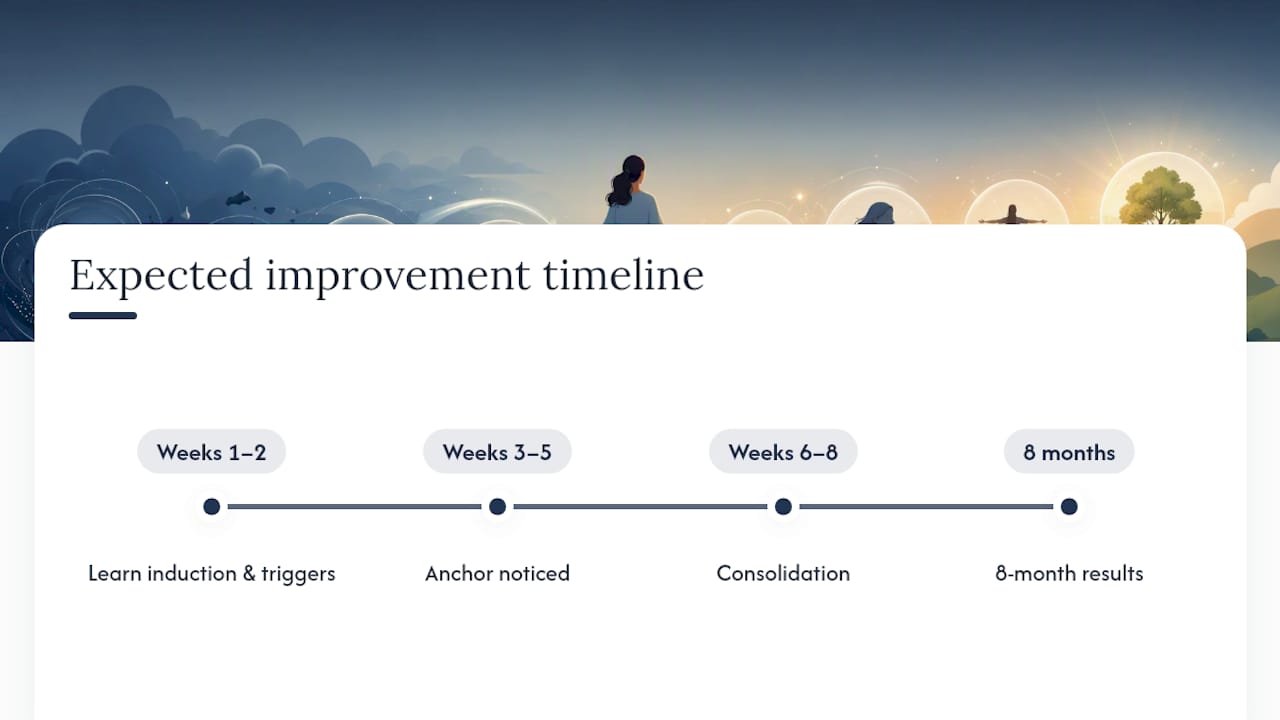
Weeks six through eight typically bring the consolidation phase, where the new response starts to feel more automatic and less like conscious effort. Full behavior change, meaning the new coping response fires without you having to think through it, tends to take a few months of consistent daily practice, matching the "habit consolidation" pattern seen across self-help strategy research.
Setbacks during high-stress weeks are normal and don't mean the approach has failed. The measure that matters is the overall trend across weeks, not any single day.
Are There Risks or Reasons Hypnotherapy Might Not Be Right for You?
Hypnotherapy for emotional eating carries a low physical risk profile since there's no medication or invasive procedure involved. That said, it isn't the right fit for everyone.
People with untreated psychosis, active severe dissociative disorders, or certain severe personality disorders may need psychiatric care coordinated with, or instead of, hypnotherapy. Anyone showing signs of a diagnosed eating disorder, including purging or binge episodes with genuine loss of control, needs a specialist evaluation before or alongside hypnosis-based work, following the same threshold the Mayo Clinic applies to binge-eating disorder generally.
There's also a realistic-expectations risk. Some providers market hypnosis as a fast fix, and when results build more slowly than promised, clients disengage before the habit-consolidation phase has a chance to work. The 25% dropout rate in the 1998 stress-reduction hypnotherapy trial reflects this pattern. Programs that set clear, modest expectations from session one tend to retain clients longer and produce better outcomes.
Finally, hypnotherapy addresses coping style and emotional regulation, not underlying medical conditions that might be contributing to weight changes. Anyone with unexplained weight loss, gain, or eating changes tied to a possible medical cause should get that checked by a physician first.
How Does Hypnotherapy Compare With Other Treatments for Emotional Eating?
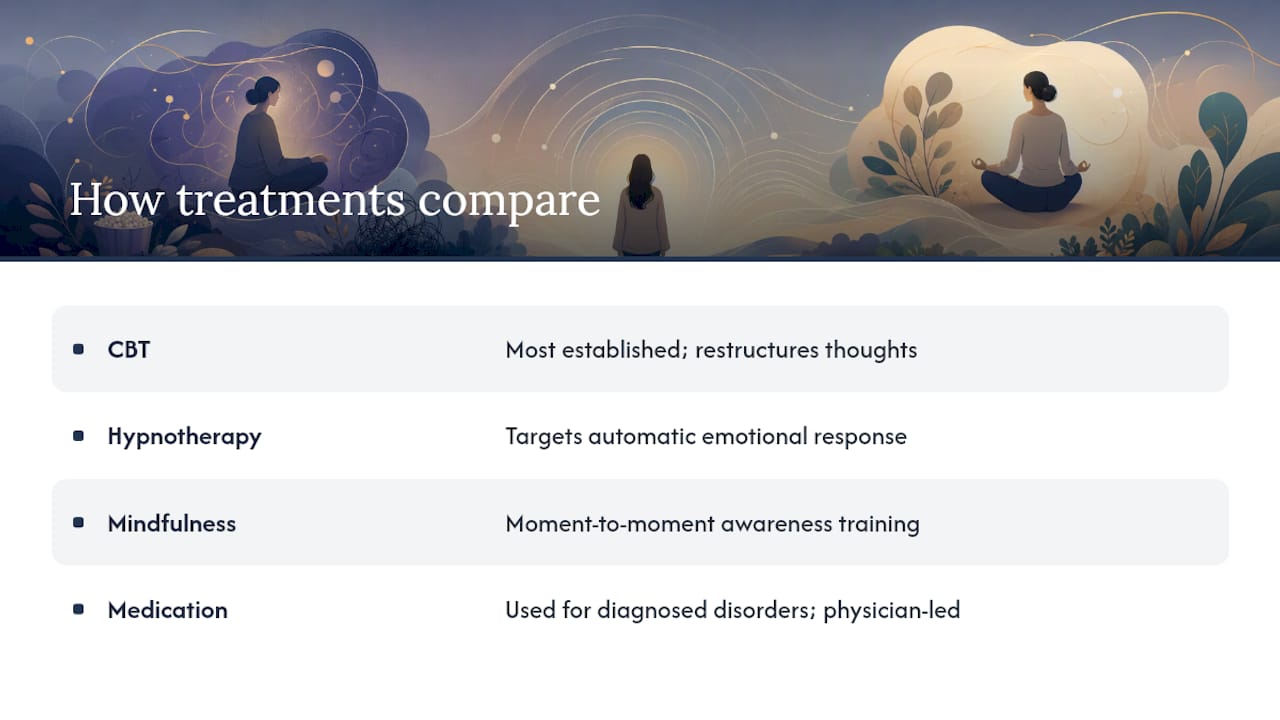
Cognitive behavioral therapy (CBT) is the most established treatment for emotional and binge eating, with a large body of research behind it. CBT focuses on identifying and restructuring the thoughts that precede eating episodes. Hypnotherapy works at a different level, addressing the automatic emotional response before the thought pattern even fully forms. The two aren't competitors. The evidence suggesting hypnosis plus CBT outperforms hypnosis alone points toward combining them rather than picking one.
Mindfulness-based approaches share some overlap with hypnotherapy, since both aim to widen the gap between trigger and reaction. Mindfulness tends to work through moment-to-moment awareness training, while hypnotherapy works through a more direct suggestion-and-rehearsal process delivered in a relaxed state. Some clients respond better to one than the other.
Medication-based approaches (appetite suppressants, certain psychiatric medications) address different mechanisms entirely and are typically reserved for cases involving diagnosed eating disorders or significant medical complications, usually under a physician's direction rather than as a first-line response to everyday stress eating.
For habit-driven, stress-driven emotional eating without a clinical eating disorder, hypnotherapy offers a structured, evidence-supported option that requires less time investment per session than traditional talk therapy while producing measurable changes over similar timeframes.
What Do People Get Wrong About Hypnotherapy for Emotional Eating?
The biggest myth is that hypnosis means losing control, being "put under," or having no memory of the session. In clinical practice, you're awake, aware, and able to stop at any point. The relaxed state resembles the moment right before falling asleep, not unconsciousness.
Another common misconception: that one session should fix the problem. The HYPNODIET results took eight sessions plus months of self-hypnosis practice to reach their strongest effect. Anyone promising a single-session cure is setting you up for disappointment, not describing how the evidence actually works.
Some people also assume hypnotherapy works by suggestion alone, as if the clinician simply tells you to stop craving sugar and it happens. The actual mechanism is closer to skill training: rehearsing a new response repeatedly until it becomes as automatic as the old one. That's why daily practice between sessions matters as much as the sessions themselves.
Last, there's a lingering idea that hypnotherapy is unscientific or purely placebo. The HYPNODIET trial's P value under 0.001 doesn't erase the field's limitations, but it does show a measurable, statistically significant effect beyond chance in a controlled setting.
A Clinician's View on Where Hypnotherapy Fits
This section follows a problem-agitate-solution structure, because that's how clients actually experience emotional eating: a real problem, a pattern that keeps getting worse under stress, then a workable path forward.
In practice, sessions start with mapping the specific fight-or-flight triggers behind the eating, not generic relaxation. Progress gets measured through concrete markers: frequency of episodes, time between trigger and response, and client-reported craving intensity, session over session.
— Kirk
Ready to Change Your Relationship With Food?
If stress, boredom, or a bad day at work keeps sending you toward the pantry, you don't need another diet plan. You need your nervous system to stop treating every rough moment like an emergency that only food can fix. Programs typically involve sessions conducted over Zoom, led by a certified clinical hypnotherapist, combining hypnotic suggestion, guided imagery, and self-hypnosis training practiced between visits.
A free consultation walks through your specific triggers, what a session actually involves, and what a realistic timeline looks like for your situation, no guesswork, no theatrics. From there, you can book a structured hypnotherapy program for weight loss or explore the full range of available services to find the right starting point. If your eating pattern is closely tied to anxiety, the anxiety-focused program may be the better fit to start with. Either way, the next step is simple: book the free consultation and get a clear read on your specific case.
This article is general information, not a substitute for advice from a qualified doctor. Consult a qualified healthcare professional about your own circumstances before acting on anything here.
Sources
- Hypnosis reduces food impulsivity in patients with obesity and high levels of disinhibition: HYPNODIET randomized controlled clinical trial
- The Use of Self-Help Strategies in Obesity Treatment. A Narrative Review Focused on Hypnosis and Mindfulness
- Randomized trial comparing hypnotherapy for stress reduction and dietary advice (1998)