
Mindful eating hypnosis can help. It works by improving your ability to notice hunger and fullness signals and by lowering the stress reactivity that pushes you toward the fridge when you're anxious, not hungry. In the HYPNODIET randomized trial, a substantial portion of adults in the hypnosis group normalized their eating disinhibition scores after eight months, compared with a much smaller portion in the control group.
You don't need to book anything to start. Try one of these right now:
- Do a 3-minute pre-meal self-hypnosis routine before your next meal (script below).
- Play a short guided hypnosis track on Spotify or YouTube before dinner tonight.
- Schedule a single session with a Certified Clinical Hypnotherapist if emotional eating feels tied to anxiety you can't manage alone.
Pro Tip: Sit down for the 3-minute practice instead of standing at the counter. Set a phone timer. The seated posture plus the timer becomes a cue your nervous system learns to recognize as "slow down" within about a week.
Key Takeaways
Mindful eating hypnosis reduces impulsive eating by lowering stress reactivity and sharpening awareness of hunger and fullness cues, especially when practiced daily and paired with diet and activity changes.
| Point | Details |
|---|---|
| Start small today | Try a 3-minute pre-meal self-hypnosis routine or a short Spotify or YouTube track tonight. |
| Evidence is real but bounded | The HYPNODIET trial found 67.7% normalized disinhibition versus 11.1% in controls at 8 months. |
| Consistency beats intensity | Daily practice for about three weeks builds the habit more reliably than occasional long sessions. |
| Choose credentials over promises | Pick recordings with a named practitioner and therapists with CCHt certification and eating-related experience. |
| Get trigger-specific support | Hypnotic Transformations offers online sessions with Kirk Hoffman, CCHt, tailored to anxiety-driven eating patterns. |
Table of Contents
- How Mindful Eating Hypnosis Affects Your Nervous System
- What Does the Research Actually Show?
- A 3-Minute Pre-Meal Hypnosis Routine You Can Start Today
- How Do You Choose a Good Recording or a Real Hypnotherapist?
- Try This Script Before Your Next Meal
- Where Hypnosis Fits Alongside Other Eating Support
- Ready for Personalized Support? Here's What a Session Looks Like
- Frequently Asked Questions
- Sources
How Mindful Eating Hypnosis Affects Your Nervous System
Hypnosis works by narrowing your focus and quieting the fight-or-flight response that hijacks eating decisions when you're stressed. When cortisol is elevated, your brain prioritizes fast reward over slow awareness. That's the biology behind eating a sleeve of crackers without noticing you did it.
A hypnotic state interrupts that pattern in a few specific ways:
- It lowers the stress response enough that you can actually feel a hunger cue instead of reacting on autopilot.
- It creates a gap between the urge to eat and the action of eating, the same gap cognitive behavioral therapy tries to build through slower methods.
- It reinforces a pre-meal intention (pause, check hunger, choose) so the behavior becomes more automatic over repetition.
- It helps loosen conditioned comfort-eating loops built over years of pairing stress with specific foods.
None of this replaces a food plan or movement. Hypnosis works as an adjunct treatment, sharpening your attention and your receptivity to suggestions that already match your goals. If you're not eating vegetables or moving your body at all, hypnosis alone won't fix that. It works alongside those changes, not instead of them.
What Does the Research Actually Show?
Short answer: hypnosis produces real, measurable changes in eating disinhibition, plus modest behavior and weight effects, when it's added to standard care. It is not a stand-alone cure, and the long-term data is thinner than the short-term data.
The clearest evidence comes from the HYPNODIET trial.
67.7% of participants in the hypnosis group normalized their food disinhibition scores at 8 months, versus 11.1% in the control group, a mean between-group difference of 4.2 points.
"Disinhibition" is the technical term for the loss-of-control eating most people describe as "I couldn't stop once I started." A drop in that score means fewer of those episodes, not necessarily a smaller number on the scale.
A narrative review of hypnosis and mindfulness strategies for obesity backs this up with a caveat: hypnosis tends to help most when paired with CBT, diet, and structured activity, and the long-term evidence base is still limited. One trial found no significant difference in 12-month weight loss between hypnosis and control groups overall, but people who practiced self-hypnosis habitually within the intervention group lost more weight than those who didn't. Consistency, not the technique alone, drove the difference.
A 3-Minute Pre-Meal Hypnosis Routine You Can Start Today
A short pre-meal practice, done consistently, reduces impulsive eating and sharpens your awareness of fullness. Three minutes is enough. Ten is better if you have it. The routine matters more than the length.
Here's a repeatable structure:
- Posture and setting. Sit down, both feet flat, away from the food itself if possible.
- Quick induction. Close your eyes and take four slow breaths, counting the exhale longer than the inhale (in for 4, out for 6).
- Calming language. Silently repeat a short phrase like "I eat slowly, I notice when I'm satisfied."
- Sensory focus. Picture the first bite: its texture, its temperature, how it will taste.
- Anchor to end. Open your eyes, take one more breath, and place your hand flat on the table as a signal you're returning to the room.
- Post-meal check. After eating, ask yourself in one sentence whether you stopped at satisfied or at full.
Do this before main meals, not snacks, for the first two to three weeks. That's roughly the window most habits need to start feeling automatic instead of effortful.
For guided audio, Spotify and YouTube both host short mindful eating hypnosis tracks, typically 5 to 20 minutes. Favor tracks that name a real practitioner or credential in the description over anonymous uploads. If a track promises to "reprogram" you overnight or uses forceful language, skip it. Hypnosis increases focus and receptivity to suggestion; it does not override your will.
Pro Tip: Use the same chair and, if possible, the same plate every time you run this routine. Repeated physical cues speed up habit formation more than the audio content itself does.
How Do You Choose a Good Recording or a Real Hypnotherapist?
Pick a recording or a clinician based on transparency, not promises. A track or a practitioner should tell you exactly what you're getting before you commit any time or money.
For a recording, check that it includes:
- A stated length (3 to 30 minutes is typical for mindful eating work).
- A clear induction and a clear reorientation at the end, so you're not left in a fog.
- A named practitioner or credential in the description, not just a generic voice.
- A free preview or sample before you commit to a full series.
- Calm, permissive language rather than commanding or coercive phrasing.
For a therapist, look for:
- Certified Clinical Hypnotherapist (CCHt) credential or an equivalent recognized certification.
- Direct experience with weight or eating-related concerns, not just general relaxation work.
- An initial consult before any paid session, so you can gauge fit.
- Use of evidence-based adjuncts like CBT or structured mindfulness alongside hypnosis.
- A clear explanation of what hypnosis can't do, including that you cannot be made to act against your will under hypnosis.
Ask directly about session length, homework between sessions, and how progress gets tracked. A therapist who can't answer those questions plainly is worth skipping.
Try This Script Before Your Next Meal
Use this for three minutes, seated, before eating. Stop and open your eyes if you feel uncomfortable at any point; this script isn't a substitute for clinical care if you have a trauma history or tend toward dissociation.
Close your eyes. Breathe in for four counts, out for six. Let your shoulders drop on the exhale.
Scan your stomach. Is there an actual pull of hunger, or just tension? Notice the difference without judging it.
Picture your hand resting flat on the table. That's your anchor. Whenever you touch it, you return to this calm.
Silently say: "I choose food that nourishes me, and I stop when I'm satisfied."
Open your eyes. Touch the table once. Begin eating slowly.
If you carry a trauma history or experience dissociation, work through body scan practices like this with a licensed clinician rather than alone.
Where Hypnosis Fits Alongside Other Eating Support
Hypnosis works best for people whose eating is driven by anxiety, stress, or a conditioned reward response, not by a lack of nutrition knowledge. If you already know what to eat but panic-eat at 9 p.m. anyway, that's the profile hypnosis addresses directly.

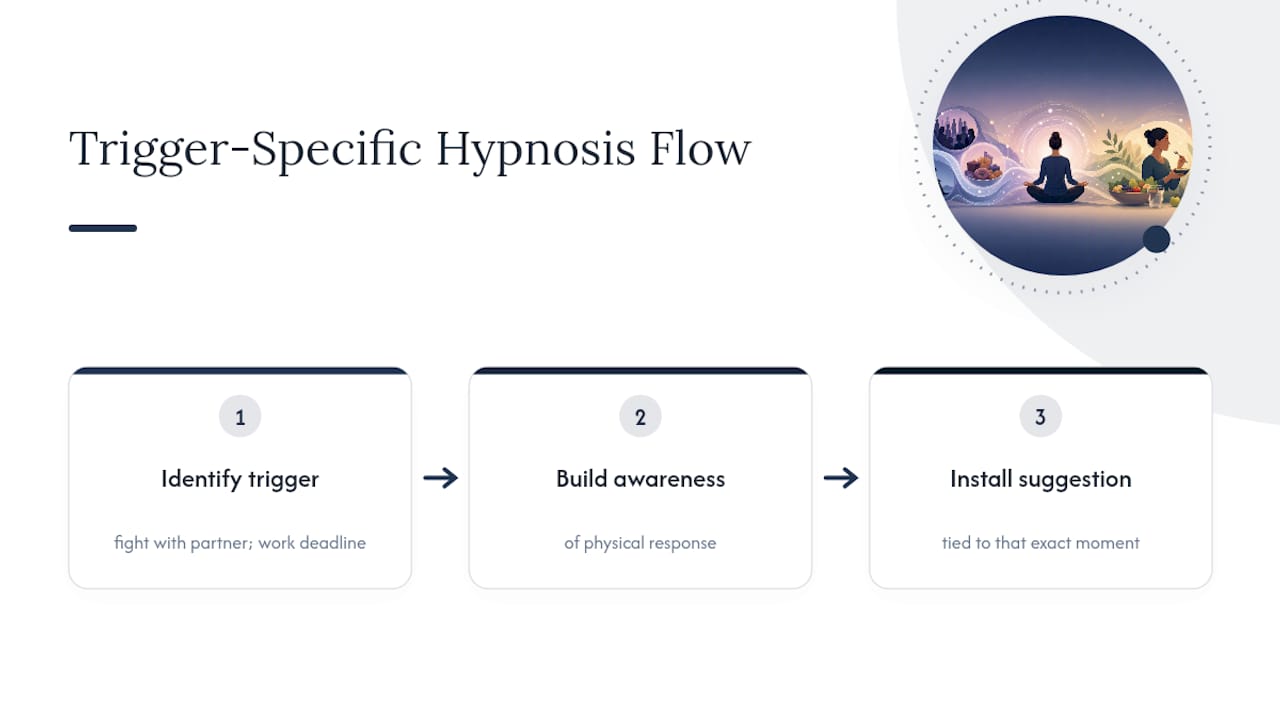
A clinician typically layers hypnosis with CBT and stress management, using a structured approach similar to the Problem, Agitation, Solution framework: identify the specific trigger (a fight with a partner, a work deadline), build awareness of the physical response it causes, then install a hypnotic suggestion tied to that exact moment. Generic audio can't do that kind of trigger-specific work. A trained clinician customizing suggestions to your actual pattern tends to outperform one-size-fits-all recordings, especially when anxiety is the root driver rather than simple habit.
Ready for Personalized Support? Here's What a Session Looks Like
If anxiety keeps steering you toward the pantry at night, a generic app track can only go so far. Hypnotic Transformations offers online hypnotherapy sessions with Kirk Hoffman, a Certified Clinical Hypnotherapist, built around the specific trigger driving your eating rather than a one-size script.
A first session runs 45 to 60 minutes. Kirk evaluates what's actually happening in your nervous system around food, whether it's evening stress, work anxiety, or a conditioned habit loop, then builds a self-hypnosis plan around it, including audio homework and clear, measurable goals. If anxiety-driven eating is the real issue behind the food, that's the pattern this format is designed to interrupt. Sessions are conducted over Zoom, so you can start from home.
Book a free consult through the services page to talk through what's driving your eating before committing to a full plan.
Frequently Asked Questions
Can hypnosis really change how I eat? It can shift how you respond to hunger and stress signals, especially when the eating pattern is anxiety-driven. It won't force you to skip food you want; it works with your existing motivation.
How long before I notice a difference? Most people report a shift in awareness within one to two weeks of daily pre-meal practice. Measurable disinhibition changes in the HYPNODIET trial appeared over an 8-month period.
Is a free YouTube track as good as seeing a therapist? For general relaxation, often yes. For trigger-specific anxiety eating, a customized approach from a certified clinician tends to work better than a generic recording.
Does mindful eating hypnosis replace dieting or exercise? No. Every major study treats it as an adjunct, not a replacement, for nutrition and activity changes.
This article is general information, not a substitute for advice from a qualified doctor. Consult a qualified healthcare professional about your own circumstances before acting on anything here.
Sources
- Hypnosis reduces food impulsivity in patients with obesity and high levels of disinhibition: HYPNODIET randomized controlled clinical trial
- The Use of Self-Help Strategies in Obesity Treatment. A Narrative Review Focused on Hypnosis and Mindfulness
- Is hypnosis beneficial for weight loss?