
Virtual gastric band hypnosis is a psychological technique that uses guided imagery during a hypnotic trance to simulate the sensation of a surgically banded stomach, reducing perceived hunger and portion tolerance without any physical procedure. The best available clinical evidence, a 24-week pilot trial published in the International Journal of Clinical and Experimental Hypnosis, found measurable weight change in participants but no statistically significant advantage over standard relaxation hypnotherapy. For U.S. adults who are motivated, medically screened, and open to suggestion-based work, it can be a reasonable adjunct to broader behavior change, not a standalone fix. Hypnotictransformations, led by Certified Clinical Hypnotherapist Kirk Hoffman, offers personalized online sessions that follow this evidence-informed approach.
Table of Contents
- What happens before, during, and after a session?
- What does the clinical evidence actually say?
- Who is likely to benefit, and who should avoid it?
- How do you choose a qualified hypnotherapist?
- Why personalization determines whether this works
- Key Takeaways
- Where virtual gastric band hypnosis fits in a real treatment plan
- Hypnotictransformations offers personalized VGB-style hypnotherapy online
- Useful sources and further reading
What happens before, during, and after a session?
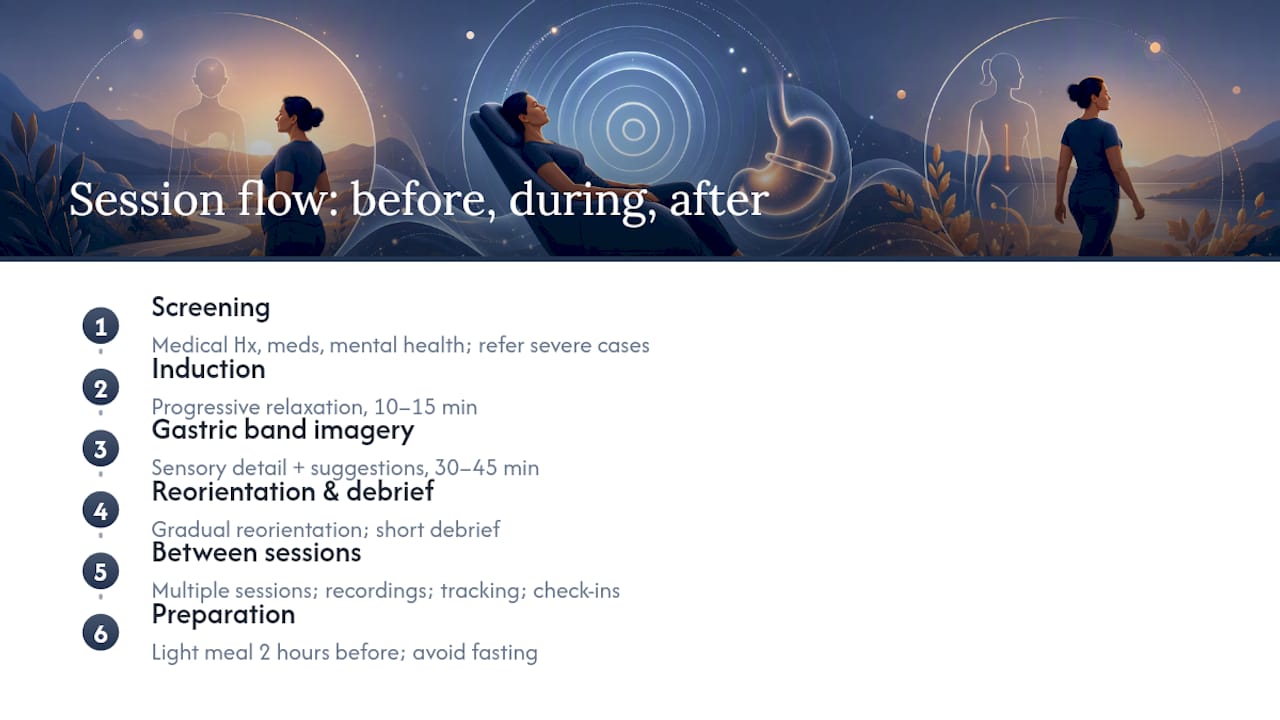
Before anything else, a qualified practitioner runs a screening conversation. This covers medical history, current medications, mental health status, and a discussion of hypnotizability. Clients with active psychosis, severe depression, or certain neurological conditions are typically referred elsewhere before any hypnotic work begins.
The session itself usually opens with a progressive relaxation induction lasting 10–15 minutes. Once the client reaches a receptive trance state, the practitioner introduces the gastric band imagery, layering in sensory detail and post-hypnotic suggestions. The core imagery portion runs roughly 30–45 minutes. The session closes with a gradual reorientation and a short debrief where the client describes what they noticed.
Most structured programs run across several sessions spaced periodically. The first session establishes the core suggestion. Later sessions reinforce it, address emotional eating patterns, and adapt the approach based on what the client reports between appointments. Clinical practice guidance recommends that programs include recordings for home use, behavior-tracking tools, and scheduled follow-up check-ins.
Between sessions, clients typically listen to a recording of the session or a shorter reinforcement audio daily. Some practitioners assign food-journal tasks or simple mindfulness exercises around meals. These between-session activities matter. The subconscious needs repetition to consolidate new associations, and a single in-office session without reinforcement tends to fade faster.
Pro Tip: Arrive at your first session having eaten a light meal two hours before, not fasted and not overfull. A calm, neutral physical state makes it easier to enter a receptive trance and respond to the stomach-fullness imagery the practitioner will use.
What does the clinical evidence actually say?
The most rigorous published data comes from a pilot investigation registered on ISRCTN and published in the International Journal of Clinical and Experimental Hypnosis. The trial enrolled 30 participants with a BMI above 27 and ran for 24 weeks.
| Metric | VGB Hypnotherapy Group | Relaxation Hypnotherapy Group |
|---|---|---|
| Sample size | 15 | 15 |
| Study duration | 24 weeks | 24 weeks |
| Weight-change range | −17 kg to +4.7 kg | −9.3 kg to +7.8 kg |
| Group difference | Not significant | — |
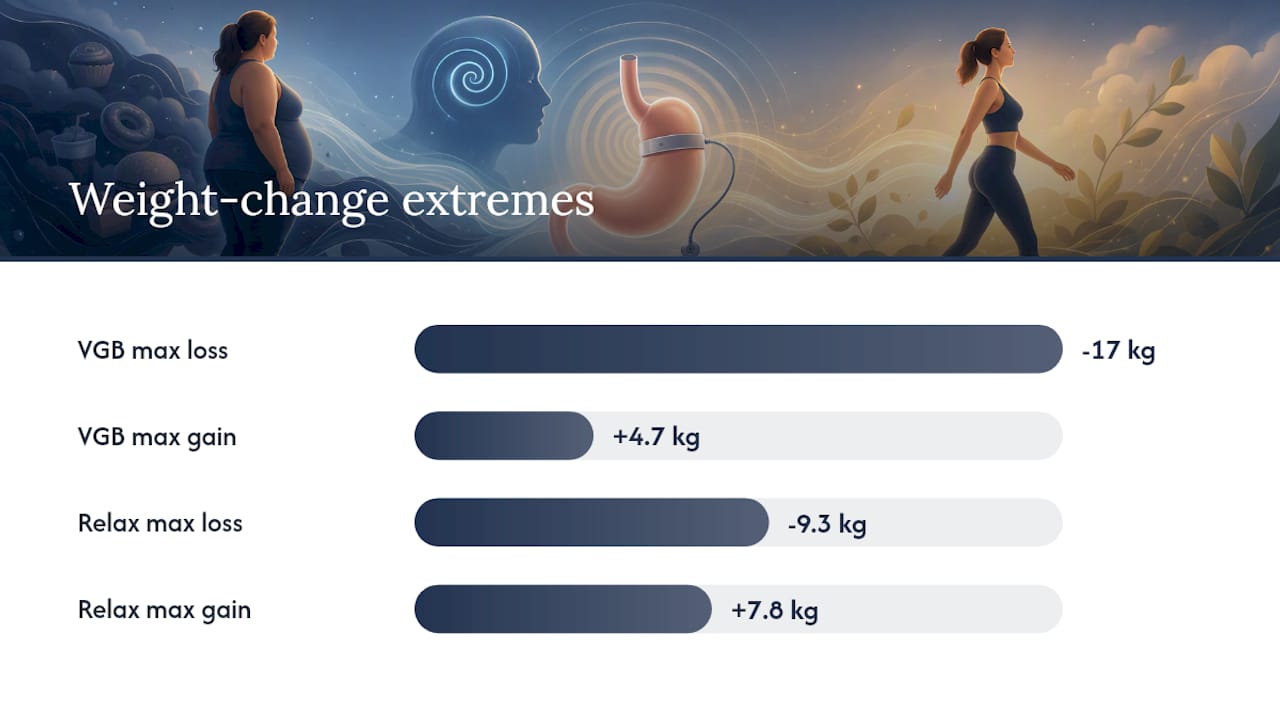
The weight-change ranges show that some individuals lost meaningful amounts of weight, while others gained. The trial data make clear that VGB hypnotherapy did not outperform relaxation hypnotherapy on a group level. Both groups changed, which suggests a general hypnotherapy effect rather than something specific to the gastric band imagery.
What the evidence does not yet tell us is substantial. The sample size of 30 is too small to draw firm conclusions. There are no large randomized controlled trials. The study population was not representative of the broader U.S. adult population. Expectancy effects, meaning the degree to which a participant believes the treatment will work, almost certainly influenced outcomes and were not fully controlled. Patient.info's clinical summary reflects this: hypnosis may help some people when combined with conventional strategies, but hypnosis alone is unlikely to be sufficient for most.
The practical interpretation: the technique is not proven ineffective, but it is also not proven superior to other forms of hypnotherapy or behavioral support. For individual decision-making, the honest framing is that it may help, particularly for people who respond well to suggestion and who pair it with behavioral change work. It is not a medical intervention, and it does not replace clinical care where that is indicated.
Who is likely to benefit, and who should avoid it?
Candidates who tend to respond well share a few characteristics:
- Mild to moderate overweight, not requiring bariatric surgery or pharmacotherapy
- Strong motivation to change eating behavior, not just lose weight passively
- Openness to suggestion-based approaches and some prior experience with relaxation or meditation
- No active psychiatric conditions that would interfere with trance work
- Willingness to complete between-session recordings and behavior tasks
Contraindications and situations requiring specialist input before proceeding:
- Active psychosis or schizophrenia spectrum disorders
- Active eating disorders, including anorexia nervosa or bulimia nervosa
- Uncontrolled epilepsy (hypnotic induction can lower seizure threshold in some individuals)
- Severe clinical depression requiring immediate psychiatric management
- Personality disorders with dissociative features
- Pregnancy (limited safety data; consult a physician first)
Hypnotizability also matters more than most practitioners advertise. RNZ's clinical coverage cites estimates that approximately a minority of people are highly susceptible to hypnotic suggestion, some show moderate responsiveness, and a similar proportion show little to no response. A practitioner who does not discuss this variability with you during intake is skipping an important clinical conversation.
How do you choose a qualified hypnotherapist?
Qualifications and credentials to verify
- Certification from a recognized body such as the American Council of Hypnotist Examiners (ACHE) or the National Guild of Hypnotists (NGH)
- Documented clinical training in hypnotherapy, not just a weekend certification
- Evidence of continuing education and supervision
- A clear intake and screening procedure described before you book
- Willingness to coordinate with your physician or mental health provider if needed
Questions to ask in an initial call
- What is your specific training in weight-related hypnotherapy?
- How do you personalize the session to my eating patterns and emotional triggers?
- What does your follow-up structure look like after each session?
- How do you handle clients who are not responding after two or three sessions?
- What outcome measures do you track, and how will we know if it is working?
Red flags to walk away from
- Guarantees of specific weight loss amounts or timelines
- No intake conversation or medical screening before the first session
- A single session presented as sufficient for lasting change
- Cookie-cutter scripts with no personalization
- High-pressure sales tactics or large upfront payment requirements with no refund policy
- Claims that the technique is equivalent to or better than bariatric surgery
Consumer reporting from Choice's investigation into hypnosis and weight loss found wide variation in practitioner quality and pricing, with some providers making claims that outpaced the evidence considerably.
Why personalization determines whether this works
The clinical framework driving the approach at Hypnotictransformations follows Problem-Agitate-Solution (PAS) structure: identify the specific subconscious pattern driving the eating behavior, surface the emotional cost of that pattern, then introduce a targeted hypnotic intervention to replace it.
That sequence matters because the subconscious mind does not respond to generic instruction. A person who overeats in response to anxiety has a different neurological pattern than someone who overeats out of habit or boredom. The hypnotic strategy for each is different. The imagery, the post-hypnotic suggestions, and the between-session tasks all need to match the individual's actual trigger profile.
A rigorous personalized program looks like this: a 30–45 minute intake that maps eating triggers, emotional history, and prior weight-loss attempts; a formulation that identifies the primary subconscious driver; a hypnotic strategy built around that driver; behavior-change tasks assigned between sessions; and a follow-up structure that measures progress and adjusts the approach.
Anonymized examples from clinical practice illustrate the range. One client presented with nighttime eating driven by a hyperactivated stress response. The hypnotic work focused on nervous system downregulation and reframing the kitchen as a neutral space after 8 PM. Another client's pattern was portion distortion at social meals. The imagery work centered on internal satiety signals and social confidence rather than restriction. Both required different scripts, different post-hypnotic anchors, and different homework.
Key Takeaways
Virtual gastric band hypnosis can support weight management for motivated, medically screened adults, but the evidence does not show it outperforms other forms of hypnotherapy on a group level.
| Point | Details |
|---|---|
| What it is | A psychological technique using trance and guided imagery to simulate stomach banding, not a physical procedure. |
| Main trial finding | A 24-week pilot (n=30) found no significant difference between VGB and relaxation hypnotherapy; weight changes ranged from −17 kg to +4.7 kg in the VGB group. |
| Who may benefit | Adults with mild to moderate overweight, strong motivation, and moderate to high hypnotizability who pair sessions with behavior-change work. |
| How to choose a practitioner | Verify accredited certification, a documented intake process, personalized session plans, and structured follow-up before booking. |
| Hypnotictransformations | Kirk Hoffman CCHt offers personalized online VGB-style hypnotherapy via Zoom with intake, bespoke session plans, recordings, and follow-up. |
Where virtual gastric band hypnosis fits in a real treatment plan
VGB-style hypnosis works best as one layer in a broader plan, not as the whole plan. In practice, the clients who get the most from this work are those who have already addressed the obvious behavioral factors, sleep, stress, meal timing, and who are using hypnotherapy to shift the subconscious patterns that keep pulling them back to old habits despite conscious effort.
The intake process at Hypnotictransformations includes a review of current medical care and a direct question about whether the client is working with a physician or registered dietitian. When a client's BMI or medical history suggests that clinical intervention is warranted, that conversation happens before any hypnotic work begins. Hypnotherapy is not a substitute for medical care. It is a tool for the subconscious layer of behavior change that medical care does not address.
Hypnotictransformations offers personalized VGB-style hypnotherapy online
Most weight-loss hypnotherapy programs hand you a recording and call it a session. Hypnotictransformations works differently. Kirk Hoffman, Certified Clinical Hypnotherapist, delivers personalized weight-loss hypnotherapy via Zoom that starts with a real intake: your eating triggers, your emotional history, and your specific subconscious patterns. The session plan is built around what you actually need, not a generic script.
Every program includes recordings for between-session reinforcement, structured follow-up, and measurable progress check-ins. You know what is being worked on and why. Sessions are available nationwide through Hypnotictransformations's online services, so location is never a barrier.
The first step is a free consultation. You will talk through your situation, ask questions, and find out whether this approach fits your goals before committing to anything. Book your consultation here.
Useful sources and further reading
- Pilot Investigation of a Virtual Gastric Band Hypnotherapy Intervention
- Pilot Investigation of a Virtual Gastric Band Hypnotherapy Intervention: International Journal of Clinical and Experimental Hypnosis: Vol 64, No 4
- Gastric Band Hypnotherapy: Evidence & UK Guidance — Bolt Pharmacy
- The Hypnotic Gastric Band: Evidence, Safety, and UK Options — Bolt Pharmacy
- Gastric Banding: Surgical vs Virtual | RNZ
- ISRCTN
- Hypnosis and weight loss — Choice
- Can hypnotherapy help you lose weight? — Patient.info
This article is general information, not medical or clinical advice. Confirm current guidance with your physician or a qualified hypnotherapist before beginning any weight-management program.