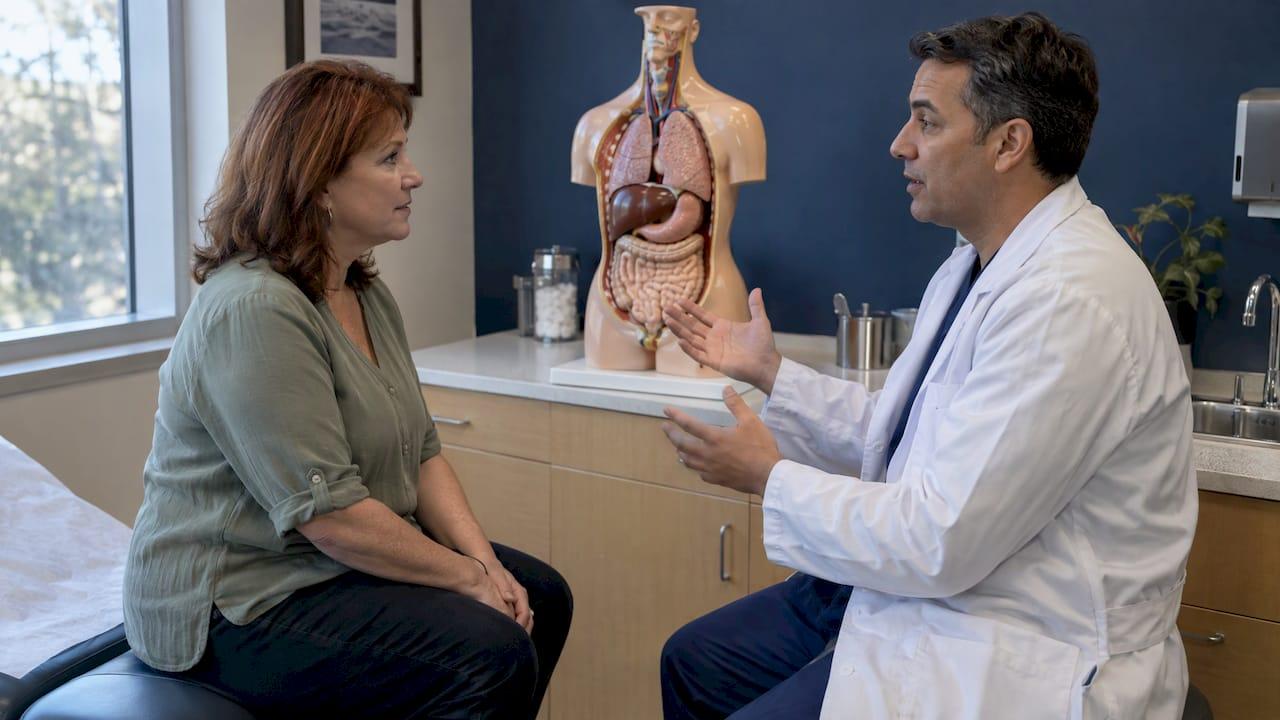
You are lying awake at 2 a.m. with your heart pounding, running the same two questions. Which surgery is safer? And what if I do it, lose the weight, and the urge to eat when I feel panicky never leaves? The surgical answer is below: bypass usually produces somewhat more weight loss and helps reflux more, while the sleeve is a simpler operation. The second question is the one most comparison pages skip. Surgery changes your stomach. It does not change the fear response that sends you to the pantry. That part is where we work, in online hypnotherapy sessions with a certified clinical hypnotherapist.
TL;DR
- The sleeve removes about 80% of the stomach. Bypass builds a small pouch and reroutes the intestine. Bypass is more complex and usually gives a little more weight loss.
- Typical total body weight loss is 25 to 30% with a sleeve and 30 to 35% with bypass, according to a clinical patient-education reference.
- If you have significant acid reflux, studies favor bypass. Your surgeon makes the final call.
- Most patients regain some weight between 3 and 10 years after surgery. Eating behavior and mental health are among the named causes.
- Anxiety-driven eating is a nervous system pattern. We work on it with hypnotherapy, before or after surgery, alongside your medical team.
Table of Contents
- The fear behind the decision
- How each surgery works
- Weight loss: what the numbers say
- Risks and recovery
- Who qualifies
- What surgery does not change: regain and the eating pattern
- What hypnotherapy works on
- Questions to bring to your surgeon and to us
- Work on the anxiety side with us
- FAQ
- Sources
The fear behind the decision
Most people reading about these two operations are not just comparing hospital stays. They are afraid of anesthesia. They are afraid of a complication. They are afraid of failing again after years of diets. And many are afraid of something harder to name: that they eat because they feel anxious, not because they are hungry.
That last fear is reasonable. When your brain detects a threat, the fight-or-flight response floods your body with stress hormones. Your heart rate climbs, your muscles tighten, and your mind looks for anything that will bring the alarm down. Food works fast. The brain notices that it worked and files the habit away in the subconscious, the part of the mind that runs automatic patterns without asking your permission. A smaller stomach limits how much you can eat. It does not remove the alarm that triggers the reach for food.
So the choice between sleeve and bypass matters, and so does what you prepare alongside it. Both get a section below.
How each surgery works
Gastric sleeve (sleeve gastrectomy)
The surgeon removes roughly 80% of your stomach, leaving a narrow tube. That means you feel full on less food. It also removes the part of the stomach that makes most of the hunger hormone, ghrelin. The American Society for Metabolic and Bariatric Surgery (ASMBS) notes the operation cannot be reversed and can cause or worsen acid reflux.
Gastric bypass (Roux-en-Y)
The surgeon creates a small stomach pouch and connects it to a lower section of the small intestine. Food skips part of the intestine, so your body absorbs less, and hunger and fullness signals change. The same ASMBS patient page says bypass has been performed for more than 50 years, often improves type 2 diabetes even before weight loss, and can help reflux. It is technically more complex. It causes more vitamin and mineral deficiencies than the sleeve and carries risks of ulcers, small bowel obstruction, and dumping syndrome, where food moves too fast into the intestine and causes cramps, sweating, and nausea.

Weight loss: what the numbers say
The two procedures are close, with bypass slightly ahead on average.
| Gastric sleeve | Gastric bypass | |
|---|---|---|
| Total body weight loss (typical) | 25 to 30% | 30 to 35% |
| Example at 300 lb | about 75 to 90 lb | about 90 to 105 lb |
| 5-year randomized trial result | 22.5% | 26% |
| Surgical complexity | Simpler | More complex |
| Reflux | Can cause or worsen | Often improves |
The first two rows come from a UpToDate patient-education table. The 5-year trial figures are summarized in a 2025 peer-reviewed review, which also reports that the sleeve accounted for about 57.4% of US metabolic and bariatric operations in 2022.
Timing matters too. The Merck Manual says weight loss is rapid at first and slows over about one to two years. The NIDDK cites one study in which people lost 38 to 87 pounds after one year across banding, sleeve, and bypass, with bypass giving the greater average loss.
If you keep a food diary or want to see how your body responds to meals, continuous glucose monitoring for weight loss is one way people spot which eating patterns spike and crash their energy.
Risks and recovery
Both operations are done mostly through small incisions (laparoscopically) under general anesthesia, per the NIDDK. Afterward you move from liquids to soft foods to solid foods over several weeks, eat small meals, chew thoroughly, and take prescribed vitamin and mineral supplements.
On safety, the June 2022 American Family Physician review puts mortality for both procedures at 0.2 to 0.3%. The 2025 review reports, for the sleeve, a 30-day mortality of 0.02% and a staple-line leak rate of 0.15 to 2.4%, mostly at the low end. It also reports an 8% combined minor and major 30-day complication rate for bypass, higher than for the sleeve.
Reflux is the practical dividing line. The same review notes bypass is preferred for people who already have GERD (chronic acid reflux), since a systematic review found the odds of later revision surgery for reflux were 11 times higher after a sleeve than after bypass. Procedure-specific cautions exist too: a 2022 review lists Crohn's disease as a relative contraindication for bypass and severe esophagitis or Barrett's esophagus for the sleeve.
Follow-up is frequent. The Merck Manual describes visits every 4 to 12 weeks in the first several months, then every 6 to 12 months.

Who qualifies
The ASMBS 2025 fact sheet says metabolic surgery is recommended for a BMI above 35 regardless of other conditions, and should be considered at BMI 30 to 34.9 with metabolic disease. People of Asian descent may qualify at lower BMIs. The 2022 joint ASMBS and IFSO guidelines replaced the 1991 NIH criteria and widened access, as summarized here.
The AFP review lists common exclusions: prohibitive heart or lung disease, current tobacco, alcohol, or drug use, and uncontrolled severe psychiatric illness. The 2022 review above adds uncontrolled eating disorders and an inability to follow lifelong nutrition requirements. If anxiety is part of your picture, say so to your surgical team early. Getting anxiety and eating patterns under good care before surgery is a practical step, not a mark against you.
Which operation fits you depends on your other medical conditions, your preferences, and your surgeon's expertise, per the AFP authors. That conversation belongs with a bariatric surgeon and your primary care physician.
What surgery does not change: regain and the eating pattern
The AFP review states that most patients regain some weight between 3 and 10 years after surgery. It names nutritional indiscretion, mental health concerns, metabolic changes, inactivity, and anatomic failure as causes. A 2023 review found significant regain (25% or more of the lowest weight reached) in 37% of 300 bypass patients at 7 years. A systematic review it cites found up to 76% of sleeve patients had significant regain at 6 years. It names dysregulated or maladaptive eating behaviors among the most common causes.
The NIDDK's 7-year LABS study gives a reassuring counterpoint: bypass patients averaged 28.4% body weight loss and regained an average of 3.9% from years 3 to 7, with most keeping their loss. Regain is common. It is usually modest. And the behavior side is where you have the most room to act.
Here is what that behavior looks like in a body with a strong stress response:
- A trigger arrives: an argument, a work email, a quiet house at night.
- The nervous system shifts into fight-or-flight. Your chest tightens, your thoughts speed up.
- The subconscious reaches for the fastest known relief, which is eating.
- Eating brings a short calm, so the loop strengthens.
A smaller stomach changes step 3's capacity. It leaves steps 1, 2, and 4 alone. After surgery, some people find the urge shifts to snacking, grazing, or soft, easy-to-eat foods, which is the nutritional indiscretion the AFP review lists.
What hypnotherapy works on
Hypnotherapy is a guided, deeply relaxed state in which you stay aware and in control while you work with the subconscious patterns behind a habit. In relaxed focus, the nervous system moves out of fight-or-flight, which is the state where those patterns are easiest to examine and change.
The research on eating behavior is specific. In the HYPNODIET randomized trial, adults with obesity and high eating disinhibition (eating beyond hunger, triggered by cues or emotion) received 8 sessions of hypnosis plus self-hypnosis training. Disinhibition scores dropped significantly more than with standard nutrition education: 67.7% of the hypnosis group normalized their scores, against 11.1% of the comparison group.
That is the pattern we work on with clients: the automatic reach for food under stress. If this sounds like you, these pages go deeper on specific patterns:
- Hypnotherapy for emotional eating covers an 8-session, evidence-based structure.
- Mindful eating hypnosis for anxiety-driven eating covers hunger cues and the stress response.
- Hypnosis for late-night eating covers evening patterns.
- Binge eating hypnosis explains what a session does and who it helps.
- Food addiction hypnosis covers craving loops.
- Hypnosis for weight loss gives the wider picture.
If you have heard of a "virtual gastric band" as a hypnosis technique, this article explains what it is and what it does. It is a hypnotic suggestion approach, not a surgical alternative, and nothing replaces a medical decision made with your surgeon.
Questions to bring to your surgeon and to us
Use this short list at your consultations.
For the surgeon:
- Do I have reflux, and does it point toward bypass?
- Do my other conditions, such as type 2 diabetes, change the choice?
- Which supplements will I take, and for how long?
- What does follow-up look like in year one and after?
For yourself:
- When do I eat without being hungry?
- What feeling comes just before I eat?
- Do I eat to calm down, to switch off, or to feel something?
Your answers to the second list are the working material for hypnotherapy.
Our view on surgery and the mind
People often arrive thinking they have a willpower problem. They don't. They have a nervous system that learned, long ago, that food ends the alarm. Surgery is a serious medical tool, and the choice between sleeve and bypass belongs to you and your surgeon.
What we do is work on the part the operation cannot reach. In sessions we use clinical hypnotherapy and NLP to find the subconscious pattern behind the reach for food, and to change how your body responds when anxiety rises. Our approach is designed to target the root of the pattern, not to manage it one craving at a time.
If you are preparing for surgery or years past it, the goal is the same: a calm body that doesn't need food to settle itself.
Kirk
Work on the anxiety side with us
We offer online clinical hypnotherapy by Zoom with Certified Clinical Hypnotherapist Kirk Hoffman, available to clients across the United States. Sessions address anxiety, weight management, and the subconscious patterns behind eating. Services include individual sessions, multi-session packages, and a free consultation. You can see the online hypnotherapy for weight loss page, the hypnotherapy for anxiety page, or all services.
This work sits next to your medical care. Keep your surgeon, primary care physician, and dietitian in the loop.
FAQ
Is gastric bypass or gastric sleeve better?
Neither wins for everyone. Bypass tends to give somewhat more weight loss and helps reflux, while the sleeve is simpler to perform. The AFP review says the choice depends on your medical conditions, your preference, and your surgeon's expertise.
Can you gain weight after gastric bypass or sleeve?
Yes. Most patients regain some weight between 3 and 10 years after surgery, according to the AFP review. The NIDDK's long-term study found the regain after bypass averaged 3.9% of body weight and most people kept most of their loss.
How long does it take to lose 50 pounds after surgery?
It varies by starting weight and procedure. Weight loss is fastest early and slows over about one to two years, per the Merck Manual. Your surgical team can give you a timeline based on your own numbers.
Can hypnosis help with comfort eating after weight loss surgery?
Hypnosis targets the automatic link between stress and eating. In the HYPNODIET trial, hypnosis sessions with self-hypnosis training reduced eating disinhibition significantly more than nutrition education. We work with clients on this pattern online, alongside their medical care.
Sources
- Bariatric Surgery Procedures, ASMBS
- UpToDate patient education: weight loss surgery and procedures
- Surgical Strategies for the Management of Obesity (2025)
- Metabolic and Bariatric Surgery, Merck Manual
- Types of Weight-loss Surgery, NIDDK
- Metabolic Surgery for Adult Obesity, American Family Physician (2022)
- Bariatric Surgery With Roux-En-Y Gastric Bypass or Sleeve Gastrectomy (2022)
- ASMBS 2025 Fact Sheet
- ASMBS / IFSO Guidelines on Indications
- Weight Regain After Bariatric Surgery (2023)
- NIDDK Longitudinal Assessment of Bariatric Surgery
- HYPNODIET trial, PubMed
- Continuous Glucose Monitoring For Weight Loss