It is 9:40 p.m. The day was fine, or at least you held it together. Then you stand in the kitchen, your chest tightens, and your hand is already in the cabinet. Ten minutes later you are full past comfortable, ashamed, and promising yourself tomorrow will be different. Hypnosis for binge eating targets that exact moment. It works with the anxious, automatic part of the mind that fires before you decide anything, and it teaches your body a calmer response to the trigger. In our online sessions, we work on the anxiety underneath the urge. Binge eating disorder itself is a medical and psychological diagnosis, so hypnotherapy sits best alongside care from your doctor or an eating disorder therapist.
TL;DR
- A binge is usually an anxiety response that runs on autopilot. Hypnosis aims at that automatic layer, not at willpower.
- Occasional overeating and binge eating disorder are different. A binge disorder involves repeated episodes, loss of control and shame, typically at least once a week for three months or more.
- Clinical hypnosis is described in the literature as an add-on to cognitive-behavioral therapy (CBT) for eating problems. It is not a replacement for a diagnosis or medical care.
- Sessions with us run online over Zoom, anywhere in the United States, and start with a free consultation.
- If you binge weekly or more, tell your doctor or a licensed therapist too. The 2023 American Psychiatric Association guideline recommends CBT or interpersonal therapy for binge eating disorder.
Table of Contents
- The problem is the 9 p.m. moment, not the food
- Overeating, binge eating and binge eating disorder
- What hypnosis does with the urge
- Where hypnosis fits with standard treatment
- What the first sessions look like online
- Practice makes the difference
- What to expect, and who should see a doctor first
- Working with us on the anxiety under the urge
- Perspective
- FAQ
- Sources
The problem is the 9 p.m. moment, not the food
Most people who search for binge eating hypnosis have already tried the obvious things. Meal plans, removing snacks from the house, promising to be good on Monday. They work for a few days. Then a stressful call, a lonely evening or a fight with a partner arrives, and the same pattern runs again.
That pattern is not a character flaw. When your body reads something as a threat, whether it is a deadline, a memory or a feeling you do not want to feel, the fight-or-flight response switches on. Heart rate rises, muscles tighten, and the thinking part of your brain gets quieter. Food becomes the fastest way to bring that alarm down. Eating is soothing, so the brain remembers it, and next time it reaches for it sooner.
Cleveland Clinic explains that overeating is tied to stress hormones such as cortisol and to disrupted hunger signals from ghrelin and leptin. In other words, your hunger system and your stress system are connected. If your anxiety is loud, your eating will be loud too.
This is also why "just stop" fails. You are asking the slow, deliberate part of your mind to overrule a fast, automatic one, at the moment it is least available.
Overeating, binge eating and binge eating disorder
The three are easy to confuse, and the line between them is thin. Here is how the medical sources separate them.
| Occasional overeating | Binge eating disorder | |
|---|---|---|
| How often | Infrequent | Usually at least once a week for three months or more |
| Effect on life | Does not dominate your thoughts or disrupt your days | Chronic, distressing, takes up mental space |
| During the episode | You eat past fullness | Eating quickly, until uncomfortably full, or when not physically hungry, often alone or in secret |
| Afterward | Maybe a stomachache | Shame or guilt |
The description comes from Columbia Psychiatry's comparison of overeating and binge eating disorder. Cleveland Clinic adds that people with binge eating disorder do not throw up the food or exercise it off afterward, which is what separates it from bulimia. It also notes that psychotherapy is usually the main treatment and medication may help.
Columbia's Lisa Ranzenhofer, PhD, points out that the line between these patterns is fine and that feeling out of control around food early in life raises the risk of binge eating disorder later. That is a good reason to act sooner rather than wait for the pattern to harden.
Only a licensed professional can diagnose binge eating disorder. If your pattern sounds like the right-hand column, book a visit with your primary care doctor or a therapist who treats eating disorders. Hypnotherapy can run next to that care.
What hypnosis does with the urge
Hypnosis is a state of focused attention and deep relaxation. You stay aware and in control. The relaxation matters because it is the opposite of the fight-or-flight state. While you are calm and focused, the part of your mind that holds automatic habits becomes easier to work with.
The clinical literature describes several tools used for eating problems. A review by Torem on hypnosis with eating disorders lists general relaxation, guided imagery, teaching self-hypnosis, ego-strengthening, direct and indirect suggestions, cognitive restructuring, symbolic imagery, age regression and progression, metaphors, and ego state therapy. Torem stresses that the practitioner first assesses the underlying dynamics of the symptom.
That last point is the one that matters most to us. A binge is a symptom. Underneath it there is usually a trigger: a feeling, a belief about yourself, a stressful routine. A session that only says "you will not want cake" misses the cause.
A 2005 Mount Sinai case report shows the idea in practice. A 16-year-old's binge eating resolved after a technique that surfaced the underlying psychological cause, and self-hypnosis gave him a tool to carry out the behavior change. The authors describe two parts: understanding what drives the behavior, and a skill to change it. One case is not a trial, but the structure it describes is the structure we follow.

Where hypnosis fits with standard treatment
The textbook Essentials of Clinical Hypnosis describes hypnosis as an adjunct to empirically supported CBT for eating disorders and for obese binge eaters. It also notes that interest in hypnotic techniques for eating problems has grown since the late 1970s as a supplement to established therapy.
That is the role we think about too. The 2023 American Psychiatric Association practice guideline recommends eating-disorder-focused CBT or interpersonal therapy for binge eating disorder, individually or in a group. CBT studies typically use 16 to 22 weekly sessions of 40 to 60 minutes. For adults who prefer medication or have not responded to psychotherapy alone, the guideline suggests an antidepressant or lisdexamfetamine. American Family Physician summarized the same guideline in February 2024 for primary care doctors.
So if you have been diagnosed, or suspect you meet the criteria, the plan can look like this: your doctor or therapist leads the medical and psychotherapy side, and hypnotherapy works on the anxiety, the automatic trigger response and the calm-down skill you practice at home.

Your gut and your nervous system also talk to each other constantly. If you have digestive symptoms along with the eating pattern, it is worth reading about the gut-brain connection and raising it with a board-certified gastroenterologist or your primary care doctor.
What the first sessions look like online
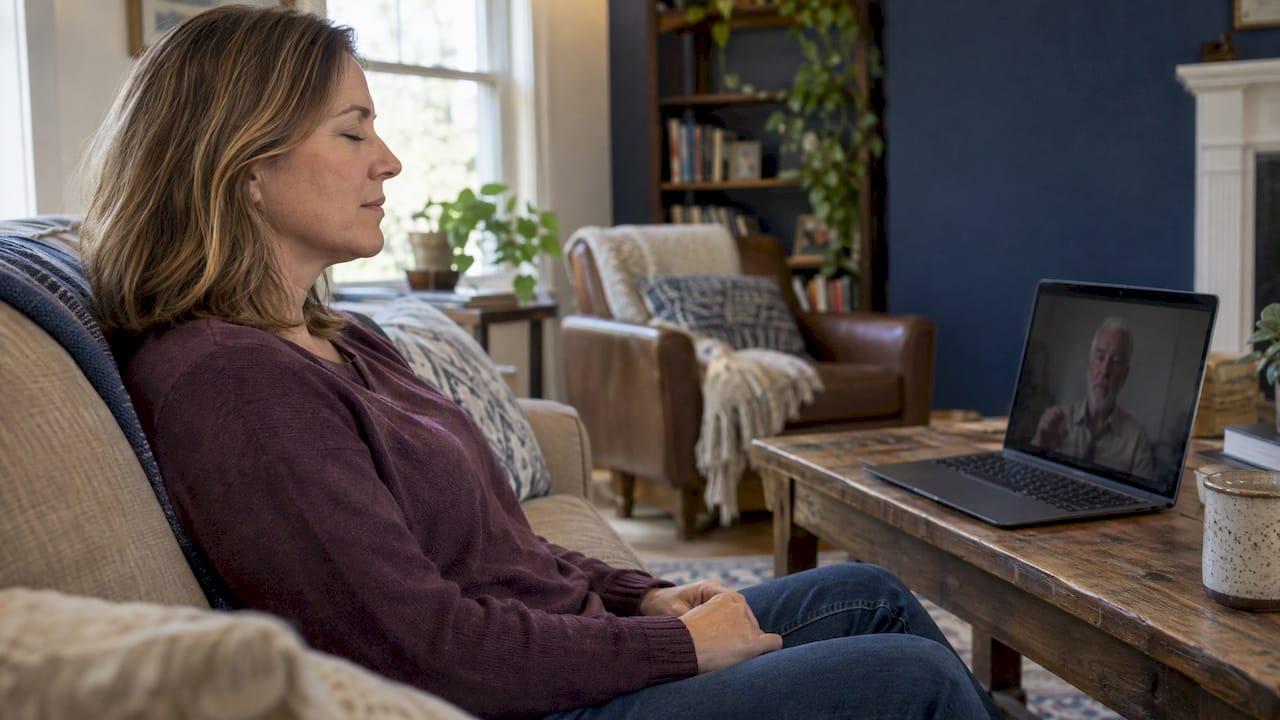
Sessions with Kirk Hoffman, a Certified Clinical Hypnotherapist, happen over Zoom, so you sit in your own chair at home. That matters for this problem. The urge happens at home, in your kitchen, on your couch. Learning the calm response in the same place where the trigger lives makes it easier to use later.
The work uses clinical hypnotherapy, NLP, guided imagery and other hypnotic methods. In practice that tends to cover three things:
- Finding the trigger. What happened in the hour before the last binge? Often it is a feeling you could not name, a message you read, or the end of a workday with nothing to absorb the tension.
- Calming the alarm. In a relaxed state, we rehearse a different response to that trigger, so the body learns that the feeling is survivable without food.
- Practice between sessions. You leave with a short routine to use when the pressure builds.
Anxiety is the thread through all of it. If panic, racing thoughts or a constant sense of dread sit under your eating, our online hypnotherapy for anxiety is where we begin. For more on how we approach the eating side, see our guides on emotional eating and an eight-session structure, anxiety-driven eating and mindful eating, and late-night eating.
Practice makes the difference
Hypnosis is a skill, and skills improve with repetition. In a randomized trial of adults with severe obesity, self-hypnosis added to standard care improved quality of life, satiety and inflammation. Participants who practiced at least once a day lost more weight (9.6 kg) than those who practiced less often (7.5 kg). That trial is about obesity, not binge eating disorder, but the pattern is useful: daily use of the technique beats occasional use.
Here is a simple routine you can try on any day, and that we build on in sessions:
- Pick a fixed time. Late afternoon works for many people, before the evening pressure arrives.
- Sit and slow your breathing. Make the exhale longer than the inhale. A long exhale is a cue to your nervous system that the threat has passed.
- Picture the trigger and your calm response. See the kitchen, feel the tightness, then see yourself breathing and staying in the room.
- Keep it to 10 minutes. Short and daily beats long and rare.
If you want to understand how calming the body connects to eating, our article on emotional regulation hypnosis walks through the steps and the clinical evidence.
What to expect, and who should see a doctor first
Hypnosis will not take over your mind. You hear everything and can open your eyes at any time. Most people describe it as deeply relaxed and focused, like the moment before sleep.
A few situations call for a medical professional first or alongside us:
- You binge at least weekly and have for three months or more. Ask your doctor or a licensed therapist about an eating disorder evaluation.
- You purge, restrict heavily or exercise compulsively after eating. These point to other eating disorders that need a medical team.
- You are taking medication for your eating or mood. Do not change it without your prescriber. The APA guideline notes bupropion is contraindicated for patients with purging behaviors because of seizure risk, which is one reason a prescriber should be involved.
- You feel hopeless or think about harming yourself. Contact your doctor, go to the nearest emergency room, or call or text 988, the Suicide and Crisis Lifeline.
None of this is a reason to wait on addressing the anxiety. It is how you build a team around the problem.
Working with us on the anxiety under the urge
We offer online clinical hypnotherapy for anxiety, designed to work on the subconscious patterns that keep the stress response firing, so the urge loses its trigger. Sessions are one-on-one with Kirk Hoffman over Zoom, available across the United States, and the first step is a free consultation where you describe what happens in your 9 p.m. moment.
You can read about the anxiety program and our other services or start from our home page to book the consultation.
Perspective
When someone tells me about a binge, they almost never start with the food. They start with the feeling right before it. A knot in the stomach, a thought like "I can't handle this," a body already braced for a fight.
That is why we work where we do. The urge is fast and automatic. It runs in the subconscious mind and the nervous system, and willpower arrives too late. In hypnosis, the body is calm and the mind is focused, and that is the state where a new response to the trigger can be rehearsed until it feels natural.
I want you to have the whole team. If you binge regularly, see your doctor or a therapist who treats eating disorders. Bring us in for the anxiety, the trigger response and the daily practice. Together, those pieces address the pattern from every side. Our approach is built to go after the root, which is why we spend the early sessions on what sets the urge off.
Kirk
FAQ
Can hypnosis stop binge eating?
Hypnosis is used to calm the anxiety and automatic responses that drive binge urges, and clinical sources describe it as an adjunct to CBT for eating problems. Individual results vary. The strongest plan pairs it with care from your doctor or an eating disorder therapist if you binge regularly.
Is binge eating hypnosis the same as a self-hypnosis recording?
A recording gives the same script to everyone. A session with a clinical hypnotherapist starts with your own triggers and adjusts the work to them, then teaches you a technique to use by yourself. People who want a practice they can use on their hardest evenings usually benefit from that personalization.
How is binge eating different from overeating?
Overeating is occasional and does not dominate your life. Binge eating disorder involves recurring episodes, usually at least once a week for three months or more, often with eating quickly, eating in secret, and shame or guilt afterward. A licensed professional makes the diagnosis.
Do I need to be hypnotized in person?
No. Our sessions run over Zoom from wherever you are in the United States. Working from home lets you practice the calm response in the same place the urge usually hits.
Sources
- Overeating vs. Binge Eating Disorder: What is the Difference? (Columbia Psychiatry)
- Binge Eating Disorder: What It Is, Symptoms & Treatment (Cleveland Clinic)
- Overeating: Causes, Symptoms & How to Stop (Cleveland Clinic)
- Treatment of binge eating with automatic word processing and self-hypnosis (Mount Sinai)
- The use of hypnosis with eating disorders (PubMed)
- Essentials of Clinical Hypnosis (Lynn)
- American Psychiatric Association Practice Guideline for the Treatment of Patients With Eating Disorders
- Treating Patients With Eating Disorders: Guidelines From the APA (American Family Physician)
- The Use of Self-Help Strategies in Obesity Treatment (PMC)
- The Gut-Brain Connection (Dr. Meet Parikh, DO)