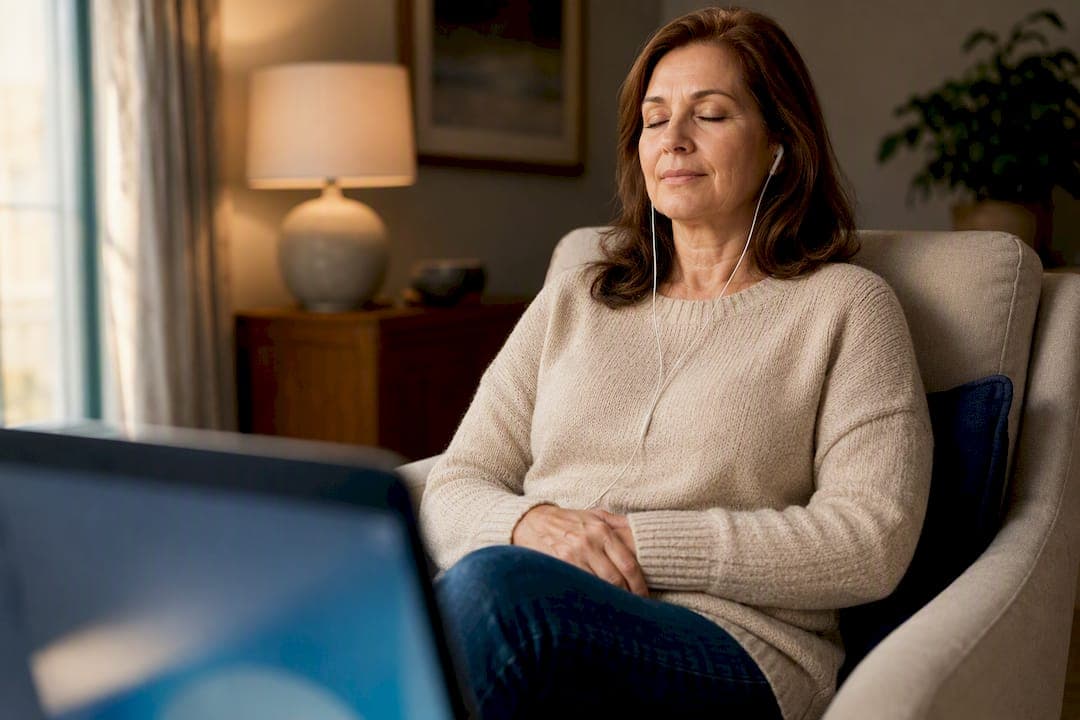
Yes. For most people dealing with anxiety, panic, phobias, or smoking, hypnotherapy over Zoom works about as well as sitting in an office chair, provided the clinician running it is trained and screens you first. The exception is complex trauma or active safety risk, where in-person care usually fits better. An experienced Certified Clinical Hypnotherapist offers this type of service as a nationwide online option.
TL;DR:
- Over 31 participants in studies showed similar symptom reduction and improved therapeutic alliance in Zoom hypnotherapy compared to in-person sessions.
- Clients often relax faster or feel less guarded during remote sessions due to comfort in their own environment, supporting effectiveness for anxiety and phobias.
- Telehypnotherapy is most suitable for anxiety, specific phobias, smoking cessation, sleep issues, and weight behaviors, but less ideal for trauma or crisis situations.
- Strong screening, secure platforms, use of headphones, and private settings are essential to ensure safety, privacy, and optimal results in online hypnotherapy.
- Costs typically depend on session length and package deals, with most sessions lasting 60 minutes and initial intake requiring more time; insurance coverage varies.
Table of Contents
- Does the Research Actually Support Zoom Hypnotherapy?
- What Happens During a Typical Zoom Hypnotherapy Session?
- Which Conditions Respond Well to Online Hypnotherapy?
- What Safety and Privacy Standards Should You Expect?
- How Do You Prepare for Your First Zoom Session?
- What Does Zoom Hypnotherapy Cost and How Do You Book It?
- Who Is Behind Hypnotic Transformations?
- A Clinician's Take on Choosing the Right Format
- Ready to Try Hypnotherapy for Anxiety From Home?
- Sources
Does the Research Actually Support Zoom Hypnotherapy?
Your nervous system doesn't know the difference between a hypnotherapist sitting three feet away and one on a screen. That's the part most people get wrong before they try it. What matters to your fight-or-flight response is whether you feel safe enough to let your guard down, not the exact millimeters between you and the person guiding you.
A study comparing Zoom-based videoconferencing psychotherapy against metaverse counseling found both produced measurable symptom reduction, and counselors reported the working alliance, the trust between client and clinician, actually climbed steadily over the course of Zoom sessions. That trust curve is the thing to watch. Hypnotherapy depends on it more than almost any other talk-based approach, because you're being asked to relax deeply while another person guides your attention.
Separate review evidence backs this up from a different angle. Research tracking video hypnotherapy's rise since the pandemic found it generally acceptable to patients, with many clinicians reporting remote delivery can match face-to-face care for selected conditions. Patients cited convenience and the comfort of being home as real reasons they preferred it, not just a fallback when travel wasn't possible.
Here's what surprises people: some clients relax faster on camera, not slower. Therapists working in teletherapy settings report that clients often feel less guarded during remote sessions. Being in your own space, your own chair, with nobody watching you walk into a building, can shortcut the vigilance your body naturally carries into a new environment.
The evidence has real limits, though.
- Telephone-only hypnotherapy carries weaker clinical support than video, since the lack of visual feedback makes it harder for clinicians to read your responses.
- Clients with significant trauma histories or trust difficulties may do better with the added physical presence of in-person work.
- Most comparative studies focus on anxiety and stress-related concerns, so evidence for more complex psychiatric presentations remains thinner.
Here's the number that matters most: in the Zoom versus metaverse counseling comparison, 31 participants across both modalities showed comparable symptom reduction, and the Zoom group's working alliance rose over time rather than staying flat. That trajectory is a good sign for anyone worried that a screen will keep them at arm's length from the process.
What Happens During a Typical Zoom Hypnotherapy Session?
A first session usually runs longer than the ones after it. Here's how a typical arc unfolds:
- Intake and screening. Before any hypnosis happens, your clinician asks about your mental health history, current medications, and any past reactions to relaxation or trance work. This isn't paperwork for its own sake. It's how a clinician decides whether Zoom is appropriate for you at all.
- Pre-talk. You'll talk through your goal for the session, whether that's calming a fear of flying or interrupting a smoking habit, and your clinician explains what to expect so nothing feels unfamiliar once your eyes close.
- Induction. This is the guided relaxation portion, usually starting with breath and progressive body relaxation, that shifts you out of an alert state and into a more receptive one.
- Therapeutic work. Once you're settled, the clinician uses techniques like guided imagery or direct suggestion to address the specific pattern you came in for.
- Debrief. You come back to full alertness gradually, then talk briefly about what came up.
- Recording. Many clinicians send a personalized audio file of the session afterward, so you can practice the same relaxation state at home between appointments.
Most sessions run 60 minutes. First sessions often stretch to 90 to leave room for a full intake conversation, so budget accordingly if you're booking your initial appointment.
Pro Tip: Ask ahead of time whether your session includes a take-home audio recording. Reinforcing the induction between sessions tends to speed up how quickly new habits stick.
Which Conditions Respond Well to Online Hypnotherapy?
Some goals translate to video almost perfectly. Others need a second look before you book.
- Anxiety and panic: This is where Zoom sessions show some of the strongest reported patient satisfaction, likely because working from a familiar, low-stress environment supports the calming work itself.
- Specific phobias: Fear of flying, driving, or public speaking respond well to guided imagery delivered remotely, since the trigger itself is usually imagined during the session rather than physically present.
- Smoking cessation: Suggestion-based work translates cleanly to video, and the convenience of not needing to drive anywhere removes one more excuse to skip a session.
- Sleep difficulties: Relaxation-focused hypnosis for sleep fits naturally into an at-home setting, since you're already practicing in the environment where the problem shows up.
- Weight-related behavior: Habit and craving work through hypnosis carries over well to video, particularly when paired with a recorded session for reinforcement.
Where it fits less cleanly: complex trauma histories, dissociative symptoms, or active psychiatric crisis. Clinicians experienced in teletherapy generally recommend in-person care for clients whose trust issues run deep enough that physical presence adds a meaningful layer of safety.
Before your first session, flag any history of seizures, dissociation, psychosis, or a recent psychiatric hospitalization. A qualified clinician needs this information to decide whether remote work is appropriate for you specifically.
What Safety and Privacy Standards Should You Expect?
Reputable clinicians won't take you into hypnosis blind. Screening comes first, every time.
- Contraindications: Clinicians generally decline remote hypnotherapy for clients with uncontrolled seizure disorders or those in an acute psychiatric crisis, since these situations need in-person support and often coordination with other providers.
- Screening and consent: A pre-session medical and psychiatric screen is standard practice, along with a plan for local emergency contacts in case something urgent comes up between sessions.
- Platform security: Look for passworded Zoom meetings, waiting rooms, and clinicians who've configured their telehealth platform to meet HIPAA standards rather than using a generic free account.
- Headphones matter more than you'd think. They keep the session private in shared living spaces and make the guided audio easier to follow into a relaxed state.
A clinician who skips the screening conversation and goes straight to induction is skipping the step that protects you. Ask what happens if you have a strong reaction during or after a session, and expect a clear answer before you agree to book.
If you have a history of trauma involving betrayal of trust, or you simply feel unsafe without someone physically in the room, say so. In-person care is the better starting point.
How Do You Prepare for Your First Zoom Session?
Getting the technical side right removes one more thing your nervous system has to manage. A dropped call mid-induction is jarring in a way that in-person sessions never risk.
- Test your connection the day before, not five minutes prior. Confirm your camera angle shows your face clearly and your Wi-Fi holds steady.
- Use headphones. They keep the audio consistent and block outside noise from pulling you out of a relaxed state.
- Choose a private room where you won't be interrupted, and let anyone else in your home know you need 60 uninterrupted minutes.
- Set up comfortable seating with good lighting, ideally not directly behind you, and dim overhead light if it feels harsh.
- Skip caffeine beforehand. It works against the calming shift your body needs to move into a receptive state.
- Keep water nearby and plan quiet time immediately after your session rather than jumping straight into a work call.
Pro Tip: If you notice unexpected emotion or grogginess after a session, that's normal and usually passes within an hour. If it lingers past that, contact your clinician directly rather than waiting for your next appointment.
What Does Zoom Hypnotherapy Cost and How Do You Book It?
Pricing varies by clinician credentials, session length, and whether you're booking a single session or a package.
- Single sessions typically cost more per session than multi-session packages, since bundled pricing rewards commitment to the full course of work.
- Package discounts are common for issues like smoking cessation or anxiety that usually need several sessions to produce lasting change.
- Most hypnotherapy is cash-pay. Check your specific telehealth benefits if you're hoping for insurance reimbursement, since coverage varies widely by plan and state.
- Booking flow usually starts with a free consultation call, then moves to a first paid session once you and the clinician agree it's a good fit.
- Value signals worth checking: clinician certification, a stated specialty in your specific concern, and whether a recorded audio file is included with your session.
Who Is Behind Hypnotic Transformations?
Kirk Hoffman is a Certified Clinical Hypnotherapist who built Hypnotic Transformations around one idea: symptoms are usually downstream of a pattern running quietly in the subconscious mind, and lasting change means addressing that pattern directly rather than managing what it produces.
The clinical focus stays narrow on purpose: anxiety, smoking cessation, and weight-related behavior, delivered through guided imagery, suggestion work, and NLP-based techniques tailored to each client's specific goal.
| What to know | Detail |
|---|---|
| Credential | Certified Clinical Hypnotherapist |
| Delivery | Online sessions via Zoom, nationwide |
| Core focus areas | Anxiety, smoking cessation, weight-related behavior |
| First step | Free consultation call before booking |
- Detailed qualifications, affiliations, and client outcomes are available through direct consultation.
- A consult call covers your specific goal, screens for fit, and outlines what a first session includes.
A Clinician's Take on Choosing the Right Format
Here's the honest rule of thumb: if your main issue is anxiety, a specific phobia, or a habit you want to break, Zoom usually works fine. If you're carrying trauma that makes trust itself the obstacle, or you're in active crisis, start with someone in the room with you.
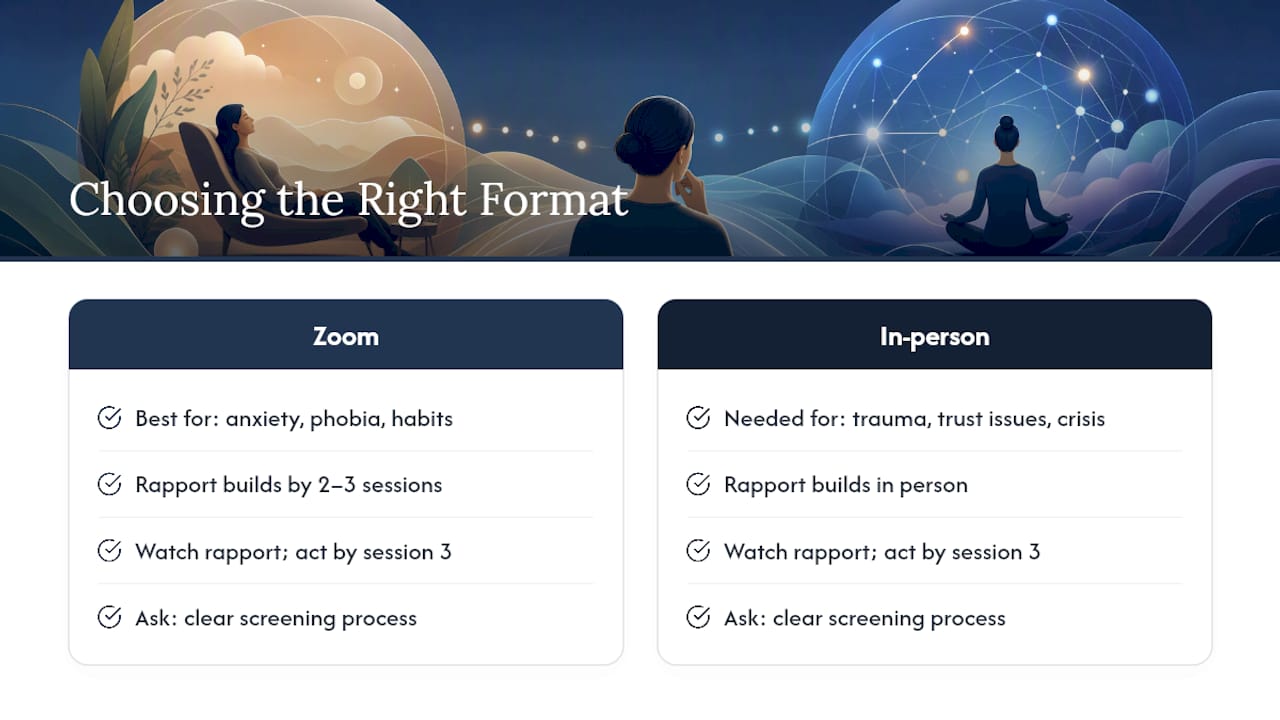
Rapport over video doesn't arrive instantly. It builds the same way it does in person, just through a slightly different channel, and most clients notice it deepen by their second or third session rather than the first. Watch for that shift. If it isn't happening by session three, say so directly.
My one recommendation: before you book anywhere, ask what the screening process looks like. A clinician who can't answer that clearly isn't the one to trust with your subconscious mind.
— Kirk
Ready to Try Hypnotherapy for Anxiety From Home?
Every session runs over Zoom, which means no waiting room, no drive across town, and no taking half a day off work for a 60 minute appointment. New clients are screened on a free consultation call first so you know before you pay whether online hypnotherapy fits your specific situation.
Sessions run about 60 minutes, with 90 minutes set aside for your first appointment to cover intake fully. Most clients receive a personal audio recording afterward to reinforce the work between sessions. If anxiety is what's driving you here, the online hypnotherapy for anxiety page walks through exactly what that looks like. If smoking or a specific habit is the target, the quit smoking program covers that path directly.
Start with a free consultation call and ask Kirk your screening questions before committing to anything.
Sources
- Therapeutic presence and teletherapy observations (PMC10888081)
- Comparing Online Counseling Outcomes: Metaverse and Zoom‐Based Videoconferencing Psychotherapy
- The Emerging New Reality of Hypnosis Teletherapy: A Major New Mode of Delivery of Hypnotherapy and Clinical Hypnosis Training
This article is general information, not a substitute for advice from a qualified doctor. Consult a qualified healthcare professional about your own circumstances before acting on anything here.