
Worthiness hypnosis is a guided hypnotherapy approach that uses suggestion, imagery, and subconscious rehearsal to reduce self-doubt and rebuild a baseline sense of value. It works for most adults dealing with low self-worth, and the evidence supports it as a practical tool, especially when combined with repeated practice or a short clinical program. This is not a vague confidence boost. It targets the specific subconscious beliefs that tell you your value depends on performance, approval, or achievement.
Quick TLDR:
- Who it helps: Adults with chronic self-doubt, fear of judgment, imposter feelings, or anxiety tied to conditional approval
- Formats: Short guided audio recordings (15–20 minutes) or clinician-led online sessions via Zoom
- Timeline: Single sessions produce immediate relaxation and rehearsal; measurable shifts in self-belief typically require 3–8 sessions plus daily reinforcement recordings
- Trusted provider: Hypnotictransformations, led by Kirk Hoffman CCHt (Certified Clinical Hypnotherapist), offers online clinical hypnotherapy for self-worth and anxiety nationwide
Table of Contents
- What worthiness hypnosis does and the benefits you can realistically expect
- How to choose a format and use it effectively
- What happens in an online clinical hypnotherapy program for self-worth
- How hypnosis actually updates worthiness beliefs, plus a short script to try now
- Who should not use hypnosis without medical guidance first
- Key Takeaways
- Why the standard advice on self-worth misses the point
- How Hypnotictransformations approaches worthiness work online
- Useful sources and further reading
What worthiness hypnosis does and the benefits you can realistically expect
The core mechanism is straightforward. Hypnosis guides you into a focused, relaxed state where the conscious critical filter is less active. In that state, the subconscious mind is more receptive to emotionally vivid suggestion. A hypnotherapy session for self-worth uses that window to introduce new beliefs about identity, not just behavior.
Low self-worth almost always traces back to conditional approval learned early. When a child's value was tied to grades, behavior, or keeping a parent calm, the nervous system encoded a rule: "I am acceptable when I perform." That rule runs automatically in adulthood, triggering the fight-or-flight response in social situations, evaluations, or any moment that resembles the original threat. Worthiness hypnosis targets that encoding directly.
Realistic benefits from regular practice or a clinical program include:
- Reduced frequency of self-critical automatic thoughts during social evaluation
- Improved emotional regulation when facing criticism or perceived failure
- Stronger self-trust in decisions, especially where approval-seeking was a pattern
- Better sleep quality when nighttime anxiety is driven by rumination about worth
- Reduced avoidance behavior in situations that previously triggered freeze or shutdown
One session will not rewrite years of conditioning. What it does is give the nervous system a new reference point. Repeated sessions consolidate that reference until the new response becomes the default.
Pro Tip: Set a measurable practice target before you start: 10–15 minutes of guided listening, daily for 21 days, with a brief written check-in each week noting your emotional reactivity in one specific situation. Vague intentions produce vague results.
How to choose a format and use it effectively
Two formats dominate clinical practice, and they serve different needs.

| Format | Session length | Best for | Frequency |
|---|---|---|---|
| Guided audio recording | 15–20 minutes | Daily reinforcement, habit formation, mild-to-moderate self-doubt | Daily, ideally same time each day |
| Clinician-led online session | — | Deep conditioning, complex anxiety, trauma-linked worth issues | Weekly or bi-weekly with recordings between |
| Active-alert self-hypnosis | 10–15 minutes | People who dislike stillness; pairs with walking or movement | Daily, during low-distraction activity |
Short guided recordings are the most scalable entry point. A 15-minute track listened to daily builds the repetition the subconscious needs to treat new beliefs as familiar. Active-alert practice, where you repeat suggestions while walking or standing, is a legitimate alternative for people who find seated relaxation frustrating. Contemporary self-hypnosis methods include this movement-based approach specifically because habit formation strengthens when paired with physical rhythm.
For clinician-led work, the intake session maps your specific triggers before any hypnotic protocol begins. That personalization is what separates a clinical program from a generic recording.
Practical schedule:
- Morning sessions (within 30 minutes of waking) work well because the brain is naturally in a slower wave state and more receptive
- Evening sessions before sleep are effective for emotional processing and reducing overnight rumination
- Avoid listening while driving or operating anything that requires full attention
Pro Tip: Pair each hypnosis session with one small behavioral test the same day. If the session focused on self-trust, make one decision that day without seeking external validation. The subconscious rehearsal transfers faster when it meets a real-world confirmation.
What happens in an online clinical hypnotherapy program for self-worth
A clinical program is not a single session with suggestions layered on top. It starts with a structured intake.
| Phase | Duration | What happens |
|---|---|---|
| Intake and assessment | — | Maps triggers, history, and how conditional approval shows up in your nervous system |
| Targeted sessions | 4–8 sessions | Induction, guided imagery, memory reevaluation, anchoring, future pacing |
| Reinforcement recordings | Between sessions | Daily listening to consolidate new neural patterns |
| Check-in and adjustment | Final 1–2 sessions | Reviews behavioral changes, addresses remaining resistance |
During the intake, a clinician like Kirk Hoffman CCHt identifies where the self-worth issue is most active. Is it at work during performance reviews? In relationships where you over-explain yourself? In the body as a tight chest before social situations? That specificity shapes every session that follows.
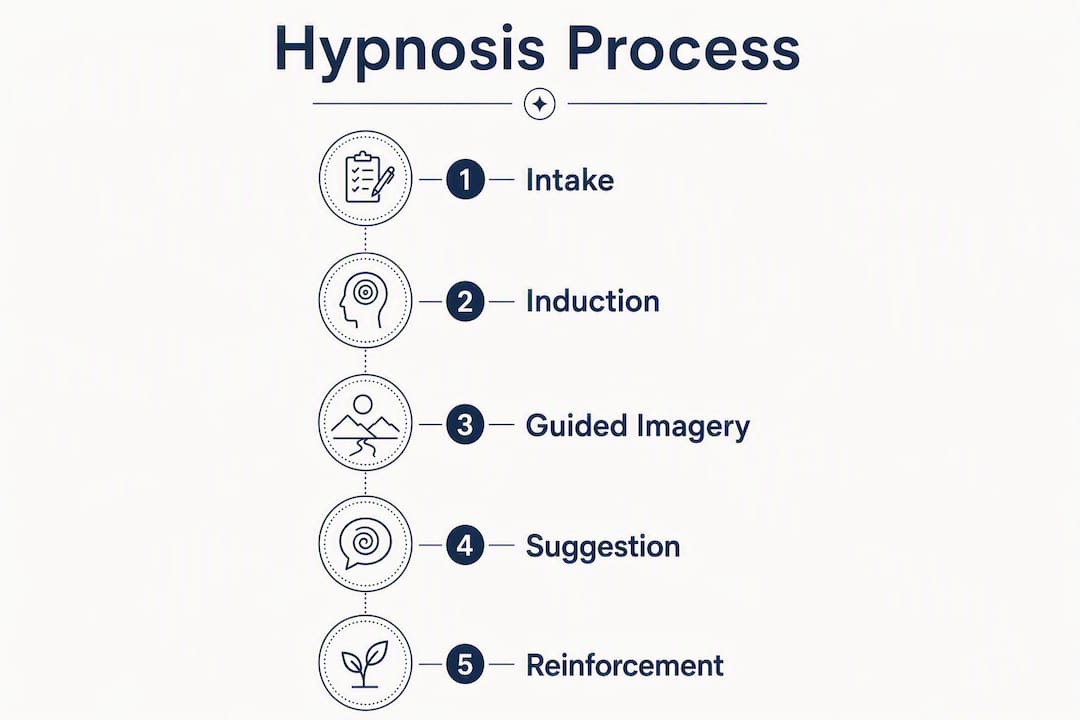
A typical hypnotherapy session moves through induction (guiding you into a focused, relaxed state), guided imagery (placing you in a scenario where you respond from a grounded sense of worth), memory reevaluation (revisiting a past experience with new emotional context), anchoring (pairing a physical cue with the calm, confident state), and future pacing (rehearsing an upcoming real situation from that same state). The nervous system does not distinguish cleanly between a vividly imagined experience and a real one. That is the clinical basis for why rehearsal works.
Practitioner consensus is clear: multi-session programs with reinforcement recordings produce more stable change than a single session. One session often delivers immediate relief and a new felt sense of calm. Durable change in self-belief requires the repetition that consolidates new neural pathways before old avoidance patterns reassert under stress.
How hypnosis actually updates worthiness beliefs, plus a short script to try now
The clinical explanation is not mystical. Hypnosis gives the subconscious mind repeated, emotionally vivid rehearsal of a calm, grounded response. The nervous system treats that rehearsal as experience. Over time, the new response becomes the familiar one, and the old threat-based pattern loses its automatic grip.
Trance is not sleep. You remain aware and can interact with a therapist. What changes is the activity of the conscious critical filter, the part of the mind that immediately counters a positive suggestion with "but that's not true." With that filter quieter, identity-level suggestions land differently.
Short sample script (read slowly, or record yourself):
- Sit comfortably. Close your eyes. Take three slow breaths, exhaling fully each time.
- With each exhale, let your shoulders drop a little more. There is nothing to do right now except be here.
- Repeat slowly, three times: "My worth is not something I earn. It is something I carry."
- Picture yourself in a situation where you usually feel judged. Notice that you are steady. Your breathing is even. You respond from that steadiness.
- Press your thumb and forefinger together gently. Hold for five seconds. This is your anchor. When you feel that pressure in daily life, your nervous system recalls this state.
- Take two slow breaths. Open your eyes.
Practice schedule:
- Week 1: Daily guided listening or the script above, 10–15 minutes, same time each day
- Week 2: Alternate days of guided listening with one behavioral test per day (a decision made without seeking approval, a boundary stated without over-explaining)
- Week 3: Consolidation, reduce to every other day, and schedule a clinician check-in if you are working with a therapist
- Week 4: Assess real-world changes in one specific situation you tracked from the start
Pro Tip: Word your suggestions as identity statements, not performance goals. "I am someone who trusts my own judgment" lands differently in the subconscious than "I will try to be more confident." The subconscious responds to who you are, not what you intend to do.
For a structured step-by-step approach, self-hypnosis for success outlines reinforcement schedules that pair well with clinical sessions.
Who should not use hypnosis without medical guidance first
Hypnosis is safe for most adults, but a few conditions require a medical or psychiatric consultation before starting any hypnotic work.
Do not begin self-hypnosis or guided recordings without professional clearance if you have:
- Active psychosis or a history of psychotic episodes
- Uncontrolled bipolar disorder, particularly during a manic phase
- Severe dissociative disorder or a history of dissociative episodes
- A recent traumatic crisis where memory regression could destabilize rather than help
- Severe panic disorder where sessions may trigger rather than reduce symptoms
"Hypnosis is generally considered safe when performed by a trained therapist. It's not appropriate for people with severe mental illness." — Mayo Clinic
For complex trauma or severe panic, clinician-led sessions are the appropriate starting point, not self-guided recordings. A trained hypnotherapist can monitor your response, adjust the depth of trance, and stop a session if distress increases. Self-hypnosis recordings cannot do that. The clinical approach to anxiety and depression outlines when hypnosis works as an adjunct to medical care and when it should wait for psychiatric stabilization.
Safety practices for self-hypnosis:
- Always practice seated or lying down, never while driving
- Stop any script that increases distress rather than reducing it
- Do not attempt deep memory regression work without a trained clinician present
Hypnosis is an adjunct to medical care, not a replacement for it. If you are currently under psychiatric care, tell your provider you are adding hypnotherapy to your routine.
Key Takeaways
Worthiness hypnosis works by giving the subconscious mind repeated, emotionally vivid rehearsal of a grounded sense of value, and durable change typically requires a multi-session program plus daily reinforcement recordings.
| Point | Details |
|---|---|
| Start with a short daily practice | Try a 10–15 minute guided script today and repeat daily for at least 21 days before evaluating results. |
| Multi-session programs produce lasting change | A single session reduces distress short-term; 4–8 sessions with recordings consolidates new self-worth patterns. |
| Safety screening matters | Anyone with active psychosis, severe dissociation, or recent trauma should consult a clinician before self-hypnosis. |
| Pair rehearsal with real-world tests | Subconscious rehearsal transfers faster when followed by one small behavioral test the same day. |
| Hypnotictransformations offers clinical support | Kirk Hoffman CCHt provides personalized online hypnotherapy for self-worth and anxiety, including intake, sessions, and reinforcement recordings. |
Why the standard advice on self-worth misses the point
Most self-worth advice tells you to think differently. Affirmations, journaling, reframing. The assumption is that if you repeat something often enough at the conscious level, the belief will change. For some people, some of the time, that works. But for anyone whose self-doubt is wired into the nervous system, conscious repetition runs directly into the critical filter that says "you don't actually believe this."
That filter is not a character flaw. It is a protective mechanism. The nervous system learned, usually early, that conditional approval was the rule. Performing well meant safety. Falling short meant something closer to rejection. The body encoded that as a threat response, and threat responses do not update through logic.
What hypnosis does differently is bypass that filter at the moment when the subconscious is most receptive. The suggestion lands before the critical mind can counter it. Repeated sessions mean the new belief gets rehearsed enough times that the nervous system starts treating it as the default, not the exception.
The piece most people underestimate is the behavioral testing. Subconscious rehearsal is necessary but not sufficient. The new belief has to meet a real situation and survive it. That is what makes the change durable. A session that ends at the recording and never touches real life will fade under stress. A session followed by one small act of self-trust that day starts building evidence the subconscious can use.
True confidence is not the absence of self-doubt. It is the capacity to stay steady while self-doubt is present. Hypnosis trains the nervous system for that steadiness, one session at a time.
How Hypnotictransformations approaches worthiness work online
If you have read this far and recognized yourself in the conditional approval pattern, the avoidance, the freeze response before situations where you feel evaluated, a guided recording is a good first step. A clinical program is the right step when that pattern runs deep.
Hypnotictransformations offers online clinical hypnotherapy with Kirk Hoffman CCHt, conducted via Zoom, available nationwide. The intake session maps your specific triggers and history before any hypnotic protocol begins. From there, a personalized session plan typically runs 4–8 sessions, with reinforcement recordings between appointments and practical homework to test changes in real situations.
This is not a subscription or a generic audio library. Each session is built around your specific patterns. Kirk uses guided imagery, anchoring, memory reevaluation, and NLP techniques tailored to what came up in your intake. The goal is a measurable shift in how you respond in the specific situations where self-doubt has been loudest.
To get started, book a consultation or review the full range of online hypnotherapy services to find the right fit for your situation.
Useful sources and further reading
- Mayo Clinic: Hypnosis overview and safety guidance
- Choosing Therapy: Hypnosis for confidence, how it works and effectiveness
- Open Lotus Sound: Guided hypnosis for worthiness and abundance (15-minute recording)
- Adam Eason: Improving self-esteem naturally with self-hypnosis, including active-alert methods
- Hypnotictransformations: Online hypnotherapy for anxiety and self-worth with Kirk Hoffman CCHt
- Hypnotictransformations: Hypnotherapy for anxiety and depression, evidence and safety