
Timeline Therapy hypnosis is a structured technique that locates and releases the emotional charge tied to past memories, so a specific fear or anxiety pattern stops firing the way it used to. It works well for anxiety, phobias, and limiting beliefs when guided by a trained practitioner. It is not recommended as a stand-alone approach for active, severe trauma without clinical oversight.
TL;DR:
- Timeline Therapy releases the emotional charge from specific past events, often reducing anxiety and phobias after one to four sessions, depending on complexity.
- Practitioners guide clients through a structured process, including locating the earliest related memory and extracting useful lessons, within about an hour per session.
- The technique is most effective for single triggers and less suitable for severe, ongoing trauma or complex trauma cases without additional clinical support.
- While hypnosis has a strong evidence base for some outcomes like pain relief, research on Timeline Therapy specifically remains limited but promising from small studies.
- Certified practitioners should have proper NLP and hypnosis credentials, and caution is necessary if a session involves strong emotions or trauma surfacing unexpectedly.
Table of Contents
- What is timeline therapy hypnosis, and how does it connect to NLP?
- What happens step by step in a timeline therapy session
- What timeline therapy hypnosis can help with
- Who this method suits and where the limits are
- How to find a qualified timeline therapy practitioner
- Does the research back it up?
- Where timeline therapy came from
- Common misconceptions about timeline therapy
- How timeline therapy compares to other hypnosis techniques
- What you might feel during or after a session
- Simple exercises you can practice between sessions
- A clinician's view on timeline work with anxiety clients
- Book Timeline Therapy hypnosis sessions online with Hypnotic Transformations
- Sources
What is timeline therapy hypnosis, and how does it connect to NLP?
Timeline Therapy was developed by Tad James in the 1980s, built on the idea that your mind stores memories along an internal timeline, sequenced from birth to now. Instead of digging into what happened in a past event, the method works with how your nervous system still reacts to it. The official Time Line Therapy Association overview describes the goal plainly: release the emotional charge attached to a memory while leaving the memory itself intact.
This is where neurolinguistic programming (NLP) and hypnosis work together. Hypnosis gets you into a relaxed, focused state where your conscious mind steps back. NLP supplies the visualization techniques, the language patterns, and the timeline model itself, giving the practitioner a map to work from during that state.
A typical session moves through a few recognizable phases:
- Identify the specific emotion causing trouble (panic, dread, shame)
- Trace it back along the timeline to the earliest similar event
- Release the emotional charge at that root event
- Extract a useful lesson from the experience
- Reconnect the memory to the present without the old reaction attached
What happens step by step in a timeline therapy session
A single Timeline Therapy session usually runs around an hour. Some clients do one intensive session focused on a single fear. Others book a short package of multiple sessions when several related issues need work. Session length and structure follow the standard clinical hypnosis format: induction, deepening, suggestion work, and emergence.
Here is roughly how it unfolds:
- Induction. The practitioner guides you into a relaxed, focused state using breathing cues and progressive relaxation. You stay aware the entire time; you are not "under" and you are not asleep.
- Deepening. A few more minutes settle your body further into that relaxed state, quieting the analytical chatter that usually runs in the background.
- Locating the timeline. With your eyes closed, you are asked to imagine your life as a line stretching behind and ahead of you, then to notice where a specific feeling, say, the tightness before a panic attack, first shows up along that line.
- Finding the earliest event. The practitioner guides you back to the earliest memory connected to that feeling. It is often smaller and older than you expected; a criticism at age seven, not the car accident at twenty-five.
- Releasing the charge. Using guided visualization, you observe the event without reliving it in full sensory detail, and the Mayo Clinic's outline of hypnosis stages notes this suggestion phase is where behavior and emotional response are actually addressed.
- Extracting the learning. You are asked what that younger version of you needed to know then. This step turns the old event into information rather than a live threat.
- Future pacing and emergence. You imagine an upcoming situation that used to trigger the fear, now without the old charge attached, then you are brought back to full alertness.
Most clients feel calm and slightly tired right after, similar to waking from a good nap. Mild lightheadedness for a few minutes is common. You should be able to drive and go about your day normally within thirty minutes.
Pro Tip: Write down the "learning" your mind surfaces during the session immediately afterward. That single sentence is often the clearest signal of what your subconscious was actually protecting you from.
What timeline therapy hypnosis can help with
Clients most often seek this method out for anxiety attacks that seem to come from nowhere, phobias tied to a specific memory, and limiting beliefs that block performance at work or in relationships. Because the technique targets the emotional root rather than managing symptoms in the moment, many people notice a shift in reactivity after one to four sessions, though the number varies with how many distinct events are feeding the pattern.
Common areas where clients see change:
- Fewer or less intense panic attacks in triggering situations
- Reduced anticipatory dread before flying, public speaking, or medical procedures
- Clearer decision-making once an old belief ("I always fail at this") loses its grip
- Better focus on goals that used to trigger performance anxiety
For anxiety rooted in ongoing trauma rather than a single past event, Timeline Therapy techniques often work best alongside cognitive behavioral therapy or trauma-focused treatment, not as a replacement for either. The Cleveland Clinic's guidance on hypnosis makes this point directly: hypnosis pairs well with other treatments for trauma related concerns rather than standing in for them.
Who this method suits and where the limits are
Hypnotizability varies from person to person, and it affects how deeply you can engage with the timeline visualization. Most people are hypnotizable enough to benefit, but not everyone responds the same way, and a small percentage find it hard to enter a focused trance state at all.
This approach is not appropriate on its own for a few situations:
- Active, severe post-traumatic stress disorder without a trauma-specialist working alongside the hypnotherapist
- Active suicidal ideation
- Uncontrolled psychosis or dissociative episodes
A competent practitioner watches for strong emotional emergence during the release step and knows how to slow down, ground you, or stop the session if the charge is bigger than expected. If your history includes complex trauma, read what anxiety sufferers should know about hypnosis safety before booking anything.
How to find a qualified timeline therapy practitioner
The trademarked "Time Line Therapy" designation requires practitioners to hold prior certification in both NLP and hypnosis before training in the method itself, which sets a real barrier to entry compared to someone who picked up a weekend course. That layered training matters when a session brings up a strong emotional reaction that needs careful handling.
Before booking, ask a practitioner these questions:
- What is your certification in hypnosis and in NLP, and who issued it?
- How many anxiety or phobia clients have you worked with using this method?
- What is your plan if I have a strong emotional reaction during the session?
- Do you have a clinical background or a referral relationship with a trauma specialist?
Walk away from anyone who guarantees a cure in one session, skips any clinical intake questions, or pushes you to relive traumatic memories in vivid detail. Good practitioners release the charge; they do not need you to suffer through the memory again to do it.
Does the research back it up?
Hypnosis has a real evidence base, though it is stronger for some outcomes than others. A systematic review of meta-analyses found medium-to-large effects for clinical hypnosis across several outcomes, with the strongest evidence for pain and medical procedure related distress. Anxiety outcomes show benefit too, but hypnotizability moderates how much any individual responds.
Timeline Therapy itself has thinner data. One field study found that rescuers who completed four Timeline Therapy sessions showed statistically significant improvement on a standard anxiety measure using a paired comparison before and after treatment. That is a real signal, but it comes from a small sample, and no large randomized trial has tested Timeline Therapy specifically the way hypnosis broadly has been studied.
Effect sizes for clinical hypnosis run medium-to-large across pain, procedural distress, and several anxiety measures, according to a review pooling multiple meta-analyses. Timeline Therapy-specific evidence is smaller in scale but directionally consistent with that broader pattern.
Where timeline therapy came from
Tad James built Timeline Therapy in the 1980s by combining two things that were already circulating in therapeutic circles: neurolinguistic programming, which had emerged a decade earlier from modeling how effective communicators and therapists got results, and clinical hypnosis techniques used for behavior change. James's core contribution was the timeline metaphor itself: the working assumption that your mind organizes memory sequentially, and that you can access and work with that sequence directly through guided visualization under hypnosis.
The method spread through NLP training organizations rather than mainstream psychology programs, which explains why it developed its own certification track and trademark rather than folding into standard clinical hypnotherapy credentials. That separate lineage is also why you will find Timeline Therapy taught inside NLP practitioner certifications more often than inside psychology graduate programs.
Over the following decades, practitioners adapted the core technique for specific applications: phobia work, performance anxiety, weight management, and smoking cessation among them. The underlying mechanic stayed consistent. Find the earliest event carrying a given emotion, work with it under hypnosis, extract what it was trying to teach, and reconnect the memory to the present without the automatic reaction attached.
What has changed more recently is scrutiny. As hypnosis broadly built a stronger academic evidence base through the 2010s and 2020s, Timeline Therapy specifically has drawn small-sample field studies attempting to validate it against standard measures like the GAD-7 anxiety scale, rather than relying purely on practitioner testimonials.
Common misconceptions about timeline therapy
The biggest myth is that Timeline Therapy erases memories. It does not. The method releases the emotional charge attached to a memory. You still remember the event; you just do not feel the same jolt of fear or shame when it comes to mind. If a practitioner claims they can make you forget something, that is not what this technique does and it is a fair reason to question their training.
A second misconception treats hypnosis itself as a loss of control, as if you black out or do whatever the practitioner says. You remain aware throughout an induction and deepening. You can hear everything, you can choose not to follow a suggestion, and you can open your eyes and stop at any point.
A third myth claims one session fixes everything permanently regardless of how complex or long-standing the issue is. Some single-event phobias do resolve quickly. A pattern built from a decade of accumulated stress responses usually takes more than one pass. Anyone promising a universal one-session cure is overselling the method.
A fourth misconception assumes Timeline Therapy is purely a self-help exercise you can do from a podcast or a script online. The visualization sounds simple to describe, but locating the actual earliest root event and managing whatever emotion surfaces when you find it is exactly the part that benefits from a trained guide. Doing it alone on a difficult memory can leave you activated with nowhere to put the feeling.
Finally, some people assume Timeline Therapy is only for trauma. In practice, it shows up just as often for performance anxiety, decision paralysis, and beliefs like "I'm not good enough," none of which require a traumatic backstory to respond well to the technique.
How timeline therapy compares to other hypnosis techniques
Timeline Therapy is one tool inside a broader hypnosis toolkit, and it is not interchangeable with every other approach. Standard suggestion-based hypnotherapy, the kind often used for smoking cessation or weight management, works by planting new suggestions during the deepened state without necessarily tracing a feeling back to its origin. It changes behavior going forward rather than addressing why the old behavior formed.
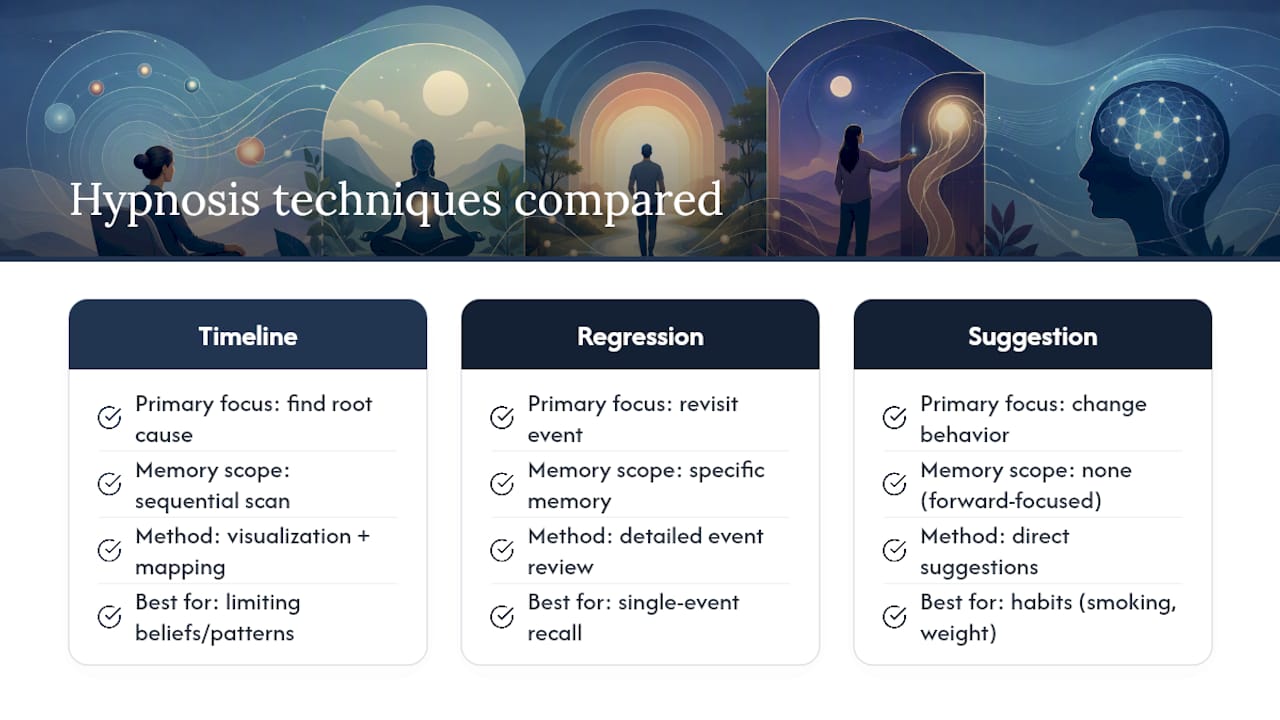
Regression-based hypnotherapy overlaps with Timeline Therapy in that both look backward, but classic regression often revisits a single identified event in detail. Timeline Therapy's distinct feature is the sequential map: you are not just returning to one memory, you are scanning an ordered line to find whichever event is actually the root of a current emotional pattern, which is sometimes not the memory you expected.
Somatic, body-based approaches like Brainspotting take a different route entirely. Rather than working through visualization and language, Brainspotting uses eye position to help the nervous system process stored trauma responses, often without requiring the person to narrate the memory verbally at all. That makes it a useful referral option for clients whose trauma is too activating to approach through the memory-focused, verbal structure that Timeline Therapy relies on.
None of these techniques cancels out the others. A practitioner working with a complex case might use Timeline Therapy for a specific limiting belief and refer out to a trauma specialist using a somatic method for a deeper injury, rather than forcing one technique to cover everything.
What you might feel during or after a session
Most people feel calm, a little tired, and mentally clear after a session, similar to waking from deep rest. That is the expected response, not a side effect to worry about.

Some clients do have stronger reactions worth knowing about ahead of time. Crying during the release step is common and is generally a sign the charge is actually moving, not a problem. A headache or mild disorientation for the first ten to fifteen minutes afterward happens occasionally, usually resolving with water and a few minutes sitting quietly. Vivid dreams the night after a session are also reported fairly often, likely reflecting continued processing while you sleep.
Less commonly, a client discovers a root event that is more significant than expected, sometimes involving trauma they had not planned to address that day. A well-trained practitioner will pause, ground you, and either continue carefully or stop and refer you to additional support rather than pushing through. This is exactly why practitioner training in both hypnosis and NLP matters. The same caution applies whether the surfacing event involves a single scary memory or a pattern connected to an anxiety disorder. Either way, if something bigger than expected comes up, the session should slow down, not speed up.
If you leave a session feeling worse rather than lighter after a day or two, that is worth raising directly with your practitioner rather than assuming it is a normal part of the process.
Simple exercises you can practice between sessions
Timeline Therapy is not designed as a full do-it-yourself protocol, particularly the root-cause release step, but a few supporting exercises can reinforce the work between sessions.
Try a brief timeline scan on your own. Sit quietly, close your eyes, and simply notice: when did this exact feeling first show up in my life? You are not trying to release anything, just building awareness of the pattern's history. That noticing alone often reduces the feeling's intensity slightly, because you stop experiencing it as random.
A future pacing exercise also helps. Picture an upcoming situation that normally triggers your anxiety, and imagine walking through it calmly, step by step, in detail. This rehearses the calmer response your nervous system is learning to default to.
Journaling the "learning" that surfaced in a session, and rereading it before a triggering event, reinforces the new association without requiring a full hypnotic state. None of these self-guided exercises replace working with a trained practitioner on a genuine root-cause release, especially if what surfaces feels bigger than expected. Treat them as maintenance between sessions, not a substitute for the sessions themselves.
A clinician's view on timeline work with anxiety clients
I use timeline techniques inside a single session when a client has one clear trigger they can name. When anxiety shows up in several unrelated situations, I usually recommend a short package instead, because each situation often traces back to a different root event. A first session for an anxiety client starts with intake questions about panic frequency, any trauma history, and what specifically the fear interrupts in daily life, before any hypnosis begins. If your history is complex, read more about how hypnotherapy works or view available sessions before booking.
— Kirk
Book Timeline Therapy hypnosis sessions online with Hypnotic Transformations
Hypnotic Transformations delivers this exact process without requiring you to travel anywhere. Sessions run over Zoom, led directly by Certified Clinical Hypnotherapist Kirk Hoffman, with a focus on anxiety, panic, and phobia work using Timeline Therapy techniques alongside guided imagery and NLP.
A typical first appointment runs 60 to 90 minutes and starts with an intake conversation about what triggers your anxiety and how long the pattern has been running, before moving into the induction and timeline work itself. Booking starts with a free consultation, so you can ask questions about the process before committing to a session or a package. If anxiety and panic are your main concern, the online hypnotherapy for anxiety page outlines exactly what that focused track covers. Ready to see if this fits your situation? Book a session or start with a free consultation through the Hypnotic Transformations services page.
Sources
- Hypnosis: What is it, and how can it help?
- Hypnosis: What It Is, How It Works, Benefits & Risks
- Systematic review of meta-analyses on the efficacy of hypnosis
- Time Line Therapy Association — official overview
- Effectiveness of Timeline Therapy under Hypnosis for the Management of Anxiety among Rescuers