
Hypnosis can change automatic emotional and behavioral responses in many people, but it does not permanently rewrite the subconscious in one session or guarantee a fixed outcome. The evidence is strongest for procedure related anxiety and pain, weaker for habits like smoking, and results depend heavily on the method and the provider. If you want measurable change, the practical path is a screened, goal specific process with a trained clinician, not a generic recording played on a loop.
TL;DR:
- Hypnosis works best for specific, well-defined anxiety triggers and shows limited, inconsistent support for habit changes like smoking cessation.
- Effective sessions follow a structured process involving screening, goal setting, mental rehearsal, and tracking measurable responses, not random scripts.
- Audio recordings are useful for reinforcement in mild cases but cannot substitute clinician-led sessions, especially for trauma or severe mental health issues.
- Safety depends on a licensed, trained provider, and lasting behavior change typically requires several sessions combined with consistent practice.
- Progress is usually seen as a calmer physical response within three sessions and not immediate mental transformation or complete subconscious rewrites.
Table of Contents
- What the Evidence Says About Subconscious Reprogramming Hypnosis
- How a Hypnosis Session Reprograms Automatic Responses
- Self-Hypnosis Recordings vs. Clinician-Led Sessions
- Safety, Contraindications, and How Long Change Actually Takes
- Preparing for Sessions and Tracking Real Progress
- Who Is Behind This Guide
- A Clinician's View on What Real Progress Looks Like
- How Hypnotic Transformations Helps You Take the Next Step
- Sources
- FAQ
What the Evidence Says About Subconscious Reprogramming Hypnosis
The National Center for Complementary and Integrative Health has studied hypnosis for irritable bowel syndrome, procedural anxiety, pain, menopausal symptoms, headaches, and PTSD. Its conclusion is straightforward: results are promising in specific settings but not conclusive across the board, according to NCCIH. That is the honest starting point for anyone hoping hypnosis will erase a fear or a habit outright.
A 2023 meta-analytic overview in Frontiers in Psychology found medium to large effects for several outcomes, with the clearest results showing up in medical-procedure anxiety and pain management. The same review flagged substantial heterogeneity, meaning hypnosis performs noticeably better in some populations and contexts than in others. That is not a flaw in the method. It is a signal that the fit between technique, target, and provider matters more than most marketing admits.
Smoking cessation tells a more cautious story. A Cochrane review found insufficient high-quality evidence that hypnotherapy beats behavioral interventions or no treatment at all. Any benefit that exists is likely small, and the certainty of that evidence is low.
Here is what that body of research means for someone dealing with anxiety or a stubborn behavior pattern:
- Hypnosis tends to work best on anxiety tied to a specific event, procedure, or trigger.
- Habit change, including smoking, shows weaker and less consistent support.
- Individual response varies more than most before and after testimonials suggest.
- Skilled delivery and clear targets matter as much as the technique itself.
The clinical takeaway is not "hypnosis fixes anxiety." It is closer to this: hypnosis can reduce avoidance and calm the body's physiological alarm response for many people, particularly around a defined trigger, but it works as one tool inside a broader plan rather than a single fix.
How a Hypnosis Session Reprograms Automatic Responses
A session that produces real change follows a structure, not a script pulled at random. Here is what that structure typically looks like with a trained provider.
- Screening and goal setting. The clinician asks about your history, current symptoms, and any red flags, then helps you name one measurable target, such as fewer panic episodes per week or tolerating a specific trigger without leaving the room.
- Induction and deepening. You are guided into a focused, relaxed state where your attention narrows and your body's stress response settles. This is not sleep and it is not loss of control.
- Targeted suggestion and rehearsal. The clinician offers specific language tied to your goal, then has you mentally rehearse the calmer response, sometimes pairing it with the exact scenario that usually triggers fear.
- Behavioral rehearsal linked to real exposure. Good sessions connect the mental rehearsal to something you will actually do between sessions, like walking into the situation you have been avoiding.
- Between-session practice and measurement. You track what happened using a simple scale or count, and the clinician adjusts the next session based on that data.
This mirrors what clinical practice notes describe: a responsible session screens for risk, sets an observable target, and assigns homework, because hypnosis does not remove your ability to choose or force you to accept a suggestion. If you want to understand why some people respond faster than others, the differences in hypnotizability play a real role.
Pro Tip: Ask your provider what specific response they plan to measure before your first session. If the answer is vague, the treatment plan probably is too.
Self-Hypnosis Recordings vs. Clinician-Led Sessions
Recordings have a place, but they are not the same tool as a live session with someone trained to read your reactions in real time.
- Well-made recordings help you practice a relaxation response you already learned in session and can reinforce progress between appointments.
- Recordings cannot screen you for trauma history, dissociation, or other risk factors, because there is no clinician present to notice a problem, according to NCCIH.
- Clinician-led sessions adjust the induction and suggestions based on how your body responds in the moment, which matters most for complex or severe presentations.
- Audio-only practice is reasonable for mild, well-defined issues once a clinician has confirmed there is no underlying risk.
- Audio-only practice is not reasonable if you have a trauma history, active panic disorder, or symptoms that interfere with daily functioning.
Red flags that call for a licensed mental-health referral rather than a recording include suicidal thoughts, dissociative episodes, or flashbacks that intensify rather than settle. If any of those apply, hypnosis by itself is not the starting point. A general anxiety hypnosis protocol still needs a clinician's screening first.
Safety, Contraindications, and How Long Change Actually Takes
Hypnosis is considered safe when delivered by a trained, licensed provider, according to NCCIH. That single condition, trained and licensed, does most of the heavy lifting in that sentence.
People with severe trauma, psychosis, dissociation, or an urgent safety concern should get an assessment from a licensed mental-health professional before starting hypnosis. This is not a formality. Relaxation techniques can occasionally increase distress in people with unresolved trauma, and a trained provider needs to recognize that shift and adjust rather than mistake it for resistance.
Timeline expectations matter too. Many clients notice an early shift, a calmer body response in a specific situation, within the first one to three sessions. Lasting behavior change, the kind that holds up months later, usually takes multiple sessions plus consistent practice between them.
Before booking, ask these screening questions:
- What conditions or symptoms do you screen for before starting hypnosis?
- What happens if I have a strong emotional reaction during a session?
- How will we measure whether this is working?
- What is your training and licensing background?
More detail on what "safe" actually means in practice is covered in this breakdown of hypnosis safety.
Preparing for Sessions and Tracking Real Progress
A little preparation turns a vague hope into a measurable process.
- Set up your space. Quiet room, stable internet connection, headphones if you are doing sessions by video, and no driving or operating machinery during or right after.
- Write a baseline before session one. Note how often the trigger occurs, how intense it feels on a 0 to 10 scale, and what you currently do to avoid it.
- Clarify one goal with your clinician. Fewer panic episodes, tolerating a specific place, or resisting a specific urge are all measurable. "Feel better" is not.
- Practice daily between sessions. Ten minutes of self-hypnosis tied to the clinician's plan, plus one small exposure step, moves things faster than sessions alone.
- Log outcomes, not impressions. A daily rating and an honest count of avoidance behaviors tell you and your clinician far more than "I think it's working."
- Revisit the plan every two sessions. If the numbers are not moving, the target or technique needs adjusting, not more of the same.
Pro Tip: Keep your log on your phone, not a notebook you might lose. Three data points a week beats a perfect journal you abandon after day four.
Who Is Behind This Guide
Kirk Hoffman is a Certified Clinical Hypnotherapist who built his online hypnotherapy practice around a screened, goal-based approach rather than one-size-fits-all scripts.
- Every client goes through an initial screening before any session work begins.
- Goals are set as observable changes, such as reduced panic frequency, not vague feelings of improvement.
- Suggestions and rehearsal are tailored to the client's specific trigger and history.
- Follow-up practice between sessions is part of the plan, not an afterthought.
A typical anxiety-focused plan runs a first session that screens and sets a single measurable target, then several follow-up sessions that build rehearsal and homework around real triggers, with progress reviewed every couple of sessions and the plan adjusted based on what the client's own tracking shows.
A Clinician's View on What Real Progress Looks Like
Early progress usually shows up as a calmer body during a trigger, not a dramatic mental shift. Clients report fewer avoidance moments before they report feeling "different." Hypnosis supports a practiced response change. It does not override your choices. Before booking anywhere, ask one question: what response will we measure, and how will I track it?
— Kirk
How Hypnotic Transformations Helps You Take the Next Step
Hypnotic Transformations is built around targeting the subconscious root of a problem instead of just managing symptoms week after week. If your goal is calmer physical responses to specific triggers rather than another round of coping strategies, the Online Hypnotherapy for Anxiety service is built for permanent relief, not temporary management.
If your concern is a habit or belief pattern rather than fear itself, Hypnotic Transformations also offers Online Hypnotherapy for Weight Loss that addresses the subconscious root of eating patterns, Online Hypnotherapy to Quit Smoking & Vaping, and Law of Attraction Hypnotherapy Online for clients working through limiting beliefs tied to their goals.
A first consultation with the hypnotherapist follows the same structure described throughout this guide: screening for risk factors, a clear conversation about what you want to measure, and informed consent before any session work starts. Sessions run over Zoom, so you can work from home with no travel required. If you are ready to see what a structured, measurable plan looks like for your specific situation, view the full service list or book a consultation directly through the appointments page.
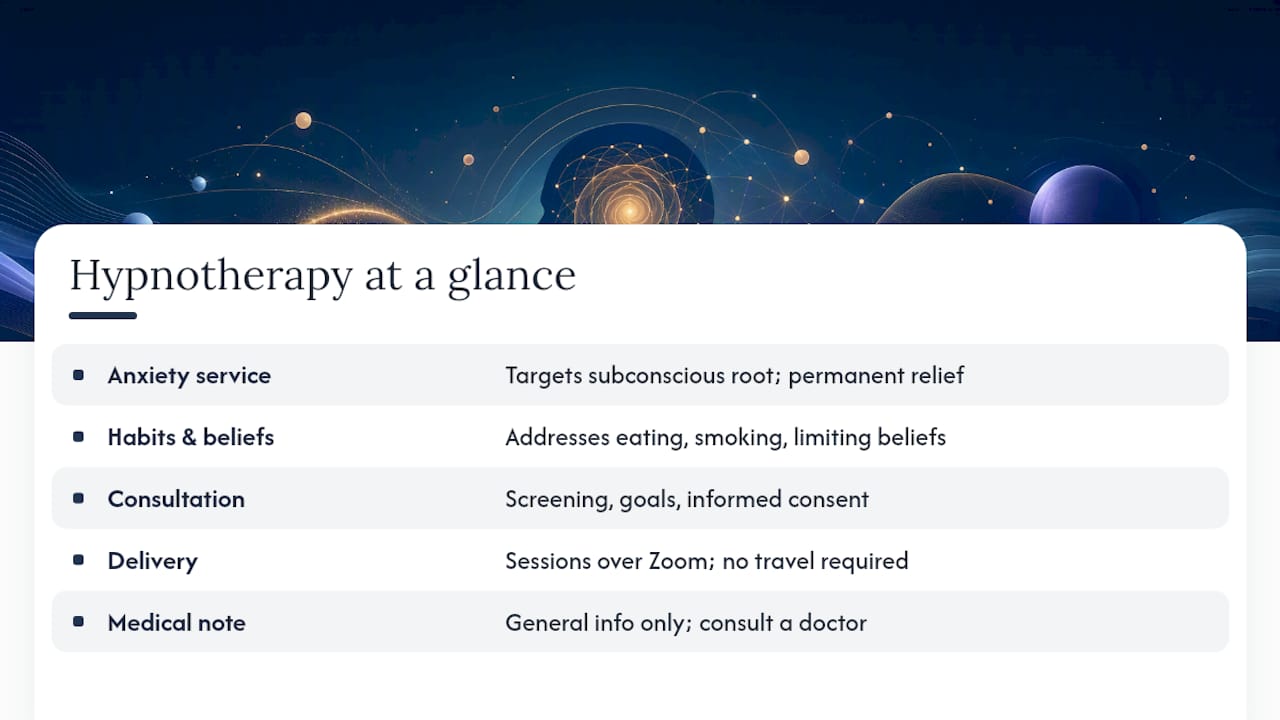
This article is general information, not a substitute for advice from a qualified doctor. Consult a qualified healthcare professional about your own circumstances before acting on anything here.
Sources
- Hypnosis | NCCIH
- Meta-analytic evidence on the efficacy of hypnosis for mental and somatic health issues: a 20-year perspective | Frontiers in Psychology
- Does hypnotherapy help people who are trying to stop smoking? | Cochrane
FAQ
Can Hypnosis Reprogram Your Subconscious Mind?
Hypnosis can change automatic emotional and physical responses to specific triggers for many people, especially around anxiety tied to a defined situation or procedure. It is not a guaranteed or permanent rewrite of every belief, and results vary by target, method, and provider skill, according to NCCIH.
How Many Sessions Does Subconscious Reprogramming Take?
Some clients notice a calmer response within the first one to three sessions, but lasting behavior change usually requires multiple sessions plus daily practice between them. A structured plan with measurable targets, like the approach used in online hypnotherapy for anxiety, tends to move faster than unstructured self-hypnosis alone.
What Is the Best Way to Reprogram the Subconscious Mind?
The most reliable approach combines clinician screening, a single measurable goal, guided suggestion and rehearsal in session, and short daily practice between sessions. Self-hypnosis recordings can reinforce this work but cannot replace individualized screening for complex or high-risk cases.
What Can't Hypnosis Do?
Hypnosis cannot force you to act against your will, cannot verify hypnotic images as accurate memories of past events, and cannot replace licensed mental-health treatment for trauma, psychosis, or dissociation. Memory recovered under hypnosis should never be treated as confirmed history, according to NCCIH.