
Hypnosis can help many people reduce vaping urges and break the automatic reach-for-the-vape pattern, particularly when paired with behavioral supports. The evidence is mixed, as Cochrane-style reviews note, but structured hypnotherapy programs show real promise for motivated adults. Your two clearest next steps right now:
- Try a focused stop-vaping hypnosis audio daily for 2–3 weeks. Commercial MP3 tracks run 30–40 minutes and are built for the withdrawal window. Low cost, low commitment, and a fair test of whether your nervous system responds to suggestion.
- Book a short consultation with a Certified Clinical Hypnotherapist. Kirk Hoffman at Hypnotictransformations offers online sessions via Zoom and can assess your dependence level and recommend a session plan in a single call.
One honest caveat: most clinical trials study cigarette smokers, not vapers. Vaping involves higher daily frequency and easier concealment, so direct evidence for vape cessation hypnosis is thinner than for smoking. That does not mean it fails for vapers. It means you should go in with realistic expectations and a backup plan.
Table of Contents
- How does stop vaping hypnosis actually work?
- What types of hypnosis resources can help you quit vaping?
- What should you expect in a hypnotherapy session?
- What does the research actually show about hypnosis for nicotine cessation?
- How much does hypnotherapy to quit vaping cost?
- How do you choose a hypnotherapist you can actually trust?
- How to use hypnosis audio effectively to reduce vaping urges
- Why Hypnotictransformations and Kirk Hoffman for online vaping cessation
- Key Takeaways
- What most people get wrong about quitting vaping
- Ready to stop vaping? Here is what a session with Hypnotictransformations looks like
- Useful sources and further reading
How does stop vaping hypnosis actually work?
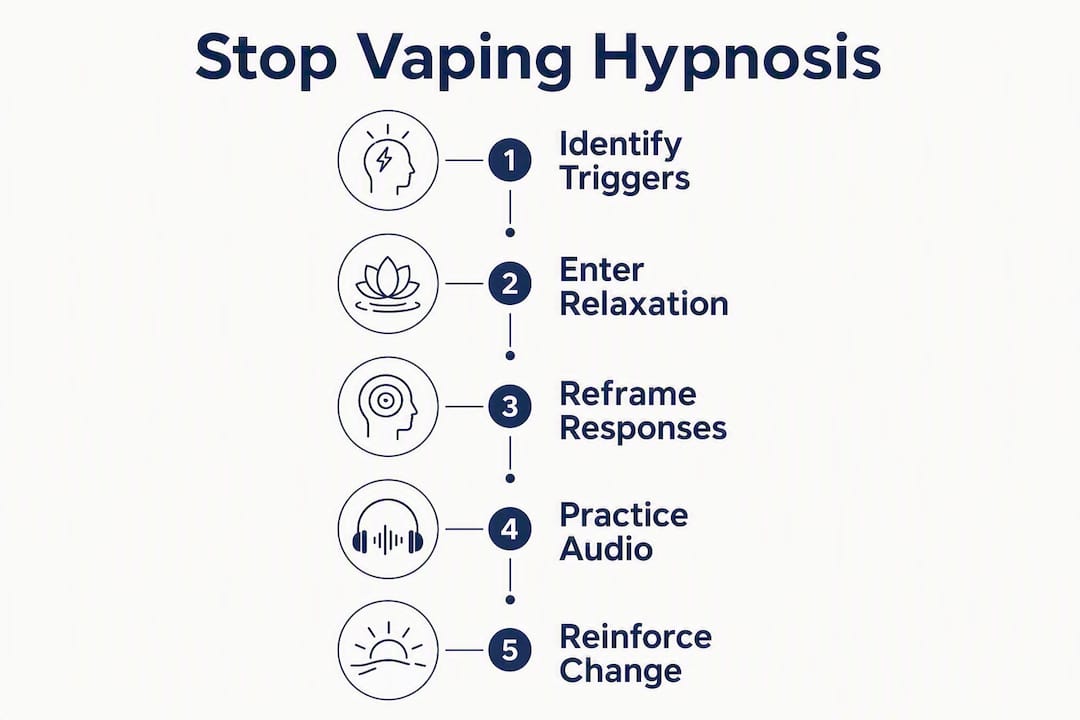
Vaping is rarely a choice you make consciously. It is a habit loop: a trigger (stress, boredom, a break at work) fires an automatic motor routine (hand to pocket, device to mouth), and a brief dopamine hit rewards it. Repeat that loop a few thousand times and the subconscious mind treats it as a fixed program, running it without any deliberate thought.
Hypnosis targets that subconscious layer directly. During a session, the therapist guides you into a state of focused relaxation where the critical, analytical part of the brain quiets down. In that state, the primitive nervous system, the part that runs your fight-or-flight response and your automatic habits, becomes more receptive to new associations. Solution-focused hypnotherapy aims specifically to calm that primitive brain so automatic urges reduce without demanding willpower.
What changes is the association. The trigger that used to fire "reach for the vape" gets paired with a different response: calm, a breath, a neutral feeling. Cognitive-hypnotherapy approaches go further by working with the memory structure around the habit, weakening the emotional pull of the cue itself.
This is why hypnosis feels different from "just deciding to quit." Willpower operates at the conscious level. Hypnosis works one layer below that.
Pro Tip: Before booking a full session, test your responsiveness to guided relaxation. Lie down, close your eyes, and follow a 10-minute body-scan audio. If you find it easy to follow the voice and notice physical relaxation within a few minutes, you are likely to respond well to hypnotic suggestion. If your mind races and you cannot stay with the audio, tell your hypnotherapist — they can adjust the induction approach.
What types of hypnosis resources can help you quit vaping?
Not every format suits every person. Someone who vapes three times a day out of mild habit has different needs than someone who reaches for their device 40 times a day to manage anxiety.
- Audio downloads and MP3 tracks are the lowest-friction starting point. Sessions typically run about half an hour and are designed for daily listening during the initial withdrawal period. They work best for light-to-moderate users who are already motivated and want to test hypnosis before spending on a clinician.
- Subscription apps offer structured programs with multiple tracks, progress tracking, and sometimes community features. Quality varies significantly. Short testimonials on product pages are common; long-term outcome data rarely is.
- Self-hypnosis scripts require more practice to use effectively but give you a tool you can deploy during a craving in real time. They suit people who have already done some guided work and want an on-demand option.
- Live online sessions with a certified hypnotherapist are the highest-evidence format. A clinician can personalize the induction, adjust suggestions based on your specific triggers, and add behavioral homework between sessions. For moderate-to-heavy nicotine dependence, this is the format most likely to produce lasting change.
| Resource type | Typical cost shape | Evidence level | Convenience |
|---|---|---|---|
| Audio / MP3 download | One-time low cost | Low (testimonial-based) | High |
| Subscription app | Monthly fee | Low to moderate | High |
| Self-hypnosis practice | Free after learning | Low (self-directed) | High |
| Live online hypnotherapy | Per session or package | Moderate (RCT-supported) | Moderate |
Audio-first approaches are popular because they let you test your response to hypnotic suggestion before committing to paid clinician sessions. If an audio track produces noticeable relaxation and a reduced urge to vape after two weeks of daily use, that is a reasonable signal to invest in a live program.
What should you expect in a hypnotherapy session?
A typical session with a certified clinical hypnotherapist follows a clear structure. It starts with an intake conversation, usually 10–15 minutes, where the therapist asks about your vaping history, triggers, previous quit attempts, and any anxiety or stress patterns driving the habit. That information shapes everything that follows.

The induction phase guides you into focused relaxation. This is not sleep and not unconsciousness. Most people describe it as feeling deeply calm but aware, similar to the state just before falling asleep. You remain in control throughout. The therapist then delivers targeted suggestions or uses cognitive-hypnotherapy techniques to weaken the automatic association between your triggers and the vaping response. A session typically closes with a debrief and often includes an audio track or written instructions to use between appointments.
Session length runs roughly 60–90 minutes for a full clinical session. Single-session quit programs exist and work for some people, particularly those with lower nicotine dependence and high motivation. A 3–6 session course is more common for moderate-to-heavy users and allows the therapist to layer suggestions, address new triggers as they surface, and reinforce progress.
Most clients notice a reduction in automatic urges within the first one to two weeks. The behavioral pull of the habit, reaching for the device out of routine rather than craving, often takes longer to fade and benefits from pairing hypnosis with simple behavioral substitutes.
Many clients are surprised that the session feels ordinary. There is no loss of control, no dramatic moment. The shift shows up later, when the usual trigger fires and the automatic reach simply does not happen.
What does the research actually show about hypnosis for nicotine cessation?
The honest answer is: mixed. Systematic reviews conclude that evidence on hypnotherapy for nicotine cessation is not definitive. Benefits, where they appear, tend to be modest and inconsistent across trials. One randomized controlled trial found comparable abstinence rates between hypnotherapy and CBT in a structured group program, which is meaningful. Parity with an established behavioral treatment is not nothing.
The bigger limitation for vapers specifically is that most clinical trials study cigarette smokers. Vaping involves different behavioral patterns: higher daily frequency, easier concealment, and often a stronger association with anxiety management. Direct evidence on vaping cessation hypnosis is thin.
A few specific limits worth knowing:
- Around one in four people have low hypnotic susceptibility and may gain limited benefit from suggestion-focused protocols alone.
- Trials reporting strong effects typically include structured multi-session programs with behavioral components, suggesting the active ingredient is often the combined protocol rather than suggestion in isolation.
- Insurance coverage for hypnotherapy cessation programs is rare in the United States. Most plans do not cover it.
The practical takeaway: hypnosis works best as one layer in a multi-modal plan. Combining it with behavioral strategies, such as identifying and disrupting trigger situations, and nicotine replacement therapy (NRT) when dependence is high, covers the gaps that hypnosis alone cannot address. Treating impulsive habit patterns as a behavioral problem alongside the subconscious work tends to produce more durable results.
How much does hypnotherapy to quit vaping cost?
Pricing varies widely depending on the therapist's experience, location, and session format. Cost guidance from practitioners shows that single-session quit offers exist at lower price points, while multi-session packages increase the total investment. Online sessions via Zoom tend to be priced similarly to in-person work, though some therapists offer slightly lower rates for teletherapy.
A few practical moves to lower your cost or test the method before committing:
- Start with a single audio download. At a fraction of the cost of a live session, it tells you whether your nervous system responds to hypnotic suggestion at all.
- Ask for a free or low-cost discovery call before booking a full session. Most reputable hypnotherapists offer one.
- Compare bundled packages against per-session pricing. A 3-session package often costs less per session than booking individually.
- Ask about the refund or follow-up policy before you pay. A therapist confident in their work will have a clear answer.
Most U.S. health insurance plans do not cover hypnotherapy for smoking or vaping cessation. Budget for out-of-pocket costs and factor that into your format choice.
Pro Tip: Ask any prospective hypnotherapist whether they include a reinforcement audio as part of the package. A take-home audio extends the session's effect into your daily routine without adding cost, and it is a standard inclusion at quality practices.
How do you choose a hypnotherapist you can actually trust?
Credentials first. Look for a Certified Clinical Hypnotherapist (CCHt) or equivalent credential from a recognized body such as the National Board for Certified Clinical Hypnotherapists. Clinical training matters more than the number of testimonials on a website.
Credential and logistics checklist:
- Certified Clinical Hypnotherapist or equivalent credential, verifiable
- Specific experience with smoking or vaping cessation (not just general stress work)
- Teletherapy experience and a secure, HIPAA-aware platform (Zoom or equivalent)
- Clear scope of practice and willingness to discuss contraindications
- Written session instructions and take-home audio included
Questions to ask on a discovery call:
- How many sessions do you typically recommend for vaping cessation, and why?
- How do you measure progress between sessions?
- What is your refund or follow-up policy if I do not see results?
- Do you recommend combining hypnosis with NRT or behavioral strategies?
- What platform do you use, and how do you protect client privacy?
Red flags to walk away from:
- Any guarantee of 100% success in one session
- Vague or unverifiable credentials
- Pressure to buy a large package before a discovery call
- No intake process or medical screening questions
- Testimonials as the only evidence offered, with no session structure explained
How to use hypnosis audio effectively to reduce vaping urges
Consistency matters more than intensity. A 30-minute audio listened to daily for three weeks will outperform a single 90-minute session listened to once.
A practical daily routine:
- Choose a fixed time: morning before checking your phone or evening before sleep. Both windows work; pick the one you will actually keep.
- Use headphones. They reduce ambient distraction and deepen the sense of focused attention the audio is designed to create.
- Lie down or sit in a supported position. Do not try to listen while driving or multitasking.
- After the audio, drink water and take two slow breaths before standing. This helps the nervous system transition out of the relaxed state cleanly.
- Keep a brief craving log. Note the time, trigger, and intensity of any urge to vape. After two weeks, review it. Most people see a pattern shift in trigger intensity even if they have not fully quit.
Pair the audio with one behavioral substitute for your most common trigger. If you vape on work breaks, replace the device with a walk, a piece of gum, or a cold drink. The audio weakens the subconscious association; the behavioral substitute fills the gap in the moment.
Common mistakes:
- Expecting full cessation after one or two listens. The subconscious responds to repetition, not single exposures.
- Using audio inconsistently, skipping days, then doubling up. Steady daily use beats sporadic intensive use.
- Ignoring nicotine replacement when dependence is moderate to high. Audio alone does not address chemical withdrawal. NRT handles the physical side while hypnosis handles the behavioral and subconscious side.
Pro Tip: If a craving hits hard mid-day, use a short 5-minute self-hypnosis breath technique: close your eyes, breathe in for four counts, hold for four, out for six, and repeat the phrase from your audio session silently. This activates the same parasympathetic response the full session creates, in a fraction of the time.
Why Hypnotictransformations and Kirk Hoffman for online vaping cessation

Kirk Hoffman is a Certified Clinical Hypnotherapist who runs Hypnotictransformations, an online hypnotherapy practice offering sessions via Zoom for clients across the United States. His work focuses on subconscious re-patterning for smoking and vaping cessation, anxiety, and weight management, using NLP, guided imagery, and advanced hypnotic modalities.
A first session at Hypnotictransformations follows a structured path: intake to identify your specific triggers and dependence level, targeted subconscious re-patterning during the hypnotic state, and a reinforcement audio or homework assignment to use between sessions. Follow-up sessions build on what shifted in the first and address any new triggers that surface during the quit period.
For vapers whose habit is tied to anxiety or stress, the online hypnotherapy for anxiety work runs alongside cessation suggestions, addressing the nervous-system pattern that makes vaping feel necessary in the first place.
Client results vary, and no ethical hypnotherapist guarantees a specific outcome. What Hypnotictransformations offers is a structured, clinician-led process grounded in how the subconscious mind actually forms and breaks habits, delivered in a format you can access from anywhere in the country.
Key Takeaways
Hypnosis addresses the subconscious habit loop driving vaping, and works best when combined with behavioral strategies or nicotine replacement for moderate-to-heavy dependence.
| Point | Details |
|---|---|
| Start with audio | A daily audio of moderate length for several weeks tests your response before you invest in live sessions. |
| Book a consult for higher dependence | Moderate-to-heavy vapers benefit most from a certified clinical hypnotherapist's structured program. |
| Combine with behavioral support | Pairing hypnosis with NRT or behavioral strategies covers gaps that suggestion alone cannot address. |
| Know the evidence limits | Systematic reviews show mixed results; around one in four people have low hypnotic susceptibility. |
| Hypnotictransformations | Kirk Hoffman offers structured online cessation sessions via Zoom; book a discovery call to start. |
What most people get wrong about quitting vaping
The conventional framing of quitting as a willpower problem is the single biggest obstacle I see. People try to white-knuckle through cravings, fail, and conclude they are weak. They are not weak. They are fighting an automatic nervous-system pattern with a conscious-mind tool, and that is a structural mismatch.
Hypnosis does not require extraordinary willpower because it does not operate at the willpower level. It works on the subconscious associations that make the craving feel automatic in the first place. When those associations weaken, the trigger fires and nothing happens. The urge does not build. That is not magic. It is how the nervous system responds when the primitive brain stops treating vaping as a survival behavior.
What I would caution against is treating any single method as a complete solution. The trials that show the strongest results for hypnotherapy almost always include structured behavioral components alongside the suggestion work. The hypnosis handles the subconscious layer. The behavioral work handles the situational triggers. NRT handles the chemistry. None of those three alone is as effective as two or three together.
The readers most likely to succeed with hypnosis are the ones who come in motivated, willing to practice between sessions, and honest about their dependence level. If you vape heavily and have strong physical withdrawal symptoms, tell your hypnotherapist upfront. A good clinician will build that into the plan rather than pretend suggestion alone will cover it.
Ready to stop vaping? Here is what a session with Hypnotictransformations looks like
Quitting vaping through willpower alone has a poor track record for most people. A structured hypnotherapy program addresses the layer of the problem that patches and cold turkey miss: the subconscious pattern that makes reaching for your device feel automatic.
At Hypnotictransformations, a discovery call takes about 20 minutes. Kirk Hoffman asks about your vaping history, your main triggers, and your previous quit attempts. From that, he outlines a session plan, typically one to three sessions for lighter users and a structured course for heavier dependence, and answers any questions about the process before you commit to anything.
Sessions run via Zoom, so there is no commute and no waiting room. You get a reinforcement audio after your first session to use between appointments. Pricing is transparent and discussed on the call.
To book your discovery call or review the full online hypnotherapy services, visit Hypnotictransformations and schedule directly. If your vaping is tied to stress or anxiety, the anxiety-focused hypnotherapy page covers how that work runs alongside cessation.
This article is general information, not medical or clinical advice. If you have significant nicotine dependence or a health condition, consult a qualified healthcare provider before starting any cessation program.
Useful sources and further reading
- teen.smokefree.gov: The U.S. government's quit-vaping resource for young adults, with practical behavioral strategies and NRT guidance.
- National Council for Hypnotherapy (the-ncip.org): Professional body for hypnotherapy standards; useful for understanding practitioner credentials and scope of practice.
- PubMed hypnotizability literature: Primary research database for peer-reviewed studies on hypnotic susceptibility and cessation outcomes.
- Happiful: Advice from a hypnotherapist on how to stop vaping: Practitioner-written explanation of how solution-focused hypnotherapy addresses vaping habit loops.
- Roon: Hypnosis to Quit Vaping: Summary of systematic review findings and what the mixed evidence means for vapers specifically.
- Hypnotictransformations services: Kirk Hoffman's online cessation program details and booking page.