
You can stop smoking naturally without nicotine patches or prescription drugs, but it takes more than willpower. The methods with the most consistent research support are a written trigger-by-trigger plan, timed breathing, short bursts of exercise, distraction and delay tactics for cravings, and some form of structured support, whether that's a quitline, an app, or a counselor.
The American Cancer Society and the CDC both frame quitting as a skill you build, not a single act of resistance. Relapse within several months is common even for well-prepared quitters, so the goal isn't perfection. It's a plan that survives a bad day.
A few situations call for medical guidance before you go the natural route:
- You smoke within five minutes of waking or more than a pack a day (signs of heavy dependence)
- You're pregnant or managing a heart condition
- You've had chest pain, severe anxiety, or fainting during past quit attempts
Key Takeaways
Quitting smoking naturally works best when a written trigger plan, timed breathing, short exercise, and delay tactics are combined rather than used alone.
| Point | Details |
|---|---|
| Cravings peak and fade | Most urges last a few minutes; a timer and breathing protocol can carry you through it. |
| Log triggers first | Track time, place, emotion, and craving strength for three days before quit day. |
| Build if-then scripts | Pair each major trigger with a specific scripted substitute, not a vague intention. |
| Choose your method deliberately | Use the dependence and support checklist to pick cold turkey or gradual reduction, not habit. |
| Consider clinician support | Hypnotic Transformations offers online hypnotherapy for anxiety-driven smoking when behavioral tools alone aren't enough. |
Table of Contents
- How Do You Manage Cravings Without Medication?
- What Triggers Make You Want To Smoke?
- Do Exercise and Relaxation Actually Reduce Cravings?
- What Can You Chew Or Eat Instead Of Smoking?
- Cold Turkey Or Gradual Reduction: Which Works Better?
- How Do You Prepare For Quit Day?
- What Role Does Hypnotherapy Play In Quitting Naturally?
- What Actually Moves The Needle When Quitting Naturally
- A Clinician-Led Option If Natural Methods Aren't Enough
- Frequently Asked Questions
- Sources
How Do You Manage Cravings Without Medication?
A craving to smoke almost always peaks and fades within five to ten minutes. That's not a guess. It's how nicotine withdrawal works physiologically: your brain's dopamine response spikes, then settles, whether or not you feed it a cigarette. Knowing that window exists changes how a craving feels. It's not a wall, it's a wave.
Here's a sequence you can run every time an urge hits:
- Start a timer for ten minutes. Commit to doing nothing about the craving until it rings.
- Sip cold water slowly. The physical act interrupts the automatic reach for a cigarette.
- Chew gum or suck on a hard candy. This keeps your mouth occupied, which matters more than people expect.
- Text or call one person on your support list. Even a two-line exchange breaks the isolation that feeds cravings.
- Walk for two to three minutes, even just around the room or down the hall.
- Breathe on a six-second count, in for four, out for six, for one full minute.
That last step deserves its own explanation. Slow diaphragmatic breathing at around six breaths per minute activates your vagus nerve, which shifts your body out of fight-or-flight mode and toward the parasympathetic "rest and digest" state. Research on nicotine withdrawal confirms that controlled deep breathing measurably lowers self-reported craving intensity. You're not distracting yourself from the craving. You're changing the physiology underneath it.
Pro Tip: Save this exact list as a note on your phone, titled "Craving Plan." When a craving hits, you don't want to think. You want to open the note and follow it.
If you want backup beyond a saved note, mobile app-based interventions raise quit rates meaningfully compared to going it alone, so a quit-tracking app isn't a gimmick. It's a legitimate tool.
What Triggers Make You Want To Smoke?
Most smokers can name two or three triggers off the top of their head, but the real list is longer, and it's specific to you. For three days before you quit, log every cigarette: the time, the place, what you were feeling, how strong the urge was on a scale of one to ten, and what happened right before.
Patterns show up fast. Maybe it's the first coffee of the day, the drive home, or a specific coworker taking a break. Once you know your top four or five triggers, build an if-then plan for each one:
- If I finish a meal, then I brush my teeth immediately instead of stepping outside
- If I get in the car after work, then I put gum in the cup holder before I turn the key
- If I feel anxious in a meeting, then I press my thumb into my palm and do one slow breath cycle
- If a coworker invites me to the smoking area, then I say I'll catch up in ten minutes and go get water instead
Environment matters as much as the script. Remove cigarettes, lighters, and ashtrays from your car, desk, and home before quit day, not after. If a certain walking route or bar always meant smoking, change the route or the seat you take.
One detail people underestimate: the hand-to-mouth motion itself becomes part of the habit, separate from nicotine. Replacing that physical pattern, with a straw, a pen, sunflower seeds, or a stress ball, reduces the restless, fidgety feeling that otherwise gets mistaken for a craving.
Do Exercise and Relaxation Actually Reduce Cravings?
Yes, but with a caveat worth knowing upfront: a Cochrane-reviewed body of evidence shows exercise reliably cuts short-term craving intensity, but it doesn't by itself guarantee you'll stay quit long-term. Treat it as a tool in the kit, not the whole plan.
A 15-minute walk, especially outdoors, lowers both craving intensity and irritability for close to an hour afterward. You don't need a gym. Stairs, a brisk lap around the block, or even bodyweight squats in your kitchen work.

Mindfulness works differently — and medical treatment options for anxiety can sometimes complement behavioral strategies to reduce smoking triggers. Instead of fighting the craving, you observe it: notice where it sits in your body, how it changes over 60 seconds, and let it pass without judging it as good or bad. This matters most for anxiety-driven smoking, where the cigarette has become a stand-in for calming an overactive nervous system.
Micro-routines that fit into a workday:
- Two minutes of box breathing (four seconds in, hold four, out four, hold four) before opening your inbox
- A standing stretch every hour instead of a smoke break
- A five-minute walk after lunch instead of a cigarette
Pro Tip: Pair a new habit with an existing one. If you already make coffee every morning, do 90 seconds of breathing while it brews. You won't need to remember a new routine, just attach it to one you already run on autopilot.
What Can You Chew Or Eat Instead Of Smoking?
Oral fixation is real, and satisfying it with something other than a cigarette reduces urge intensity noticeably. Keep these within arm's reach: sugar-free gum, mints, carrot sticks, raw nuts, sunflower seeds, hard candy, and cinnamon sticks (the smell and taste substitute for the sensory hit of smoke).

On the food and drink side, the evidence is real but limited. A systematic review of herbal preparations for smoking cessation found some trials showing benefit for herbs like St. John's Wort and lavender oil, but results varied too much across studies to recommend any one supplement with confidence. Ginseng tea and black pepper oil show up in smaller studies with similarly mixed results. None of these are a substitute for a real plan, and unregulated stop-smoking supplements carry their own safety risks since they aren't vetted the way medications are.
Storage matters more than people think. Put gum in your car's cup holder, mints in your coat pocket, nuts on your desk. If a substitute takes more effort to reach than a cigarette would, you won't use it in the moment that counts.
Cold Turkey Or Gradual Reduction: Which Works Better?
Both approaches show up constantly in quit stories, and neither is universally right. Cold turkey, quitting on a set date with no tapering, is the method most former smokers report using, and public health guidance treats a firm quit date as a stronger predictor of success than a slow taper. Gradual reduction can work, but it risks stretching out the withdrawal period and, for some smokers, becomes an excuse to never fully stop.
Run through this checklist before choosing:
- Dependence level: if you smoke your first cigarette within 30 minutes of waking, cold turkey with strong support tends to work better than tapering
- Prior attempts: if gradual tapering has failed you twice already, a hard quit date is worth trying instead
- Support in place: cold turkey works best when you've lined up a quitline, app, or person to call before day one, not after
- Medical factors: heart conditions or severe anxiety history mean loop in a doctor regardless of which method you pick
If you try natural methods for four to six weeks and keep relapsing, that's useful information, not failure. It's a sign to add counseling or a quitline, which measurably improves odds even without medication.
How Do You Prepare For Quit Day?
Preparation in the week before matters more than anything you do on quit day itself.
Before you quit:
- Pick an actual date and put it on your calendar
- Throw out cigarettes, lighters, and ashtrays from your home and car
- Tell two or three people your quit date and ask them to check in
- Schedule something active or social for your first three high-risk evenings
On quit day and through week one, replace the rituals tied to your biggest triggers first, usually morning coffee, the post-meal cigarette, and the drive home. Fill high-risk windows, typically mid-morning, right after lunch, and early evening, with a walk, a call, or a task that keeps your hands busy.
A few quit-day basics work because they're simple: leave the house for a walk, chew gum, and keep your hands occupied rather than sitting still waiting out an urge.
If you slip, don't spiral. Log what triggered it, restart your quit clock immediately, and treat the slip as data rather than proof you've failed. Two or three slips in a row is your signal to add outside support, whether that's a clinician, a structured program, or both.
What Role Does Hypnotherapy Play In Quitting Naturally?
The evidence on hypnotherapy for smoking cessation is mixed but real. Some randomized trials find hypnotherapy achieves quit rates comparable to standard counseling, particularly for smokers whose habit is tightly linked to stress or anxiety rather than pure physical dependence. It isn't a guaranteed fix, and no reputable practitioner will tell you otherwise, but it's a legitimate non-medication option worth understanding.
The mechanism isn't mystical. In a deeply relaxed state, a clinician works to re-pattern the automatic cue-response loop, the coffee-then-cigarette or stress-then-cigarette link, that's been reinforced hundreds of times. It also targets the nervous-system arousal underneath anxiety-driven smoking, which willpower-only approaches tend to ignore entirely.
Anxiety-driven smoking rarely responds to advice alone, because the cigarette isn't the real target. It's standing in for an autonomic arousal pattern that needs its own intervention, not just a substitute habit.
At Hypnotic Transformations, Certified Clinical Hypnotherapist Kirk Hoffman runs sessions built around this exact framing:
- Sessions are conducted online, so scheduling doesn't require travel
- Programs typically run as a short series rather than a single session since re-patterning a habit built over years takes more than one visit
- Sessions work alongside the behavioral tools already covered here, not instead of them
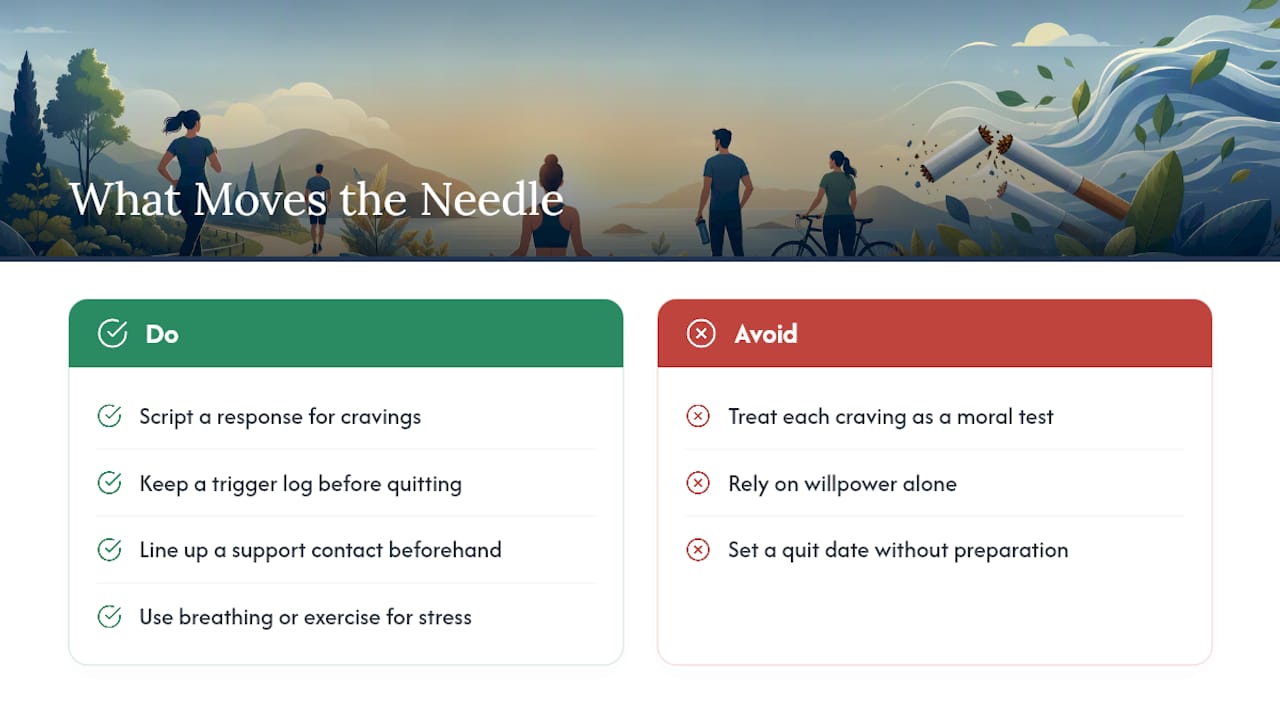
What Actually Moves The Needle When Quitting Naturally
Most quit-smoking content treats willpower as the missing ingredient. It isn't. The smokers who succeed naturally are the ones who stop treating each craving as a moral test and start treating it as a predictable event with a scripted response.
The conventional advice oversells cold turkey as an act of resolve and undersells preparation. A quit date without a trigger log, a breathing habit, and a support contact lined up beforehand is just a hope with a deadline. The data on relapse backs this up: most people who quit without a structured plan relapse within six months, not because they lacked commitment, but because they had no answer ready for the moment a craving hit at 4 p.m. on a stressful Tuesday.
If you smoke mainly under stress, address the stress response directly, through breathing, exercise, or clinician-led work like hypnotherapy, rather than white-knuckling through it. That's not a lesser strategy than raw willpower. For anxiety-driven smokers, it's usually the more direct one.
A Clinician-Led Option If Natural Methods Aren't Enough
If you've tried the behavioral tools above and keep circling back to the same trigger, especially one tied to stress or anxiety, that's not a sign you need more willpower. It's a sign the underlying arousal pattern needs its own attention.
Hypnotic Transformations offers online sessions with Certified Clinical Hypnotherapist Kirk Hoffman, built specifically around re-patterning the cue-response loops behind smoking, particularly for clients whose habit is driven by anxiety rather than physical dependence alone. Sessions run over Zoom, so there's no office visit required, and they're designed to work alongside the trigger plans and breathing techniques covered in this guide, not replace them. If anxiety has been quietly running your smoking habit for years, this addresses that directly instead of asking you to out-willpower it. You can review session details and book a smoking cessation hypnotherapy session to see if it fits where you are right now.
Frequently Asked Questions
Can you really stop smoking naturally without medication? Yes. Many people quit using only behavioral tools like trigger planning, breathing techniques, and support systems, though the CDC notes that combining these with counseling or a quitline improves success odds further.
How long do nicotine cravings last when quitting naturally? Individual cravings typically peak and fade within five to ten minutes, though the overall withdrawal period, irritability, difficulty concentrating, and appetite changes, usually eases substantially within two to four weeks.
What natural remedy works best for smoking cravings? No single remedy outperforms the others consistently. Timed breathing, a brisk walk, and oral substitutes like gum or hard candy each reduce craving intensity, and using them together works better than relying on one alone.
Is cold turkey more effective than gradually cutting down? Setting a firm quit date tends to outperform tapering for most smokers, particularly with support lined up beforehand, though gradual reduction can work for smokers with lower dependence levels.
Does hypnotherapy actually help you quit smoking? Some clinical trials show hypnotherapy achieving quit rates similar to standard counseling, especially for anxiety-driven smoking, though evidence across studies is mixed rather than uniformly conclusive.
This article is general information, not a substitute for advice from a qualified doctor. Consult a qualified healthcare professional about your own circumstances before acting on anything here.