
Hypnosis produces meaningful quit rates for some smokers, but it does not outperform other proven treatments in most head-to-head trials. A 2025 systematic review found that 66.7 percent of 33 included studies showed a positive impact of hypnotherapy on smoking cessation, with the strongest results coming from longer, multi-session programs that used objective verification like carbon monoxide testing. That is a real signal of benefit, not proof that hypnosis beats nicotine patches or medication.
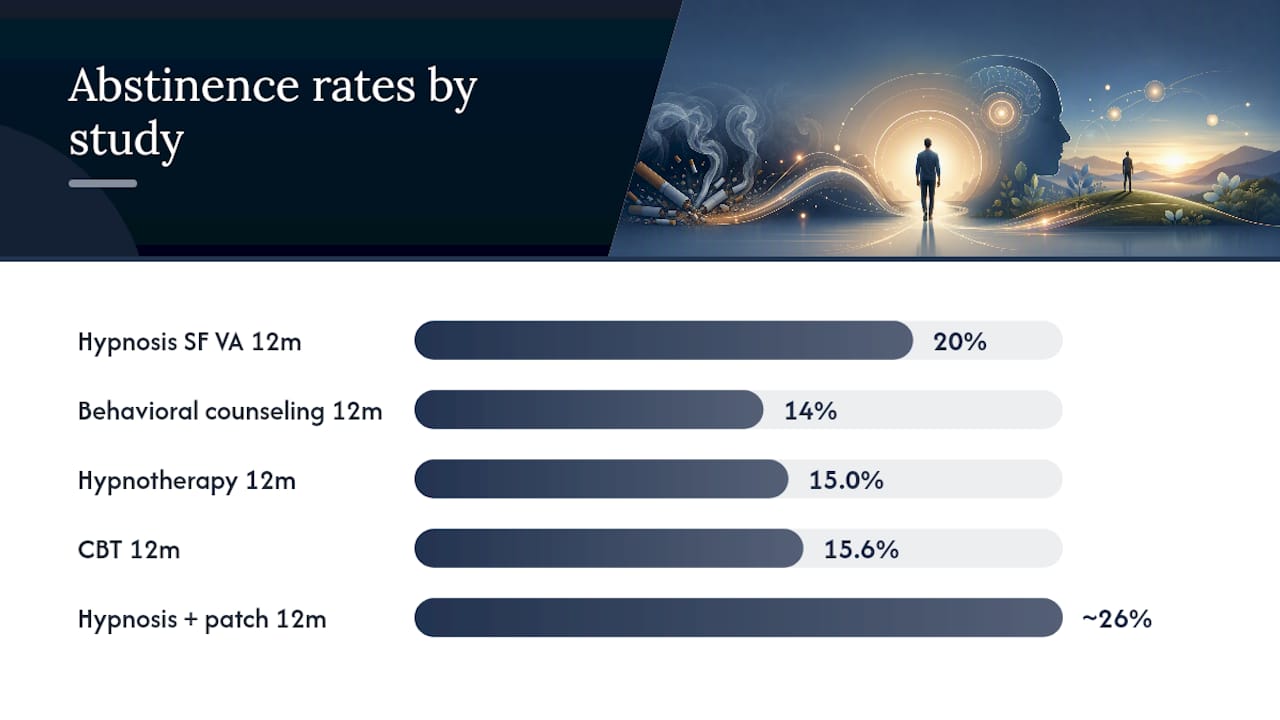
A well-designed randomized controlled trial from the San Francisco VA Medical Center found 20 percent validated abstinence at 12 months in the hypnosis group compared with 14 percent in a behavioral counseling group. Meanwhile, a 2024 RCT comparing hypnotherapy directly to cognitive-behavioral therapy found almost no difference: 15.0 percent versus 15.6 percent continuous abstinence at one year.
So where does that leave you?
- Try hypnotherapy if you've struggled with willpower-based methods, want a non-pharmaceutical approach, or respond well to relaxation and suggestion-based techniques.
- Combine hypnosis with medication or nicotine replacement if you smoke heavily or have failed multiple quit attempts. The evidence supports combination approaches over any single method used alone.
- Prioritize medication first if you have severe nicotine dependence and want the treatment with the largest evidence base behind it.
Key Takeaways
Hypnosis produces meaningful quit rates in roughly two thirds of well-designed studies, but it works best combined with medication or counseling rather than used alone.
| Point | Details |
|---|---|
| Overall evidence quality | A 2025 systematic review found 66.7% of 33 studies showed a positive effect, stronger with longer programs. |
| Hypnosis versus CBT | A 2024 RCT found near-identical 12-month abstinence rates (15.0% vs. 15.6%), suggesting comparable effectiveness. |
| Combined treatment works best | Pairing hypnosis with nicotine patches produced roughly 26% validated six-month abstinence in one RCT. |
| Verification changes the numbers | Biochemically verified studies report lower but more trustworthy rates than self-report studies. |
| Where Hypnotictransformations fits | Offers online, multi-session hypnotherapy for smoking cessation with individualized triggers work and structured follow-up. |
Table of Contents
- What Do Systematic Reviews and RCTs Say About Hypnosis for Quitting Smoking?
- What Do Recent Studies From 2023 to 2025 Add to the Picture?
- How Does Hypnosis Actually Help People Stop Smoking?
- Why Do Reported Success Rates Vary So Widely?
- How Is Smoking Cessation Hypnotherapy Actually Delivered?
- Are There Risks or Reasons to Avoid Hypnotherapy?
- How Do You Find a Qualified Hypnotherapist for Smoking Cessation?
- How Should Hypnotherapy Fit Into a Complete Quit Plan?
- What Should You Do Next If You're Considering Hypnosis?
- A Clinical Hypnotherapist's View on Where Hypnosis Fits
- How Hypnotic Transformations Approaches Smoking Cessation
- Sources
What Do Systematic Reviews and RCTs Say About Hypnosis for Quitting Smoking?
The honest answer is: it's mixed, and that's actually useful information. Systematic reviews pool data from many studies to smooth out the noise of any single trial, and the picture they paint is that of moderate, inconsistent benefit rather than a slam dunk.
The 2025 systematic review is the most current word on the subject. Out of 33 studies reviewed, two thirds reported a positive effect of hypnotherapy on smoking cessation. The review's authors noted that positive outcomes clustered around programs with longer treatment duration and multiple sessions, and that studies using objective confirmation of abstinence, rather than just asking people if they still smoke, tended to produce more credible results. The review also flagged a persistent problem: significant variability in study methods, and a call for future trials to use biologically confirmed abstinence and report on treatment fidelity and hypnotizability, the degree to which a given person responds to hypnotic suggestion at all.
Randomized controlled trials tell a more granular story. Three trials matter most here:
- The San Francisco VA trial found 20 percent validated abstinence in the hypnosis group at 12 months versus 14 percent for behavioral counseling, a meaningful gap in favor of hypnosis in a controlled comparison.
- The 2024 hypnotherapy versus CBT trial found essentially no difference at 12 months (15.0 percent versus 15.6 percent), suggesting hypnosis and CBT may work through overlapping psychological pathways with similar payoff.
- An earlier trial pairing hypnosis with nicotine patches reported validated six-month abstinence around 26 percent in the combined hypnosis group, higher than hypnosis alone in other studies, hinting that hypnosis works best as an add-on rather than a solo act.
Here's a snapshot of how these figures compare side by side:
| Study Type | Comparison Group | Hypnosis Result | Follow-Up |
|---|---|---|---|
| San Francisco VA RCT | Behavioral counseling | 20% vs. 14% validated abstinence | 12 months |
| Hypnotherapy vs. CBT RCT | Cognitive-behavioral therapy | 15.0% vs. 15.6% | 12 months |
| Hypnosis + nicotine patch RCT | Hypnosis alone (historical comparison) | ~26% validated abstinence | 12 months |
| Hospitalized patient RCT | Nicotine replacement + counseling | Higher abstinence for hypnotherapy | Follow-up period |
Sample sizes across these trials tend to be relatively small rather than very large, which matters. A trial with 200 participants can show a real effect, but the confidence interval around that effect is wider than what you'd get from a trial of 2,000. That's part of why reviewers keep asking for more data rather than declaring the question settled.
One more RCT deserves mention: a trial in hospitalized patients found higher abstinence in the hypnotherapy group compared with nicotine replacement therapy plus counseling at the 26 week mark. That's a striking result, and it points to something clinicians have suspected for a while: context and timing change how well hypnosis works.

What Do Recent Studies From 2023 to 2025 Add to the Picture?
The last few years brought sharper trial design and one review that finally pulled the scattered evidence into a single frame.
Three developments stand out:
- The 2025 systematic review is the most comprehensive synthesis to date, covering 33 studies and confirming that program length and verification method drive most of the variance in reported outcomes.
- The 2024 hypnotherapy versus CBT RCT gave clinicians a rare head-to-head comparison between two established behavioral treatments, finding rough parity rather than a clear winner.
- Ongoing trials registered on Clinicaltrials show continued research interest in hypnosis for tobacco dependence, though protocols vary enough that pooling their future results will require care.
Does any of this change clinical practice? Modestly. The 2024 CBT comparison confirms that hypnosis belongs in the same conversation as other established behavioral therapies, not as a fringe alternative. It doesn't clearly outperform CBT, but it doesn't underperform it either, and for a patient who has already tried CBT and relapsed, hypnosis is a reasonable next attempt rather than a long shot.
Pro Tip: When a new study makes headlines with a dramatic quit rate, check three things before you get excited: how many people were in it, whether abstinence was confirmed with a breath or saliva test rather than self-report, and how long they followed up. A 40 percent quit rate at four weeks with no biochemical check means far less than a 20 percent rate confirmed at 12 months.
How Does Hypnosis Actually Help People Stop Smoking?
Hypnosis doesn't erase nicotine dependence chemically. It works on the behavioral and emotional layer that sits on top of the addiction, the part of quitting that has nothing to do with receptors and everything to do with habit loops and stress response.
Four mechanisms are usually cited by clinicians and researchers:
- Suggestion under focused attention. In a relaxed state, the mind becomes more receptive to direct suggestions, like the idea that cigarettes taste unpleasant or that the smoker identifies as a non-smoker.
- Cue reconditioning. Smoking is deeply tied to triggers, coffee, driving, stress, a phone call. Hypnosis works to weaken the automatic link between those cues and the urge to light up.
- Craving and stress regulation. Many smokers reach for a cigarette to calm a stress response. Hypnotic relaxation techniques train the nervous system to downshift out of that state without nicotine, which overlaps closely with how hypnotherapy addresses stress more broadly.
- Improved self-regulation. Post-hypnotic suggestions reinforce a sense of control, helping people notice the urge to smoke and choose differently before acting on autopilot.
A typical session moves through four phases: induction (guiding the person into a relaxed, focused state), targeted suggestion (addressing specific triggers and self-image around smoking), installation of post-hypnotic cues (a phrase, image, or physical gesture the person can use later), and reinforcement (reviewing progress and adjusting suggestions for the next session). Picture it as a funnel: broad relaxation narrows into specific suggestion, then narrows again into a portable tool the person carries out the door.
Why Do Reported Success Rates Vary So Widely?
If you've searched around and found numbers anywhere from 15 percent to 60 percent, you're not imagining things. The variation is real, and it comes down to how each study was built, not how well hypnosis works in some absolute sense.
Reported abstinence rates cluster into rough bands depending on study rigor:
| Study Type | Typical Reported Range | Verification Method |
|---|---|---|
| Uncontrolled/older studies | 20% to 35% at 12 months | Often self-report only |
| Controlled RCTs | 15% to 26% at 6 to 12 months | Mostly biochemically verified |
| Combined hypnosis + NRT | Up to ~26% at 12 months | Biochemically verified |
Older and uncontrolled studies report highly variable six-month abstinence, often in the 20 to 35 percent range, but the quality and verification methods behind those numbers are inconsistent enough that reviewers treat them with caution.
Five factors explain most of the spread:
- Follow-up length. A study measuring abstinence at four weeks will always look better than one measuring at 12 months, because relapse accumulates over time.
- Verification method. Self-reported quitting inflates success rates. Studies using carbon monoxide or cotinine testing report lower but far more trustworthy numbers.
- Sample selection. A study recruiting highly motivated volunteers from a hospital ward after a heart attack will show different results than one recruiting from a general smoking-cessation clinic.
- Treatment intensity. More sessions and longer programs correlate with better outcomes, which the 2025 systematic review flagged directly.
- Hypnotizability. Not everyone responds to hypnotic suggestion equally. Individual variation in suggestibility is rarely measured or reported, which muddies comparisons between studies.
The clearest illustration of intensity mattering: the trial pairing hypnosis with nicotine patches reported roughly 26 percent validated abstinence at six months, a stronger showing than hypnosis-only arms in comparable trials. Add in the finding that people with a history of depression sometimes see higher validated abstinence with hypnosis than with standard counseling in certain trials, and you start to see why blanket statements about "the success rate of hypnosis" fall apart under scrutiny. There isn't one number. There's a range shaped by who is in the study, how long anyone bothered to check, and whether anyone verified the answer with anything more objective than a phone call.
How Is Smoking Cessation Hypnotherapy Actually Delivered?
Clinical trials typically use somewhere between four and eight sessions spread across four to twelve weeks, though protocols vary. Some programs front-load two sessions in the first week to build momentum, then space out follow-up sessions as cravings taper.
Delivery format matters as much as session count:
- Clinician-led individual sessions, in person or via telehealth, allow suggestions to be tailored to the person's specific triggers, history, and relapse pattern.
- Group hypnotherapy sessions cost less per person and add peer accountability, though suggestions are necessarily more generic.
- Recorded self-hypnosis audio, used between clinician sessions or as a lower-cost standalone option, reinforces suggestions but lacks the real-time adjustment a live session offers. A structured self-hypnosis practice can extend the benefit of clinician sessions between appointments.
- Apps and pre-recorded programs are the cheapest and most accessible option, but they cannot adapt to an individual's specific relapse triggers the way a clinician can.
Pricing for individual clinician-led sessions typically runs from moderate per-session fees up to multi-session package rates, with group programs usually priced lower per person than one-on-one work. Costs vary by provider and region, so ask directly rather than assuming a flat national rate.
Pro Tip: Before booking, ask two direct questions: "Do you verify abstinence with anything other than self-report, and what does follow-up look like after the initial sessions end?" A practitioner who has a clear answer for both is signaling a program built on the same principles the better-designed clinical trials use.
Are There Risks or Reasons to Avoid Hypnotherapy?
Hypnotherapy for smoking cessation carries a low physical risk profile compared with pharmaceutical options, but it isn't risk-free or right for everyone.
The most commonly reported issues are mild: temporary lightheadedness after a session, brief anxiety if a suggestion touches on an unexpected memory, or disappointment if expectations were set unrealistically high by a practitioner overselling results. These are more nocebo effects, a negative response driven by expectation, than direct harms from the technique itself.
Certain groups need extra caution. People with active psychosis, severe dissociative disorders, or significant cognitive impairment may not engage safely or productively with hypnotic induction, since the technique depends on focused attention and the ability to distinguish suggestion from reality. A qualified hypnotherapist should screen for these conditions before starting, and refer out rather than proceed if something concerning surfaces.
If you have a diagnosed psychiatric condition, particularly psychosis, bipolar disorder with active mania, or a severe dissociative disorder, talk to your psychiatrist before starting hypnotherapy. Hypnosis is not a substitute for psychiatric stabilization, and a responsible practitioner will ask about your mental health history before your first session, not after.
For most adults without a serious psychiatric diagnosis, hypnotherapy for smoking cessation is a low-risk addition to a quit plan.
How Do You Find a Qualified Hypnotherapist for Smoking Cessation?
Not every practitioner offering hypnosis for smoking is equally qualified, and the gap between a well-trained clinician and someone who took a weekend course is significant.
Ask these questions before booking:
- What certification do you hold, and is it from a recognized clinical hypnotherapy body?
- How many sessions does your smoking cessation program typically involve, and why?
- Do you use or recommend any form of biochemical verification, such as CO monitoring, to track progress?
- What does follow-up support look like after the core sessions end?
- Have you worked with clients who are also using nicotine replacement therapy or prescription medication, and how do you coordinate that?
Watch for red flags along the way:
- Claims of a guaranteed quit rate or a "one session cure," language no legitimate clinical trial supports.
- No mention of follow-up, booster sessions, or relapse planning.
- No willingness to discuss combining hypnosis with medication or nicotine replacement if you're a heavy smoker.
- Vague or absent credentials when asked directly.
Trust signals worth weighing in a practitioner's favor include a named clinical certification, experience with structured multi-session programs rather than single drop-in sessions, and a willingness to talk candidly about the actual range of outcomes rather than promising a specific number. A clinician-led online quit-smoking program built around multiple sessions and structured follow-up reflects the same program features the stronger clinical trials used.
How Should Hypnotherapy Fit Into a Complete Quit Plan?
Clinicians tend to view hypnosis as one component of a broader plan rather than a standalone fix, and the evidence supports that framing, as detailed in post-cessation vaping and lung consequences. Combining hypnosis with medications and counseling produces the most consistent results, rather than relying on any single method in isolation.
A few sample combinations show how this plays out in practice:
- Heavy smoker, multiple failed attempts: nicotine replacement therapy or prescription medication as the primary treatment, hypnosis added for craving and stress management between doses.
- Motivated quitter after a health scare: hypnotherapy as the primary tool, leveraging the higher motivation window that follows a hospitalization, with brief counseling support.
- Smoker with high anxiety around quitting: hypnosis focused on stress regulation, paired with a structured counseling check-in schedule.
Two decision rules help sort where to start:
- If nicotine dependence is severe (a pack a day or more, smoking within minutes of waking), start with medication or nicotine replacement and add hypnosis as a support layer.
- If previous quit attempts failed due to stress, habit triggers, or lack of a mental "hook" for identity change, hypnosis may be the more useful lead treatment.
Relapse is common with every cessation method, not just hypnosis, so build in a follow-up session at the one-month and three-month marks regardless of which approach you start with. A single booster session after a slip is often enough to get back on track without restarting the whole program.
What Should You Do Next If You're Considering Hypnosis?
The evidence is real but modest: hypnosis produces meaningful quit rates in a majority of the better-designed studies, roughly matches CBT head-to-head, and works best as part of a combined plan rather than alone.
Three concrete next steps:
- Get an honest assessment of your smoking history, previous quit attempts, and any psychiatric conditions before choosing a method.
- Combine hypnosis with a proven aid like nicotine replacement or medication if you smoke heavily, rather than choosing one or the other.
- Find a clinician who verifies progress, ideally with CO monitoring or another objective measure, and who schedules follow-up rather than ending after one session.
If your practitioner can build biochemical verification into your plan, even something as simple as periodic CO breath checks, you'll have a far clearer picture of whether the approach is actually working for you.
A Clinical Hypnotherapist's View on Where Hypnosis Fits
I recommend hypnotherapy for smoking cessation most confidently when a client has already tried willpower alone or nicotine gum and relapsed within weeks, usually because the trigger, a stressful commute, a coffee break, an argument, never actually got addressed. Nicotine replacement handles the chemical withdrawal. It does nothing for the fifteen years of muscle memory that says "stressed equals cigarette."
My sessions with quit-smoking clients typically run four to six appointments, spaced a week apart at first, then stretched out as cravings settle. Early sessions focus on identifying specific triggers and reframing self-image around smoking. Later sessions reinforce the post-hypnotic cues the client can use in real moments of craving, at a stoplight, during a work call, after dinner. The clients who do best are the ones who come in already having tried something else and hit a wall, not the ones looking for a single-session miracle.
If you're weighing whether this fits your situation, a short consultation is a low-pressure way to find out.
How Hypnotic Transformations Approaches Smoking Cessation
Hypnotic Transformations offers a structured, multi-session hypnotherapy program for smoking cessation delivered entirely online via Zoom, built around the same principles the stronger clinical trials point to: cue reconditioning, stress regulation, and reinforced follow-up rather than a single scripted session.
This program fits people who have tried nicotine replacement or willpower-based methods and relapsed, people who want a non-pharmaceutical option, and people whose smoking is closely tied to stress or specific daily triggers. It is not the right starting point for someone with an untreated severe psychiatric condition. Kirk Hoffman, a Certified Clinical Hypnotherapist, screens for that during the free initial consultation before any session work begins.
Sessions are conducted individually, tailored to your specific smoking history and triggers rather than a generic script, and structured with follow-up built in rather than ending after one appointment. If you want to see whether this approach fits your situation, book a consultation for the quit-smoking program and Kirk will walk you through what the first few sessions look like before you commit to anything.
Sources
- Systematic review on hypnotherapy and smoking cessation
- Hypnotherapy compared to cognitive-behavioral therapy for smoking cessation in a randomized controlled trial
- Hypnosis for smoking cessation: randomized trial (San Francisco VAMC)
- Hypnotherapy is more effective than nicotine replacement therapy for smoking cessation: randomized trial