
Self hypnosis for success is the practice of deliberately entering a focused, relaxed mental state to communicate directly with your subconscious mind and shift the patterns that hold you back. It works through three phases: induction (relaxing the body and quieting mental noise), suggestion (planting specific, goal-oriented thoughts), and emergence (returning to full alertness). The process targets the subconscious thoughts and limiting beliefs that block confidence and forward movement, not the surface-level symptoms you can reason your way around.
Here is what that looks like in practice:
- Induction: You relax your body and slow your breathing until your mind enters a receptive, daydream-like state
- Suggestion: You introduce clear, positive statements about your goal, paired with detailed mental imagery
- Emergence: You count yourself back to alertness, carrying the new mental associations with you
Self-hypnosis uses focused attention and relaxation to enter a suggestible state that reframes anxiety and habit patterns. Effective sessions typically last 10–20 minutes, an interval supported by research for producing optimal results through focused attention and relaxation. You do not need a therapist to start, but structure and personalization matter more than most people expect.
How self hypnosis addresses the mental blocks that stall success
The reason most people struggle to achieve their goals has less to do with strategy and more to do with what the nervous system is doing underneath conscious awareness. Fear-based thoughts, self-doubt, and old failure memories keep the brain in a low-grade fight-or-flight state. That state is designed for survival, not for focused, creative action.
Hypnosis reduces internal resistance by shifting the nervous system away from fight-or-flight and toward calm, directed clarity. When that shift happens, the subconscious becomes more open to new associations. You stop running old scripts on autopilot and start building new ones.

Holistic psychotherapist Jillian Williams, LISW-S, puts it plainly: "Self-hypnosis is all about developing and using your focus in a goal-directed fashion." That framing matters. This is not a passive process where you lie back and let something happen to you. You are actively training your brain to respond with intention rather than waiting for motivation to show up on its own. Waiting for motivation is one of the biggest barriers to consistent action, and self hypnosis directly addresses that by conditioning the mind to focus independent of emotional state.
Multiple studies support self-hypnosis for improving self-confidence, reducing anxiety, and aiding habit change. A 2019 systematic review found that structured, goal-directed self hypnosis produces moderate to large effects on anxiety, stress, and behavioral outcomes. Three or more practice sessions are commonly required before benefits become noticeable.
Pro Tip: Pair your self hypnosis practice with anxiety-focused hypnotherapy if fear-based thinking is your primary block. A clinical session can identify the specific subconscious patterns your self practice should target.
How to practice self hypnosis step by step
The process below follows the structure validated by the University of Wisconsin's clinical patient handout on self-hypnosis phases and adapted for success-focused goals. Read through it once before your first session so you are not stopping to check instructions mid-practice.
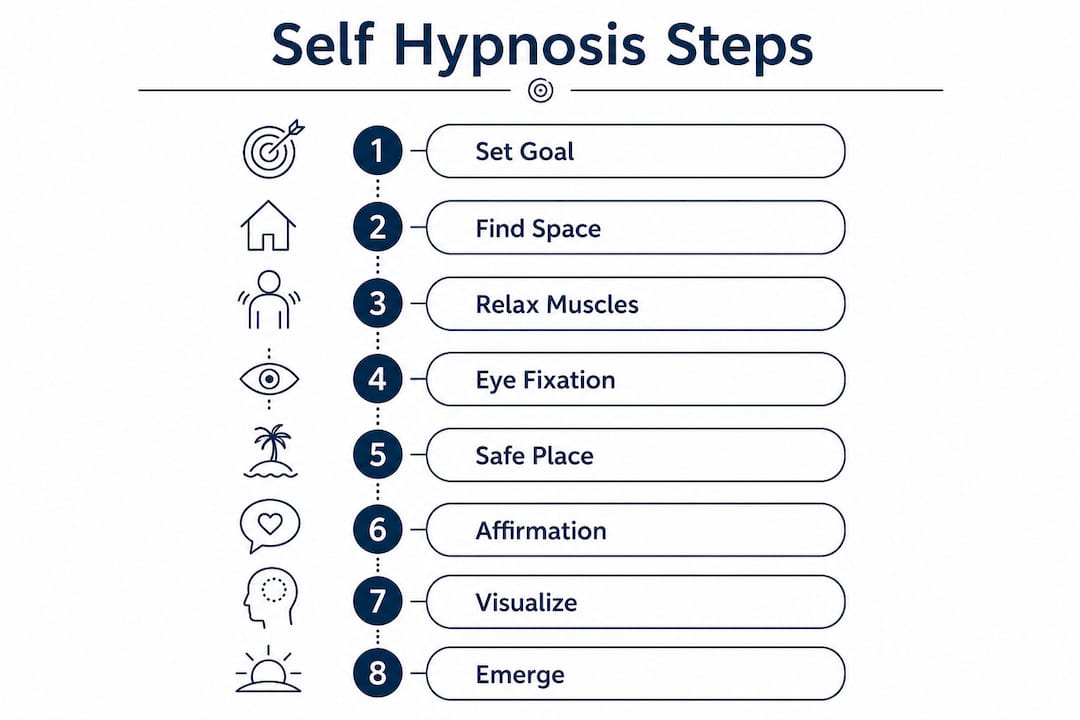
Step 1: Set your goal before you begin. Write down one specific outcome. "I speak confidently in meetings" is workable. "I want to be more successful" is too vague to anchor a suggestion.

Step 2: Find a quiet space and get comfortable. Sit or lie down. Dim the lights if possible. You need a focused period without interruption suitable for relaxation and mental preparation.
Step 3: Begin physical relaxation. Tense each muscle group for a few seconds, then release, starting at your feet and moving upward to your head. This progressive muscle relaxation signals the nervous system to downshift.
Step 4: Use eye fixation to deepen the trance. Eye fixation works well for people with racing thoughts. Fix your gaze on a single point slightly above eye level. Breathe slowly and deeply. With each exhale, let your eyelids grow heavier. When they close on their own, you are ready to move deeper.
Step 5: Visualize your safe place. Picture a location where you feel completely at ease. Use all five senses. What do you see, hear, smell, and feel? Detailed sensory imagery deepens the trance and makes the subconscious more receptive to suggestion.
Step 6: Introduce your suggestion. State your goal as a present-tense affirmation: "I am calm and confident when I present my ideas." Repeat it several times, mentally and with genuine feeling. Direct compassion toward yourself as you do this.
Step 7: Reinforce with visualization for success. See yourself achieving the goal in specific detail. Where are you? Who is there? What does it feel like in your body when it goes well?
Step 8: Emerge slowly. Count from one to five, telling yourself that with each number you are becoming more alert. Wiggle your fingers and toes. Open your eyes when you reach five.
Research supports 10–20 minute sessions as the practical range. Longer sessions do not produce better results and often increase the friction that kills consistency.
Pro Tip: Once you have practiced for a week or two, layer in a physical trigger. Pressing your thumb and index finger together while taking a deep breath conditions your nervous system to drop into a relaxed state quickly, without running the full induction every time.
Common questions and misconceptions about self hypnosis
Does self hypnosis cause you to lose control? No. You remain fully aware throughout the process. Hypnosis increases your focus and receptivity; it does not override your judgment or values. The University of Wisconsin's clinical handout states directly that the popular myth of losing control is false.
How long before I notice results? Most people need at least three sessions before they feel a shift. Common failures include expecting instant results, setting vague goals, and practicing in distracting environments. Consistency across multiple sessions matters far more than any single session.
Is self hypnosis the same as meditation? They share relaxation as a starting point, but the purpose differs. Meditation typically aims at present-moment awareness without attachment to outcome. Self hypnosis is goal-directed. You enter the relaxed state specifically to deliver a targeted suggestion to the subconscious.
What if I cannot seem to enter a trance? That is common early on. Adults often need more practice than children to quiet the analytical mind. If self-induction remains difficult after several weeks, working with a qualified hypnotherapist can identify what is blocking the process. As Williams notes, a professional can teach you techniques like guided imagery and progressive relaxation tailored to how your mind works.
Can self hypnosis replace therapy or other treatment? No. It complements other healthy habits and therapies but should not stand alone, particularly for clinical anxiety, phobias, or trauma. Use it as one tool among several, not as a substitute for professional care.
Reinforcing a success mindset beyond the session
Self hypnosis works best when the rest of your day supports what you practiced. A single 15-minute session cannot override hours of anxious self-talk, poor sleep, and no goal tracking. These complementary practices close that gap:
- Mindfulness and breathing exercises reduce baseline anxiety between sessions, keeping the nervous system out of fight-or-flight so suggestions have somewhere to land. Mindfulness and breathing directly complement hypnosis for stress and behavior management.
- Journaling and goal tracking make progress visible. Writing down what shifted after each session, even small things, builds the evidence your subconscious needs to accept the new belief as real. An anxiety journal structured around mindset and mood can make this habit easier to sustain.
- Physical anchors outside sessions extend the conditioning. Use the thumb-and-index-finger trigger before a high-stakes conversation or presentation. The conditioned response carries the calm state into real-world situations.
- Consistent daily routines reduce decision fatigue and mental noise, which makes it easier to enter a focused state when you sit down to practice.
- Visualization outside formal sessions reinforces the neural pathways built during hypnosis. Spend two minutes each morning picturing the specific outcome you are working toward.
- Professional hypnotherapy for customized support when self practice plateaus. A certified clinical hypnotherapist can identify the exact subconscious pattern blocking progress and design a session around it. Hypnotictransformations offers personalized online sessions with Kirk Hoffman, CCHt, addressing anxiety, confidence, and subconscious blocks to goal achievement.
The goal is not to rely on any single method. Self hypnosis trains the subconscious; the habits above keep the environment consistent with what you are training it to believe.
When to work with a clinical hypnotherapist
Self practice is a real starting point, but it has limits. If anxiety is severe enough to trigger panic responses, or if a specific phobia is driving avoidance behavior, the subconscious resistance may be too strong for self-guided suggestion alone. That is when structured clinical support changes the outcome.
Hypnotictransformations works with adults across the United States via Zoom, targeting the subconscious patterns behind anxiety, fear-based thinking, and the mental blocks that stall personal and professional progress. Kirk Hoffman, CCHt, uses NLP, guided imagery, and advanced hypnotic techniques tailored to each person's cognitive style. A free consultation is available to identify whether clinical hypnotherapy fits your situation.
Book a free consultation and find out what is actually driving the pattern you keep running into.
Key takeaways
Self hypnosis for success works by guiding the subconscious through induction, suggestion, and emergence to build new neural associations that support confidence and goal achievement.
| Point | Details |
|---|---|
| Three-phase structure | Every session follows induction, suggestion, and emergence to shift subconscious patterns. |
| Session length | Research supports 10–20 minute sessions; consistency matters more than duration. |
| Physical trigger | Pressing thumb and index finger together conditions rapid relaxation after regular practice. |
| Minimum practice threshold | Three or more sessions are typically needed before measurable benefits appear. |
| Complement, not replace | Self hypnosis works best alongside mindfulness, journaling, and professional support when needed. |