
Yes, self-hypnosis can improve self-esteem. The mechanism is straightforward: a focused, relaxed state narrows your attention inward and temporarily lowers the critical filter your conscious mind uses to reject new beliefs. That window is when direct suggestions reach the subconscious patterns driving negative self-talk. Your nervous system downregulates out of fight-or-flight, and the habitual voice that says "you're not enough" loses its grip, at least long enough for a different message to land.
Here is a 10-minute micro-practice you can try today:
- Find a quiet, safe place where you won't be interrupted. Sit or lie down.
- Close your eyes and take five slow breaths, exhaling twice as long as you inhale.
- Count down slowly from ten to one, imagining each number sinking you deeper into calm.
- Repeat two present-tense statements to yourself: "I am enough exactly as I am" and "I trust myself to handle what comes."
- Visualize one specific moment from your past where you felt genuinely capable. Hold it for 30 seconds.
- Count up from one to five, open your eyes, and take one more slow breath.
That is the core of self esteem hypnosis in its simplest form. The rest of this guide explains how to do it well, what the evidence says, and when a professional session will get you further than solo practice.
Key Takeaways
Self-hypnosis is a practical, learnable tool for improving self-esteem, and consistent daily practice of 10 to 15 minutes produces measurable shifts in internal dialogue within six to eight weeks for most people.
| Point | Details |
|---|---|
| Self-hypnosis works on real mechanisms | It lowers the critical filter, allowing subconscious suggestions to replace habitual negative self-talk. |
| Daily short sessions beat weekly long ones | Regular short daily sessions, at roughly the same time each morning, often produce faster and more stable change. |
| Combine with CBT or affirmations | Deliver affirmations and CBT reframes during the receptive post-induction state for stronger uptake. |
| Know when to go clinical | Trauma history, persistent panic, or eight weeks of no progress are clear signals to seek professional care. |
| Hypnotictransformations offers structured online sessions | Kirk Hoffman's Zoom-based hypnotherapy targets the subconscious roots of anxiety-driven low self-esteem. |
Table of Contents
- What is self-hypnosis for self-esteem, and how does it work?
- Does hypnosis actually work for self-esteem?
- How to do self-hypnosis for self-esteem, step by step
- A sample self-hypnosis script you can record tonight
- When should you see a clinical hypnotherapist instead?
- How long does it take, and what does it cost?
- Is self-hypnosis safe? Contraindications and precautions
- How to get more out of your self-hypnosis practice at home
- How to combine self-hypnosis with other self-esteem techniques
- What I've seen working with anxiety-driven low self-esteem
- Ready to work with a Certified Clinical Hypnotherapist?
- Sources
What is self-hypnosis for self-esteem, and how does it work?
Self-hypnosis is a self-directed, focused-attention practice. You guide yourself into a state of heightened inward attention and reduced external distraction, which increases your receptivity to suggestion. You are not asleep. You are not unconscious. You are simply less defended, which is exactly what makes suggestion more effective.
The process follows a simple sequence:
- Prepare. Choose a quiet environment, set a timer, and decide your two or three suggestions in advance.
- Induce. Use slow breathing, a countdown, or progressive muscle relaxation to shift your nervous system from alert to calm.
- Suggest and visualize. Deliver your pre-written statements and pair each one with a specific mental image.
- Deepen. Extend the relaxed state with a second countdown or a slow body scan.
- Anchor. Press two fingers together while holding the peak of your positive visualization. This creates a physical trigger you can use later.
- Reorient. Count up slowly, open your eyes, and take a grounding breath.
The targets here are specific cognitive habits: the automatic negative self-talk that fires before you consciously notice it, the attention bias that scans for evidence of failure, and the memory rehearsal loop that replays embarrassing moments on repeat. Practitioner guides describe self-hypnosis as a way to interrupt those loops by changing what the mind rehearses and how it talks to itself.
Pro Tip: Write your suggestions before you sit down. Deciding what to say while you're already in a relaxed state breaks the induction and forces your analytical mind back online.
Does hypnosis actually work for self-esteem?
The honest answer is: the evidence is promising but not definitive, and results vary by person.
Controlled studies and sport-performance research indicate hypnosis and mental rehearsal can influence attention and performance outcomes in some groups, which supports using rehearsal-based suggestions for confidence work. Peer-reviewed clinical guidance notes that hypnosis can support behavioral and emotional change, particularly when integrated with broader mental health care. Clinical-session reports describe improved self-efficacy in clients treated for low confidence and related anxiety triggers.
The strongest signals from the literature:
- Clinical hypnotherapy sessions show consistent promise for anxiety-related confidence issues.
- Mental rehearsal under hypnosis tends to produce more durable self-esteem gains than standalone affirmations, according to practitioner research.
- Hypnosis appears to work partly by altering attention networks and reducing emotional reactivity, not by implanting beliefs wholesale.
- Expectancy and receptiveness matter. People who enter practice with some openness tend to respond more quickly than those who are deeply skeptical.
Realistic expectations matter here. Some people notice a shift in internal tone within two to three weeks of daily practice. Others need six to eight weeks before the change feels stable. A small number respond minimally to self-practice alone and benefit more from clinical sessions. That variance is not a failure of the technique; it reflects individual differences in hypnotic suggestibility and the depth of the underlying pattern.
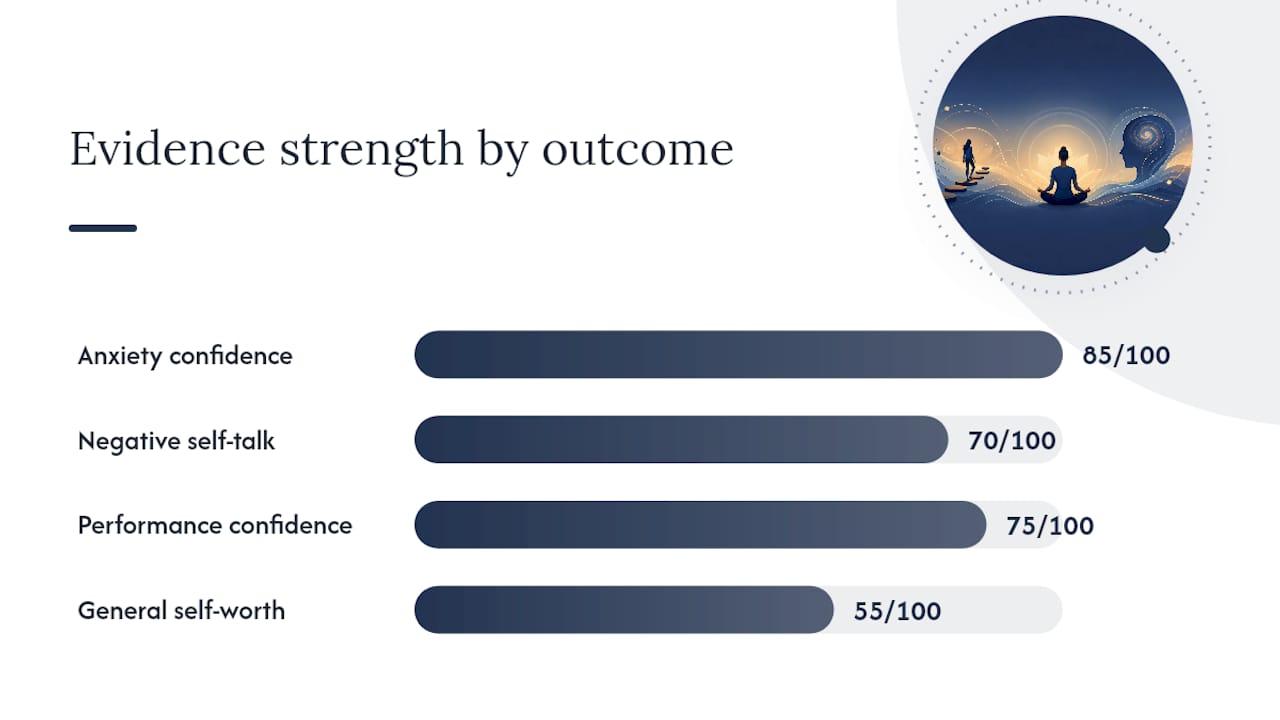
| Outcome area | What the evidence suggests |
|---|---|
| Anxiety-driven low confidence | Consistent clinical support; hypnotherapy often used alongside CBT |
| Negative self-talk reduction | Practitioner reports and controlled studies support rehearsal-based change |
| Performance confidence | Sport and performance literature shows attention and outcome benefits |
| General self-worth | Promising but variable; self-practice works for many, clinical care for complex cases |
How to do self-hypnosis for self-esteem, step by step
This protocol is clinician-informed and safe for most adults practicing alone. Read the safety section before starting if you have a history of dissociation, psychosis, or severe depression.
Pre-session checklist:
- You are in a safe, private space with no driving or operating machinery planned for the next 20 minutes.
- You have written two to three present-tense suggestions specific to your self-esteem goal.
- You have set a soft alarm for 15 minutes so you don't need to watch the clock.
- You are not in acute emotional distress right now. If you are, pause and use a grounding technique first.
The protocol:
- Sit in a comfortable chair with your feet flat on the floor, or lie on your back with arms at your sides.
- Fix your gaze softly on a point slightly above eye level. Take three slow breaths.
- Close your eyes and count down from ten to one, saying each number on an exhale. With each number, imagine your body becoming heavier and your mind quieter.
- Scan your body from head to feet, consciously releasing tension in each area as you go.
- Deliver your first suggestion slowly, in your own voice, in present tense: "I am calm and confident in my own skin."
- Immediately follow it with a specific visualization: see yourself in a real situation where that statement is true. Add sensory detail. What do you hear? What does your posture feel like?
- Repeat with your second suggestion.
- At the peak of the most vivid image, press your thumb and index finger together firmly for five seconds. This is your anchor.
- Count up from one to five, take a deep breath, and open your eyes.
Self-hypnosis practiced this way reduces negative self-talk, rehearses confident behaviors, and strengthens self-compassion through focused suggestion and imagery. Daily practice of 10 to 15 minutes tends to outperform one long weekly session.
Pro Tip: After you open your eyes, immediately do one small action that matches your suggestion. If your suggestion was about confidence in conversation, send one message or make one brief call. The behavioral follow-through cements the subconscious rehearsal faster than repetition alone.
A sample self-hypnosis script you can record tonight
Read this script slowly, or record it on your phone at a pace of roughly one sentence every four seconds. Use a calm, even tone. No dramatic pauses, no theatrical voice.
Close your eyes and take a slow breath in... and out. Let your body settle. Count with me from ten... nine... eight... feeling heavier with each number... seven... six... five... more relaxed now... four... three... two... one.
You are calm. You are safe. In this quiet place, you can hear yourself clearly.
Repeat after me, silently: I am enough. I have always been enough. I trust myself.
Now picture a moment when you felt genuinely capable. See the room, the people, the light. Feel what your body felt then. Hold it.
Press your thumb and finger together. This feeling is yours. You can return to it anytime.
When you're ready, count up from one to five. One... two... three... becoming more alert... four... five. Open your eyes.
Tips for recording or choosing guided audio:
- Record in a quiet room with no background hum. A phone voice memo works fine.
- Speak at 60 to 70% of your normal conversational speed.
- Keep the file under 15 minutes. Longer recordings often lose attention before the suggestion phase.
- Never listen while driving, operating machinery, or in any situation where you need full alertness.
- When choosing a pre-made guided recording, look for a practitioner with named credentials (Certified Clinical Hypnotherapist or equivalent), clear suggestion language, and a structured reorientation at the end. Avoid recordings that make specific medical claims or promise results in a single session.
Pro Tip: Listen to your recording at the same time each day, ideally in the morning before your phone fills with other people's demands. Consistency of timing trains your nervous system to drop into the relaxed state faster over time.
When should you see a clinical hypnotherapist instead?
Self-practice works well for mild to moderate confidence issues, especially when the root is habitual negative self-talk or anxiety-driven self-doubt. But some situations call for a trained clinician.
Seek professional hypnotherapy when:
- Low self-esteem is tied to a history of trauma, abuse, or significant loss.
- You experience persistent panic attacks, severe depression, or suicidal thoughts.
- Self-practice consistently triggers distress rather than calm.
- You've tried self-directed approaches for eight or more weeks with no noticeable shift.
- A licensed mental health provider has recommended adjunct hypnotherapy as part of your care.
A clinical session with a qualified hypnotherapist follows a structured path. Clinical-session descriptions show that therapists begin with a thorough assessment of specific triggers and goals, then guide the client into a focused state where targeted suggestions address the subconscious material driving low self-esteem.
A typical session structure:
- Intake and assessment. The clinician asks about your history, specific triggers, and what you want to change. This is not optional small talk; it shapes every suggestion used.
- Guided induction. A deeper, more controlled induction than most people achieve alone.
- Targeted interventions. NLP reframing, guided imagery, and anchoring techniques tailored to your specific pattern.
- Homework and follow-up. A short daily practice assigned between sessions to maintain momentum.
Questions to ask before booking:
- What is your credential and training background?
- How many sessions do you typically recommend for self-esteem work?
- Do you use a structured protocol or adapt session by session?
- What happens if I feel distressed during a session?
Red flags to avoid: any provider who guarantees results in one session, refuses to discuss their credentials, or discourages you from continuing with your existing therapist or doctor.
How long does it take, and what does it cost?
Timeline estimates:
- Self-practice: many people notice a shift in internal tone within two to three weeks of daily 10-minute sessions. Reliable, stable change typically takes six to eight weeks of consistent practice.
- Clinical hypnotherapy: self-esteem and confidence work usually involves multiple sessions. Complex cases with trauma history may require additional care.
- Maintenance: after initial gains, two to three self-practice sessions per week is usually enough to sustain the change.
Typical U.S. pricing (verify directly with providers, as rates vary):
Insurance coverage for hypnotherapy in the U.S. is limited. Most private health insurance plans do not cover standalone hypnotherapy sessions. Some plans cover sessions when billed under a licensed mental health provider's credentials (psychologist, licensed counselor) using a recognized diagnostic code. Always confirm with your insurer before assuming coverage.
Is self-hypnosis safe? Contraindications and precautions
For most adults, self-hypnosis is safe. The state itself is similar to focused daydreaming. You remain in control throughout and can reorient yourself at any time.
Do not practice self-hypnosis without clinical supervision if you have:
- Active psychosis or a history of psychotic episodes.
- Uncontrolled bipolar disorder, particularly during manic phases.
- Current suicidal ideation or a recent suicide attempt.
- Severe dissociative disorder (e.g., dissociative identity disorder).
- Epilepsy triggered by relaxation states (rare but documented).
Published clinical guidance supports referral for complex psychiatric comorbidity rather than sole reliance on self-hypnosis. If you are already working with a therapist or psychiatrist, tell them you are adding self-hypnosis to your routine. Most will support it; some may want to guide the suggestion content.
Basic safety procedures:
- Never practice while driving, cycling, or operating any machinery.
- Set a soft alarm before each session so you reorient on schedule.
- Practice in a physically safe environment where you won't fall or be startled.
- If a session triggers unexpected distress, count up from one to five, open your eyes, and ground yourself with five slow breaths before doing anything else.
Pro Tip: If you're new to self-hypnosis and have a history of anxiety, start with just the breathing and countdown. Skip the suggestion phase entirely for the first three sessions. Let your nervous system learn that the relaxed state is safe before you add content.
How to get more out of your self-hypnosis practice at home
Consistency matters more than session length. Short daily practice beats one long weekly session. Beyond that, a few specific habits separate people who see real change from those who plateau.

Practice at the same time each day. Your nervous system responds to routine. Morning sessions, before the day's demands activate your stress response, tend to produce faster induction and cleaner suggestion uptake.
Track your internal dialogue outside sessions. Keep a simple note on your phone. When you catch a negative self-statement during the day ("I'm terrible at this," "They must think I'm an idiot"), write it down. Use it as raw material for your next suggestion. The more specific your suggestions are to your actual patterns, the faster they work.
Use your anchor in real situations. The thumb-and-finger press you built during practice is only useful if you actually use it. Press it before a meeting, a difficult conversation, or any moment where your self-esteem usually takes a hit. The nervous system association builds through repetition.
Review your suggestions every two weeks. What felt true to work toward in week one may feel too easy or too vague by week four. Adjust the language to stay slightly ahead of where you are, not so far ahead that it feels false.
How to combine self-hypnosis with other self-esteem techniques
Self-hypnosis works well alongside other approaches. The key is sequencing them so each one reinforces the others rather than competing for attention.
With affirmations: Affirmations work better when delivered during or immediately after a self-hypnosis session, not as a standalone habit repeated mechanically throughout the day. The relaxed, receptive state created by induction makes the subconscious far more likely to accept a new statement as true. Practitioner research suggests that building self-trust through small commitments and rehearsal under hypnosis produces more durable gains than affirmations used alone.
With cognitive behavioral therapy (CBT): CBT identifies the specific thought distortions driving low self-esteem. Self-hypnosis gives you a way to rehearse the corrected thought at a deeper level. If your therapist has given you a reframe ("I make mistakes and still have value"), that reframe becomes your hypnotic suggestion. The two approaches target the same pattern from different angles.
With self-compassion practices: Loving-kindness hypnosis pairs naturally with self-esteem work. After your standard suggestion phase, spend two minutes directing the same warmth toward yourself that you'd offer a close friend who was struggling. This is not vague positivity; it is a specific shift in the nervous system's threat response toward the self.
With journaling: Write for five minutes immediately after a session while the relaxed state is still fading. Note what images came up, what felt true, and what felt forced. That data tells you which suggestions are landing and which need to be rewritten.
What I've seen working with anxiety-driven low self-esteem
Low self-esteem and anxiety are almost always tangled together. The anxiety fires first, the self-doubt follows, and most people spend years managing the anxiety without ever addressing the belief underneath it: that they are fundamentally less capable, less worthy, or less safe than other people.
What I've found, working as a Certified Clinical Hypnotherapist with clients whose confidence has been eroded by fear, is that the subconscious does not respond well to pressure. Forcing yourself to "think positively" while your nervous system is still in a low-grade threat state rarely produces lasting change. The hypnotic state works because it removes that pressure. The nervous system settles, the critical filter relaxes, and a new belief has room to be rehearsed without being immediately rejected.
The daily habit I recommend to every client: two five-minute morning sessions, back to back, using the same two suggestions for at least two weeks before changing them. Repetition at that frequency builds a neural groove. You are not trying to convince yourself of something in a single session. You are rehearsing a new response until it becomes the default.
Realistic commitment: many people who practice consistently over several weeks report a noticeable change in how they talk to themselves. That is not a guarantee. It is what I observe. Some people need clinical support to get there, and that is not a failure; it is just a different starting point.
Ready to work with a Certified Clinical Hypnotherapist?
If self-practice has given you a foundation but you're ready for targeted, professional support, Hypnotictransformations offers online hypnotherapy sessions via Zoom, led by Kirk Hoffman, Certified Clinical Hypnotherapist. Sessions address the subconscious patterns behind anxiety-driven low self-esteem using NLP, guided imagery, and structured suggestion protocols, not generic relaxation scripts.
The first step is a free consultation. Kirk reviews your specific triggers and goals, explains what a session will involve, and recommends a realistic session plan. There is no pressure to commit to a package on that call. View available services and book your consultation to get started. If anxiety is the primary driver of your low self-worth, the online hypnotherapy for anxiety page describes that specific work in detail.
Sources
- Hypnosis for Confidence: How It Works, Examples, & Effectiveness
- Self-Hypnosis For Self-Esteem: Boosting Confidence & Self-Esteem Through Self-Hypnosis – Hypnosis Training Academy
- Checking your browser - reCAPTCHA
- Doi
This article is general information, not a substitute for advice from a qualified doctor. Consult a qualified healthcare professional about your own circumstances before acting on anything here.