
You can identify one limiting belief and begin removing it today, using a focused exercise that takes about 20 minutes. No years of therapy required to start. The exercise below uses a technique modeled on the Lefkoe Method, a structured process for finding and dismantling the beliefs that keep you stuck.
Here's the quick version: write down a fear or behavior you can't seem to shake, trace it back to the belief underneath it, then test that belief against real evidence until it loses its grip.
Do this now (15 to 25 minutes):
- Name one situation that triggers fear, avoidance, or a harsh inner voice.
- Ask "what does this mean about me?" until you land on a single sentence (example: "I'm not safe unless I'm in control").
- Write three memories that seem to prove that belief.
- For each memory, write one detail the belief ignores.
- Say the belief out loud. Notice if it feels less true.
This works best if you notice:
- Avoidance you can't logically explain
- Anxiety spikes tied to specific situations, not random ones
- The same self-critical sentence showing up across different areas of life
Pro Tip: Do this exercise before a meal or right after waking up, when your nervous system is calmer and less reactive to the memories you're examining.
Key Takeaways
Removing a limiting belief requires naming it precisely, testing it against real evidence, and reinforcing the new belief until it becomes the automatic response.
| Point | Details |
|---|---|
| Name the belief first | Write it as one present-tense sentence before trying to change it. |
| Use the 20-minute method | Test the memories that "proved" the belief, then rerate how true it feels. |
| Pair CBT with action | Behavioral experiments make cognitive work stick faster than insight alone. |
| Expect an extinction burst | Resistance often spikes briefly before a belief loosens for good. |
| Consider clinical hypnotherapy | Hypnotic Transformations addresses somatic, subconscious fear patterns when self-guided work stalls. |
Table of Contents
- What Is a Limiting Belief and Where Does It Come From?
- How Do You Identify Your Own Limiting Beliefs?
- A 20-Minute Method to Remove a Limiting Belief
- What Evidence-Based Techniques Change Beliefs Long-Term?
- How Does Clinical Hypnotherapy Address Limiting Beliefs?
- How Do You Keep a New Belief From Slipping Back?
- Ready for Guided Support? Here's What a Session Looks Like
- Frequently Asked Questions
- Sources
What Is a Limiting Belief and Where Does It Come From?
A limiting belief is a conclusion your mind treats as fact even though it isn't universally true. It usually sounds like "I'm not good enough," "I'll fail if I try," or "Something bad will happen if I'm not in control." For someone with anxiety or a phobia, these show up as specific predictions: "If I speak in public, I'll humiliate myself," or "If I fly, the plane will crash and there's nothing I can do."
These beliefs don't form randomly. Your brain builds them the same way it builds any other prediction model: through repetition, emotional intensity, and pattern matching. A single bad experience, especially in childhood or during a high-stress event, can get coded as a rule for the future. This is the same mechanism behind learned helplessness, where repeated exposure to an uncontrollable stressor teaches an organism that effort won't change the outcome, even after the situation changes.
The nervous system doesn't file these beliefs as opinions. It files them as survival data. That's why logic alone rarely dislodges them.
Three things make a belief stick:
- Emotional charge. The stronger the fear or shame attached to the original event, the deeper the encoding.
- Repetition. Every time you avoid the feared situation, you confirm the belief was right to protect you.
- Somatic memory. Your body stores the physical sensations (tight chest, racing heart) alongside the belief, so the fear response fires before conscious thought catches up.
Roughly one in three adults will experience an anxiety disorder at some point, and a large share of that anxiety traces back to specific, nameable beliefs rather than vague unease.
How Do You Identify Your Own Limiting Beliefs?
You can't remove a belief you haven't named precisely. Vague dissatisfaction ("I just feel anxious all the time") won't respond to targeted work. A specific sentence will.
- Track the pattern, not the incident. Write down three separate moments this month where you felt the same fear or held back the same way.
- Ask what they have in common. Look for a repeated theme: rejection, failure, loss of control, being judged.
- Use the downward-arrow technique. Take your first thought ("I don't want to speak up in that meeting") and keep asking "and if that happened, what would that mean?" until you hit bedrock ("It would mean I'm not competent"). Therapists rely on this and Socratic questioning precisely because they cut through surface complaints fast.
- Write the belief as one sentence, present tense. Not "sometimes I worry I'll fail," but "I am not capable."
Watch for these red flags in daily life:
- Avoiding a task, call, or conversation without a clear practical reason
- A safety behavior you rely on (over-preparing, checking, staying quiet) that never actually gets tested
- The same negative prediction appearing before unrelated events
Pro Tip: Notice where the fear lives in your body first. Tight throat, shallow breath, clenched jaw. That physical location often points to the belief faster than your thoughts do, because the body reacts before the mind finishes the sentence.
A 20-Minute Method to Remove a Limiting Belief
This protocol borrows its structure from the Lefkoe Method, built around a simple premise: beliefs are conclusions you formed from a small set of memories, and if you can show your mind those memories don't actually prove the belief, the belief loses its hold.
Phase 1: Name it (5 minutes)
- Write the belief in one sentence.
- Rate how true it feels right now, from 0 to 10.
Phase 2: Find the evidence (7 minutes) 3. List the two or three specific memories that "proved" this belief was true. 4. For each one, write down what actually happened, not your interpretation of it.
Phase 3: Test the proof (5 minutes) 5. Ask: does this memory prove the belief, or does it just show one thing happened once? 6. Write an alternative explanation for each memory that doesn't require the belief to be true.
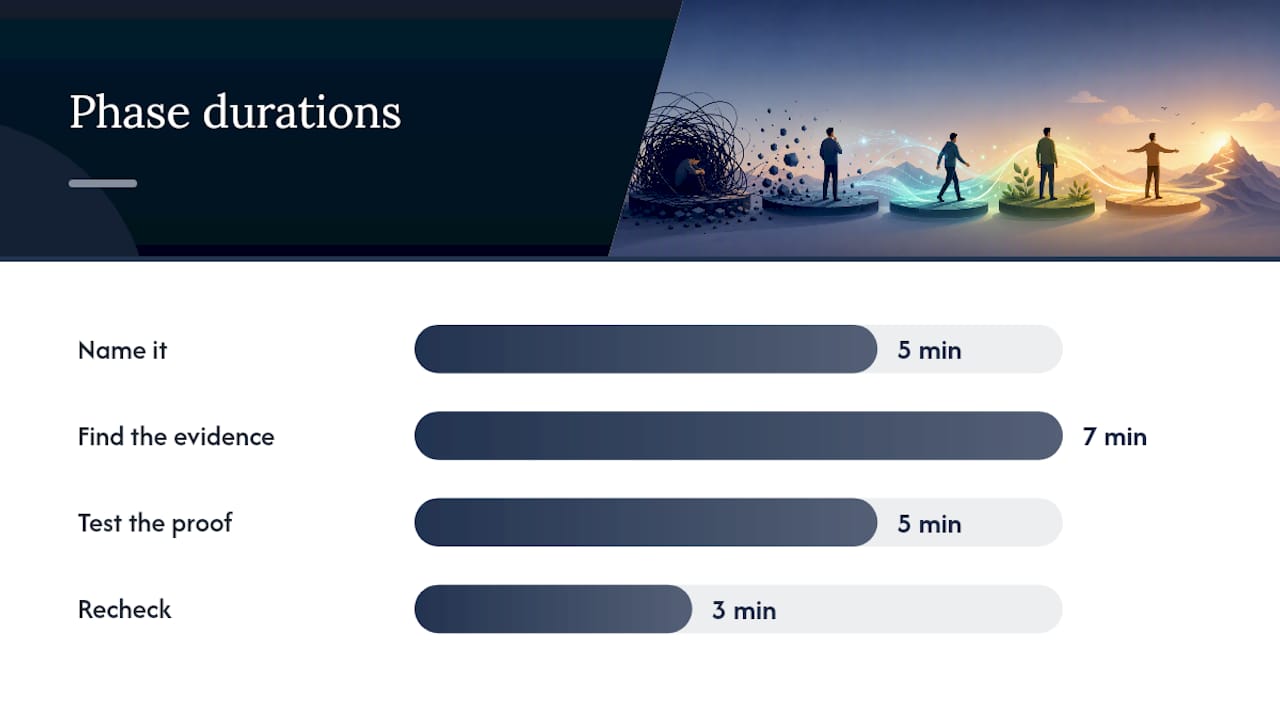
Phase 4: Recheck (3 minutes) 7. Say the original belief out loud again. Rerate it 0 to 10.
Most people see the number drop by at least a few points on the first pass. That's not the belief gone forever. It's the belief weakened enough that new evidence can start to compete with it.
A safety note: if a memory triggers intense panic, shaking, or dissociation, stop and ground yourself (feet on the floor, slow exhale, name five things you see) before continuing. If the emotional intensity doesn't settle within a few minutes, that's a signal to work with a licensed professional rather than push through alone.
Pro Tip: Test the new belief with a small real-world action within 24 hours. If the old belief said "I'll be judged if I speak up," say one honest sentence in a low-stakes conversation and watch what actually happens.
"Permanent" in this context means the belief no longer fires automatically in most situations, not that every trace disappears. Deeper layers, especially ones formed in childhood, sometimes need more than one pass or a different modality entirely.
What Evidence-Based Techniques Change Beliefs Long-Term?
Cognitive behavioral therapy (CBT) remains the most researched framework for challenging limiting beliefs with structure instead of guesswork. It works by identifying the automatic thought, testing it against evidence, and replacing it with a more accurate one.
- Cognitive restructuring: Identify the thought, list evidence for and against it, write a balanced alternative.
- REBT (Rational Emotive Behavior Therapy): Targets the "musts" and "shoulds" underneath anxiety ("I must never fail in public") and disputes them directly.
- Schema therapy: Used when beliefs trace back to early, repeated patterns rather than a single incident. Deeper, longstanding beliefs often respond better to this than to a single fast exercise.
- Behavioral experiments: Design a small, specific test of the belief (example: speak up once in a meeting), predict the outcome in advance, then compare prediction to reality.
Combining cognitive work with behavioral experiments produces more durable change than insight alone, because the brain updates faster when a prediction is tested and disproven in real life rather than just reasoned about on paper.
Belief change isn't a single event. It's evidence accumulating until the old prediction can't hold up anymore.
Here's a realistic timeline for regular practice:
- Week one: The belief feels less absolute. You notice it firing but can question it in the moment.
- Week three: New behavior (speaking up, trying the feared thing) starts to feel less forced.
- Month three: The old belief rarely triggers a full fear response; when it does, you recover faster.
Research on cognitive interventions consistently shows measurable change unfolds over weeks to months, not hours, when the work involves both cognitive and behavioral components.
How Does Clinical Hypnotherapy Address Limiting Beliefs?
CBT works on the conscious, reasoning layer of the mind. Clinical hypnotherapy works on the layer underneath it, the part that fires your fight-or-flight response before you've had a single conscious thought about the situation.
Limiting beliefs tied to anxiety and phobia are often encoded with a strong somatic component: your heart rate spikes, your chest tightens, your body reacts as if the threat is happening now. Hypnotherapy uses a deeply relaxed state to access that encoding directly, working with imagery and targeted suggestion rather than argument and evidence.
A typical session with Hypnotic Transformations follows this structure:
- Intake: Identify the specific fear, its triggers, and how long it's been present.
- Induction: Guide you into a relaxed, focused state where the analytical mind steps back.
- Suggestion and imagery: Work directly with the belief and its emotional charge, often using techniques drawn from NLP and guided imagery.
- Integration: Connect the new response to real situations you'll face this week.
- Home practice: A short daily exercise to reinforce the shift between sessions.
Consider clinical hypnotherapy when self-guided work stalls, when the fear is intense enough to disrupt daily function (panic attacks, phobia, avoidance that limits your life), or when the belief seems to sit beneath conscious reach no matter how much journaling you do.
Some patterns respond to a worksheet. Others need someone trained to work with the nervous system directly, not just the thoughts sitting on top of it.
A Certified Clinical Hypnotherapist (CCHt) has completed accredited training in hypnotic technique, ethics, and scope of practice. In a first appointment, ask what modalities they use, how many sessions they typically recommend for your specific fear, and how they measure progress.
| Approach | Best fit |
|---|---|
| CBT / behavioral experiments | Testable, specific fears with clear predictions to check |
| REBT / schema therapy | Longstanding patterns traced to early or repeated experiences |
| Clinical hypnotherapy | Somatic, high-intensity fear responses or stalled self-guided progress |
Pro Tip: If a fear shows up as a physical reaction (racing heart, freezing, nausea) before you've had a conscious thought, that's usually a sign the belief lives below the level talk-based methods alone can reach.
How Do You Keep a New Belief From Slipping Back?
A belief you've weakened once can return under stress if you don't reinforce it. Treat the first few weeks like retraining, not a one-time fix.
Daily: Take one small brave action tied to the old fear, then log it in a short evidence file. Weekly: Reread that log and add up what it's proving. Monthly: Rerun the belief-rating exercise to confirm the number is still dropping.

Collecting evidence matters more than repeating affirmations. A single sentence noting what actually happened ("Spoke up in the meeting, nothing bad occurred") does more to rewire the prediction than a hundred repetitions of "I am confident."
Watch for these common relapse triggers: high stress weeks, sleep deprivation, and returning to the exact environment where the belief first formed; practicing self-compassion therapy during setbacks can help mitigate these effects. Self-compassion during setbacks matters here too. Treating a slip as data instead of failure keeps the nervous system from re-encoding the old fear response.
Pro Tip: Pair the new belief with a physical cue, like a hand on your chest or a slow exhale, right after a moment that disproves the old fear. The body remembers the pairing, which speeds up how fast the new belief becomes automatic.
What Therapists See When Beliefs Start to Shift
Resistance often gets stronger right before it breaks. Clinicians see this pattern constantly: someone weakens a belief, then the fear spikes harder for a few days as the nervous system tries to reassert its old prediction. That's not failure, it's a known phase, and it usually passes within a week or two.
When someone has tried self-guided CBT tools without lasting change, or the fear is tied to trauma or a longstanding phobia, multiple sessions combining hypnotherapy with cognitive techniques tend to produce steadier results than either approach alone.
Ready for Guided Support? Here's What a Session Looks Like
If the fast exercise above helped but the fear keeps circling back, that usually means the belief is encoded deeper than a worksheet can reach. Hypnotic Transformations offers online clinical hypnotherapy sessions built specifically for that: working directly with the subconscious patterns behind anxiety, panic, and fear-based thinking, not just the thoughts sitting on top of them.
A first appointment runs through your specific fear, how long it's been active, and what's already been tried, then moves into a guided session designed around your exact trigger. Most clients notice a shift in intensity within the first one to three sessions, though longstanding phobias sometimes need a short series to fully settle. A free consultation is available if you want to talk through your situation before committing to a session; come ready to describe one specific fear and one situation where it shows up most.
Explore the anxiety-focused hypnotherapy service with Certified Clinical Hypnotherapist Kirk Hoffman, or book an appointment directly to get a specific time on the calendar.
Frequently Asked Questions
How long does it take to remove a limiting belief? A single focused exercise can weaken a belief's intensity within 20 minutes, but lasting change for anxiety-driven beliefs typically develops over one to three months of consistent practice or one to three clinical sessions.
Can you remove a limiting belief permanently in one session? Some beliefs, especially recent or single-incident ones, can lose most of their charge in one session. Longstanding or trauma-linked beliefs usually need a short series of sessions to fully settle.
What's the difference between CBT and hypnotherapy for limiting beliefs? CBT works with the conscious, reasoning mind through evidence and behavioral tests. Hypnotherapy works with the subconscious layer that drives the fight-or-flight response before conscious thought engages.
When should you seek professional help instead of self-guided exercises? Seek professional support if the fear disrupts daily function, triggers panic attacks, or intensifies rather than eases after a few weeks of self-guided practice.
What does a Certified Clinical Hypnotherapist actually do? A CCHt guides you into a relaxed, focused state and uses targeted suggestion and imagery to work directly with the subconscious patterns behind anxiety, fear, or habitual behavior.
This article is general information, not a substitute for advice from a qualified doctor. Consult a qualified healthcare professional about your own circumstances before acting on anything here.
Sources
- NCBI review article on psychological interventions and cognitive restructuring
- How to Overcome Self-Limiting Beliefs
- The research on self-compassion
- Positivepsychology
- APA journal DOI entry related to cognitive interventions
Read more on the mechanics of anxiety relief in hypnotherapy for anxiety and depression, or explore self-hypnosis practice for daily reinforcement between sessions.