
NLP works on the conscious mind through language and mental rehearsal. Hypnosis works by guiding you into a relaxed, focused state where the subconscious mind becomes more open to new patterns. Neither one wins outright. The right choice depends on what you're dealing with and how ready you are to actively practice versus simply receive.
For a phobia, a panic response, or a fear that hijacks your body before you can think, hypnosis usually gets there faster because it works below the level of conscious resistance. For confidence, communication, or reframing a specific negative thought pattern, NLP techniques can move the needle quickly because you're awake and actively rehearsing the change. Many clinicians, including NLP and Hypnosis: Similarities, Differences, and Synergies, use both in the same session.
A few quick signals for deciding where to start:
- If your fear triggers a physical reaction (racing heart, shaking, freezing), start with hypnosis.
- If your struggle is a specific thought loop or a performance block, start with NLP.
- If nothing has worked before, combining them is often the more reliable path.
Key Takeaways
Hypnosis reaches the subconscious mind through induction, NLP works through conscious language and rehearsal, and combining both often speeds up anxiety treatment more than either method alone.
| Point | Details |
|---|---|
| Match method to trigger | Use hypnosis for phobias and physical panic responses; use NLP for confidence and reframing tasks. |
| Trial evidence is balanced | A randomized trial found hypnosis and NLP produced similar success rates, both beating standard care. |
| Combining speeds consolidation | Reframe consciously with NLP first, then use hypnosis to lock the new response in at a deeper level. |
| Check practitioner training | Hypnosis certification often requires 200 to 500 hours; ask any practitioner about their specific hours. |
| Hypnotic Transformations blends both | Kirk Hoffman combines NLP and hypnosis in the same Zoom session, built around your specific anxiety trigger. |
This article is general information, not a substitute for advice from a qualified doctor. Consult a qualified healthcare professional about your own circumstances before acting on anything here.
Table of Contents
- NLP vs Hypnosis: What NLP Actually Is
- What Hypnosis Actually Does to the Brain and Body
- The Real Differences Between NLP and Hypnosis
- Where NLP and Hypnosis Overlap
- What the Research Actually Shows
- Matching the Method to the Problem
- How a Combined Session Actually Runs
- Where NLP and Hypnosis Draw Real Criticism
- Two Different Theories Behind Two Different Tools
- How Hypnotic Transformations Approaches Anxiety Treatment
- A Clinician's Note on What Actually Changes
- Sources
NLP vs Hypnosis: What NLP Actually Is
Richard Bandler and John Grinder developed Neuro-Linguistic Programming in the 1970s by studying how effective therapists used language to create change. NLP is a set of conscious, structured techniques, not a trance state. You're awake, talking, and actively practicing the entire time.
The core tools include anchoring (linking a physical gesture to a calm feeling so you can trigger it on demand), reframing (changing how you interpret a trigger), submodalities (adjusting the mental "picture" of a memory to shrink its emotional charge), and Milton Model language patterns, which borrow hypnotic phrasing to guide attention without formal induction. Sessions tend to feel conversational, with active exercises and homework between visits, according to Mindtraining.
Here's a real-world example: before a client faces an elevator or a needle, a therapist might anchor a calm, steady feeling to a specific hand gesture. The client practices recalling that calm state and firing the anchor several times before ever approaching the trigger. By the time exposure happens, the nervous system already has a rehearsed alternative response ready to go.
Pro Tip: Practice your anchor gesture at least ten times in a calm state before you ever use it under stress. The nervous system needs repetition to trust the shortcut.
What Hypnosis Actually Does to the Brain and Body
Hypnosis is a focused, relaxed state in which the usual critical filter relaxes and suggestion gets more direct access to subconscious processes, according to the Harmonika Institute. Induction methods vary. Some use progressive relaxation, some use fixed-gaze techniques, some use rapid inductions for clients who respond quickly.

This isn't stage hypnosis. You stay aware the entire time. You simply stop fighting your own nervous system's urge to relax.
Hypnosis has the deeper clinical track record among the two, particularly for:
- Specific phobias (needles, flying, enclosed spaces)
- Procedural anxiety before medical or dental appointments
- Smoking cessation
- Sleep disruption tied to racing thoughts
Some research has even shown measurable effects in the brain. Functional imaging in highly hypnotizable subjects has shown reduced activity in neural networks tied to worry during hypnosis, per MindTraining.net. That's not a universal effect. It tends to show up most clearly in people who respond well to hypnotic suggestion in the first place, which is why expectation and suggestibility shape outcomes as much as the technique itself.
Recorded sessions differ from live ones mainly in flexibility. A live session adapts to what's happening in your body in real time. A recording, listened to nightly, works more like repetition training, reinforcing a suggestion until it sticks.
The Real Differences Between NLP and Hypnosis
Once you strip away the marketing language, the differences between NLP and hypnosis come down to four practical factors.
- Mechanism. NLP works through conscious language mapping. You identify a pattern, then consciously rehearse a new one. Hypnosis works by lowering the usual mental filter so a suggestion can settle into subconscious patterns without you actively fighting it.
- Format. NLP sessions are active. You're talking, testing, adjusting in real time. Hypnosis sessions are receptive. You're guided into a relaxed state and given suggestions, sometimes reinforced later through a recording.
- Training and credentials. Hypnosis certification through bodies like the National Guild of Hypnotists or the American Board of Hypnotherapy commonly requires 200 to 500 hours of training. NLP certification hours vary widely between programs, so ask directly about a practitioner's specific training hours and supervised practice before booking.
- Time and repetition. NLP changes can sometimes shift in a single session because the client actively rehearses the new response. Hypnosis often benefits from repetition, either through follow-up sessions or nightly recordings, to consolidate a suggestion into lasting behavior.
None of this makes one method inherently better. It means they solve different parts of the same problem, which is exactly why so many clinicians use both.
Where NLP and Hypnosis Overlap
Both methods share a toolbox: metaphor, pacing and mirroring, anchoring, and suggestive language. A skilled clinician often uses NLP's Milton Model patterns, indirect suggestion phrased loosely enough that the mind fills in its own meaning, inside a hypnotic induction itself. That's not two separate disciplines bolted together. It's one continuous language style that shifts in intensity depending on how relaxed the client becomes.
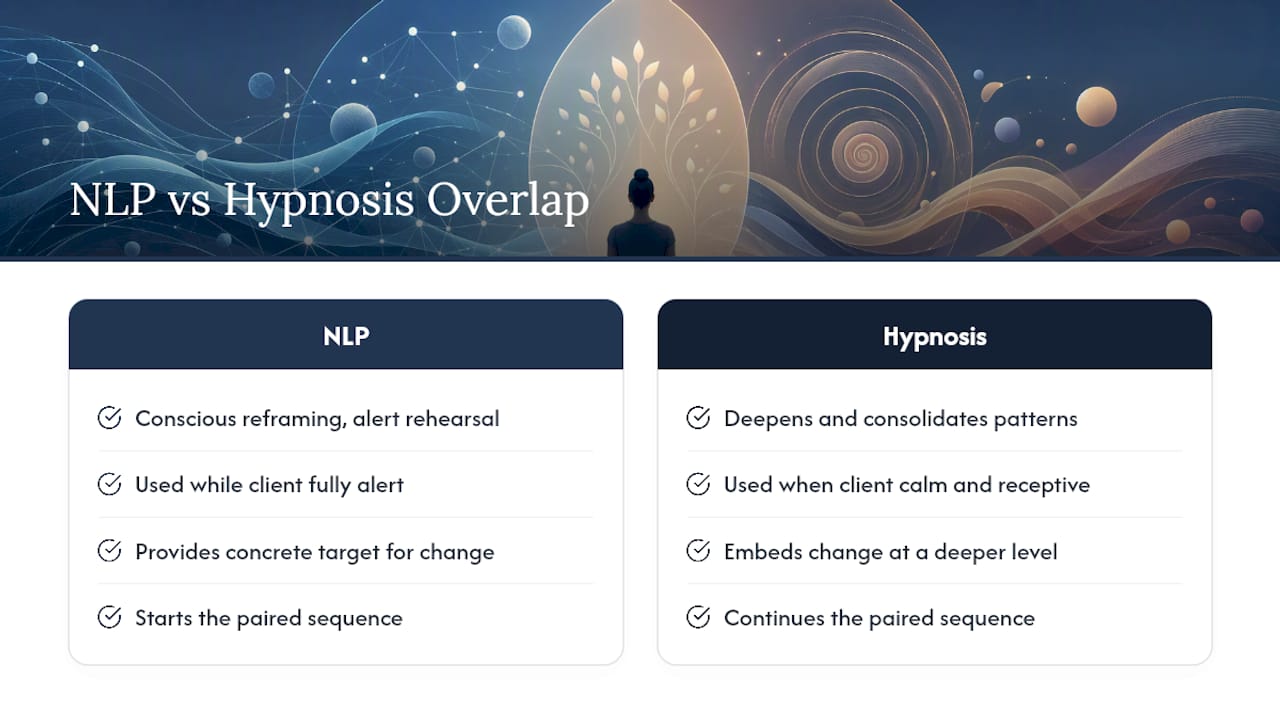
A practical sequence looks like this: use NLP first to reframe the fear consciously and rehearse a new response while the client is fully alert. Then use hypnosis to consolidate that new pattern at a deeper level, while the client is calm and receptive. iNLP Center describes this exact pairing as standard professional practice, not a shortcut.
For anxiety specifically, this combination tends to move faster than either method alone, because the conscious reframe gives the subconscious suggestion something concrete to lock onto.
Pro Tip: If you try NLP alone and the change doesn't hold under real stress, that's often a sign the pattern needs consolidating at a deeper level, not that NLP failed.
What the Research Actually Shows
The strongest head-to-head evidence comes from a randomized, double-blind trial testing clinical hypnosis against NLP before external cephalic version, a procedure to turn a breech baby before delivery. The hypnosis and NLP groups each achieved a similar success rate notably higher than the standard care group, indicating both interventions outperform routine medical care.
Both interventions outperformed standard care by a meaningful margin, and neither outperformed the other. That's the clearest signal in the literature: pick the method that fits the person, not the one with better marketing.
Outside that trial, the evidence pattern is uneven. Hypnosis has a deeper research base for pain and anxiety-related uses. NLP research tends to focus on individual techniques rather than testing the full model as a package, according to the Harmonika Institute. Small sample sizes and inconsistent methods across studies limit how far any single trial's findings can generalize. The practical takeaway holds regardless: both can help, and the right choice depends on the problem type and the clinician's specific skill set.
Matching the Method to the Problem
Not every anxiety problem responds the same way, and matching the method to the actual trigger saves time.
- Deep-rooted fears and phobias (needles, driving, flying, enclosed spaces) tend to respond well to hypnosis, since the fear response usually fires before conscious thought kicks in.
- Habit reversal (nail biting, smoking, nighttime snacking) often benefits from hypnosis for the same reason. Our needle phobia guide walks through a real clinical example.
- Confidence, communication, and performance anxiety (public speaking, interviews, sports) often respond faster to NLP's active reframing and rehearsal.
- Generalized anxiety with racing thoughts frequently benefits from a blend, and our generalized anxiety guide breaks down what that looks like session by session.
Client readiness matters too. Someone highly open to suggestion tends to respond faster to hypnosis. Someone who prefers logic and active problem-solving may connect better with NLP first. If a panic attack includes chest pain, fainting, or thoughts of self-harm, that calls for a medical or psychiatric evaluation before any hypnotherapy session, not instead of one.
How a Combined Session Actually Runs
A clinician-led session that blends both methods usually follows a clear structure, not a loose mix of techniques.
- Assessment and goal setting. The clinician identifies the trigger, its physical symptoms, and what a realistic outcome looks like in three to six sessions.
- Brief NLP intervention. A short reframing or anchoring exercise while the client is fully alert, giving the subconscious mind something concrete to work with later.
- Hypnotic induction and consolidation. The client relaxes into a focused state, and the clinician reinforces the new response using suggestion language tied to the earlier reframe.
- Home recording and practice. The client receives a recording to reinforce the session between visits, since repetition helps the change hold under real stress.
Setting expectations before induction changes how the client responds once they're relaxed. A client who understands exactly what's about to happen, and why, tends to respond faster than one who walks in unsure what hypnosis even feels like.
Most clients notice a measurable shift, calmer response to the trigger, fewer physical symptoms, easier avoidance-free days, somewhere between three and six sessions, though timelines vary by problem and individual.
Where NLP and Hypnosis Draw Real Criticism
Both fields have earned skepticism, and it's worth naming honestly rather than glossing over.
NLP's biggest problem is evidentiary. Much of the research tests isolated techniques, like anchoring, rather than the full NLP model as originally packaged. Some early NLP claims, particularly around eye movement patterns supposedly revealing thinking styles, have not held up under controlled testing. That doesn't erase the value of specific NLP techniques. It means the broader theoretical framework behind NLP carries less scientific weight than individual tools like reframing or anchoring, which have more targeted support.
Hypnosis carries a different kind of baggage: decades of stage hypnosis and pop culture have left many people picturing swinging pocket watches and loss of control. That's not clinical hypnosis. Our hypnosis versus mind control breakdown covers exactly why that fear is misplaced, but the misconception still keeps some people from trying a method that could genuinely help.
There's also a fair critique that applies to both fields: not everyone responds equally well. Suggestibility varies from person to person, and a small percentage of people don't respond strongly to hypnotic induction at all. Our guide on hypnotizability covers what the research actually says about who responds and why, which matters more than the stage-show stereotype most people carry into their first session.
Two Different Theories Behind Two Different Tools
NLP's underlying theory assumes that changing conscious mental representations, the internal pictures, sounds, and language you use to describe an experience, changes emotional response. Shift the "submodality" of a scary memory (make the picture smaller, farther away, black and white) and the fear attached to it tends to shrink. This model treats the mind somewhat like software: adjust the input, get a different output.
Hypnosis operates on a different assumption entirely. Its theoretical model holds that the subconscious mind stores patterns, habits, and fear responses that operate faster than conscious thought, which is why willpower alone often fails against a phobia. By guiding the mind into a relaxed, focused state, hypnosis theory suggests a suggestion can reach past the usual analytical filter and directly influence how the nervous system files that pattern away.
Neither theory has been proven with the kind of large-scale, gold-standard evidence that exists for treatments like cognitive behavioral therapy. Both rest on a mix of clinical observation, smaller trials, and decades of practitioner-reported outcomes. What matters practically is this: NLP's theory points toward changing how you consciously represent a problem, while hypnosis theory points toward changing how the subconscious mind has already filed it away. That difference in mechanism is exactly why the two methods so often work better together than either does alone.
How Hypnotic Transformations Approaches Anxiety Treatment
Hypnotic Transformations offers a direct alternative to sitting through weeks of talk therapy before addressing the fear itself. Sessions run over Zoom, led by Kirk Hoffman, a Certified Clinical Hypnotherapist, and combine NLP techniques with guided hypnotic induction in the same visit rather than treating them as separate services.
If you're dealing with panic attacks, a specific phobia, generalized anxiety, or a habit tied to stress (smoking, overeating, avoidance behaviors), sessions are built around your specific trigger, not a generic script. A typical session runs about an hour: a short conscious portion to identify the pattern and reframe it, followed by a guided hypnotic segment to consolidate the change, plus a take-home recording for practice between visits. Packages are available for clients who want multiple sessions built around a measurable goal, rather than paying per visit with no plan.
If you're ready to address a specific fear instead of just managing it, book a free consultation to talk through what a combined NLP and hypnosis approach could look like for your situation, or browse session packages to see what fits your goals.
A Clinician's Note on What Actually Changes
Panic around flying or needles rarely responds to logic alone, because the fear response fires before the thinking brain gets a vote. In my sessions, clients working through a specific phobia often notice a real shift by the third session: less physical tension, less avoidance, more room to think clearly when the trigger shows up. If that sounds like what you're dealing with, a free consult is the easiest way to find out what a combined approach could do for you.
— Kirk
Sources
- The Effects of Clinical Hypnosis versus Neurolinguistic Programming (NLP) before External Cephalic Version (ECV): A Prospective Off-Centre Randomised, Double-Blind, Controlled Trial - PMC
- Mindtraining
- Hypnosis vs NLP vs EFT: Which Mind-Body Modality Fits You? | Harmonika Institute
- NLP and Hypnosis: Similarities, Differences, and Synergies | iNLP Center