
Yes, several NLP techniques including anchoring, reframing, visualization, and the swish pattern can reduce anxiety symptoms when practiced correctly, but the evidence is modest and inconsistent. A 2024 meta-analysis found a small but statistically significant effect for self-administered NLP-based interventions, and clinical reviews stop short of recommending NLP as a standalone treatment. Use these techniques as a bridge to calm, not a replacement for professional care if your anxiety is severe or persistent.
TL;DR:
- Anchoring is most effective for predictable anxiety spikes and requires five to ten repetitions over days to establish a reliable calming trigger.
- Reframing is best for looping anxious thoughts, but should be paired with exposure therapy if anxiety stems from genuine avoidance behaviors.
- Visualization training involves five-sense mental rehearsal for five to ten minutes daily before an event, with early signs of success shown by reduced anxiety levels.
- In acute moments, quick techniques like the 3-3-3 rule or the breath-and-anchor method can provide temporary relief within two minutes.
- Evidence for NLP's effectiveness is modest and uncertain, so it should complement, not replace, professional treatment for serious or persistent anxiety.
Table of Contents
- What Are the Best NLP Techniques for Anxiety?
- How Do You Set an NLP Anchor for Anxiety?
- What NLP Reframing Scripts Actually Help With Anxiety?
- How Does Visualization Reduce Anxiety Before an Event?
- What Can You Do When Anxiety Hits in the Moment?
- Does the Research Actually Support NLP for Anxiety?
- How Do You Combine NLP With Therapy or Hypnotherapy?
- When I Bring NLP Into a Hypnotherapy Session
- Get Clinician-Led Support for Anxiety That Self-Practice Can't Reach
- Sources
- FAQ
What Are the Best NLP Techniques for Anxiety?
Neuro-linguistic programming (NLP) works from a simple premise: the words you use, the images you picture, and the physical states you rehearse all send signals to your nervous system. Change the input, and you can change the response. That's the theory behind most NLP techniques for anxiety, and it lines up with how conditioning and cognitive reframing already work in established therapy models.
Here's a working shortlist, ranked roughly by how fast you can learn them:
- Anchoring — links a physical touch (like pressing thumb to finger) to a calm state, so you can trigger calm on demand. Best for predictable anxiety spikes: elevators, flights, public speaking. Takes 5 to 10 minutes to set up, then a few seconds to use.
- Reframing — swaps an anxious interpretation of an event for a more workable one. Best for anxious self-talk and catastrophic thinking. Take seconds once you know the pattern.
- Visualization — rehearses a feared scenario mentally, using multiple senses, so your nervous system logs it as familiar rather than dangerous. Best for upcoming events: interviews, medical procedures, first dates. Needs 5 to 15 minutes of practice, several times before the event.
- Swish technique — interrupts an intrusive or anxious mental image by rapidly replacing it with a stronger, more confident one. Best for recurring intrusive thoughts or phobic triggers. Takes under a minute per repetition, done in short bursts.
- Circle of excellence — a variant of anchoring that stacks multiple confident memories into one anchor. Best for generalized anxiety or low confidence heading into a stressful stretch of time (a exam week, a big presentation season).
If your anxiety shows up mostly as physical panic, start with anchoring. If it shows up as a loop of anxious thoughts, start with reframing. Save visualization for anything you can see coming on the calendar.
How Do You Set an NLP Anchor for Anxiety?
Anchoring borrows from classical conditioning, the same principle behind Pavlov's dogs. Pair a specific physical touch with a strong internal state often enough, and the touch alone starts to produce that state. It's simple, but it takes real repetition to hold up under stress.
Here's the practice routine:
- Pick your anchor. Choose a distinct, private touch: pressing thumb and middle finger together works well. It needs to be something you don't do casually.
- Recall a real calm memory. Close your eyes and remember a specific time you felt genuinely relaxed and safe. Not a general idea of calm. One real moment.
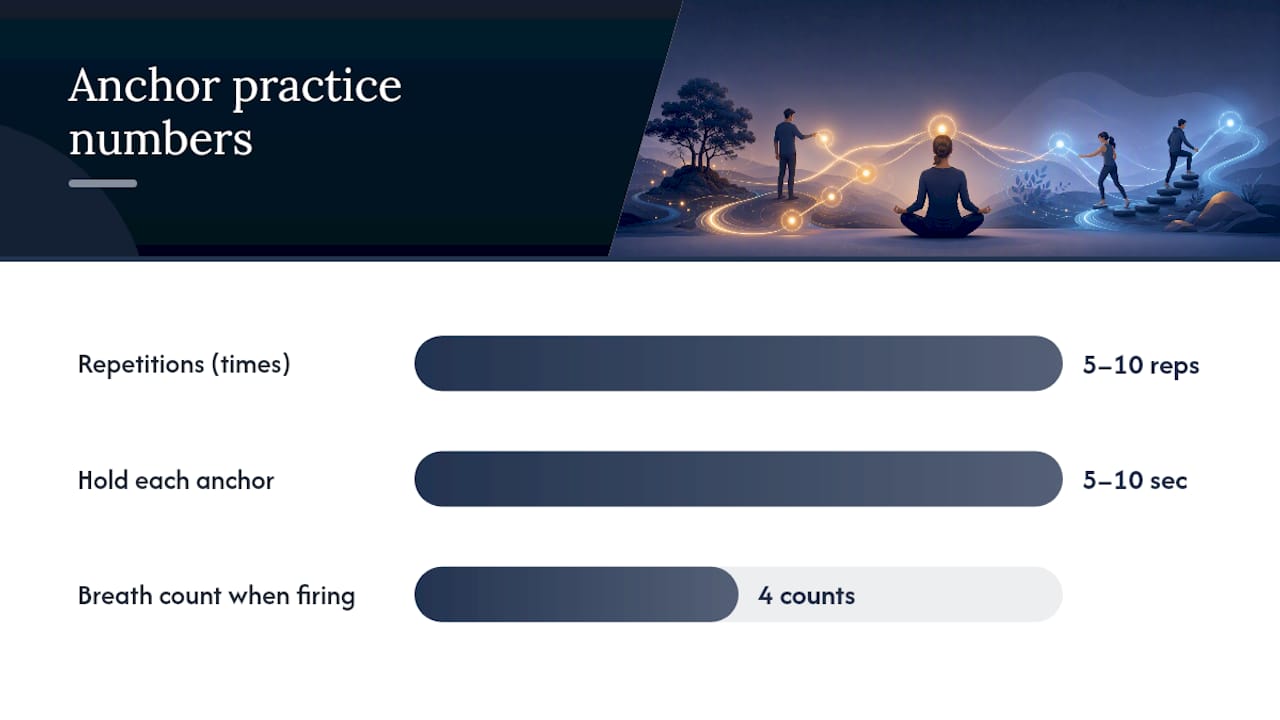
- Build the state, then fire the anchor. As the memory gets vivid, the calm feeling should build. Right at the peak, apply your anchor touch and hold it for 5 to 10 seconds.
- Break state and repeat. Open your eyes, shake it off, then repeat steps 2 and 3 four or five more times using the same anchor and, ideally, different calm memories.
- Test it under mild stress. Try firing the anchor before something mildly nerve-wracking, like a phone call you've been putting off. If the calm doesn't show up, the anchor isn't consolidated yet. Go back to step 2.
Most people need 5 to 10 repetitions over a few days before an anchor holds under real pressure. If it fades fast, the original memory probably wasn't vivid enough.
Pro Tip: Pair your anchor with one slow exhale, four counts out, when you fire it. The breath alone signals your nervous system to downshift, and it speeds up how quickly the anchor takes hold.
What NLP Reframing Scripts Actually Help With Anxiety?
Reframing changes the meaning of a situation without changing the facts of it. It's not about lying to yourself. It's about picking a truer, more useful interpretation than the anxious one your brain defaults to under stress.
Two patterns cover most anxious thoughts:
- Context reframe: ask where this exact reaction would actually be useful. "My racing heart before this presentation would keep me alive if I were being chased. Right now, it just means I'm alert." This doesn't erase the sensation, it changes what it means.
- Outcome reframe: ask what this situation is preparing you for, not just threatening you with. "This job interview is uncomfortable practice for the one that actually matters." It shifts the anxious event from threat to rehearsal.
For a fast in-the-moment drill, catch yourself mid-thought and ask: "Is this the only way to read this?" Then name one alternative reading out loud, even if you don't fully believe it yet. Repetition builds the habit faster than conviction does.
One caution: reframing should never talk you out of a feeling that's telling you something real. If your anxiety comes from genuine avoidance, like skipping a doctor's appointment or dodging a hard conversation, pair reframing with actual exposure to the situation. A reframe without action just becomes a more polite way to stay stuck.
How Does Visualization Reduce Anxiety Before an Event?
Visualization works because your nervous system doesn't fully distinguish between a vividly imagined experience and a real one. Rehearse a scenario enough times in detail, and your body stops treating it as novel and threatening.
A useful script covers five senses in sequence:
- Sight: picture the room, the people, the lighting of the event you're dreading.
- Sound: add in the specific sounds, your own voice, other people talking, background noise.
- Touch: notice the feel of your clothes, the chair, the object in your hands.
- Smell: even a vague scent detail (coffee, fresh air, a hallway) adds realism.
- Movement: picture yourself moving through the space calmly, not frozen.
Run this for 5 to 10 minutes, once a day, for the three to five days leading up to the event. Track progress by noting your anxiety on a 0 to 10 scale before and after each session. A drop of even two points across a week is a real signal the rehearsal is working.
For extra effect, fire your calm anchor right as the visualization peaks. That combination, mental rehearsal plus a physical calm cue, is close to what's used in hypnotherapy sessions built around generalized anxiety.
What Can You Do When Anxiety Hits in the Moment?
Not every anxious moment gives you time for a five-step process. These take under three minutes and work on acute spikes.
- The 3-3-3 rule: name three things you can see, three sounds you can hear, and move three parts of your body (fingers, ankles, shoulders). It pulls your attention out of your head and back into the room, which interrupts the spiral before it builds.
- Fast swish: picture the anxious image small and dim in a corner, then snap it out and replace it instantly with a large, bright image of yourself handling the situation calmly. Repeat five times, fast, like flipping a switch.
- Breath and anchor combo: inhale for four counts, exhale for six, and fire your calm anchor on the exhale. The longer exhale alone slows your heart rate; adding the anchor reinforces it.
None of these fix the underlying pattern. They buy you 60 to 90 seconds of clearer thinking, which is often enough to make a better next decision.
Does the Research Actually Support NLP for Anxiety?
Here's where a lot of guides get sloppy: they blur therapeutic NLP (anchoring, reframing, visualization) with AI-based natural language processing tools, which are a completely different thing built on machine learning rather than clinical technique. Keep those separate when you're reading anything about "NLP" and anxiety.
A 2024 systematic review and meta-analysis of self-administered, NLP-model-based interventions found a small but statistically significant reduction in anxiety symptoms (SMD 0.272, 95% CI 0.116 to 0.428). The same study, indexed on PubMed, rated overall certainty as very low due to bias and inconsistency across the included trials.
That's a real effect, but a small and shaky one. It tells you these techniques can move the needle, not that they're a cure.
On the clinical side, a review of clinical effectiveness and guidelines concluded there isn't enough high-quality evidence to recommend NLP as a primary treatment for PTSD, generalized anxiety disorder, or depression. Established approaches like CBT and exposure therapy carry far stronger meta-analytic support for treating diagnosable anxiety disorders. Healthline's overview lands in the same place: NLP might help some symptoms, but the research base is inconsistent, and it shouldn't replace licensed therapy for serious mental health concerns.
Certain signs mean it's time to stop self-practicing and get professional help instead:
- Thoughts of suicide or self-harm, at any intensity.
- Panic attacks that are increasing in frequency or severity despite your efforts.
- Anxiety that's keeping you from work, school, driving, or basic daily tasks.
- Symptoms that have lasted more than a few weeks without improvement.
If any of those apply, a licensed clinician or hypnotherapist should be your next call, not another technique.
How Do You Combine NLP With Therapy or Hypnotherapy?
NLP techniques work best as a layer on top of established treatment, not a substitute for it. A few pairings tend to work well in practice:
- Anchoring plus exposure therapy: use your calm anchor right before and during a planned exposure exercise, so your nervous system has a tool to draw on instead of just white-knuckling through it.
- Reframing plus CBT worksheets: if you're already doing thought records for CBT, add a context or outcome reframe as one of the alternative thoughts you write down.
- Visualization plus hypnotherapy: hypnotherapy uses a similarly deep relaxed state to make visualization and suggestion more effective. Sessions often build on the exact rehearsal skills described above, which is part of why NLP and hypnosis overlap so much in clinical settings.
At a first clinician appointment, ask what a typical session structure looks like, how many sessions are usually recommended, and how progress gets measured. Many clinicians use the GAD-7, a short seven-question anxiety screening tool, at intervals to track whether symptoms are actually dropping. Keeping a simple daily log, anxiety rating plus which technique you used, gives you and any clinician real data instead of a vague impression of "better" or "worse."
When I Bring NLP Into a Hypnotherapy Session
I use NLP techniques as a starting point, not the whole plan. Anchoring and reframing work well for clients who need something to use between sessions, especially in the first two or three weeks before deeper hypnotherapy work has taken hold.
Self-practice makes sense for mild, situational anxiety: a flight, a presentation, a first date. Clinician-led work matters more once panic attacks are frequent, or anxiety has started shrinking someone's life. In sessions, I fold anchoring and visualization into the relaxed hypnotic state itself, which tends to make both stick faster than practicing them alone. Most clients check in weekly for the first month, then move to every other week as the changes hold on their own.
— Kirk
Get Clinician-Led Support for Anxiety That Self-Practice Can't Reach
Anchoring and reframing can take the edge off a bad moment. They don't rewire the fight-or-flight response that keeps firing at 2 a.m. or before every meeting on your calendar. That's where online hypnotherapy for anxiety with Hypnotic Transformations comes in: sessions with Kirk Hoffman, a Certified Clinical Hypnotherapist, work directly with the subconscious patterns driving the anxiety response, aiming for lasting change instead of a technique you have to keep repeating.
A first session covers your specific triggers, how your anxiety shows up physically, and what's kept it in place. From there, sessions build in NLP-based tools like anchoring and visualization inside a deeply relaxed state, which tends to make them stick faster than practicing solo. This differs from self-help NLP in one key way: it's built around your specific history and nervous system response, not a generic script. If short techniques haven't been enough, or your anxiety is affecting daily life, book a session through the full list of services and get a plan built around what's actually driving the anxiety.
Sources
- Self-Administered Interventions Based on Natural Language Processing Models for Reducing Depressive and Anxiety Symptoms: Systematic Review and Meta-Analysis
- PubMed record for systematic review (PMID 39167795)
- Neuro-Linguistic Programming for the Treatment of Adults with PTSD, GAD, or Depression: A Review of Clinical Effectiveness and Guidelines
- NLP Therapy: Uses, Techniques, and Criticisms (Healthline)
FAQ
What Is the 3-3-3 Rule for Anxiety?
It's a grounding drill: name three things you see, three sounds you hear, then move three parts of your body. It interrupts an anxiety spiral by shifting your attention back to the present moment.
Can NLP Help Anxiety, or Is It Just Placebo?
A 2024 meta-analysis found a small, statistically significant reduction in anxiety symptoms from self-administered NLP-based techniques, though certainty was rated very low. It can help as an adjunct, but it isn't a substitute for established treatment in moderate to severe cases.
What Are the Top NLP Techniques for Anxiety?
The five most practical are anchoring, reframing, visualization, the swish technique, and the circle of excellence. Each targets a different anxiety pattern, from physical panic spikes to intrusive thoughts.
How Do You Overcome Fear or Anxiety in 30 Seconds?
A fast swish (replacing an anxious image with a confident one) or a breath-and-anchor combo, four counts in and six counts out with a calm anchor fired on the exhale, can shift acute anxiety within half a minute. It won't resolve the underlying cause, but it can clear enough space to think.
What Supplements Help With Anxiety?
This article focuses on NLP techniques rather than supplements, and any supplement decision should go through a doctor or pharmacist, since interactions and dosing vary by individual health history.
When Should I See a Professional Instead of Using NLP on My Own?
Seek a licensed clinician or hypnotherapist if you have thoughts of self-harm, panic attacks that are worsening, or anxiety that's interfering with work, school, or relationships. Hypnotic Transformations offers online hypnotherapy for anxiety for exactly this level of support.