
Hypnosis is an effective, evidence-supported option for most adults with needle phobia. A multicenter randomized trial (KTHYPE) found that hypnosis-based communication during IV cannulation reduced mean pain scores significantly compared with neutral or negative language, and a PubMed case report documented a child tolerating painless venepuncture after a single short hypnotic induction. If you want professional support now, Kirk Hoffman, Certified Clinical Hypnotherapist (CCHt) at Hypnotictransformations, offers telehealth sessions across the United States specifically for anxiety and procedure-related fear.
Key Takeaways
Needle phobia hypnosis is an evidence-supported treatment that targets the nervous system's learned fear response, and most adults who complete a short clinical course can tolerate routine medical procedures.
| Point | Details |
|---|---|
| Evidence is real | The KTHYPE trial with 272 participants showed a statistically significant pain reduction from hypnotic communication alone |
| Root cause determines technique | Pain fear, traumatic memory, and vasovagal response each require a different hypnotic approach; intake assessment is essential. |
| Session count varies | A single session supports an imminent procedure; durable change typically takes 3–6 sessions plus daily self-hypnosis practice. |
| Safety screening matters | Hypnosis is not appropriate for active psychosis, severe dissociative disorders, or clients who cannot give informed consent. |
| Hypnotictransformations | Kirk Hoffman, CCHt, offers telehealth hypnotherapy for needle phobia across the U.S., with free initial consultations available. |
Table of Contents
- What is trypanophobia and what causes needle fear?
- How clinical hypnosis works on needle fear
- Specific techniques clinicians use and a short self-hypnosis script
- What the clinical evidence actually shows
- What to expect in sessions: structure, timeline, and cost
- Preparing for the actual procedure: what to do on the day
- When hypnosis may not be appropriate
- How to choose a qualified hypnotherapist in the United States
- Hypnotictransformations' clinical approach to needle phobia
- What realistic progress looks like
- Professional support for needle phobia is available online
- Primary research and clinical resources
- Sources
What is trypanophobia and what causes needle fear?
Trypanophobia is the clinical term for a persistent, intense fear of needles or injections. The physical reactions go well beyond ordinary nervousness. Many people experience a racing heart, nausea, dizziness, or a full vasovagal response, meaning they faint or nearly faint when a needle is introduced or even anticipated. That fainting reflex is a physiological event, not a character flaw, and it is one reason standard reassurance rarely works.
Clinical guidance identifies three distinct root causes, and the right hypnotic approach depends on which one drives your fear:
- Fear of pain. The expectation of sharp, uncontrollable pain triggers the fight-or-flight response before the needle is even visible. Past painful procedures reinforce this loop.
- Traumatic memory. A specific medical event, often from childhood, becomes encoded as a threat. The nervous system replays that memory every time a needle is near.
- Fear of losing control or fainting. Some people fear the vasovagal response itself, the loss of consciousness, the embarrassment, or the helplessness of lying in a clinical chair.
Needle fear often begins early. Population data suggests the majority of children under 11 experience significant needle fear, with 20–50% of adolescents and 20–30% of young adults reporting it as a genuine barrier to care. Many adults who avoid blood draws or vaccines trace the pattern back to a single childhood procedure that went badly.
Knowing which category fits you matters because it determines which hypnotic technique a clinician will use first.
How clinical hypnosis works on needle fear
Hypnosis targets the learned nervous-system reaction directly. It does not just calm you in the moment; it reconditions the fight-or-flight response so the cue, a syringe, a clinical smell, a tourniquet, stops triggering threat-level arousal in the first place. UCHealth's clinical commentary describes this as working at the level of the subconscious pattern rather than managing panic after it starts.
Here is the short physiology: when your brain classifies a needle as a threat, the amygdala fires, cortisol and adrenaline flood the body, and the vasovagal reflex can kick in as a secondary response to that spike. Anticipatory anxiety, the dread you feel days before a blood draw, amplifies this by rehearsing the threat response repeatedly. By the time you sit in the chair, your nervous system has already run the fear loop dozens of times.
Clinical hypnosis interrupts that loop through four mechanisms:
- Suggestion to down-regulate threat. The hypnotherapist introduces language that reframes the needle cue as neutral or manageable. The subconscious accepts this more readily in a relaxed, focused state than during ordinary waking conversation.
- Dissociation. The client mentally separates from the procedure site, often by placing attention in a vivid imagined scene. Pain signals still travel the nerve pathway, but the brain's threat-evaluation of those signals drops.
- Memory reconsolidation. Traumatic procedural memories can be revisited and rewritten under hypnosis, reducing their emotional charge without erasing the factual record.
- Hypnotic language. Replacing pain-related words with neutral or positive imagery lowers anxiety measurably. The KTHYPE trial showed this works even when delivered by trained nurses rather than dedicated hypnotherapists.
Think of it as a three-step sequence: the needle cue fires, the nervous system responds, and hypnotic reconditioning changes what that response looks like at step two.
Specific techniques clinicians use and a short self-hypnosis script
Clinical reviews consistently recommend tailoring the technique to the root cause rather than applying a generic script. Here are the most commonly used approaches:
- Guided imagery. The client focuses on a vivid, safe mental scene during the procedure. Attention shifts away from the needle site, and the brain's threat response quiets.
- Age regression and memory restructuring. The therapist guides the client back to the original traumatic memory in a safe, controlled way, then introduces a different emotional outcome. This is the primary tool when a specific past event drives the fear.
- Switch-wire imagery. A PubMed case report describes a 5-year-old who was guided to imagine a switch that turned off sensation in the arm. Two days later, the child tolerated painless venepuncture without topical anesthetic. The technique works by giving the subconscious a concrete, mechanical metaphor for numbness.
- Dissociation and analgesic imagery. The client imagines the arm as separate from the body, or as belonging to someone else. This reduces the subjective intensity of sensation without blocking the procedure.
- Direct suggestion. The therapist delivers calm, specific suggestions during induction: "Your arm feels heavy and comfortable. Any sensation you notice is simply pressure, not pain." Simple, but effective when delivered in a genuine hypnotic state.
- Self-hypnosis anchoring. The client learns a physical cue, pressing two fingers together, for example, that re-triggers the calm state practiced in sessions. This is the tool you use in the waiting room.
A short micro self-hypnosis script (for practice after clinical training):
Close your eyes and take three slow breaths. With each exhale, let your shoulders drop. Picture a place where you feel completely safe, somewhere specific: the temperature, the sounds, the light. Stay there for 30 seconds. Now, in that scene, notice that your left arm feels distant, like it belongs to the scene rather than to you. Press your index finger and thumb together. Hold that feeling. Open your eyes slowly.

Practice this daily for two weeks before a procedure. The anchor builds through repetition.
Pro Tip: Not everyone responds equally to hypnosis. Hypnotizability varies, and people who score lower on standardized scales may need more sessions or a combined approach with cognitive behavioral techniques. A qualified clinician will assess this in the intake and adjust accordingly.
What the clinical evidence actually shows
The evidence for needle phobia hypnosis is encouraging, though not yet built on dozens of large randomized trials. Here is an honest summary:
| Study / Source | Design | Sample | Main Finding |
|---|---|---|---|
| KTHYPE trial | Multicenter RCT | 272 adults | significantly reduced mean pain with hypnosis compared to neutral or negative language |
| Switch-wire imagery case report | Single case report | 1 child, age 5 | Painless venepuncture achieved after 10-minute induction; no topical anesthetic needed |
| Clinical reviews consistently recommend tailoring techniques | Narrative review | Multiple cases | Recommends integrating hypnosis with behavioral and cognitive techniques for best outcomes |
| UCHealth clinical commentary | Health-system guidance | General population | Many patients respond after a few sessions with a clinician trained in hypnosis |
The KTHYPE trial is the strongest single piece of evidence: a controlled, multicenter design with 272 participants showing a statistically significant pain reduction from hypnotic communication alone. The case reports add clinical texture, showing rapid benefit in individual patients, but they cannot establish population-level effect sizes.
The honest gap: most existing trials are small or use heterogeneous outcome measures. Pain scores, behavioral compliance, and self-reported anxiety are all used, making direct comparison difficult. What the literature does not show is that hypnosis fails. The signal is consistently positive; the question is magnitude and durability across different patient profiles.
What to expect in sessions: structure, timeline, and cost
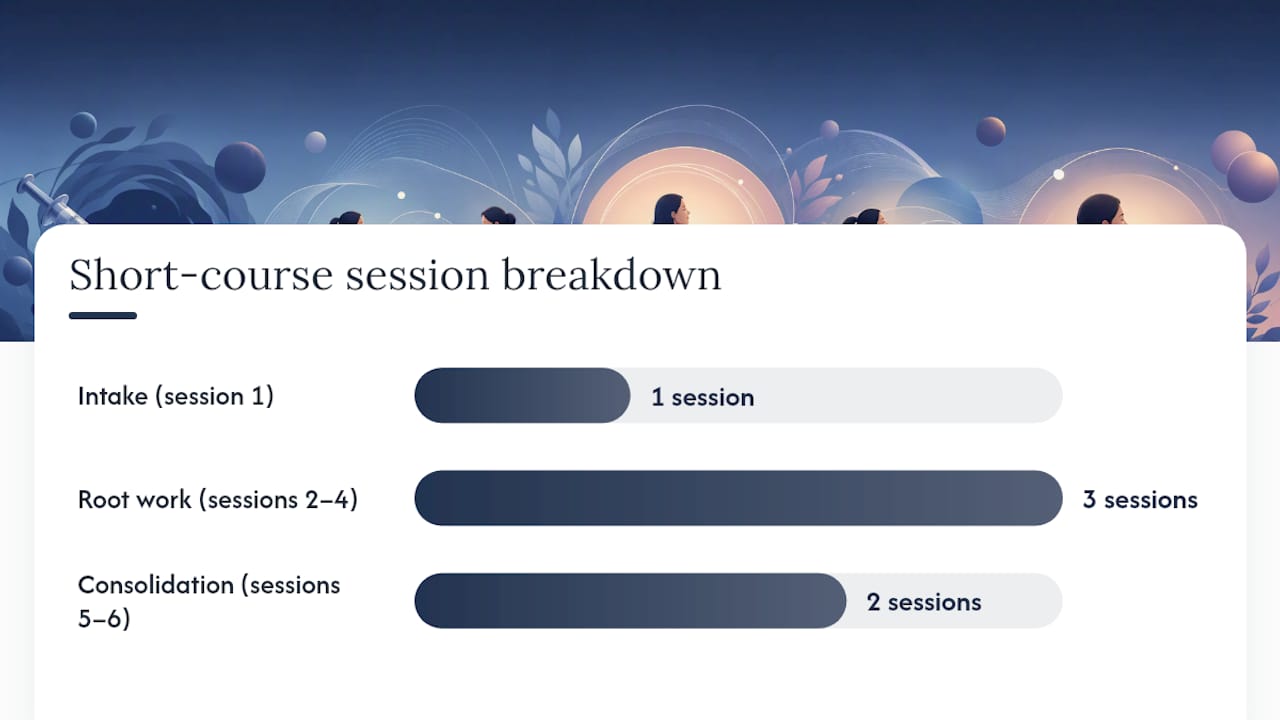
Expect an intake assessment, a short course of targeted sessions, and a self-hypnosis practice component that you continue between appointments and on procedure days.
Timeline options:
- Single-session procedure support. One session before a scheduled injection, focused on immediate anxiety reduction and a self-hypnosis anchor. Appropriate when the fear is moderate and the procedure is imminent.
- Short course (3–6 sessions). The standard approach for deeper fear. The first session is intake and light induction. Sessions two through four target the root cause directly, using memory work, imagery, or suggestion. Sessions five and six consolidate gains and rehearse the procedure mentally.
- Maintenance practice. Clinical guidance is clear that durable change requires daily self-hypnosis practice between sessions. A single session may support one procedure; lasting change is built through repetition.
Cost and insurance:
U.S. telehealth hypnotherapy sessions typically run $100–$250 per session, depending on the clinician's credentials and session length. Package pricing for a 4–6 session course often reduces the per-session cost. Hypnotherapy is rarely covered by standard health insurance, though some flexible spending accounts (FSAs) or health savings accounts (HSAs) may apply. Ask the clinician directly about package options, cancellation policies, and whether a free initial consultation is available.
Client responsibilities checklist:
- Complete the intake questionnaire honestly, including fainting history
- Practice self-hypnosis daily between sessions (10–15 minutes)
- Disclose any psychiatric history or medications that may affect hypnotic response
- Schedule the procedure after at least two or three sessions, not before
- Bring your anchor cue to the appointment and use it in the waiting room
Preparing for the actual procedure: what to do on the day
Simple hypnotic cues and deliberate clinician language reduce anxiety on procedure day more than most people expect.
- Use your anchor in the waiting room. Press your fingers together, close your eyes for 30 seconds, and return to your safe scene. Do this twice before your name is called.
- Tell the clinician your preference upfront. Say: "I have a needle phobia. I'd like you to avoid counting down or describing what you're about to do. Just let me know when you're ready to start."
- Request topical anesthetic in advance. EMLA cream or a lidocaine patch applied 45–60 minutes before the procedure reduces the initial sting that often triggers the fear response. Ask for this when you book the appointment.
- Choose your position carefully. Lying down reduces fainting risk for people with a vasovagal history. Tell the clinician you prefer to recline.
- Disclose your fainting history. A clinician who knows you have fainted before can prepare accordingly, have you lie flat, monitor your color, and keep you horizontal for a few minutes after.
- Use a distraction device if imagery alone is not enough. Focusing on a phone screen, a specific sound, or a tactile object in the opposite hand gives the brain a competing input.
- Ask the clinician to use neutral language. KTHYPE trial data shows that replacing phrases like "sharp scratch" or "this will hurt" with "you may notice a sensation" or "pressure" measurably lowers pain scores.
Phrases that help: "You may feel some pressure." "Take a breath whenever you like." "Let me know if you need a moment."
Phrases to ask clinicians to avoid: "This is going to sting." "Almost done, just a little more." "Don't move." Anticipatory warnings amplify the threat signal before the needle touches skin.
When hypnosis may not be appropriate
Hypnosis is safe for most adults, but there are clinical situations where it should be approached with caution or not used as the primary intervention.
- Severe psychiatric instability. Active psychosis, dissociative disorders with poor reality testing, or severe borderline presentations require psychiatric stabilization before hypnosis is appropriate.
- Inability to follow instructions. Hypnosis requires the client to engage with imagery and suggestion. Significant cognitive impairment or acute intoxication makes this unreliable.
- Lack of informed consent. The client must understand what hypnosis is and is not, and must agree to the process voluntarily. Hypnosis cannot be used covertly or without clear agreement.
- Severe vasovagal history requiring medical precautions. If you have fainted repeatedly during procedures and have a cardiac or autonomic condition, discuss this with your physician before starting hypnotherapy. The hypnotherapist should coordinate with your medical team.
- Active trauma that has not been assessed. Memory-restructuring techniques like age regression can surface difficult material. A clinician should screen for trauma history in the intake before using these methods.
Safety checklist to discuss with your clinician before starting:
- Disclose all current medications, particularly psychiatric medications
- Describe your fainting history in detail, including how quickly it happens
- Ask whether the clinician has an emergency protocol if you faint during a session
- Confirm that informed consent is documented before the first induction
- Ask how the clinician handles distressing material if it surfaces during memory work
One practical note: hypnotic protocols can include vasovagal stabilization techniques, specifically suggestions that keep blood pressure stable and reduce the bradycardic response. A clinician experienced with medical procedure support will know these.
How to choose a qualified hypnotherapist in the United States
Credentials, clinical experience with medical procedures, and telehealth competence are the three criteria that matter most. The hypnotherapy field in the U.S. is not uniformly regulated, so vetting is on you.
- Look for the CCHt credential. Certified Clinical Hypnotherapist, issued by the American Council of Hypnotist Examiners (ACHE) or equivalent body, indicates formal clinical training beyond basic certification.
- Ask about specific experience with needle phobia or medical procedure support. A general anxiety hypnotherapist and a clinician who has worked with trypanophobia patients are not the same. Ask directly: "Have you treated needle phobia before? What techniques do you use?"
- Confirm telehealth competence. Telehealth hypnotherapy is effective, but the clinician should have a clear protocol for online induction, a secure platform, and a plan if the connection drops mid-session.
- Red flags to watch for: No clinical disclosure, vague promises of guaranteed results in one session, no intake assessment, and no discussion of contraindications. A credentialed clinician will ask about your psychiatric history before starting.
- Questions to ask in a free consult:
- What is your training in clinical hypnosis, and where did you complete it?
- How many clients with needle phobia have you treated?
- What does a typical session outline look like for this issue?
- Do you offer package pricing, and what is your cancellation policy?
- What happens if I feel distressed during a session?
Kirk Hoffman, CCHt, at Hypnotictransformations meets these criteria. He holds the CCHt credential, works exclusively via telehealth across the United States, and uses individualized protocols rather than generic scripts. The online hypnotherapy for anxiety service page describes the session structure and scope in detail.
Hypnotictransformations' clinical approach to needle phobia
Hypnotictransformations uses short, targeted courses that combine clinical induction, tailored suggestion, and self-hypnosis practice. The approach is built around the intake assessment, not a fixed script.
A typical 1–6 session plan with Kirk Hoffman:
Session 1 (Intake and orientation). Kirk reviews your fear history, identifies the root cause (pain, memory, or vasovagal), and sets measurable goals. A sample goal: "Tolerate a routine blood draw without fainting or leaving the room within four sessions." The first induction is light, focused on building the relaxation response and establishing the self-hypnosis anchor.
Sessions 2–3 (Targeted intervention). Depending on the root cause, Kirk uses guided imagery for pain-based fear, age regression and memory restructuring for trauma-based fear, or vasovagal stabilization suggestions for fainting-based fear. Each session ends with a self-hypnosis assignment.
Sessions 4–5 (Rehearsal and consolidation). The client mentally rehearses the procedure in detail under hypnosis, from the waiting room to the needle to the walk out. This rehearsal builds a new neural pathway that competes with the old fear response.
Session 6 (Follow-up and maintenance). Review of progress, refinement of the anchor cue, and a plan for ongoing self-practice. For most clients, this session is scheduled after a real procedure has been completed.
Telehealth sessions run via Zoom. The intake form is completed before the first call, so the first session goes directly into clinical work rather than paperwork.
What realistic progress looks like
Most clients who complete a 3–6 session course and practice self-hypnosis daily between appointments reach a point where they can attend a routine blood draw or vaccination without leaving the room or fainting. That is the realistic baseline goal, not zero anxiety, but functional tolerance. A single session before an urgent procedure can reduce acute anxiety enough to get through it. Durable change, the kind where the waiting room no longer triggers a panic response, takes consistent practice over several weeks. The clients who see the fastest progress are the ones who treat the self-hypnosis homework as seriously as the sessions themselves.
Professional support for needle phobia is available online
Hypnotictransformations offers online clinical hypnotherapy for needle phobia and procedure-related anxiety, delivered via Zoom across the United States. Kirk Hoffman, CCHt, provides individualized sessions that address the specific root cause of your fear, whether that is pain anticipation, a past traumatic procedure, or a vasovagal response pattern.
A single support session is available for clients with an imminent procedure. A short course of 3–6 sessions is available for clients who want lasting change. Free initial consultations are offered so you can ask questions, describe your history, and decide whether the approach fits before committing to a session. To book, visit the appointments page or review the full service offerings to see what each format includes.
Primary research and clinical resources
- KTHYPE multicenter randomized trial — The strongest controlled trial showing hypnotic communication reduces pain during IV cannulation.
- How to treat fear of needles (Psychology Today) — Clinical guidance on identifying root causes and selecting targeted hypnotic techniques.
- How children and adults can overcome needle phobia (UCHealth Today) — Health-system commentary on session counts, referral pathways, and effectiveness across age groups.
- Brief hypnosis for severe needle phobia using switch-wire imagery (PubMed) — Case report of a 5-year-old achieving painless venepuncture after a 10-minute hypnotic induction.
- Fear of injections: the value of hypnosis in facilitating clinical treatment (Wiley) — Clinical review recommending integrated hypnosis and behavioral approaches for injection fear.
This article is general information, not a substitute for advice from a qualified doctor. Consult a qualified healthcare professional about your own circumstances before acting on anything here.
Sources
- How to treat fear of needles
- How children and adults can overcome needle phobia - UCHealth Today
- Brief hypnosis for severe needle phobia using switch-wire imagery in a 5-year old
- Fear of injections: the value of hypnosis in facilitating clinical treatment