
Loving kindness hypnosis is a therapeutic practice that combines the structured compassion sequences of metta meditation with hypnotherapy's induction techniques to rewire subconscious emotional patterns. The formal term for the meditation component is metta bhavana, a Pali phrase meaning "cultivation of loving kindness." Together, these two methods create something more targeted than either approach alone. Where standard mindfulness asks you to observe feelings, this practice actively plants new ones at the subconscious level. The result is measurable progress on anxiety, shame, low self-esteem, and social disconnection, which makes it especially relevant for people who feel stuck despite trying conventional approaches.
What is loving kindness hypnosis and how does it work?
Loving kindness hypnosis works by using a hypnotic induction to deepen relaxation, then guiding the mind through the traditional 5-target sequence of metta practice: self, benefactor, neutral person, difficult person, and all beings. Standard metta sessions typically run 15–30 minutes. The hypnosis component extends that window by first bringing you into a deeply receptive state, so the compassionate phrases land in the subconscious rather than bouncing off the analytical mind.
The key distinction from purely meditative loving kindness is the induction phase. Hypnosis deepens the relaxed state to replace reactive emotional patterns with grounded feelings of warmth and connection. That means a person who consciously resists self-compassion, because they believe they do not deserve it, can receive those suggestions below the level of critical resistance. This is why the practice is particularly effective for people with low self-esteem or a history of self-criticism.
The practice also yields what the Pali Canon's Discourse AN 11.16 lists as 11 traditional benefits, including improved sleep, a more serene demeanor, and reduced fear. These are not abstract promises. They reflect what happens when the nervous system repeatedly rehearses warmth instead of threat.
What do you need before starting a session?
Effective sessions require three things: a quiet environment, a willing mental attitude, and at least 15 minutes of uninterrupted time. The environment does not need to be elaborate. A chair, a dim room, and headphones are enough. What matters more is your willingness to observe whatever arises without forcing a particular feeling.

Optional tools make a real difference, especially for beginners. Guided audio recordings or written scripts give the mind a structure to follow when it would otherwise wander. A timer set for 20–25 minutes removes the distraction of clock-watching. The table below summarizes what supports a productive session.
| Element | Why it matters |
|---|---|
| Quiet, comfortable space | Reduces external distraction during induction |
| Guided audio or script | Provides structure and keeps attention anchored |
| 15–30 minute time block | Matches the clinically observed session length for metta practice |
| Open, non-judgmental attitude | Allows subconscious suggestions to take hold without resistance |
| Loose, comfortable clothing | Prevents physical discomfort from breaking the relaxed state |
The biggest difference between purely meditative loving kindness and the hypnotic version is the entry point. Meditation asks you to settle the mind yourself. Hypnosis uses a guided induction to do that settling for you, which is a significant advantage when anxiety or emotional distress makes self-directed relaxation difficult.
Pro Tip: If you struggle to relax on your own, try a body scan induction before beginning the loving kindness sequence. Starting at the feet and moving upward, consciously releasing tension in each muscle group, reliably produces the receptive state the practice needs.
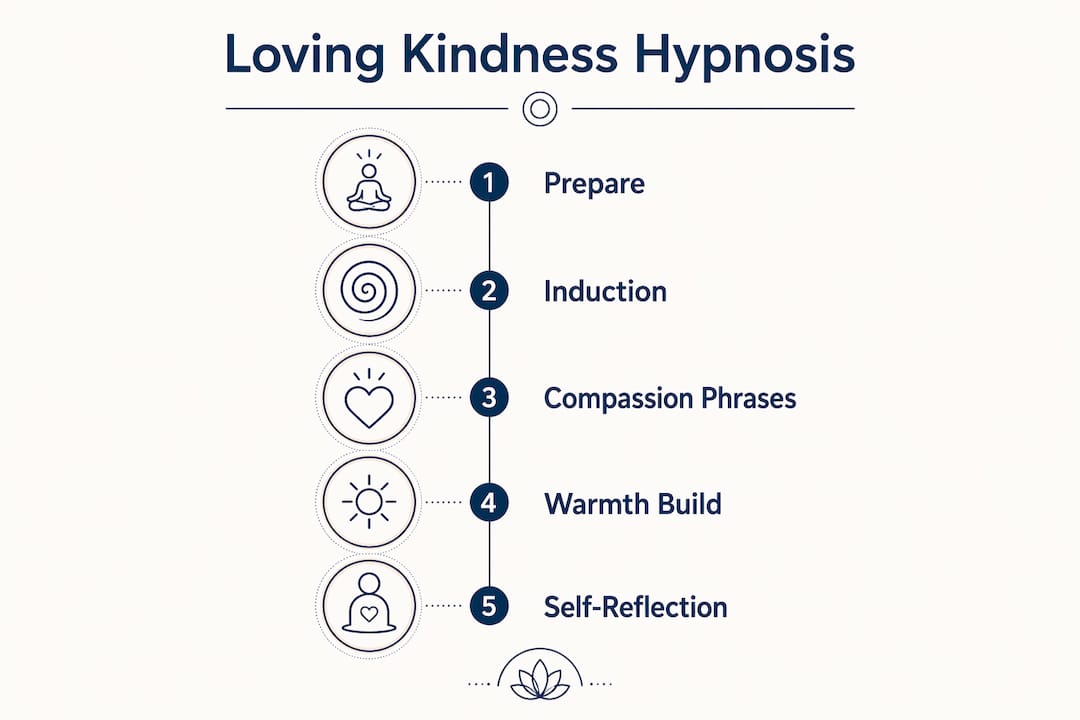
How to perform a loving kindness hypnosis session step by step
A well-structured session follows six clear phases. Each phase builds on the last, so skipping steps reduces effectiveness.
-
Settle and induce. Sit or lie in a comfortable position. Close your eyes and take five slow, deep breaths. With each exhale, allow your body to become heavier. A simple counting induction, counting down from ten to one while imagining descending a staircase, brings most people into a light hypnotic state within three to four minutes.
-
Anchor a feeling of safety. Before introducing any compassion phrases, spend one to two minutes simply noticing that you are safe in this moment. This step primes the nervous system to receive warmth rather than scan for threat.
-
Direct kindness toward yourself. Silently repeat four phrases: "May I be safe. May I be healthy. May I be happy. May I live with ease." The phrases act as gentle scaffolding, and the real target is any softening sensation, especially warmth in the chest or face. Do not force a feeling. Simply notice what is there.
-
Extend to a benefactor. Bring to mind someone who has shown you unconditional care, a grandparent, a mentor, or even a pet. Direct the same four phrases toward them. This step is easier than self-directed kindness for most people, which is exactly why it appears here. Starting with a benefactor before redirecting warmth toward yourself reduces resistance and increases effectiveness, especially for those with low self-esteem.
-
Move through the sequence. After the benefactor, extend the phrases to a neutral person (someone you see but do not know well), then to a mildly difficult person, and finally to all beings everywhere. Spend two to three minutes on each target.
-
Return and integrate. Slowly count upward from one to five. With each count, bring awareness back to the room. Wiggle your fingers and toes. Open your eyes. Take thirty seconds to notice how your body feels before standing.
Pro Tip: Record your own voice reading the four phrases and the induction script. Hearing your own voice deliver compassionate suggestions is more effective for many people than a stranger's voice, because the subconscious recognizes it as internally generated rather than externally imposed.
What common challenges come up, and how do you handle them?
The most common obstacle is resistance to self-directed kindness. People experiencing depression or shame often report that the phrases feel hollow or even irritating when pointed at themselves. Experts treat this resistance as valuable observation data, not failure. The resistance itself is information about where the subconscious holds protective patterns.
The practical fix is sequencing. Always begin with the benefactor stage and let warmth build there before redirecting it inward. This approach sidesteps the critical inner voice that says "I don't deserve this" by first proving that the feeling of warmth is real and accessible.
A second common mistake is choosing the wrong "difficult person." Selecting someone who caused serious trauma can overwhelm the nervous system rather than build emotional regulation. Choose a mildly irritating person rather than someone deeply harmful. Think of a coworker who interrupts you, not someone who hurt you significantly. The goal is gradual expansion of compassion, not forced forgiveness of major wounds.
Three other challenges come up regularly:
- Mechanical repetition. Repeating the phrases without feeling anything is normal and still useful. Mechanical repetition can unlock subconscious emotional responses over time, even when it feels rote in the moment.
- Mind wandering. When attention drifts, gently return to the phrase without self-criticism. Each return is a repetition of the compassion habit, not a failure.
- Skepticism. Doubting whether hypnosis "works on you" is extremely common. The skepticism does not block the practice. Relaxation and repetition produce results regardless of belief.
Pro Tip: Practice at the same time each day for at least three weeks. Consistency matters more than session length. A 15-minute daily session produces more lasting change than an occasional 45-minute one.
What does the science say about the benefits?
The neuroscience behind this practice is specific and well-documented. Gamma brainwave power increases during metta practice, and activity rises in the insula and temporal-parietal junction, two regions directly linked to empathy and social connectedness. These are not subtle shifts. They represent measurable changes in how the brain processes other people's emotional states.
"Loving kindness meditation shifts neural activity away from self-referential rumination and toward prosocial emotion-generation circuits, which explains its role in reducing self-criticism and enhancing empathy."
This shift matters clinically. Reduced amygdala reactivity means the brain's threat-detection system fires less aggressively in social situations. That translates directly to lower anxiety, less shame, and reduced social isolation. The practice is especially beneficial for those with depression because it cultivates positive affect gradually, without requiring the person to feel better before they can begin.
The table below summarizes the documented effects.
| Scientific effect | Practical outcome |
|---|---|
| Increased gamma brainwave activity | Heightened empathy and emotional awareness |
| Reduced amygdala reactivity | Lower anxiety and fewer threat responses in social settings |
| Improved vagal tone | Better emotional recovery after stress |
| Insula and TPJ activation | Stronger capacity for compassion toward self and others |
| Reduced self-referential rumination | Less self-criticism and mental looping |
When hypnotherapy's induction layer is added, these effects deepen. The subconscious is more receptive during hypnosis, which means the compassion phrases reach neural circuits that are harder to access during ordinary waking awareness. You can learn more about how hypnotherapy works and why the induction phase matters for lasting emotional change.
Key Takeaways
Loving kindness hypnosis produces lasting emotional change by combining the 5-target metta sequence with hypnotic induction to reach subconscious patterns that conscious effort alone cannot access.
| Point | Details |
|---|---|
| Start with a benefactor | Reduces self-directed resistance and builds warmth before turning it inward. |
| Use physical sensations as feedback | Chest warmth or facial softening signals the practice is working, not the phrases themselves. |
| Choose a mild "difficult person" | Prevents re-traumatization and builds emotional regulation gradually. |
| Consistency beats session length | Daily 15-minute sessions produce more change than occasional longer ones. |
| Science supports the method | Gamma brainwave increases and reduced amygdala reactivity are documented outcomes of metta practice. |
What I've learned from working with loving kindness hypnosis
The biggest misconception I encounter is that people think they need to feel love before the practice works. They wait for a warm feeling to arrive before they believe they are "doing it right." That gets it exactly backward. The feeling is the output, not the input. You show up, repeat the phrases, and notice whatever is there. Sometimes it is warmth. Sometimes it is nothing. Sometimes it is irritation. All of those are valid data points, and all of them move the needle.
What I have seen in sessions is that the people who struggle most with self-compassion are also the ones who benefit most from the hypnotic induction layer. The induction bypasses the critical voice long enough for the suggestion to land. After enough repetitions, the subconscious starts generating warmth on its own, without the fight. That is the shift people describe as life-changing, and it is not dramatic or sudden. It is quiet and cumulative.
My honest advice: do not treat this as a performance. You are not trying to convince anyone, including yourself, that you feel something you do not. You are training a circuit. Treat it the way you would treat physical therapy after an injury. Show up, do the repetitions, and trust that the tissue is changing even when you cannot feel it yet.
— Kirk
Professional support for your self-compassion practice
Practicing loving kindness hypnosis on your own builds a real foundation. Working with a trained hypnotherapist accelerates it significantly.
At Hypnotictransformations, Certified Clinical Hypnotherapist Kirk Hoffman leads personalized online sessions designed to address the subconscious patterns behind anxiety, shame, and emotional disconnection. Sessions are conducted entirely online, which means you access professional support from wherever you are most comfortable. If emotional distress or low self-esteem has made self-directed practice feel out of reach, online hypnotherapy services offer a structured, guided path forward. For those dealing specifically with anxiety, the hypnotherapy for anxiety program applies these same principles in a clinically focused format. You can book a session directly through the appointments page.
FAQ
What is the difference between loving kindness meditation and loving kindness hypnosis?
Loving kindness meditation uses conscious attention to direct compassionate phrases through the 5-target metta sequence. Loving kindness hypnosis adds a hypnotic induction first, placing the mind in a deeply receptive state so the phrases reach subconscious emotional patterns more directly.
How long does a loving kindness hypnosis session take?
Most sessions run 15–30 minutes, consistent with the traditional metta practice length described in the Pali Canon's Discourse AN 11.16. Beginners often find 20 minutes sufficient to move through all five targets without rushing.
Can loving kindness hypnosis help with anxiety and depression?
The practice produces documented reductions in amygdala reactivity and self-referential rumination, both of which drive anxiety and depression. It is particularly effective for people with shame or social isolation because it builds positive affect gradually rather than demanding an immediate emotional shift.
What if I feel nothing during the session?
Feeling nothing is normal, especially in early sessions. Mechanical repetition still produces subconscious change over time. The target is any softening sensation, including reduced muscle tension, not a dramatic emotional experience.
Is loving kindness hypnosis safe to practice before sleep?
Practicing compassionate phrases before sleep can calm racing thoughts and promote rest. A four-phrase method focusing on safety, health, happiness, and ease trains attention to settle and works well as a wind-down routine for people with anxiety-driven insomnia.