
Manifestation blocks are subconscious programs that clash with what you consciously want, and no amount of positive thinking overrides them on its own. Clearing them takes three steps: name the specific block, calm the nervous system that's guarding it, and retrain the pattern with small actions repeated daily. If you've done the inner work and the block still holds, hypnotherapy can speed up what journaling alone cannot finish.
TL;DR:
- Most manifestation blocks are rooted in deep subconscious beliefs or emotional patterns formed childhood, which resist change through positive affirmations alone.
- Calming the nervous system with breathing or grounding exercises before cognitive work enhances the effectiveness of clearing these blocks.
- Identifying your primary blocks through journaling, body scans, and reflection reveals which protective beliefs need targeted retraining.
- Persistent blocks after three months of self-work may require professional hypnotherapy to access and reprogram deeper subconscious patterns.
- Small, daily micro-actions and consistent practice within your window of tolerance build safety and momentum for manifesting desired outcomes.
Table of Contents
- What Are Law of Attraction Blocks, Really?
- What Are the Common Types of Manifestation Blocks?
- How Do You Identify Your Own Manifestation Blocks?
- How Do You Calm the Nervous System to Clear a Block?
- Which Cognitive Practices Actually Support the Subconscious?
- What Daily Routine Actually Consolidates These Changes?
- When Should You Consider Professional Hypnotherapy?
- What I See Most Often With Clients on This
- Ready to Work With the Root Cause Directly?
- Sources
- FAQ
What Are Law of Attraction Blocks, Really?
A manifestation block is a subconscious belief, memory, or emotional pattern that contradicts what you say you want out loud. You want more income, but a part of you associates money with conflict you saw growing up. You want a relationship, but your body remembers rejection and treats connection as danger. The conscious mind sets a goal. The subconscious mind, which runs the show far more than most people realize, vetoes it.
That imbalance is not a metaphor. Roughly 95% of thoughts and beliefs operate below conscious awareness, which means the mental chatter you notice is a small fraction of what's actually steering your behavior. That's why repeating "I am worthy of abundance" in the mirror can feel hollow, or even trigger irritation. You're talking to the wrong part of the brain.
Here's how these programs form:
- A childhood experience taught your nervous system that a certain outcome (success, love, visibility) was unsafe.
- Your brain filed that lesson away as protection, not punishment.
- Decades later, the circumstances changed but the filing system didn't update.
- Your body still reacts to opportunity the way it once reacted to threat.
This connects to what therapists call the window of tolerance, the zone where your nervous system feels calm enough to take in new information and act on it. Push past that window with too much change too fast, and the body defaults to fight, flight, or freeze. That's often what "self-sabotage" actually is: a stress response, not a character flaw. Clearing blocks means working inside that window, not blasting through it.
What Are the Common Types of Manifestation Blocks?
Most blocks fall into a handful of recognizable categories. Experienced teachers in the manifestation space describe these patterns consistently, and each one tends to serve a hidden protective purpose once you look closely.
Worthiness blocks. The thought sounds like, "Good things happen to other people, not me." Behaviorally, this shows up as deflecting compliments, undercharging for your work, or feeling guilty right after something good happens.
Scarcity blocks. The core belief is that resources, whether money, time, or love, are finite and someone else getting more means you get less. This one often produces hoarding behavior, difficulty spending on yourself, or anxiety around generosity.
Fear of success blocks. Counterintuitive but common: the fear isn't failing, it's succeeding and then losing control, attracting envy, or having to maintain a new standard forever. People with this block often stall right before a breakthrough.
Perfectionism blocks. The rule here is "if I can't do it perfectly, I won't start." This delays the small actions that manifestation actually depends on, because nothing ever meets the bar.
Social belonging blocks. The fear is that changing your circumstances will change your relationships, and you'll lose your place in your family or friend group. This shows up as quietly downplaying goals around certain people.
You can spot which ones apply to you by watching your body, not just your thoughts. Common cues include:
- A tight chest or shallow breath when you think about your goal.
- Sudden fatigue or the urge to nap right after setting an intention.
- A wave of nausea or a knot in the stomach when opportunity actually appears.
- Procrastination that shows up specifically around the one task that would move the goal forward.
- Irritability or defensiveness when someone asks how the goal is going.
Ask yourself: does my body feel calm or braced when I picture this outcome already happening? Braced means there's a block worth investigating.
How Do You Identify Your Own Manifestation Blocks?
You find blocks the same way a detective finds evidence: by asking specific questions and paying attention to what the body does before the mind can edit the answer.
-
Set a timer for seven minutes and free-write the sentence: "The reason I don't already have this is..." Don't stop to think. Let your hand keep moving even if the answers feel silly or repetitive. The first thing that surfaces after the second minute is usually the real block, not the polished excuse you gave in minute one.
-
Run a short body scan before or after journaling. Sit down, close your eyes, and mentally walk from your scalp to your feet, pausing for three seconds at each spot. Notice where you feel tension, heat, numbness, or nothing at all. A script as simple as, "I'm noticing my shoulders... I'm noticing my stomach... I'm noticing my jaw," is enough. Areas that feel numb or tight often correspond to the emotion tied to the block.
-
Fill out the worksheet question: "What do I gain by staying exactly the same?" This one surprises people. Staying stuck usually pays a hidden dividend: safety, sympathy, avoiding the risk of trying and failing publicly, or not having to change relationships that depend on you staying small. Write down every gain, even the ones that embarrass you.
Once you have your answers, look for the theme, not the wording. If three different journal entries point to fear of visibility, that's your primary block for now. You don't need to fix everything at once.
Pro Tip: Do the body scan before the journaling, not after. Your body usually knows the answer before your mind writes an explanation for it.
How Do You Calm the Nervous System to Clear a Block?
This is the piece most manifestation content skips, and it's the reason so many people practice gratitude and visualization for months without a shift. If your nervous system reads the desired change as dangerous, it will override your intentions every time, regardless of how sincerely you set them. Removing a block often comes down to creating enough safety in the body that the old protective pattern no longer has a job to do.
That's the logic behind working inside your window of tolerance instead of forcing a leap. Small, incremental steps retrain the body's alarm system without triggering the defensive shutdown that big, sudden change tends to cause. Here are three protocols that do that work directly:
- The 4-4-8 breath reset. Inhale for four counts, hold for four, exhale for eight. Repeat five rounds. The extended exhale signals the vagus nerve to shift the body out of fight-or-flight and into a state where new input can actually land.
- The two-minute grounding anchor. Press your feet into the floor, name five things you can see and three sounds you can hear, then place a hand on your chest and say, "I am here, and this moment is safe." This interrupts the mental spiral before it hijacks the body.
- A progressive micro-action plan. If your goal feels too large to approach, break it into a version so small it barely registers as a risk. Someone with a fear of visibility might not "post daily on social media." They might comment on one other person's post, then wait three days before the next tiny step.
Sequence matters here. Do the somatic work first, even if it's just ninety seconds of breathing, and only then move into the cognitive tools like journaling or visualization. Trying to think your way past a nervous system that's already activated rarely works, because the thinking brain goes partially offline under stress. Calm the body, then talk to the mind.
Pro Tip: If a micro-action still triggers panic, it's not micro enough yet. Cut it in half again. The goal is a step small enough that your body barely notices you took it.
Which Cognitive Practices Actually Support the Subconscious?
Once the nervous system is calmer, cognitive tools get real traction, but only if you scale them to something your subconscious will accept rather than reject.
Identity statements work better than affirmations because they describe a believable version of you instead of a finished fantasy. Instead of "I am a millionaire," try "I am someone who is learning to handle money with more confidence." The second version doesn't trip the internal lie detector the way an unbelievable claim does.
Scene-based visualization works best in short, specific bursts rather than long, vague daydreams. Pick one scene, maybe thirty seconds long, of a moment just after the goal has happened: the phone call, the handshake, the number on the scale. Run it for two or three minutes, ideally right after your breathing practice, when your body is already calm enough to absorb it.
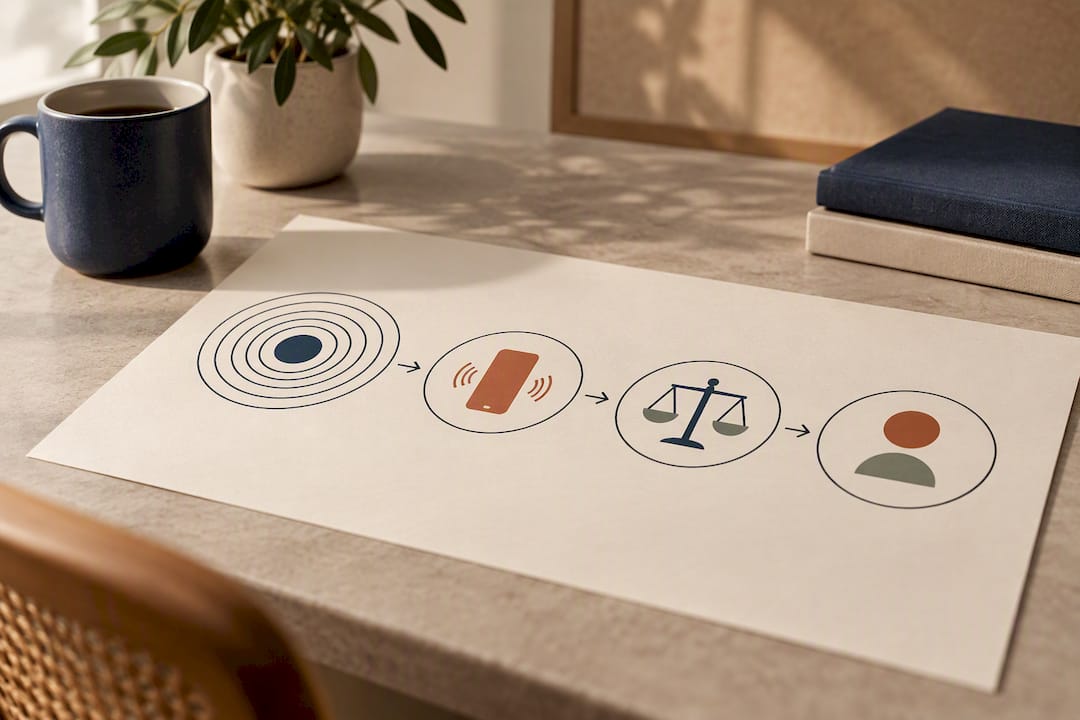
A simple EFT or tapping sequence can help release the emotional charge attached to a specific memory tied to the block. Tap the side of the hand while naming the issue out loud ("Even though I'm afraid of being seen, I accept this feeling"), then move through the eyebrow, side of eye, under eye, and collarbone points while repeating a shortened version of the phrase. Skip this if you have a trauma history that feels too intense to approach without a trained practitioner present; that's a sign to work with a professional rather than alone.
A few guardrails matter here:
- Large, sweeping affirmations tend to fail because they contradict current evidence too sharply, and the subconscious flags the contradiction.
- Forcing positivity when the body is still braced just adds a layer of pretending on top of the original fear.
- Scale every statement down until it feels believable, even if that means it sounds modest.
What Daily Routine Actually Consolidates These Changes?
Consistency does more than intensity here. A short daily sequence, repeated, works better than an occasional deep session.
- Somatic primer (2 minutes). One round of 4-4-8 breathing or the grounding anchor.
- One micro-action (5 to 10 minutes). The smallest next step toward your goal, done regardless of mood.
- Two-line journal entry. Note what came up in the body during the micro-action, not just what you did.
- Thirty-second scene visualization. Picture the goal already achieved, briefly, right before moving on with your day.
- One-sentence identity statement, spoken out loud, not just read silently.
Weekly, set aside ten minutes to ask three questions: Which micro-actions felt easier than last week? Where did resistance show up again? What's the next size-up step now that the smaller one feels manageable?
Give this real time before judging results. Committing to a 90-day window rather than a few days lets the nervous system actually update, and it keeps you from abandoning practice right before the shift would have shown up. Most people quit in week two, exactly when the pattern is starting to loosen.
When Should You Consider Professional Hypnotherapy?
Self-directed work clears a real percentage of blocks, but some patterns are wired in deeply enough that journaling and breathwork can't fully reach them. Consider professional support if:
- You've done consistent somatic and cognitive work for 90 days with no shift in the specific area.
- The same fear (money, visibility, relationships) keeps resurfacing no matter which technique you try.
- Body sensations like panic, nausea, or dissociation show up the moment you approach the topic, and they don't settle with breathing alone.
- You suspect the block traces back to a specific early event you can name but can't process on your own.
Clinical hypnotherapy works by guiding you into a deeply relaxed state where the analytical, defensive part of the mind steps back, allowing direct communication with the subconscious programming that's driving the block. Sessions target the root pattern rather than managing the surface symptom, which is why the change tends to hold rather than requiring daily maintenance forever.
An online session typically starts with a conversation about the specific pattern you want to shift, followed by an induction into that relaxed state, then targeted suggestion work aimed at the exact belief you identified in your journaling. A Certified Clinical Hypnotherapist structures sessions around this root-cause approach rather than symptom management, working with clients nationwide through Zoom.
What I See Most Often With Clients on This
A pattern I run into constantly: someone has journaled for months, can name their block precisely, and still feels stuck. They know it's a fear of visibility or an old scarcity belief. Naming it isn't the same as clearing it, though, because the nervous system doesn't respond to insight the way the thinking mind does. It responds to felt safety.
The most common misstep is skipping the body work and jumping straight to bigger goals, hoping momentum will override the fear. It rarely does. The fear just gets louder.
If you take one thing from this article today, do the seven-minute journaling prompt this evening: "The reason I don't already have this is..." Write until the timer goes off. Don't edit. See what shows up in minute five that wasn't there in minute one.
— Kirk
Ready to Work With the Root Cause Directly?
If you've tried journaling, breathwork, and micro-actions and a specific block still won't budge, that's usually a sign the pattern is wired in deeper than conscious tools can reach alone, and that's exactly what a targeted session addresses. Law of Attraction Hypnotherapy Online with Kirk Hoffman works directly with the subconscious programming behind the block, rather than adding another layer of willpower on top of it.
Many clients come in for manifestation work and discover the real block is anxiety about being seen or judged, which is why Online Hypnotherapy for Anxiety is often the more accurate starting point. A first consultation is a straightforward conversation: what you want, what's been getting in the way, and whether the pattern traces to a specific memory or a general belief formed over years. Sessions happen over Zoom, so location isn't a barrier. Browse the full list of online hypnotherapy services and book a time that works for your schedule.
Sources
The claim that most mental activity happens below conscious awareness comes from research summarized in The Power of the Subconscious Mind; this is useful background for anyone skeptical that affirmations alone can shift behavior. For a breakdown of specific block categories like upper limit problems and fear of success, Mindvalley's guide to manifestation blocks offers practical language. On pacing expectations, Amiett Kumar's piece on why manifestation stalls makes the case for a 90-day commitment window rather than judging results too early. For related exercises, see this guide on removing limiting beliefs.
- The Power of the Subconscious Mind (ResearchGate entry)
- 10 Things Blocking Your Manifestations (& How to Find Yours) — Mindvalley
- Why the Law of Attraction May Not Be Working for You — Amiett Kumar
FAQ
How Do You Remove Blocks in Manifestation?
Identify the specific block through journaling or a body scan, calm the nervous system with breathwork or grounding, then retrain the pattern with small, repeated actions rather than one big leap. If the block persists after consistent practice, hypnotherapy can address the subconscious programming directly through services like law of attraction hypnotherapy.
What Is the 3-3-3 Rule for Manifestation?
Definitions of this rule vary across manifestation content, and there isn't one consistent, verified version worth stating as fact. Rather than repeat an unverified formula, focus on the practices with clearer support here: daily micro-actions, nervous-system regulation, and a committed practice window of around 90 days.
What Is the Most Powerful Law of Attraction Technique?
No single technique outperforms the rest for everyone, because the right tool depends on which block is active. Pairing nervous-system work like breathwork with small consistent actions tends to outperform visualization or affirmations alone, since most thought and belief happens below conscious awareness and needs a body-based approach to shift.
What Are the Core Laws Often Cited Alongside the Law of Attraction?
Different teachers list slightly different sets of universal laws, and there's no single official list of seven that all sources agree on. Rather than present a shaky enumeration, it's more useful to focus on the mechanics that actually matter for clearing blocks: subconscious belief, nervous-system safety, and consistent small action.
Can Hypnotherapy Really Clear a Manifestation Block?
Clinical hypnotherapy works by guiding the mind into a relaxed state where the subconscious becomes more accessible, allowing direct work on the belief or pattern driving the block. Sessions are structured around this root-cause approach; current pricing and session details are available on the services page.