
Most U.S. health insurance plans do not routinely cover hypnotherapy, but coverage is possible under specific conditions. Three things determine whether your plan will pay: your provider holds a primary clinical license, the treatment is tied to a documented medical or mental health diagnosis using an ICD-10 code, and your plan's language includes alternative or behavioral therapy benefits. Without all three, a denial is the likely outcome.
Before your first session, take these steps:
- Call your insurer and ask specifically about CPT code 90880 (the standard billing code for hypnotherapy)
- Confirm whether your provider must be a licensed mental health professional
- Ask if a referral or preauthorization is required
- Check whether your plan has an alternative therapy benefit or a behavioral health carve-out
Table of Contents
- How does insurance decide whether to cover hypnotherapy?
- What can you expect from Medicare and Medicaid?
- How to check your benefits and pursue coverage
- When is hypnotherapy unlikely to be covered?
- What are your options if insurance denies coverage?
- How to find a clinician who meets insurer expectations
- Key Takeaways
- What most people get wrong about insurance and hypnotherapy
- How Hypnotictransformations supports your insurance process
- Useful sources to verify coverage and policy language
How does insurance decide whether to cover hypnotherapy?
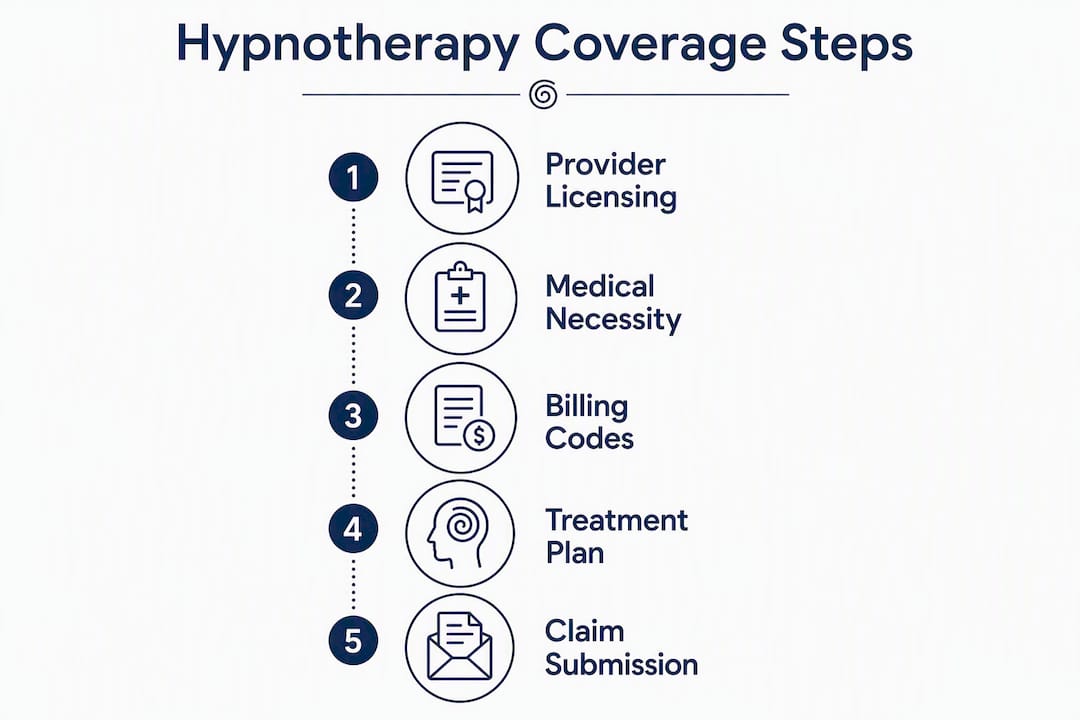
Insurers do not evaluate hypnotherapy as a single category. They run it through several decision filters, and each one can kill a claim.
Provider credentialing is the first filter. Insurers favor licensed psychologists, psychiatrists, or physicians who use hypnotherapy as part of evidence-based care. A hypnotherapy certification alone, without an underlying clinical license, rarely satisfies payer requirements. No federal licensing standard exists for hypnotherapists in the United States, so payers default to the clinician's primary state license.
Medical necessity is the second filter. The insurer needs an ICD-10 diagnosis code and a documented treatment plan with measurable goals. Sessions framed as self-improvement or wellness are excluded almost universally.
Billing code specifics matter too. CPT 90880 is the standard code for hypnotherapy billing. Some payers disallow billing CPT 90880 and a psychotherapy code in the same encounter, so clinicians need to know which code to submit.
| Provider type | Treatment purpose | Coverage likelihood |
|---|---|---|
| Licensed mental health provider (psychologist, LCSW, LPC) | Documented anxiety, chronic pain, or behavioral health diagnosis | Likely covered with prior auth |
| Physician with hypnotherapy training | Adjunctive pain management or preprocedural anxiety | Sometimes covered with restrictions |
| Certified hypnotherapist, no clinical license | Any purpose | Rarely covered |
Pro Tip: When submitting a claim, the treatment plan should name the ICD-10 diagnosis, list measurable session goals (e.g., reduction in panic frequency), and specify the number of sessions planned. Vague documentation is the fastest path to a denial.
What can you expect from Medicare and Medicaid?
Original Medicare generally does not cover hypnotherapy as a standalone service. Coverage is rare and typically contingent on hypnotherapy being embedded within a covered treatment plan, such as chronic pain management, rather than billed independently.
Medicare Advantage is a different story. Some MA plans add alternative therapy riders for chronic pain or behavioral health. When hypnotherapy is documented as part of a pain management plan and performed by a licensed clinician, certain MA plans may approve it with session limits and documentation requirements, which vary widely by carrier and county. The catch is that MA plan benefits vary widely by carrier and county; therefore, you have to check your specific plan's Evidence of Coverage document.
Medicaid coverage for hypnotherapy varies by state. Some states allow it under behavioral health benefits when a licensed provider performs it and medical necessity is documented. Others exclude it entirely. To find your state's rules, search your state Medicaid agency's provider manual for "hypnotherapy" or "hypnosis." The Medicare Advantage plan differences between carriers also affect which supplemental benefits are available, so comparing plans matters if you are in an open enrollment period.
How to check your benefits and pursue coverage
Work through this checklist before you book a session.
- Pull your plan documents. Find your Summary Plan Description or Evidence of Coverage. Search for "hypnotherapy," "hypnosis," and "alternative therapy."
- Call member services. Ask these exact questions:
- "Does my plan cover CPT code 90880?"
- "Does the provider need to be a licensed mental health professional?"
- "Is a referral from my primary care physician required?"
- "Is preauthorization required, and at what visit threshold?"
- "How many sessions per year does my plan allow?"
- "Does my plan reimburse out-of-network claims if I submit a superbill?"
- Get a referral if required. Some plans, particularly HMOs, require a primary care referral before any mental health service.
- Confirm preauthorization rules. Some insurers require preauthorization once you reach a visit threshold, sometimes as low as 15 sessions. Ask about the process before you hit that number, not after.
- Request documentation from your clinician. You need a written treatment plan, your ICD-10 diagnosis, progress notes, and a superbill with CPT 90880.
- Submit and track. If the insurer requests a peer-to-peer review, ask your clinician to respond promptly. Delays can result in automatic denials.
When is hypnotherapy unlikely to be covered?
Several scenarios almost always result in a denial.
- Elective or wellness purposes. Weight loss, smoking cessation framed as lifestyle change, performance enhancement, and relaxation sessions are excluded by most plans. Hypnotherapy for weight loss is rarely covered unless it is part of a medically supervised obesity treatment program with a documented diagnosis.
- Unlicensed provider. Blue Cross Blue Shield of Illinois, for example, explicitly excludes hypnosis performed by a non-licensed professional and covers it only when administered by a licensed clinical psychologist or physician. Most major carriers follow similar logic.
- No documented medical necessity. Without an ICD-10 code and a treatment plan, the claim reads as elective.
- Conditions classified as investigative. AAPC coding guidance categorizes several hypnotherapy indications as investigative, meaning the evidence base is not yet strong enough for routine coverage.
- Clinical contraindications. Some payers deny claims when the patient's record shows psychosis, significant cognitive deficits, or certain personality disorders, which insurers list as contraindications.
If you receive a denial, an appeal can succeed when you attach peer-reviewed studies tied to your specific diagnosis, a physician's written rationale, and progress notes showing measurable improvement.
What are your options if insurance denies coverage?
A denial is not the end. Several practical routes exist.
- Superbill for out-of-network reimbursement. A superbill is an itemized receipt your clinician provides that includes CPT 90880, the ICD-10 diagnosis code, provider NPI number, and session dates. Submit it to your insurer with a completed out-of-network claim form. Reimbursement is not guaranteed, but many PPO plans pay a percentage of the allowed amount.
- HSA or FSA funds. Hypnotherapy for a diagnosed medical or mental health condition generally qualifies as an eligible expense under a Health Savings Account or Flexible Spending Account. Check your plan's eligible expense list, and keep the superbill as your receipt.
- Session packages. Some clinicians offer multi-session packages at a reduced per-session rate, which lowers the out-of-pocket cost when insurance is not involved.
- Request a coverage extension. If your plan approved a limited number of sessions and you need more, submit progress notes showing measurable improvement and ask your clinician to write a letter of medical necessity for additional sessions.
Pro Tip: When submitting an out-of-network claim or appeal, attach the treatment plan and at least two progress notes that document specific, measurable changes (e.g., panic attack frequency dropped from five per week to one). Subjective improvement alone rarely moves an insurer.
How to find a clinician who meets insurer expectations
The credential combination that satisfies most payers is a primary clinical license paired with formal hypnotherapy training.
Credentials that carry weight with insurers:
- Licensed Psychologist (PhD or PsyD)
- Licensed Clinical Social Worker (LCSW)
- Licensed Professional Counselor (LPC) or Licensed Mental Health Counselor (LMHC)
- Board-certified physician with a relevant specialty
- Certified Clinical Hypnotherapist (CCHt) credential held alongside one of the above clinical licenses
Insurers prioritize the clinical license over the hypnotherapy certification. The CCHt credential matters, but only when it accompanies a state clinical license.
Where to search:
- Your insurer's online provider directory (filter by "psychologist" or "licensed counselor," then call to confirm they offer hypnotherapy)
- Your state licensing board's public lookup tool
- The Mayo Clinic's guidance on hypnosis recommends asking any prospective provider about their state license, specialty training in hypnosis, and years of practice
- Hypnotictransformations's online hypnotherapy for anxiety service, where Kirk Hoffman, Certified Clinical Hypnotherapist, provides documented treatment plans and superbills on request
The minimum paperwork a clinician should provide: a written treatment plan with ICD-10 diagnosis, session progress notes, and a superbill with CPT 90880 and the provider's NPI number.

Key Takeaways
Hypnotherapy insurance coverage depends on three non-negotiable factors: a licensed clinical provider, a documented ICD-10 diagnosis, and a plan that allows alternative or behavioral health therapy benefits.
| Point | Details |
|---|---|
| Licensure drives coverage | Insurers cover hypnotherapy only when a licensed psychologist, physician, or mental health clinician performs it. |
| Medical necessity is required | You need an ICD-10 diagnosis and a written treatment plan; wellness or elective uses are excluded. |
| Call insurer with CPT 90880 | Ask specifically about CPT code 90880, preauthorization thresholds, and session caps before your first appointment. |
| Use HSA/FSA if denied | Hypnotherapy for a diagnosed condition typically qualifies as an eligible HSA or FSA expense; keep your superbill. |
| Hypnotictransformations provides documentation | Kirk Hoffman, CCHt, offers online clinical sessions for anxiety with treatment plans and superbills available on request. |
What most people get wrong about insurance and hypnotherapy
People assume that because their plan covers mental health, it automatically covers hypnotherapy. That assumption costs them. Insurers treat hypnotherapy as a specific modality with its own billing code, its own evidence threshold, and its own provider-credentialing rules. General mental health coverage does not carry over.
The anxiety clients I see most often run into the same wall: they find a hypnotherapist, book a session, and only ask about insurance afterward. By then, they have already paid out of pocket for a provider whose credentials do not match what the insurer requires. The sequence matters. Check licensure and plan language first, then book.
The other thing people underestimate is how much the treatment plan documentation changes the outcome. A claim submitted with a vague note reads as elective. The same session, documented with a specific ICD-10 code, measurable goals, and a signed treatment plan, reads as medically necessary. The clinical work is identical. The paperwork is what the insurer sees.
[]
[]
How Hypnotictransformations supports your insurance process
If you are dealing with anxiety, panic, or a specific fear and want clinical hypnotherapy that actually produces documentation your insurer can work with, Hypnotictransformations offers online sessions via Zoom led by Kirk Hoffman, Certified Clinical Hypnotherapist. Sessions address the subconscious patterns driving your nervous system's fight-or-flight response, and Kirk provides written treatment plans, ICD-10-ready session notes, and superbills with CPT 90880 on request.

That means you have what you need to submit an out-of-network claim, apply HSA or FSA funds, or support an appeal if your insurer initially denies coverage. The process is straightforward: book a free consultation, discuss your diagnosis and goals, and get the clinical documentation your plan requires. Book your free consultation and get the paperwork right from the start.
Useful sources to verify coverage and policy language
Use these authoritative sources to confirm plan rules and state-level policy language yourself.
- Your insurer's medical policy documents. Search your insurer's website for "hypnotherapy clinical policy" or "hypnosis coverage policy." Most major carriers publish these as PDFs.
- Your plan's Summary Plan Description (SPD) or Evidence of Coverage. Search for "hypnotherapy," "hypnosis," and "alternative therapy." The SPD is the legally binding document.
- State Medicaid provider manuals. Go to your state Medicaid agency's website and search the provider manual for "hypnotherapy." Coverage rules, licensed provider requirements, and billing codes are listed there.
- Medicare contractor local coverage determinations (LCDs). Search the CMS website at cms.gov for "hypnotherapy LCD" to find your Medicare Administrative Contractor's policy.
- AAPC coding and policy guidance. Useful for understanding which indications are classified as medically necessary versus investigative.
- Medicare Advantage HMO plan limitations. If you are on an MA plan, understanding network restrictions helps you identify whether your hypnotherapy provider is accessible under your plan.
Keep written records of every call with your insurer: date, representative name, and what was confirmed. If coverage is disputed, request all claim reviews in writing so you have a paper trail for appeals.
This article is general information, not professional legal, medical, or insurance advice. Confirm your specific plan's rules with your insurer or a licensed insurance professional before making coverage decisions.