
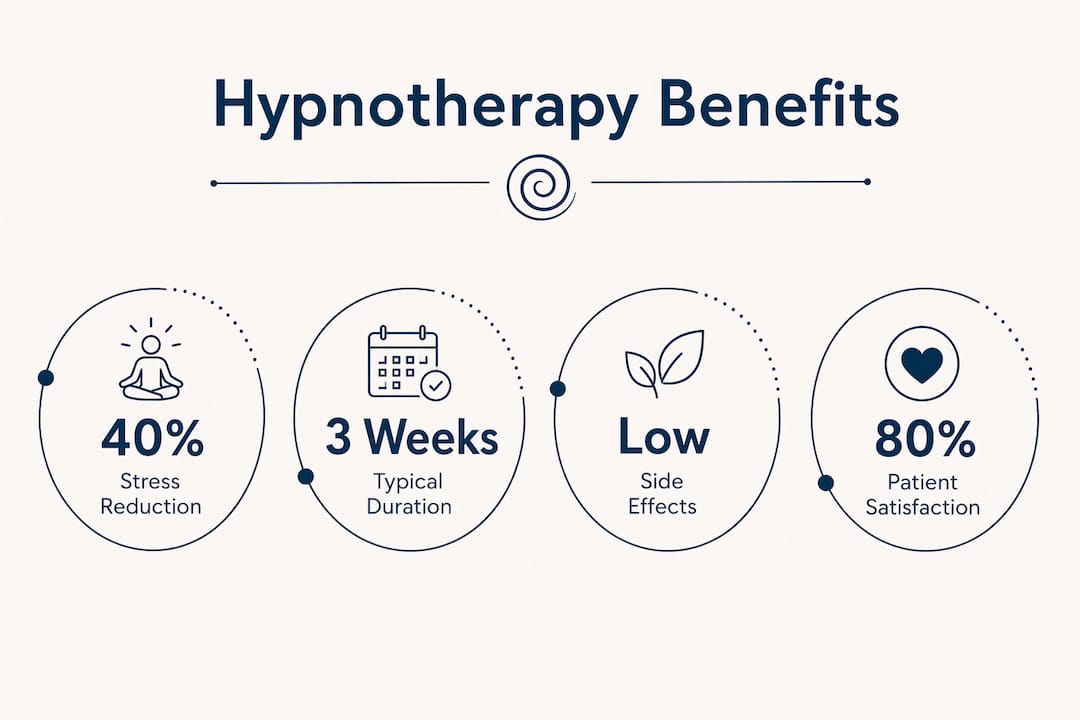
Yes, hypnotherapy for stress works. A 2019 meta-analysis of 17 trials found that hypnosis reduced anxiety more than approximately 79% of control participants at the end of treatment, rising to 84% at longest follow-up. The Mayo Clinic lists hypnosis as a recognized complementary approach for stress and anxiety. A 2024 Frontiers review confirmed that hypnotic interventions reduce sympathetic nervous system activation and increase parasympathetic tone. That is the fight-or-flight brake being applied at a physiological level.
Three things you can do right now:
- Try the 10-minute progressive relaxation script in Section 7 of this article.
- Write down your top two stress triggers before your first session so your clinician can build targeted suggestions.
- If symptoms are severe or include panic attacks, contact your primary care provider before starting any self-directed practice.
Quick safety notes:
- You stay conscious and in control throughout every hypnosis session.
- Hypnotherapy is not a substitute for psychiatric care when psychosis or uncontrolled dissociation is present.
- Self-hypnosis is safe for most adults but should be avoided immediately before driving or operating machinery.
Table of Contents
- What is hypnotherapy and how is it used for stress?
- How does a clinical hypnotherapy session for stress actually work?
- What does the research say about how hypnosis reduces stress?
- What are the benefits, side effects, and contraindications?
- What should you expect in terms of sessions, timeline, and cost?
- Three self-hypnosis techniques you can try right now
- How do you find a qualified hypnotherapist for stress in the United States?
- When should hypnotherapy stand alone, and when should it be combined with other treatments?
- Key Takeaways
- What I see in clinical practice that most guides miss
- Ready to address stress at the source with Hypnotictransformations?
- Useful sources and further reading
What is hypnotherapy and how is it used for stress?
Hypnosis is a state of focused attention and reduced peripheral awareness in which the subconscious mind becomes more receptive to suggestion. It is not sleep. You are aware of what is happening, you can hear the clinician's voice, and you can end the session at any point. Hypnotherapy is the clinical application of that state, using it to introduce new thought patterns, behavioral responses, and physiological habits.
For stress and anxiety, clinicians use hypnotherapy to interrupt the automatic threat-response cycle. When the subconscious has learned to treat ordinary situations as dangerous, the fight-or-flight response fires constantly. Hypnotherapy works at the level where that pattern is stored, not just at the level of conscious reasoning.
Myth vs. fact:
- Myth: You lose control during hypnosis. Fact: Clients retain full agency and can decline or exit at any time.
- Myth: A hypnotist can make you reveal secrets or act against your values. Fact: Suggestions that conflict with a person's core values are simply rejected by the subconscious.
- Myth: Hypnotherapy is only for highly suggestible people. Fact: Most adults can enter a useful hypnotic state with a trained clinician; depth varies but therapeutic benefit does not require deep trance.
Short glossary:
- Induction: The opening process that guides attention inward and relaxes the body.
- Deepening: Techniques that deepen the relaxed, focused state after induction.
- Suggestions: Specific language patterns the clinician delivers to shift beliefs, responses, or behaviors.
- Post-hypnotic suggestion: A suggestion designed to activate automatically in a future real-world situation.
- Self-hypnosis: A self-directed version of the same process, practiced between sessions or as a stand-alone tool.
Centers such as the Cleveland Clinic and Vanderbilt Osher Center for Integrative Health both frame hypnotherapy as a complementary technique within broader behavioral medicine programs, which reflects where mainstream clinical opinion currently sits.
How does a clinical hypnotherapy session for stress actually work?
Understanding the session structure removes most of the anxiety people feel about trying it for the first time. Here is what typically happens.
Step-by-step session flow:
- Intake and history: The clinician gathers information about your stress patterns, triggers, sleep, and any relevant medical or psychiatric history. This is not optional. A good clinician will not skip it.
- Goal setting: You and the clinician agree on specific, measurable outcomes for the session series. "Feel less stressed" is too vague. "Reduce the physical tension response when my manager calls" is workable.
- Induction: The clinician guides you into a relaxed, focused state using a verbal script, often paired with slow breathing or a visual anchor. This typically takes 5–10 minutes.
- Deepening: Progressive relaxation, counting techniques, or imagery are used to deepen the state so suggestions land at the subconscious level.
- Therapeutic suggestion: The core of the session. The clinician delivers carefully worded suggestions tailored to your specific stress pattern. Examples include anchoring a calm physical state to a hand gesture, imagery of a safe place that interrupts rumination, and breathing cues that activate the parasympathetic nervous system automatically in high-stress moments.
- Emergence: A gradual, guided return to full waking awareness. This is not abrupt. Most clients feel alert and calm within two minutes.
- Debrief: The clinician checks in, notes what resonated, and assigns a home practice recording or script.
Types of suggestions used for stress:
- Anchoring: "Each time you press your thumb and forefinger together, your body remembers this calm."
- Imagery: Visualizing a specific place where the nervous system has historically felt safe, then linking that image to a physical cue.
- Breathing cues: Post-hypnotic suggestions that trigger a slow exhale automatically when cortisol rises.
Clinicians track progress by asking clients to rate stress intensity on a 0–10 scale before and after each session, note changes in sleep quality, and report how often post-hypnotic anchors activated during the week.
Pro Tip: Write down three specific situations that triggered your stress response in the week before your first session. Bring that list. Clinicians build more precise suggestions when they have concrete scenarios rather than general descriptions.

What does the research say about how hypnosis reduces stress?
The evidence base is stronger than most people expect. The 2019 meta-analysis covering 17 randomized and controlled trials reported a mean weighted effect size of 0.79 at end of active treatment. At the longest follow-up, hypnosis improved outcomes more than about 84% of control participants, with an effect size of 0.99, which is considered large by standard clinical benchmarks. The analysis also found that hypnosis produced better outcomes when combined with other psychological interventions, a finding that has since been replicated in applied settings.
The physiological mechanism is now better understood. The 2024 Frontiers review synthesized multiple studies showing that hypnotic interventions reduce sympathetic nervous system activation and increase parasympathetic tone. In plain terms: the body's alarm system quiets down, and the rest-and-digest system takes over. That shift shows up in measurable markers including heart rate variability and blood pressure in some studies.
Effect size at longest follow-up: 0.99 — meaning hypnosis outperformed control conditions in nearly all participants tracked over time in the 2019 meta-analysis.
There are also cognitive mechanisms at work. The MedicalNewsToday overview describes the core clinical value as access to internal coping resources when the conscious mind is less protective. In a hypnotic state, the subconscious is more open to reframing a threat as manageable, which changes the automatic appraisal that triggers the stress response in the first place.
Why combining hypnotherapy with CBT often improves outcomes:
- CBT addresses conscious thought patterns and behavioral avoidance.
- Hypnotherapy reaches the subconscious layer where automatic threat-appraisals are stored.
- Together, they work on both the surface and the root.
- The Frontiers review specifically notes that hypnosis techniques including guided imagery and progressive relaxation overlap with established anxiety-reduction protocols.
Applied research also shows benefit in context-specific stress: studies on exam anxiety and performance anxiety in competitive athletes show measurable improvement compared to controls, suggesting the technique generalizes across different stress triggers.

What are the benefits, side effects, and contraindications?
Common clinical benefits for stress and anxiety:
- Reduced frequency and intensity of worry cycles
- Improved heart rate variability, a physiological marker of stress resilience
- Better sleep onset, since the subconscious rehearsal of threat scenarios decreases
- Stronger response to post-hypnotic anchors in high-pressure moments
- Reduced reliance on avoidance behaviors that reinforce anxiety over time
Side effects are generally mild and short-lived. Some people experience brief dizziness or light-headedness during emergence, a mild headache after a first session, or unusual drowsiness for an hour or two. These are not dangerous and typically resolve without intervention.
"Although hypnosis is often described as a sleep-like trance state, it's better described as a state of focused attention, heightened suggestibility, and vivid fantasy. People in a hypnotic state often seem sleepy and zoned out, but in reality they are in a state of hyper-awareness." — Mayo Clinic
Contraindications and caution:
- Trauma processing: Standard suggestibility-based hypnotherapy is not the right tool for processing traumatic memory. Attempting to revisit traumatic events without trauma-informed training can trigger intense emotional reactions. Clinicians trained in trauma-focused modalities use different protocols.
- Psychosis: Active psychosis is a contraindication. Hypnotherapy is not appropriate when a person cannot reliably distinguish internal experience from external reality.
- Uncontrolled dissociation: If a client already dissociates frequently, deepening that state without clinical safeguards can worsen symptoms.
When to refer to a medical or psychiatric provider: If stress symptoms include chest pain, persistent insomnia lasting more than three weeks, panic attacks occurring daily, or any suicidal ideation, see a physician or licensed mental health provider before starting hypnotherapy. Hypnotherapy works best as a complement to, not a replacement for, medical evaluation.
This article is general information, not professional medical or mental health advice. Confirm the right approach for your situation with a qualified clinician.
What should you expect in terms of sessions, timeline, and cost?
| Factor | Typical Range | Notes |
|---|---|---|
| Session length | — | First session is longer due to intake |
| Sessions for stress | 4 sessions | Mild to moderate stress; chronic cases may need more |
| Measurable improvement | 2–4 sessions | Most clients notice change within this window |
| Self-practice recommendation | Daily, 10–20 minutes | For 21 days to consolidate new patterns |
| Cost per session (US) | — | Varies by clinician credentials and location |
| Insurance coverage | Limited | Most US insurers do not cover hypnotherapy as a standalone service |
The 21-day daily practice guideline comes from practitioner experience: a single session can produce immediate relief, but durable change requires repeated reinforcement so the subconscious adopts the new response as its default. Think of it the same way you would think about physical therapy. One session shows you the exercise. Daily repetition is what rebuilds the pattern.
Session preparation checklist:
- Write down your top stress triggers and when they typically occur.
- Avoid caffeine for two hours before your session.
- Choose a quiet space where you will not be interrupted for the session duration.
- Wear comfortable clothing; you will be seated or reclined.
- Bring any notes from previous sessions or relevant medical history.
- For online sessions, test your audio and video connection beforehand.
For telehealth sessions specifically, a calm home environment supports the induction process. Reducing visual clutter and ambient noise in your space makes it easier to achieve the focused state the clinician is guiding you toward.
Three self-hypnosis techniques you can try right now
Self-hypnosis is safe for most adults and can be practiced between sessions or as a stand-alone tool for acute stress. Before you begin, a few ground rules.
When not to use self-hypnosis:
- Do not practice while driving, operating machinery, or in any situation requiring full alertness.
- Do not attempt to revisit or process traumatic memories on your own. That work requires a trained clinician.
- If you experience significant dissociation in daily life, consult a clinician before starting solo practice.
Script 1: Quick anchor for acute stress (2–3 minutes)
- Sit upright with both feet flat on the floor.
- Take three slow breaths: inhale for four counts, exhale for six counts.
- On the third exhale, press your thumb and forefinger together gently.
- Say internally: "My nervous system knows how to be calm. This is that signal."
- Hold the pressure for five seconds, then release slowly.
- Repeat twice more, each time noticing the physical sensation of your shoulders dropping.
Use this anchor in real-time stress situations once you have practiced it at least five times in a calm state.
Script 2: 10-minute progressive relaxation (stress reset)
- Lie down or sit in a reclined chair. Close your eyes.
- Breathe slowly. With each exhale, mentally say "release."
- Starting at your feet, tense each muscle group for five seconds, then let go completely. Move upward: calves, thighs, abdomen, chest, hands, arms, shoulders, face.
- Once your whole body is relaxed, imagine a place where you have felt genuinely safe. It can be real or imagined. Notice the colors, sounds, and temperature.
- Spend three minutes in that place. If a stressful thought enters, acknowledge it briefly and return to the image.
- Count slowly from five to one. At one, open your eyes and take one more slow breath before moving.
Pro Tip: Record yourself reading this script aloud at a slow pace and play it back during practice. Your own voice is one of the most effective induction tools available, and you can access it from the Hypnotictransformations store or create your own recording.
Script 3: Breath-focused resilience script (10 minutes)
- Sit comfortably. Set a timer for 10 minutes.
- Breathe in for four counts, hold for two, out for six. Repeat this cycle for two minutes.
- After two minutes, let your breathing return to its natural rhythm. Simply observe it without controlling it.
- Introduce this suggestion silently: "Each breath I take strengthens my ability to respond calmly to pressure."
- If your mind wanders to a stressor, note it as "thinking" and return to the breath.
- In the final two minutes, visualize yourself handling one specific upcoming stressor with a steady, measured response. See the situation clearly. Notice that you are calm.
Practice plan: Daily, 10–20 minutes, for 21 consecutive days. Track your baseline stress rating (0–10) each morning before practice and again each evening. Most people notice a consistent downward trend by day 7–10.
How do you find a qualified hypnotherapist for stress in the United States?
Credential verification is the most important step. The hypnotherapy field is not uniformly regulated across US states, which means the title "hypnotherapist" alone tells you very little.
Credential checklist:
- Look for the Certified Clinical Hypnotherapist (CCHt) designation, which requires documented training hours and examination.
- Prefer clinicians who also hold a mental health license (Licensed Professional Counselor, Licensed Clinical Social Worker, or Licensed Psychologist), especially for anxiety and stress work.
- Confirm training in trauma-informed care if your stress has roots in past adverse experiences.
- Ask whether the clinician participates in continuing education specific to hypnotherapy and anxiety.
Questions to ask a prospective hypnotherapist:
- What is your intake process, and do you conduct a safety screening before the first session?
- How do you measure progress across sessions?
- What happens if I have an intense emotional reaction during a session?
- Do you have an emergency protocol or a referral relationship with a licensed mental health provider?
- How do you handle sessions if a client discloses trauma during treatment?
Red flags:
- Guarantees of results in a fixed number of sessions with no intake or assessment.
- Pressure to disclose traumatic details before trust and safety are established.
- No written informed consent or explanation of what hypnosis involves.
- Claims that hypnotherapy alone can treat diagnosed psychiatric conditions without any medical coordination.
For telehealth, the online hypnotherapy for anxiety format works well for stress-focused work. The induction and suggestion phases translate effectively to video sessions, and home-based practice recordings integrate naturally into the treatment plan. Confirm that your clinician uses a HIPAA-compliant platform and that sessions are conducted in a private, distraction-free space on both ends.
When should hypnotherapy stand alone, and when should it be combined with other treatments?
The answer depends on symptom severity, chronicity, and whether trauma is involved.
Stand-alone hypnotherapy tends to work well when:
- Stress is situational (work pressure, exam anxiety, performance situations).
- Symptoms are mild to moderate and have not persisted for more than six months.
- There is no underlying psychiatric diagnosis requiring medication management.
- The client is motivated to practice self-hypnosis between sessions.
Combined approaches are typically indicated when:
- Stress is chronic, lasting more than six months, or significantly impairing daily function.
- Anxiety co-occurs with depression, OCD, or PTSD.
- A prescribing provider has already recommended medication; hypnotherapy can complement pharmacotherapy by addressing the behavioral and subconscious patterns medication does not reach.
- CBT has been partially effective but the client still struggles with automatic threat-appraisals that conscious reframing alone has not resolved.
The MedicalNewsToday review and the 2019 meta-analysis both note that hypnosis produces stronger outcomes when integrated with other psychological interventions. In practice, this often means a clinician coordinates with a CBT therapist or prescribing provider, sharing session notes and aligning on treatment goals. That coordination is a sign of clinical competence, not a limitation of hypnotherapy.
Decision note: If your stress symptoms include daily panic attacks, significant functional impairment at work or in relationships, or any history of psychosis, start with a psychiatric evaluation. Hypnotherapy can be added once a medical provider has assessed and stabilized the primary condition.
For mental health support resources and information on complementary care options, the Mental Health Resource Center provides accessible guidance for adults navigating anxiety treatment decisions.
Key Takeaways
Hypnotherapy reduces stress by calming the autonomic nervous system and reshaping subconscious threat-appraisal patterns, with a meta-analysis effect size of 0.99 at longest follow-up.
| Point | Details |
|---|---|
| Strong evidence base | A 2019 meta-analysis found hypnosis outperformed controls in about 84% of participants at the longest follow-up. |
| Physiological mechanism | Hypnosis reduces sympathetic activation and increases parasympathetic tone, directly calming the fight-or-flight response. |
| 21-day practice rule | Daily self-hypnosis for 21 days consolidates new subconscious patterns; single sessions provide relief but not lasting change. |
| Combination advantage | Hypnotherapy combined with CBT consistently outperforms either approach alone for moderate to severe anxiety. |
| Hypnotictransformations | Kirk Hoffman, CCHt, offers personalized online hypnotherapy for stress and anxiety via Zoom, with self-practice recordings included. |
What I see in clinical practice that most guides miss
Most articles about hypnotherapy for stress focus on whether it works. That question is settled. The more useful question is: why do some people get lasting results and others plateau after two or three sessions?
The answer, in my clinical experience, almost always comes down to one thing: whether the client practices between sessions. A session with a clinician opens a window. The subconscious is receptive, the new pattern is introduced, and the nervous system gets a genuine reset. But the subconscious learns through repetition, not revelation. If the only time a client practices is in the session itself, the old pattern reasserts itself within days because it has years of reinforcement behind it.
The second thing most guides understate is the specificity of suggestions. Generic relaxation scripts produce generic results. When a clinician builds a suggestion around the exact physical sensation a client feels when their manager's name appears on their phone, that is when the post-hypnotic anchor actually fires in the real situation. Precision matters more than depth of trance.
There is also a common misconception worth addressing directly: hypnotherapy is not a passive experience where something is done to you. The most effective clients are active participants. They track their stress ratings, they notice when anchors activate, and they bring that data back to the next session. That feedback loop is what separates a four-session resolution from an eight-session plateau.
If you are considering hypnotherapy for the first time, the most important thing you can do before your first session is get specific about what stress actually feels like in your body. Not "I feel anxious" but "my chest tightens, my jaw clenches, and I start rehearsing worst-case scenarios." That level of specificity gives a clinician something to work with.
Ready to address stress at the source with Hypnotictransformations?
Most stress management approaches teach you to cope with the alarm. Hypnotictransformations works on the alarm itself.
Kirk Hoffman, Certified Clinical Hypnotherapist, offers personalized online hypnotherapy sessions via Zoom for adults dealing with chronic stress, anxiety, and fear-based thinking. The first session includes a full intake and assessment, a brief induction to establish your baseline responsiveness, and a custom self-hypnosis recording you can use daily between sessions. There are no long-term contracts. You book sessions as you need them, and the free initial consultation lets you ask questions and confirm fit before committing.
To schedule your free consultation or book a first session, visit the appointments page and choose a time that works for you.
Useful sources and further reading
The claims in this article draw from the following primary sources. If you want to read the original research, these are the most relevant starting points.
- The Efficacy of Hypnosis as a Treatment for Anxiety: A Meta-Analysis — 2019 PubMed meta-analysis of 17 trials; the primary source for effect size data cited throughout this article.
- "Close your eyes and relax": the role of hypnosis in reducing anxiety, and its implications for the prevention of cardiovascular diseases — 2024 Frontiers in Psychology review; primary source for autonomic nervous system mechanisms.
- PMC full text of the Frontiers 2024 review — Open-access version of the same review for readers without journal access.
- Hypnosis — Mayo Clinic — Clinical overview covering client safety, contraindications, and complementary use with CBT.
- Hypnosis for anxiety, depression, and fear: Does it work? — Medical News Today — Accessible summary of mechanisms and evidence for a general audience.
A note on reading effect sizes: An effect size of 0.79 means the average person receiving hypnosis scored better on anxiety measures than approximately 79% of people in the control group. An effect size of 0.99 is considered large by Cohen's standard benchmarks (small = 0.2, medium = 0.5, large = 0.8). These are clinically meaningful numbers, not statistical artifacts.