
Hypnotherapy can reduce public speaking anxiety for many adults, and clinical evidence suggests it works even better when paired with cognitive-behavioral techniques. A doctoral dissertation found that combined cognitive-behavioral hypnotherapy produced greater improvement in public speaking anxiety than CBT alone or no treatment. If you are researching this option, the most practical next step is a free screening call with a qualified clinician to assess whether hypnotherapy fits your situation. One safety note first: if your anxiety involves active panic disorder, psychosis, or suicidal ideation, start with a physician or licensed mental health professional before pursuing hypnotherapy.
- Hypnotherapy targets the subconscious patterns and fight-or-flight responses that drive speaking anxiety, not just the surface symptoms.
- Clinical evidence supports combined CBT and hypnotherapy as more effective than CBT alone.
- Most clients see measurable change within 1–3 sessions, with consolidation over several weeks.
- Online delivery via Zoom makes access straightforward regardless of location.
- Certain medical and psychiatric conditions require a referral before starting.
Pro Tip: Before your first call with any hypnotherapist, rate your anxiety on a 0–10 scale in three situations: preparing a speech, walking to the podium, and speaking the first sentence. That three-number snapshot gives the clinician a fast, useful baseline.
Table of Contents
- What is public speaking anxiety, and how do you know you have it?
- How does hypnotherapy work for public speaking anxiety?
- What actually happens in a hypnotherapy session for speaking anxiety?
- What does the research say about effectiveness?
- How many sessions does it take, and what does it cost?
- Is hypnotherapy safe, and who should be cautious?
- How does hypnotherapy compare with CBT and medication?
- How do you choose a qualified hypnotherapist for speaking anxiety?
- Short practices to use between sessions
- Key Takeaways
- What I've learned treating public speaking anxiety with hypnotherapy
- What Hypnotictransformations offers for public speaking anxiety
- Useful sources and further reading
What is public speaking anxiety, and how do you know you have it?
Glossophobia is the clinical term for a persistent, disproportionate fear of speaking in front of others. It sits on a spectrum. At one end, mild nervousness before a presentation is normal and can even sharpen performance. At the other end, the fear triggers a full fight-or-flight response: the nervous system reads the audience as a threat, floods the body with adrenaline, and produces symptoms that feel impossible to hide.
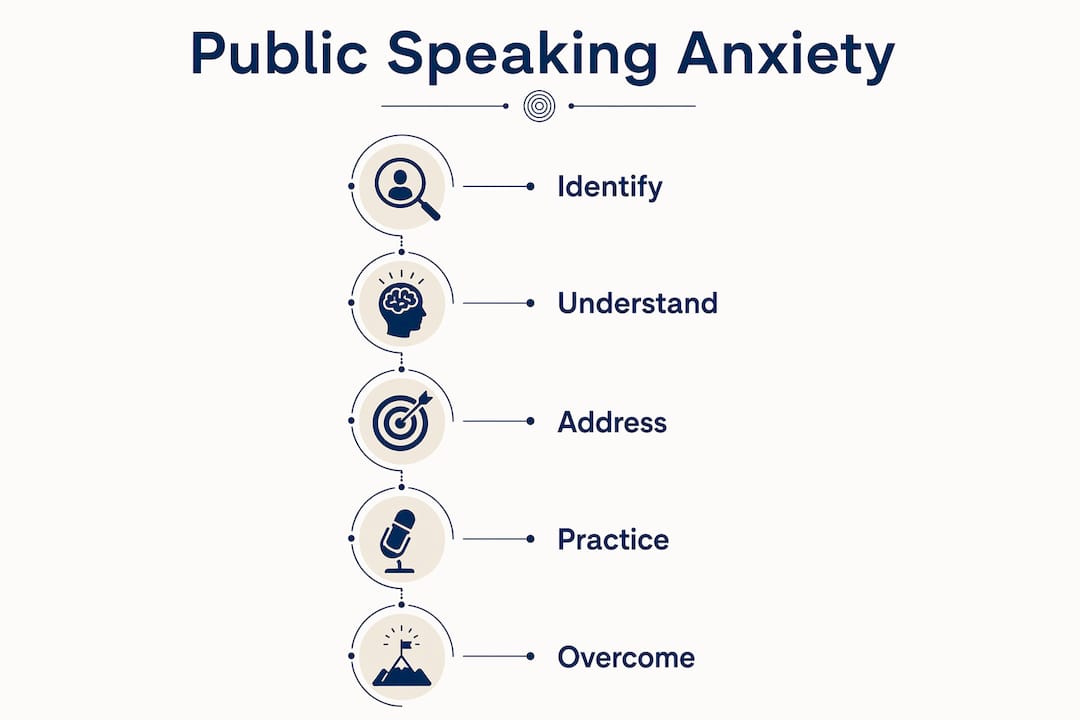
Public speaking is considered the biggest fear reported by many American adults, ahead of financial ruin and even death. That prevalence matters because it means the fear is well-studied and highly treatable.
Common signs fall into three categories:
- Physical: racing heart, dry mouth, shaking hands, sweating, voice tremor, nausea
- Cognitive: blanking on material, catastrophic predictions ("I'll humiliate myself"), racing thoughts, difficulty concentrating
- Behavioral: avoiding presentations, over-rehearsing to the point of rigidity, speaking too fast, turning down promotions or opportunities
Severity indicators that suggest clinical intervention rather than self-help alone include: symptoms that cause you to avoid situations entirely, anxiety that spills into other social settings, or physical symptoms severe enough to interfere with daily functioning. If your fear fits that description, a structured clinical approach like hypnotherapy or CBT is more appropriate than breathing tips alone.
Pro Tip: Rate your anxiety in three specific moments: preparing the speech, approaching the podium, and speaking the opening sentence. If any score is 7 or above, that is a useful signal to bring to a clinician rather than manage on your own.
How does hypnotherapy work for public speaking anxiety?

Hypnotherapy works by accessing the subconscious mind in a focused, relaxed state and directly modifying the conditioned threat response that fires when you face an audience. The fight-or-flight circuit does not distinguish between a predator and a conference room. Hypnotherapy interrupts that automatic survival response at the level where it was learned, rather than simply teaching you to manage symptoms after they appear.
Hypnosis reframes the stage as nonthreatening by working directly with conditioned fear responses in the amygdala, the brain structure that tags situations as dangerous. In a hypnotic state, the brain is more receptive to new associations, which is why targeted suggestions can replace a threat signal with a signal of calm alertness.
The mechanism in plain terms:
- Relaxed focused state: Induction slows the nervous system and reduces cortisol, making the subconscious more accessible.
- Targeted suggestions: The clinician introduces new associations between speaking situations and calm, capable performance.
- Reprocessing origin events: Many speaking fears trace back to a specific humiliation or critical moment. Hypnotherapy can revisit and reprocess that memory so it loses its emotional charge.
- Anchoring calm alertness: A physical or mental anchor (a breath, a word, a gesture) is conditioned to trigger the calm state on demand, even backstage before a speech.
Hypnotherapy does not remove personality or make you unaware of your surroundings. The goal is calm alertness: you still feel some arousal, which is useful for performance, but the nervous system stops treating the audience as a threat.
Integrating CBT principles with hypnotherapy is both common and evidence-backed. Cognitive restructuring, mental rehearsal, and behavioral exposure all deepen the gains made in a hypnotic state. You can read more about how hypnotherapy works at the subconscious level on the Hypnotictransformations site.
What actually happens in a hypnotherapy session for speaking anxiety?
A typical session is collaborative, runs 45–60 minutes, and keeps you aware and in control throughout. You are not asleep, and you cannot be made to say or do anything against your will. Here is what the structure usually looks like:
- Intake and history (10–15 minutes): The clinician asks about the origin of the fear, current triggers, past treatments, and your specific goals. For speaking anxiety, this often includes identifying the first memory of feeling judged while speaking.
- Induction and deepening (5–10 minutes): Guided relaxation slows the nervous system. Common methods include progressive muscle relaxation, focused breathing, and imagery. You remain alert and can speak at any time.
- Targeted interventions (20–25 minutes): This is the core work. Techniques vary by clinician and client, but commonly include:
- Guided imagery: Rehearsing a successful speech in vivid sensory detail while in a relaxed state, conditioning the nervous system to associate speaking with success rather than threat.
- Suggestion therapy: Direct suggestions that reframe the audience as receptive and the speaker as capable.
- NLP elements: Techniques like anchoring and submodality shifts to change the emotional weight of speaking memories.
- Reprocessing: Revisiting a past humiliation and updating the emotional response stored around it.
- Emergence and aftercare (5–10 minutes): The clinician brings you back to full alertness, checks in on your experience, and assigns between-session practice.
Between-session work matters. Many clinicians provide a recorded self-hypnosis audio to reinforce the session gains at home. Combined modalities including NLP and hypnosis audio can produce rapid symptom relief in some clients, particularly when practiced consistently between appointments.
Online delivery via Zoom works well for hypnotherapy. You need a quiet space, a stable connection, and headphones. The induction and suggestion work translate directly to a remote format, and many clients find the familiarity of their own environment actually deepens relaxation.

What does the research say about effectiveness?
Clinical evidence supports combined cognitive-behavioral hypnotherapy as more effective for public speaking anxiety than CBT alone. The doctoral dissertation reporting this finding compared three groups: combined CBT and hypnotherapy, CBT alone, and no treatment. The combined group showed the greatest improvement, which suggests hypnotherapy adds measurable value beyond what cognitive restructuring and exposure achieve on their own.
What does that mean for an individual client? It means the combination is worth pursuing if you have already tried CBT with limited results, or if you want to address both the cognitive patterns and the deeper subconscious conditioning simultaneously.
A first-person account published in Women's Health described reduced public speaking anxiety after two hypnotherapy sessions combined with psychosensory coping strategies, with the writer reporting noticeably less physical tension and more control over her internal state before speaking.
Practitioner reports consistently describe rapid early responses in some clients, particularly for discrete performance anxiety rather than generalized social anxiety disorder. That said, variability is real. Clients with deeply rooted fears, trauma histories, or co-occurring anxiety disorders typically need more sessions and may benefit from coordinated care with a therapist or physician.
| Evidence type | Finding | Implication for clients |
|---|---|---|
| Doctoral dissertation | Combined CBT+hypnotherapy outperformed CBT alone | Combining methods is worth considering |
| Practitioner case reports | Rapid symptom relief reported in some clients after 1–3 sessions | Early response is possible but not guaranteed |
| First-person published account | Reduced anxiety and physical tension after two sessions | Short courses can produce subjective improvement |
| CBT literature | Exposure therapy is among the most effective approaches for speaking fear | Behavioral exposure remains a core component |
How many sessions does it take, and what does it cost?
Many clients notice measurable change after 1–3 sessions, with consolidation continuing over the following weeks as between-session practice reinforces the work. More entrenched fears, or anxiety tied to broader social anxiety disorder, typically require a longer course.
Typical U.S. pricing for online clinical hypnotherapy ranges from $100–$300 per individual session, depending on the clinician's credentials, location, and session length. Package pricing (3–6 sessions) often runs $400–$1,200 and usually includes between-session recordings and follow-up support. Hypnotictransformations offers online hypnotherapy for anxiety via Zoom; specific pricing and package options are listed on the appointments page.
| Session count | Typical outcomes | Follow-up |
|---|---|---|
| 1 session | Initial relaxation of the fear response; first new associations formed | Home practice with audio recording |
| 2–3 sessions | Measurable reduction in physical symptoms; improved mental rehearsal | Weekly or biweekly sessions |
| 4–6 sessions | Consolidation; reprocessing of origin events; anchoring complete | Monthly check-in or as needed |
| 6+ sessions | Recommended for generalized social anxiety or trauma-linked fear | Coordinated care with therapist or physician |
- Insurance rarely covers hypnotherapy in the U.S. Most clinicians operate on a fee-for-service basis.
- If your anxiety is severe enough to meet criteria for social anxiety disorder, a psychiatrist or licensed psychologist referral may open insurance coverage for CBT, which can then be combined with hypnotherapy.
- Some employee assistance programs (EAPs) cover a limited number of mental health sessions; check whether your plan includes telehealth counseling.
Is hypnotherapy safe, and who should be cautious?
Hypnotherapy is generally safe when provided by a trained clinician, but certain conditions require caution or a medical referral before starting.
Contraindications and cautions:
- Active psychosis or schizophrenia spectrum disorders: hypnotic induction can blur the boundary between imagination and reality in ways that are unsafe.
- Active suicidal ideation: stabilization with a licensed mental health professional comes first.
- Uncontrolled seizure disorders: some induction techniques can lower seizure threshold; medical clearance is needed.
- Severe dissociative disorders: deep trance states may worsen dissociation without careful clinical management.
- Active substance intoxication: sessions should never occur while a client is under the influence.
Red flags that mean pause and refer:
- Anxiety that has worsened suddenly without a clear trigger
- Panic attacks occurring at rest, not only in speaking situations
- Physical symptoms (heart palpitations, chest pain) that have not been medically evaluated
- Significant depression alongside the anxiety
A well-trained clinician will screen for all of these at intake and will coordinate with your primary care provider or psychiatrist when needed. If a hypnotherapist skips the intake screening and moves straight to induction, that is itself a red flag.
Pro Tip: Before booking any hypnotherapy session, tell the clinician about any psychiatric diagnoses, current medications, and past trauma. That information shapes the induction technique and the depth of trance used, and withholding it reduces both safety and effectiveness.
How does hypnotherapy compare with CBT and medication?
Each approach targets a different layer of the problem. CBT restructures the conscious thought patterns and uses graduated exposure to reduce avoidance. Beta blockers like propranolol blunt the physical symptoms (heart rate, tremor) for a specific performance event but do not change the underlying fear. Hypnotherapy works at the subconscious level, modifying the conditioned response before it reaches conscious thought.
Use-case comparison:
- Rapid symptom control for a single event: Propranolol, taken 30–60 minutes before speaking, reduces physical symptoms acutely. It does not address the fear itself and requires a physician's prescription.
- Long-term pattern change: CBT and hypnotherapy both produce durable change, with the combined approach showing the strongest outcomes in the research.
- Stage management and performance polish: Communication coaching and rehearsal-based methods work well for people whose anxiety is mild and primarily about skill gaps rather than fear.
- Workplace requirements with a tight timeline: A combined approach (1–2 hypnotherapy sessions plus CBT techniques) can produce noticeable improvement within two to four weeks.
| Approach | Mechanism | Speed of effect | Best suited for |
|---|---|---|---|
| Hypnotherapy | Subconscious reprocessing, nervous system recalibration | Often rapid (1–3 sessions) | Conditioned fear, origin-event reprocessing |
| CBT | Cognitive restructuring, behavioral exposure | Moderate (6 sessions typical) | Thought patterns, avoidance cycles |
| Beta blockers (e.g., propranolol) | Blocks adrenaline receptors | Immediate (single dose) | Acute physical symptoms, one-off events |
| Combined CBT + hypnotherapy | Both mechanisms simultaneously | Faster than CBT alone | Persistent anxiety with subconscious roots |
Combining hypnotherapy and medication is generally safe, but always tell your prescribing physician you are pursuing hypnotherapy. The two approaches work on different systems and rarely conflict, but a clinician who knows your full picture can adjust the plan if needed.
How do you choose a qualified hypnotherapist for speaking anxiety?
Choose clinicians with formal clinical training, a Certified Clinical Hypnotherapist (CCHt) credential or equivalent, and documented experience treating anxiety and performance fear. A CCHt credential from the National Guild of Hypnotists or the American Council of Hypnotist Examiners indicates a minimum standard of training and ethical oversight.
Screening checklist:
- Credential: CCHt, CHt, or licensed mental health professional with hypnotherapy training
- Scope of practice: explicitly treats anxiety and performance fear, not only habit change
- Informed consent: provides a written consent form before the first session
- Session structure: can describe a clear intake, intervention, and aftercare process
- Online delivery: has experience with telehealth hypnotherapy and can troubleshoot technical issues
- Confidentiality: explains HIPAA-aligned privacy practices
- Measurable outcomes: tracks symptom change across sessions, not just subjective reports
Questions to ask on a first call:
- What training and credentials do you hold, and are they current?
- How many clients with public speaking anxiety have you treated?
- What does a typical session look like from start to finish?
- Do you assign between-session practice, and what does it involve?
- What is your cancellation and refund policy?
- Do you offer package pricing, and what does it include?
- How do you handle situations where a client needs a referral to another provider?
Red flags to walk away from:
- Promises of a guaranteed cure or a specific number of sessions to "fix" the fear
- No intake process or screening before the first session
- Pressure to commit to a long package before you have had a single session
- Vague or unverifiable credentials
- No referral plan for clients who need additional support
Short practices to use between sessions
Short daily practices speed improvement and help consolidate what happens in sessions. Communication coaches view coping strategies as helpful but limited; hypnotherapy addresses the deeper subconscious patterns, while these techniques manage the nervous system in real time.
Diaphragmatic breathing (use pre-speech, backstage, or during Q&A):
- Sit or stand with your spine straight.
- Inhale through your nose for 4 counts, letting your belly expand rather than your chest.
- Hold for 2 counts.
- Exhale slowly through pursed lips for 6 counts, pulling your belly in.
- Repeat 4–6 times. Belly breathing activates the parasympathetic nervous system and reduces adrenaline output, which is why chest breathing (the instinctive panic response) makes symptoms worse, not better.
7-day visualization practice:
- Days 1–2: Visualize walking to the podium feeling calm and prepared. Hold the image for 2 minutes.
- Days 3–4: Add the first 30 seconds of your speech. Hear your voice steady and clear.
- Days 5–6: Run the full speech in your mind, including a small mistake you handle smoothly.
- Day 7: Visualize the audience responding positively and you finishing with confidence.
Pro Tip: If your clinician provides a recorded self-hypnosis audio, use it seated or lying down in a quiet space. Never listen while driving, operating machinery, or doing anything that requires full alertness. The recording induces a light trance state, which is safe at rest but incompatible with tasks requiring divided attention.
Key Takeaways
Hypnotherapy reduces public speaking anxiety by modifying conditioned subconscious responses, and clinical evidence shows the combined CBT and hypnotherapy approach outperforms CBT alone.
| Point | Details |
|---|---|
| Clinical evidence supports it | A doctoral dissertation found combined CBT and hypnotherapy outperformed CBT alone for public speaking anxiety. |
| Change can come quickly | Many clients notice measurable symptom reduction after 1–3 sessions, with consolidation over several weeks. |
| Safety screening matters | Conditions like active psychosis, suicidal ideation, or uncontrolled seizures require medical referral before starting. |
| Credentials to look for | Seek a Certified Clinical Hypnotherapist (CCHt) with documented anxiety and performance fear experience. |
| Hypnotictransformations | Kirk Hoffman CCHt offers online hypnotherapy for anxiety via Zoom, with a free screening call available to assess fit. |
What I've learned treating public speaking anxiety with hypnotherapy
Most people who come to me for speaking anxiety are not afraid of words. They are afraid of being seen, judged, and found lacking. That distinction matters clinically because it tells you where the real work happens: not in rehearsing better material, but in changing what the nervous system has been trained to predict when someone looks at you.
The framework I use is Problem-Agitate-Solve (PAS). We start by getting specific about the fear: not "I hate public speaking" but "my voice shakes in the first 90 seconds and I lose my train of thought." Then we trace that response back to where it was conditioned, usually a specific moment of humiliation or criticism that the subconscious filed as evidence that speaking is dangerous. From there, the hypnotherapy work is precise: reprocess that memory, install a new conditioned response, and rehearse the new response until it becomes the default.
What clients typically report after 1–3 sessions is not the absence of nerves. It is a different relationship with the nerves. The physical sensations are still there, but they stop feeling like a warning signal and start feeling manageable, even useful. That shift is what the research reflects, and it is what I see consistently in practice.
What Hypnotictransformations offers for public speaking anxiety
If you have read this far and recognized your own experience in these pages, the clearest next step is a conversation, not a commitment.
Hypnotictransformations provides online hypnotherapy for anxiety via Zoom, led by Kirk Hoffman CCHt. Sessions are structured around the specific fear pattern you bring, not a generic relaxation script. The free consultation covers your history, current symptom severity, and whether hypnotherapy is the right fit for your situation. If it is not, you will hear that plainly and get a referral direction instead.
Sessions run 45–60 minutes. Package options are available for clients who want a structured multi-session course. Pricing and booking details are on the appointments page. You can book a free screening call there directly, with no obligation to continue.
Useful sources and further reading
-
Doctoral dissertation: combined cognitive-behavioral hypnotherapy — The primary clinical study cited in this article. Read it to understand the research design and what "greater improvement" means in measurable terms.
-
Fear of Public Speaking: Mayo Clinic — Reliable overview of the fear spectrum, CBT options, and when medication may be appropriate. Useful for understanding where your symptoms sit on the severity scale.
-
Conquering Stage Fright: ADAA — The Anxiety and Depression Association of America's practical guide to stage fright, including the connection to social anxiety disorder and evidence-based self-help strategies.
-
CBT and Exposure Therapy for Speaking Fear: Dr. Whitley Lassen — A clear explanation of the CBT cycle driving speaking anxiety and how exposure therapy interrupts it. Read this alongside the hypnotherapy research to understand how the two approaches complement each other.
-
How to Conquer a Fear of Public Speaking: Columbia Magazine — Natalie H. Rogers, a psychotherapist and speaking coach who has worked with more than 13,000 people, explains the role of diaphragmatic breathing, structured preparation, and the childhood origins of speaking shame.
-
Hypnotictransformations: online hypnotherapy for anxiety — Kirk Hoffman CCHt's service page describing session structure, online delivery, and the clinical approach used at Hypnotictransformations.
-
How hypnotherapy works: Hypnotictransformations — Internal explanatory page covering the mechanism of hypnotherapy, what to expect in a session, and safety considerations. A good starting point if you want to understand the process before booking.
This article is general information, not professional medical or mental health advice. Confirm whether hypnotherapy is appropriate for your specific situation with a qualified clinician or your primary care provider.