
Does hypnotherapy actually help with OCD and anxiety?
Yes. Clinical research confirms that hypnotherapy for OCD and anxiety produces measurable reductions in symptoms, particularly obsessive rumination and physiological fear responses. A meta-analysis of 17 trials found that people treated with hypnosis reduced anxiety more than 84% of control participants at follow-up, with a mean weighted effect size of 0.99 (p ≤ .001). That is not a marginal finding.
Hypnotherapy works by guiding you into a focused, deeply relaxed state where the subconscious mind becomes more receptive to new patterns of response. For OCD and anxiety specifically, this means the nervous system gets a chance to step out of the chronic fight-or-flight loop that keeps intrusive thoughts feeling urgent and dangerous. The three main clinical approaches you will encounter are Cognitive Behavioral Therapy (CBT), Exposure and Response Prevention (ERP), and Ericksonian Hypnotherapy (EH). Each targets different parts of the OCD and anxiety cycle.
Key effects supported by clinical evidence:
- Reduces physiological arousal by lowering sympathetic nervous system activation
- Shifts the relationship to intrusive thoughts from reactive to observational
- Decreases obsessive rumination, particularly through Ericksonian Hypnotherapy techniques
- Supports emotional regulation by modulating activity in the amygdala, the brain's fear center
- Enhances the effectiveness of CBT and ERP when used alongside them
Statistic callout: At the longest follow-up across 17 trials, hypnosis outperformed control conditions for anxiety in 84% of participants, with hypnosis combined with other psychological interventions showing the strongest results.
How hypnotherapy works during OCD and anxiety treatment
The hypnotic state is not unconsciousness. You remain aware throughout the session. What changes is the depth of focused attention and the reduction of peripheral mental noise, which is exactly what makes it useful for OCD. When the analytical, hypervigilant part of the mind quiets down, the subconscious becomes accessible. That is where habitual fear responses are stored, and that is where change actually happens.

During a session, a trained hypnotherapist typically guides you through a relaxation induction, then uses specific techniques tailored to your OCD or anxiety presentation. The nervous system responds to this state by reducing sympathetic activation, which lowers the physical intensity of the fight-or-flight response. That physical calm is not just pleasant. It creates the neurological conditions under which new responses to feared triggers can actually take hold.
Ericksonian Hypnotherapy, developed by psychiatrist Milton Erickson, uses indirect suggestion, metaphor, and storytelling rather than direct commands. For OCD, this often means using imagery like clouds drifting across the sky to represent intrusive thoughts, teaching the mind to observe rather than react to them. The urgency to perform a compulsion drops when the thought no longer feels like a threat demanding immediate action.
Common elements in a hypnotherapy session for OCD and anxiety:
- Relaxation induction: Breathing exercises and progressive muscle relaxation to lower baseline arousal
- Guided imagery: Visualization of safe, calm scenarios to retrain the nervous system's default state
- Hypnotic metaphors: Thought-distancing techniques that reduce the emotional charge of intrusive thoughts
- Post-hypnotic suggestions: Anchoring calm responses to real-world triggers so the effect carries beyond the session
- Behavioral rehearsal: Practicing new responses to feared situations while in the hypnotic state
Pro Tip: Keep a simple anxiety journal between sessions to track which triggers still feel charged and which have lost their urgency. This gives your hypnotherapist precise targets for the next session.
How hypnotherapy compares to CBT and ERP for OCD
CBT and ERP are the frontline treatments for OCD, with decades of evidence behind them. ERP, the core component of CBT for OCD, works by gradually exposing you to feared triggers while preventing the compulsive response, allowing the anxiety to peak and then naturally subside. Over repeated exposures, the brain learns that the feared outcome does not occur and the compulsion becomes unnecessary.
A randomized controlled trial compared Ericksonian Hypnotherapy and CBT directly over several weeks of online sessions. Both treatments significantly reduced OCD symptoms on the Yale-Brown OCD Scale and Beck Anxiety Inventory. CBT showed stronger results for compulsive behaviors. Ericksonian Hypnotherapy showed stronger results for obsessive rumination and anxiety. That distinction matters practically: if your OCD is driven more by relentless mental loops than by behavioral rituals, hypnotherapy may address the core problem more directly.

| Approach | Primary target | Session format | Best for |
|---|---|---|---|
| CBT with ERP | Compulsive behaviors and avoidance | Structured exposure tasks | Behavioral rituals, avoidance patterns |
| Ericksonian Hypnotherapy | Obsessive rumination and anxiety | Guided relaxation and suggestion | Mental loops, fear-based anxiety |
| Combined approach | Both behavioral and cognitive symptoms | Integrated multimodal sessions | Moderate to severe OCD with anxiety |
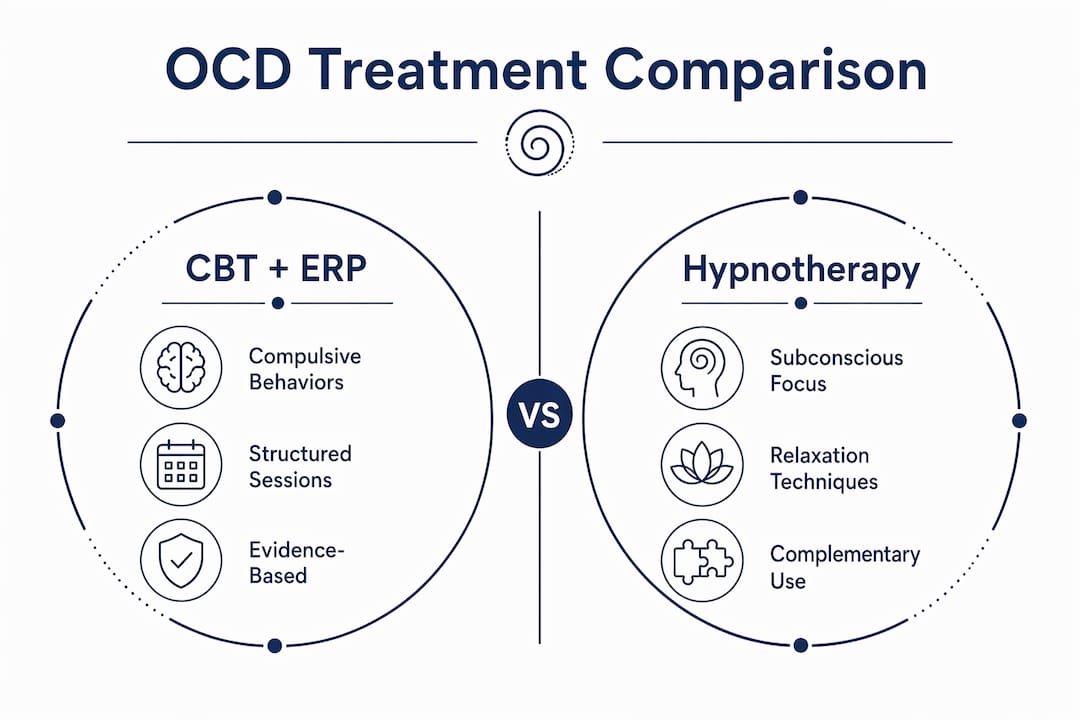
Hypnotherapy is not a replacement for CBT or ERP. The research is clear that it works best as a complement. Hypnosis reduces the physiological arousal that makes ERP feel unbearable for many people, which means clients can engage with exposure work more effectively when hypnotherapy is part of the plan.
Benefits and limitations of hypnotherapy for OCD and anxiety
The benefits of hypnotherapy go beyond symptom reduction. Because the work happens at the subconscious level, changes in how the nervous system responds to triggers can feel more automatic than the deliberate effort required by CBT homework. People often report that feared thoughts lose their emotional charge without having to consciously argue against them.
Benefits:
- Reduces baseline physiological arousal, making daily anxiety less exhausting
- Teaches the nervous system to respond to intrusive thoughts without triggering fight-or-flight
- Addresses obsessive rumination directly, where CBT alone is sometimes less effective
- Can be delivered online, removing access barriers for people in areas with limited mental health providers
- Produces durable results, particularly when combined with other psychological treatments
Limitations:
- Not a standalone cure. Severe OCD typically requires CBT, ERP, and sometimes medication alongside hypnotherapy
- Results vary based on the individual's hypnotic responsiveness and the therapist's skill
- Requires a qualified, credentialed practitioner. Unqualified practitioners can cause harm
- Not appropriate for everyone. People with psychosis, certain dissociative disorders, or active suicidal ideation need different primary care first
Side effects and safety: Hypnotherapy poses minimal risks for most people. Uncommon side effects include temporary dizziness, headache, or brief emotional distress during or after a session. You remain in control throughout. The idea that a hypnotherapist can make you do something against your will is a myth rooted in stage hypnosis, not clinical practice.
A common misconception worth addressing directly: hypnotherapy does not erase memories or implant false ones. What it does is change the emotional weight attached to existing thought patterns, which is precisely what makes it useful for OCD and anxiety.
Clinical evidence and Kirk Hoffman's perspective on treating OCD and anxiety
The neuroscience behind hypnotherapy's effectiveness is increasingly well understood. Hypnotic states modulate the amygdala, the brain structure most responsible for generating fear responses. When amygdala reactivity decreases, the perceived threat level of intrusive OCD thoughts drops with it. This is not a placebo effect. It reflects measurable changes in how the brain processes emotionally charged information.
The 2026 RCT comparing Ericksonian Hypnotherapy and CBT is particularly significant because it used rigorous methodology: 99 adults, randomized assignment, 12 weeks of online sessions, and validated outcome measures including the Yale-Brown OCD Scale. Both treatments produced reliable symptom reductions. The finding that EH outperformed CBT specifically for obsessive rumination aligns with what clinicians working with hypnosis have observed for years. Rumination is a subconscious habit, and subconscious habits respond to subconscious intervention.
Expert consensus across clinical guidelines now supports multimodal treatment for OCD, meaning no single approach is expected to do everything. Hypnotherapy earns its place in that model by addressing the physiological and subconscious dimensions that behavioral therapies do not fully reach.
Pro Tip: When evaluating a hypnotherapist, ask specifically about their training in clinical hypnotherapy for anxiety disorders, not just general hypnosis certification. There is a meaningful difference between a stage hypnotist and a Certified Clinical Hypnotherapist.
Kirk Hoffman, CCHt, at Hypnotictransformations works specifically with adults dealing with anxiety, OCD, panic, and fear-based thinking through online hypnotherapy sessions conducted via Zoom. The approach targets the subconscious patterns driving the anxiety cycle rather than managing surface symptoms. Sessions use NLP, guided imagery, and advanced hypnotic techniques tailored to each person's specific presentation.
How to find a qualified hypnotherapist for OCD and anxiety
Credentials matter more in hypnotherapy than in almost any other wellness field, because the term "hypnotherapist" is not uniformly regulated across all U.S. states. Look for practitioners with clinical training, not just a weekend certification.
What to look for:
- Certified Clinical Hypnotherapist (CCHt) designation from a recognized credentialing body
- Specific experience treating anxiety disorders and OCD, not just general stress or habit change
- Willingness to coordinate with your existing mental health providers
- Clear explanation of their methods, session structure, and realistic outcomes
- Telehealth availability, which expands access significantly and has been validated in the 2026 RCT mentioned above
Avoid practitioners who promise to cure OCD in a single session or who cannot explain how their techniques work in clinical terms. Effective hypnotherapy for OCD is a process, typically across multiple sessions, with measurable progress tracked against your specific symptoms.
For people who want to manage stress and anxiety between sessions, evidence-based unwinding strategies that reduce sympathetic nervous system activation can support the work done in hypnotherapy. The nervous system benefits from consistent, daily input, not just weekly sessions.
Ready to address the root of your anxiety?
If OCD or anxiety has been running your nervous system for years, the issue is not willpower or awareness. The subconscious patterns driving the fear response need direct intervention. Hypnotictransformations offers online clinical hypnotherapy sessions with Kirk Hoffman, CCHt, accessible nationwide via Zoom. Sessions address the specific subconscious triggers behind your anxiety, not just the surface symptoms. Book a free consultation to find out whether hypnotherapy fits your situation.
Key Takeaways
Hypnotherapy for OCD and anxiety produces clinically measurable reductions in obsessive rumination and physiological fear responses, and works best when integrated with CBT or ERP rather than used alone.
| Point | Details |
|---|---|
| Hypnosis outperforms controls | At follow-up across 17 trials, hypnosis reduced anxiety symptoms more than 84% of control groups. |
| EH targets rumination specifically | A 2026 RCT found Ericksonian Hypnotherapy outperformed CBT for obsessive rumination and anxiety in OCD. |
| CBT and ERP remain first-line | ERP is the established first-line treatment for compulsive behaviors; hypnotherapy complements rather than replaces it. |
| Amygdala modulation explains the mechanism | Hypnotic states reduce amygdala reactivity, lowering the perceived threat level of intrusive thoughts. |
| Credentials are non-negotiable | Seek a Certified Clinical Hypnotherapist with specific experience in anxiety disorders, not general certification. |