
How hypnosis and mind control actually differ
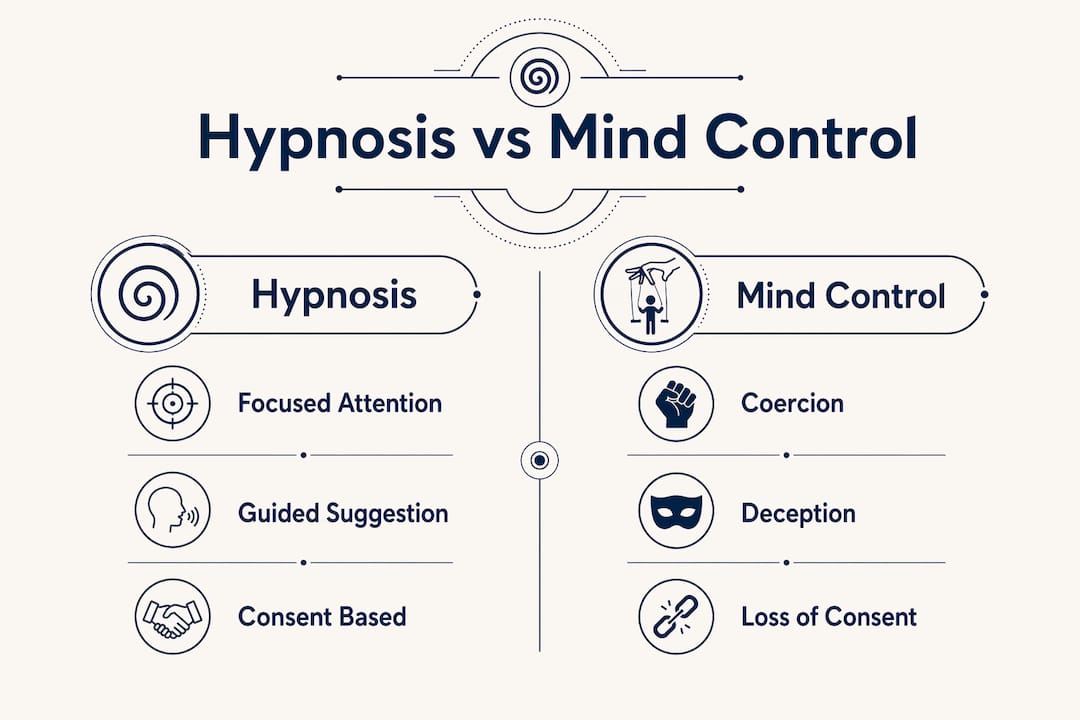
Hypnosis is a self-directed state of focused attention where you remain aware, in control, and free to reject any suggestion you find uncomfortable. Mind control, by contrast, describes external attempts to override your will through coercion, deception, or force. These two things are not on the same spectrum. They operate on opposite principles.
Research confirms that hypnosis cannot force anyone to act against their moral code. Participants in studies consistently reject suggestions they find objectionable. The American Psychological Association defines hypnosis as "a state of consciousness involving focused attention and reduced peripheral awareness characterized by an enhanced capacity for response to suggestion." That capacity belongs to you, not the hypnotist.
Here is what separates the two at a practical level:
- Hypnosis: Voluntary participation; you choose to enter and can exit at any time
- Hypnosis: Collaborative process between client and therapist with shared goals
- Hypnosis: Preserves moral agency; you cannot be made to do something you find wrong
- Hypnosis: Used in licensed clinical settings with informed consent
- Mind control: Relies on coercion, deception, or manipulation without consent
- Mind control: Attempts to override personal will, not work with it
- Mind control: No ethical clinical framework; operates through dominance or fear
Common myths about hypnosis that keep people stuck
Fear of hypnosis as mind control comes largely from movies, stage shows, and spy thrillers, not from clinical reality. That fear is understandable. It is also wrong in almost every specific.
- Myth: A hypnotist can make you do anything. False. People remain fully conscious during hypnosis and can resist any suggestion. As hypnosis researcher Amanda Barnier puts it, "If it sits uncomfortably with them, they will open their eyes and say, 'No.'"
- Myth: Hypnosis is brainwashing. Brainwashing involves prolonged coercion, isolation, and psychological pressure. Hypnosis involves relaxed focus and guided suggestion that you control.
- Myth: Stage hypnosis equals clinical hypnosis. Stage performers select highly suggestible volunteers who want to participate in entertainment. Clinical hypnotherapy has a completely different intent: your therapeutic goals, your pace, your consent.
- Myth: You fall asleep and lose awareness. You stay awake and aware. People who appear to "sleep" on stage are deeply relaxed but responsive, not unconscious.
- Myth: You will reveal secrets or lose your memory. All hypnosis is essentially self-hypnosis where you maintain awareness throughout. You remember what happens.
What brain science actually shows about hypnosis
Neuroscience has made the picture clearer. Brain imaging shows that changes during hypnosis reflect shifts in attention and perception, not external programming or submission. The brain during hypnosis looks similar to the brain genuinely experiencing whatever is being suggested. That is why hypnotic pain relief works: the brain processes the suggestion as real.

| Feature | Hypnosis | Mind control |
|---|---|---|
| Mechanism | Focused attention, guided suggestion | Coercion, deception, or force |
| Brain changes | Natural attention shifts (confirmed by MRI) | N/A — no clinical basis |
| Agency preserved | Yes, fully | No, by design |
| Consent required | Always | Never |
| Reversible | Yes, at any time | Often not without intervention |
Hypnotizability varies by person. People who are more prone to absorption, meaning they get genuinely absorbed in books or music, tend to respond more readily. But the hypnotist acts as a facilitator, not a programmer. The capacity for change lives entirely within you.
Pro Tip: If you are anxious about losing control during hypnotherapy, tell your therapist before the session starts. A skilled clinician will walk you through exactly what to expect and let you practice stopping the session yourself, which most people find immediately reassuring.
What ethical clinical hypnotherapy actually looks like
Licensed clinical hypnotherapists operate under formal codes of ethics that make coercion structurally impossible. The International Society of Hypnosis code of ethics requires practitioners to protect client autonomy at every stage.
- Informed consent is obtained before any session begins
- Sessions are structured around the client's stated goals, not the therapist's agenda
- Clients can stop a session at any point, no explanation needed
- Therapists do not use hypnosis to treat conditions outside their licensed scope
- Suggestions align with the client's values, never against them
- No ethical practitioner attempts to implant beliefs the client has not agreed to explore
Hypnosis sessions cannot override personal moral standards. That is not a reassurance, it is a neurological and psychological fact backed by decades of research. The subconscious mind does not become a blank slate. It becomes more receptive to ideas you already want to act on.
A certified clinical hypnotherapist's perspective on the fear of mind control
Kirk Hoffman, Certified Clinical Hypnotherapist at Hypnotictransformations, works with adults whose anxiety, panic, and phobias have not responded to willpower alone. The concern about mind control comes up often, especially with first-time clients.
What clinical hypnotherapy actually targets is the subconscious pattern driving the fight-or-flight response. Anxiety, for example, often runs on an automatic loop: a trigger fires, the nervous system escalates, and the conscious mind has no time to intervene. Hypnosis works by accessing that loop at the subconscious level, where the pattern was formed, and introducing new responses the client has chosen. That is the opposite of control. It is restoration of it.
Pro Tip: Ask any hypnotherapist you consider working with to describe exactly what happens if you want to stop mid-session. The answer should be immediate and clear: you open your eyes, and it's over. If they hesitate, find someone else.
Where hypnosis and mind control come from historically
Franz Anton Mesmer introduced "animal magnetism" in the 1770s, claiming an invisible fluid connected hypnotist to subject. James Braid, a Scottish surgeon, rejected that mysticism in the 1840s and coined the term "hypnosis" from the Greek word for sleep. He recognized it as a neurological phenomenon, not a supernatural one. By the late 19th century, figures like Jean-Martin Charcot and Pierre Janet were using hypnosis in clinical psychiatry.
Mind control as a concept took a darker turn in the 20th century. The CIA's MK-Ultra program, active from the early 1950s through the 1970s, attempted to use hypnosis, drugs, and psychological pressure to create programmable agents. No verified evidence exists that these programs succeeded in producing genuine mind control. The programs were eventually shut down and declassified, revealing their failure alongside their ethical violations.
What hypnosis is actually used for, compared to mind control
Clinical hypnosis has a documented track record in medicine and behavioral health. Research has found hypnosis can reduce pain comparably to other mental techniques like mindfulness. It is used as an adjunct treatment for anxiety, phobias, smoking cessation, weight management, chronic pain, and insomnia.

Mind control, as a concept, has no legitimate therapeutic application. Its historical uses, from propaganda to coercive interrogation, share one feature: the subject's interests are irrelevant. Ethical hypnotherapy inverts that entirely. The client's goals define every session. You can learn more about how hypnotherapy addresses anxiety specifically, including what a session looks like from start to finish.
How hypnosis is regulated in the United States
Hypnotherapy regulation in the United States varies by state. Some states, including California and Washington, require licensure or certification for practitioners. Others have minimal formal requirements. Professional bodies like the American Society of Clinical Hypnosis and the International Society of Hypnosis set voluntary credentialing standards that reputable practitioners follow.
Mind control, as a coercive practice, falls under existing criminal law. Coercion, fraud, and assault statutes apply regardless of the method used. No legal framework in the United States recognizes "mind control" as a legitimate therapeutic or research practice.
The psychological mechanisms: why they work so differently
Hypnosis works through a temporary narrowing of attention combined with increased responsiveness to suggestion. The conscious mind's critical filter relaxes. The subconscious becomes more accessible. Crucially, the person's values and moral framework remain intact throughout. Research on highly suggestible individuals shows they experience a reduced sense of authorship over their actions during hypnosis, but they do not lose the ability to refuse.
Mind control techniques, by contrast, work through sustained pressure: sleep deprivation, social isolation, repetitive messaging, and fear. These methods do not access the subconscious through relaxation. They wear down conscious resistance through exhaustion. The psychological mechanisms are entirely different, and so are the outcomes.
Real-world cases that illustrate the distinction
The clearest real-world illustration comes from MK-Ultra itself. Despite years of effort and unlimited resources, the CIA could not produce a reliably programmable human being through hypnosis. What they found instead was that coercion, drugs, and psychological abuse could destabilize a person, but that is not hypnosis. That is torture.
On the clinical side, hypnosis has been used successfully during surgical procedures as a supplement to local anesthetic, particularly in burn care where repeated wound treatment is painful. Patients in these cases are conscious, communicating, and directing their own experience. The mechanism of hypnotherapy in these contexts is focused attention and suggestion, with the patient's full awareness and cooperation at every step.
If anxiety, panic, or a specific phobia is driving you to look for answers, Hypnotictransformations offers online clinical hypnotherapy sessions with Kirk Hoffman, CCHt, available nationwide via Zoom. Sessions target the subconscious patterns behind your symptoms, not just the surface behavior. A free consultation is available to answer your questions before you commit to anything.
Key Takeaways
Hypnosis is a collaborative, consent-based mental state that enhances your own focus and agency; mind control is coercive by definition and has no legitimate clinical application.
| Point | Details |
|---|---|
| Consent defines hypnosis | You enter voluntarily, set the goals, and can stop at any moment. |
| Agency is preserved | Research confirms hypnosis cannot override your moral code or force unwanted actions. |
| Brain changes are natural | MRI studies show hypnosis produces attention shifts, not external programming. |
| Mind control has no clinical basis | Historical programs like MK-Ultra failed to produce genuine mind control through hypnosis. |
| Regulation protects clients | Professional ethics codes and, in some states, licensure laws govern legitimate hypnotherapy practice. |