
Hypnosis can help some people quit smoking, but the evidence does not show it works better than standard behavioral treatments on its own. The 2019 Cochrane review of 14 trials and nearly 1,926 participants found no consistent long-term benefit over other quit methods, and a 2024 randomized trial found hypnotherapy produced a 15.0% 12-month abstinence rate compared to 15.6% for CBT, essentially a tie. That doesn't mean hypnosis is useless. It means hypnosis works best as one tool in a larger plan, especially for smokers whose habit is tangled up with stress or anxiety.
If you're deciding what to do next, three options make sense depending on your situation:
- Try structured self-hypnosis as a free, low-risk starting point for managing cravings and anxiety triggers.
- Book a credentialed clinical hypnotherapist if your smoking is anxiety-driven and you want a guided, personalized approach.
- Combine hypnosis with nicotine replacement therapy, medication, or counseling for the strongest odds of quitting for good.
Key Takeaways
Hypnosis performs comparably to CBT in recent trials but shows no clear long-term advantage over standard behavioral treatments on its own, so it works best combined with proven cessation tools.
| Point | Details |
|---|---|
| Evidence is mixed, not negative | The 2019 Cochrane review found no consistent long-term benefit, while a 2024 RCT showed hypnotherapy nearly matching CBT at 12 months. |
| Best for anxiety-driven smoking | Hypnosis targets stress and trigger response more effectively than it targets physical nicotine dependency alone. |
| Combine methods for best odds | Pairing hypnosis with nicotine replacement, medication, or CBT-based relapse prevention outperforms any single approach. |
| Vet your clinician carefully | Prefer a licensed healthcare background plus hypnotherapy training, and avoid anyone guaranteeing 100% success. |
| Hypnotictransformations offers a structured path | Online sessions with a Certified Clinical Hypnotherapist integrate anxiety management, self-hypnosis training, and follow-up into one plan. |
Table of Contents
- What Hypnosis to Quit Smoking Actually Involves
- How Hypnosis Might Reduce Cravings and Withdrawal
- Does Hypnosis Actually Work? What the Research Shows
- What Happens During a Stop Smoking Hypnosis Session
- How to Practice Self-Hypnosis for Cravings at Home
- Choosing a Hypnotherapist: Credentials and Red Flags
- Combining Hypnosis With Proven Cessation Methods
- Is Hypnosis Safe? Risks and Who Should Be Cautious
- Ready to Try Hypnosis to Quit Smoking? Here's How Sessions Work
- Frequently Asked Questions
- Sources
What Hypnosis to Quit Smoking Actually Involves
Clinical hypnotherapy is a guided state of focused attention where a trained clinician uses relaxation and suggestion to help you change automatic behaviors. Self-hypnosis is the same mental state, practiced on your own, usually with a recorded script or a memorized routine you run through daily.
Here's the misconception to drop right away: hypnosis is not mind control, and you don't lose awareness of what's happening. You stay conscious the entire time. You can hear the clinician's voice, you remember the session afterward, and you can reject any suggestion that doesn't sit right with you. What actually happens is your brain shifts into a state similar to the drowsy window right before sleep, where the analytical, arguing part of your mind quiets down and you become more receptive to suggestion. WebMD's clinical overview describes this as a collaborative process between clinician and client, not something done to you.
For smoking specifically, hypnotherapists draw on a handful of established techniques:
- Aversion imagery, where you're guided to associate cigarettes with an unpleasant sensory experience instead of relief or reward.
- Ego-strengthening suggestions, which reinforce your identity as a nonsmoker rather than someone "trying to quit."
- Posthypnotic suggestions, planted during the session to trigger automatically when you'd normally reach for a cigarette.
- Self-hypnosis training, so you can reinforce the work between sessions instead of relying on the clinician alone.
Sessions can happen in person or over video. Online formats have become common because the induction and suggestion work don't require hands-on contact, just a quiet room and a clinician who knows how to guide you verbally. A typical structure runs one intake conversation followed by one to three working sessions, though this varies by provider and by how entrenched the habit is.
How Hypnosis Might Reduce Cravings and Withdrawal
Smoking runs on a conditioned loop. A trigger hits, stress rises, your nervous system flips into a mild fight-or-flight response, and lighting a cigarette becomes the fastest way to bring your body back down. Over years, that loop stops being a conscious decision and becomes an automatic script your brain runs without asking permission.

Hypnosis works on that script in two ways. First, the relaxed state itself lowers physiological arousal, the same sympathetic nervous system activation that spikes when you're anxious or craving nicotine. Second, suggestion and imagery aim to interrupt the trigger-to-craving pathway before it fires, giving you a moment of choice where there used to be none.
This is why hypnosis tends to help most with the psychological and habitual side of smoking, not the physical nicotine dependency itself. WebMD's clinical guidance notes that hypnosis often works best when it targets stress-driven smoking patterns rather than trying to erase chemical dependence outright. If you smoke because your hands are anxious in social situations, or because a cigarette is the only five minutes of quiet you get during a stressful workday, hypnosis is aimed squarely at that mechanism.
Self-hypnosis also functions as a short-term coping tool in the moment a craving hits. A 90-second script that walks you through slow breathing and a mental image of yourself as a nonsmoker can blunt the intensity of a craving wave, which typically peaks and fades within a few minutes anyway.
Pro Tip: Listen to your self-hypnosis audio within 24 hours of a clinical session, while the suggestions are still fresh. Waiting a week to start practicing on your own is one of the most common reasons carryover from a session fades faster than it should.
Does Hypnosis Actually Work? What the Research Shows
Here's the honest answer: the evidence is mixed, and anyone promising guaranteed results isn't reading the same studies you're about to read.
The 2019 Cochrane review is the most cited systematic analysis on this topic. It pooled 14 trials covering 1,926 participants and concluded there isn't reliable evidence that hypnotherapy beats other behavioral interventions, or even no treatment at all, for long-term quitting. The reviewers flagged that most included trials carried a high or unclear risk of bias, and study designs varied so much that pooling the results cleanly was difficult. If hypnosis has a real advantage over other methods, this review says it's small at most.
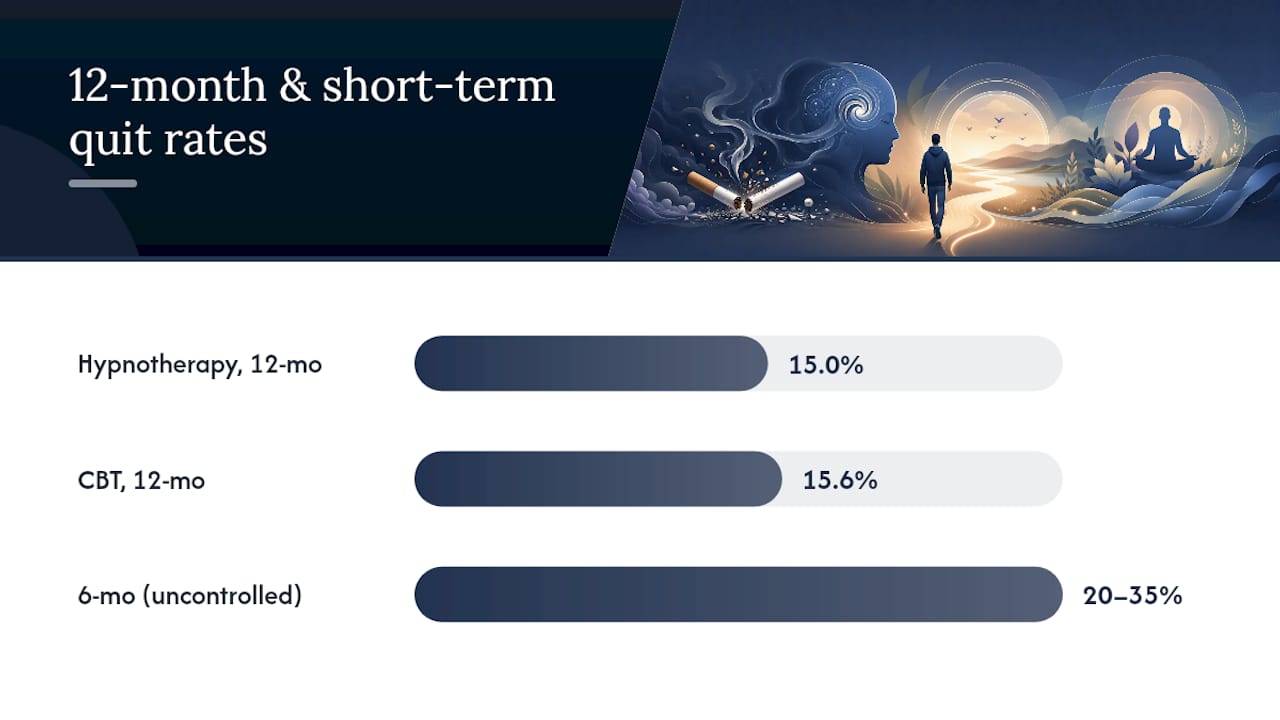
More recent data adds nuance rather than overturning that conclusion. A 2024 randomized controlled trial with 360 participants compared hypnotherapy directly against CBT and found nearly identical 12-month continuous abstinence rates: 15.0% for hypnotherapy versus 15.6% for CBT. When researchers controlled for hypnotic suggestibility (how naturally responsive a person is to hypnotic suggestion), CBT showed a slight edge on 7-day point-prevalence abstinence. That confound matters. It suggests some of hypnosis's apparent effect depends on how suggestible the individual patient is to begin with, which is not something you can predict from a phone consultation.
A separate analysis of the same trial data, published in PMC, reached a similar conclusion: no significant long-term difference in continuous abstinence between the hypnotherapy group and the CBT group over 12 months. The takeaway isn't that hypnosis fails, it's that hypnosis and one of the gold-standard behavioral treatments perform about the same for many people.
Short-term numbers tell a messier story. Healthline's review of the wider literature notes that uncontrolled studies and self-reported outcomes sometimes show six-month abstinence rates ranging from 20% to 35%, and one frequently cited case reported an 86% quit rate at six months that dropped to 32% on longer follow-up in the same sample. That pattern, a strong early number that fades over time, shows up across most cessation methods, not just hypnosis. It's a reason to treat any single-session "instant cure" claim with real skepticism.
A few limitations show up across this body of research that are worth knowing before you interpret any of these numbers as a personal guarantee:
- Many older trials had small sample sizes, sometimes under 50 participants per arm.
- Definitions of "quit" and "abstinence" varied between studies, making direct comparisons harder than they look.
- Several trials didn't match contact time between hypnosis and comparison groups, so one group simply got more clinician attention.
- Not every study used biochemical validation (a carbon monoxide or cotinine test) to confirm self-reported quitting, which means some reported success rates may be inflated.
| Study | Design | Sample size | Follow-up | Primary abstinence outcome |
|---|---|---|---|---|
| Cochrane review (2019) | Systematic review of 14 trials | 1,926 participants | 6+ months | No consistent benefit over other treatments |
| RCT (2024, PubMed) | Randomized, hypnotherapy vs. CBT | 360 participants | 12 months | 15.0% (hypnotherapy) vs. 15.6% (CBT) |
| RCT analysis (PMC) | Randomized, hypnotherapy vs. CBT | 360 participants | 12 months | No significant long-term difference |
The single number worth remembering: in the largest recent head-to-head trial, hypnotherapy and CBT landed within 0.6 percentage points of each other at 12 months. That's not a case for skipping hypnosis, it's a case for treating it as comparable to an established behavioral therapy rather than a lesser or magical alternative.
Ongoing research continues to test refinements to hypnotic protocols, and Clinicaltrials show new studies are still being designed to address the gaps the Cochrane reviewers identified.
What Happens During a Stop Smoking Hypnosis Session
Walking into a session blind is a good way to feel awkward for the first ten minutes. Here's what actually happens.
Most providers start with an intake conversation, either during a free consultation or at the start of the first paid session. The clinician asks about your smoking history, your triggers, how many cigarettes you smoke and when, and whether anxiety, stress, or specific situations tend to set off cravings. This isn't small talk. It's how the clinician tailors the suggestions that come later instead of running a generic script.
The working session itself typically runs 60 to 90 minutes. It usually includes:
- A relaxation induction, guiding your body out of everyday alertness into a calmer, more receptive state.
- Targeted suggestions addressing your specific triggers, whether that's stress at work, social smoking, or the after-meal cigarette.
- Posthypnotic suggestions designed to activate automatically the next time a trigger hits.
- A self-hypnosis walkthrough, so you leave with a tool you can use on your own between sessions.
Most plans run one to three sessions total, though this depends on how long you've smoked and how much the habit is tied to anxiety versus routine. Session pricing varies widely across providers, with individual sessions commonly running somewhere between $75 and $300 or more depending on the clinician's experience and whether it's a single session or a package.
As for what to watch for afterward: the first few days often bring noticeably reduced urge intensity, especially around your most predictable triggers. Weeks two and three are where relapse risk climbs, particularly around stress spikes or social situations you haven't yet rehearsed a response for. That's exactly why follow-up sessions and self-hypnosis practice matter more than the first session alone.
How to Practice Self-Hypnosis for Cravings at Home
You don't need a clinician in the room to get some benefit from hypnosis. A structured self-hypnosis routine is free, private, and something you can use the moment a craving hits, not just during a scheduled appointment. Here's a practical version you can start today.
- Set up your space. Sit or lie somewhere quiet for five to ten minutes where you won't be interrupted. Phone on silent.
- Do a short induction. Close your eyes, take three slow breaths, and count down from ten to one, telling yourself you're becoming more relaxed with each number.
- Deepen the state. Picture yourself walking down a staircase, one step per count, sinking further into calm with each step.
- Deliver targeted suggestions. Silently or aloud, repeat phrases specific to your triggers: "I feel calm and in control when stress rises," or "I am a nonsmoker, and cigarettes hold no pull over me."
- Add a cue-response image. Picture your specific trigger (the coffee break, the after-dinner moment) and mentally rehearse walking through it without smoking, feeling steady instead of anxious.
- Reorient. Count back up from one to five, telling yourself you'll feel alert and refreshed at five, then open your eyes.
Use this routine at two different times: once daily as reinforcement, ideally at the same time each day so it becomes a habit, and again in the moment a craving spikes, when a shortened two- to three-minute version works fine.
Recorded audio makes this easier to stick with. You can build your own short script and record it in your own voice, or use one provided by a clinician after a session. Patient resources from cancer treatment centers commonly recommend daily practice as a reinforcement tool between formal sessions, not a replacement for them.

Pro Tip: Practice at your most predictable trigger time, not just whenever you remember. If your hardest craving hits at 3 p.m. every day, run your self-hypnosis routine at 2:45 p.m. as prevention, not just as damage control after the craving has already started. Pairing this with nicotine replacement therapy during the first few weeks tends to soften the physical side while the hypnosis work targets the psychological one.
Choosing a Hypnotherapist: Credentials and Red Flags
Not every hypnotherapist has the same training, and the gap between a weekend-certificate provider and a clinically trained one is bigger than most people expect. Here's what to check before you book.
Look for a clinician who combines two things: a licensed healthcare or mental health background (psychology, counseling, nursing, or similar) plus specific clinical hypnotherapy training. WebMD's guidance on selecting a provider recommends verifying both credentials, not just the hypnotherapy certification alone, since addiction work often intersects with underlying anxiety or trauma that benefits from a broader clinical background.
Before booking, ask these questions during a consultation:
- What's your treatment approach, and how many sessions do you typically recommend for smoking cessation?
- How do you integrate hypnosis with medical supports like nicotine replacement or prescription medication?
- What does follow-up look like after the first session?
- How do you track outcomes, and do you use any biochemical validation (like a carbon monoxide check) or rely on self-report?
- What happens if the first approach doesn't work, is there a plan B?
Watch for these red flags, because they show up more often in this field than in most areas of healthcare:
- Any guarantee of 100% success or a claim you'll "never crave a cigarette again" after one session.
- No mention of clinical oversight, licensing, or a healthcare background, only a hypnotherapy certificate.
- High-pressure sales tactics pushing you to buy a large session package before a consultation.
- A single-session promise with no discussion of follow-up, self-hypnosis training, or a broader plan.
Telehealth has made credentialed clinicians far more accessible regardless of where you live. A well-run online session should feel structurally similar to an in-person one: an intake conversation, a guided induction over video, and a plan for follow-up, minus the commute.
Combining Hypnosis With Proven Cessation Methods
Smoking has two separate problems tangled together: a physical nicotine dependency and a psychological habit loop built around triggers and stress. Hypnosis addresses the second piece well. It doesn't do much for the first on its own, which is why pairing it with medically proven tools tends to outperform any single method alone.
A few pairings work particularly well in practice:
- Hypnosis plus nicotine replacement therapy for the first six to twelve weeks, letting the patch or gum handle physical withdrawal while hypnosis targets trigger response and stress-driven urges.
- Hypnosis integrated with CBT-based relapse prevention, using the behavioral skills from CBT (identifying high-risk situations, building alternative responses) alongside hypnotic reinforcement of those same skills.
- Hypnosis alongside prescription medication like varenicline or bupropion, always discussed with a physician first, since these medications work through different pharmacological pathways than nicotine replacement.
A reasonable sequence: start NRT and your first hypnotherapy session in the same week, add a self-hypnosis routine within the first few days, and check in with your clinician at two and six weeks to adjust the plan based on what's actually happening with your cravings. If stress-related cravings are still spiking, that's a sign to add a targeted anxiety-management technique alongside the hypnosis work rather than assuming hypnosis alone will eventually catch up.
Track your progress honestly, cravings per day, situations that trigger them, and whether NRT dosing needs adjusting, and bring that data back to whichever clinician or physician is managing your plan.
Is Hypnosis Safe? Risks and Who Should Be Cautious
Serious harm from hypnosis is rare in the clinical literature. Mayo Clinic's overview notes that hypnosis is generally safe when performed by a trained practitioner, and most reported side effects are mild and short-lived: temporary anxiety, headache, or a brief sense of disorientation as you come out of the relaxed state.
A few groups should be more cautious or skip hypnosis in favor of other treatments:
- People with a history of psychosis or active severe psychiatric instability, since altered states of attention can occasionally be disorienting for these conditions.
- People with certain seizure disorders, who should check with their neurologist first.
- Anyone currently in an acute mental health crisis, who needs stabilization before adding any new therapeutic approach.
If you have a psychiatric history or you're currently under care for a mental health condition, talk to your primary care provider or psychiatrist before starting hypnotherapy, not instead of it. The evidence base shows little sign of serious harm in controlled trials, but that safety record assumes you're working with a credentialed clinician, not a self-guided app with no clinical oversight.
When hypnosis helps most, and what one case looked like
This piece follows a straightforward problem, agitate, solution structure: the problem is that most smokers have already tried quitting and failed, the agitation is realizing why, usually because nobody addressed the anxiety underneath the habit, and the solution is treating that root driver directly instead of white-knuckling through cravings.
In practice, hypnosis tends to help most with clients whose smoking is anxiety-driven rather than purely habitual, and who are willing to actually practice self-hypnosis between sessions rather than treating it as a passive fix. The clients who do best are usually open to combining approaches instead of expecting hypnosis alone to carry the whole plan.
One anonymized pattern worth mentioning: a client who paired two hypnotherapy sessions with a nicotine patch and daily self-hypnosis practice reported a sharp drop in craving intensity within the first ten days, with occasional check-ins over the following six weeks to adjust the self-hypnosis script as new triggers surfaced. The timeline mattered as much as the sessions themselves. Quitting rarely resolves in one appointment.
Ready to Try Hypnosis to Quit Smoking? Here's How Sessions Work
Hypnotictransformations runs online clinical hypnotherapy sessions built specifically around the anxiety and stress patterns that keep smokers stuck, not a generic relaxation script applied to everyone the same way. Sessions are led by Kirk Hoffman, a Certified Clinical Hypnotherapist, over Zoom, so you don't need to live near a specialist to work with one.
Each plan starts with a free consultation to map out your specific triggers, followed by sessions that combine posthypnotic suggestion, self-hypnosis training, and follow-up check-ins to adjust the approach as cravings shift over the first several weeks. Anxiety management is built into the process directly, since stress-driven smoking responds differently than habit-driven smoking, and treating them the same way is one of the more common reasons quit attempts stall. Session pricing is discussed during your consultation so you know the cost estimate for your specific plan before committing to anything.
If you're ready to see whether this approach fits your situation, book a free consultation and talk through your smoking history, your triggers, and what a realistic plan looks like for you.
Frequently Asked Questions
Can hypnosis actually help me quit smoking? It can help some people, particularly those whose smoking is tied to stress or anxiety, but current evidence doesn't show it works better than other behavioral treatments on its own. It performs best as part of a combined plan.
What is the success rate of hypnosis for quitting smoking? Rates vary widely by study design. A 2024 randomized trial found a 15.0% 12-month continuous abstinence rate for hypnotherapy versus 15.6% for CBT, while some uncontrolled short-term reports cite six-month rates between 20% and 35% that often decline over longer follow-up.
How many hypnotherapy sessions does it take to quit smoking? Most plans run one to three sessions, though this depends on how entrenched the habit is and how tied it is to specific stress triggers. Self-hypnosis practice between sessions tends to reinforce the effect.
Is self-hypnosis as effective as working with a hypnotherapist? Self-hypnosis is a useful, free tool for managing cravings in the moment, but a trained clinician can tailor suggestions to your specific triggers and combine hypnosis with other supports like nicotine replacement, which self-guided practice alone can't do.
Is hypnosis to quit smoking safe? Serious adverse effects are rare when hypnosis is performed by a trained practitioner. Mild, short-lived effects like temporary anxiety or headache can occur. People with a history of psychosis or certain seizure disorders should consult a doctor first.
Should I combine hypnosis with nicotine replacement therapy? Yes, for most people. Hypnosis targets the psychological and trigger-based side of smoking while nicotine replacement addresses physical withdrawal, and combining both tends to outperform either approach alone.
This article is general information, not a substitute for advice from a qualified doctor. Consult a qualified healthcare professional about your own circumstances before acting on anything here.
Sources
If you want to dig into the primary research yourself rather than take any summary at face value, start with these:
- Hypnotherapy for smoking cessation - Cochrane review (2019)
- Hypnotherapy compared to cognitive-behavioral therapy for smoking cessation - randomized trial (2024)
- Hypnotherapy compared to cognitive-behavioral therapy for smoking cessation - PMC article
- Hypnosis - Mayo Clinic
When you're evaluating new studies as they publish, check sample size, whether the study used biochemical validation instead of relying purely on self-report, and how long the follow-up period ran. A study claiming success at four weeks tells you very little about whether that success holds at six months or a year.