
Most common beliefs about hypnosis are false. Hypnosis is not mind control and it is not sleep. Clinical hypnotherapy is a focused, suggestible state of attention, and research backs its use for pain and anxiety relief. You stay aware, you remember the session, and you cannot be made to do anything against your will.
TL;DR:
- Most people respond to hypnosis with moderate suggestibility, and even those with low suggestibility can benefit significantly from well-trained clinicians.
- Hypnosis does not cause loss of control or memory blackouts, and participants remain aware and retain agency throughout sessions.
- The safety profile of hypnotherapy is very high, with adverse effects occurring in less than 1% of cases and no serious events reported in clinical trials.
- Evidence shows hypnosis is especially effective for managing pain and medical procedure-related anxiety, with medium to large effect sizes in many studies.
- Choosing a qualified, credentialed clinician who explains their screening process and treatment approach is crucial for expecting safe and effective results.
Table of Contents
- What Are the Most Common Hypnosis Myths?
- Hypnosis Myths Debunked: A Myth-by-Myth Breakdown
- What Does the Research Actually Show?
- Is Hypnosis Safe? Side Effects and Who Should Be Cautious
- Who Benefits Most, and What Hypnotizability Really Means
- How Do You Choose a Qualified Hypnotherapist?
- What Myths Look Like in an Actual Clinic Session
- Stage Hypnosis vs. Clinical Hypnosis: What's the Real Difference?
- How Does Hypnosis Actually Work?
- Does Hypnosis Work Better Than Placebo or Talk Therapy?
- Why the Loudest Myths Miss the Real Story
- Ready to Address Anxiety at the Root, Not Just the Symptoms
- Sources
- FAQ
What Are the Most Common Hypnosis Myths?
Hollywood built most of what people think they know about hypnosis, and almost none of it holds up. Stage performers swing pocket watches and turn strangers into chickens. Horror films show hypnotists erasing memories or bending victims to their will. None of that resembles what happens in a clinical office.
The word "trance" does a lot of damage on its own. It sounds like something imposed on you, a state you fall into rather than a process you actively participate in. Clinicians rarely use it anymore for that reason, but the term stuck around in pop culture long after the science moved on.
Media coverage adds another layer. A sensational headline about "hypnotized" witnesses or courtroom testimony gets more clicks than a nuanced explanation of suggestibility. Peer-reviewed research traces many of these persistent myths directly back to early film and literary portrayals, not clinical evidence.
- Stage hypnosis shows prioritize entertainment over accuracy, and audiences generalize from what they see.
- Clinical language sometimes gets flattened into scarier, simpler soundbites for headlines.
- Historical terms like "trance" and "under" imply a loss of self that current research doesn't support.
Hypnosis Myths Debunked: A Myth-by-Myth Breakdown
Here's where the specific claims fall apart, one at a time, against what the actual evidence shows.
-
Myth: Hypnosis means losing control. Reviews and expert summaries find no systematic evidence that hypnosis causes loss of control or "blind obedience." Multiple studies show participants retain their own agency throughout a session and cannot be pushed to act against their own morals. You can reject a suggestion the same way you'd reject unwanted advice from a friend.
-
Myth: Hypnosis is a sleep state. It isn't. Hypnotic responding is a state of narrowed, focused attention, and how well someone responds tracks with their personal suggestibility, not with how "under" they go. A review of hypnosis mechanisms found no evidence for a distinct sleep-like brain state during hypnosis. You hear everything, and you can open your eyes and stand up any time you choose.
-
Myth: You won't remember the session. Spontaneous amnesia after routine clinical hypnosis is rare. Most people recall the session clearly afterward, often describing it as similar to being deeply absorbed in a good book or a long drive where the miles blur together but the destination stays clear.
-
Myth: Only certain people can be hypnotized. Hypnotizability exists on a spectrum, and most people fall somewhere in the middle rather than at either extreme. A minority respond very strongly or very little, but most people show some meaningful response to well-delivered suggestion.
-
Myth: One session fixes everything, or nothing changes at all. Both extremes are wrong. Change in hypnotherapy tends to build across a small number of sessions as the nervous system learns a new response to a trigger, not through a single dramatic reversal.
The real number behind the fear: A 2018 analysis of clinical trials covering 429 participants found zero serious adverse events attributable to hypnosis, and a minor adverse-event rate of just 0.47%. That's lower than the side-effect rate most people accept without a second thought for over-the-counter medication.
What Does the Research Actually Show?
Evidence for hypnosis is strongest in two areas: pain management and anxiety around medical procedures. A wide-ranging overview covering 49 meta-analyses and 261 individual studies found consistently medium to large effect sizes for patients undergoing procedures and those managing chronic or acute pain.
Effect sizes vary by condition and by study design, and researchers note real heterogeneity across the literature, meaning results are not identical everywhere. That's normal for behavioral medicine research generally, not a red flag specific to hypnosis.
- Pain and procedure-related anxiety show the most consistent, well-replicated results.
- Many randomized controlled trials report effects at least medium in size, with some reaching large effects.
- Adverse events remain rare across trials, and serious ones are essentially absent from the clinical literature.
Safety in numbers: Across the 429 participants tracked in that 2018 trial analysis, the minor adverse-event rate held at 0.47%, with no serious adverse events reported at all.
Is Hypnosis Safe? Side Effects and Who Should Be Cautious
For most healthy adults, hypnosis carries a low risk profile. Mayo Clinic lists it as generally safe when delivered by a trained clinician, and Cleveland Clinic's patient guidance frames typical sessions as active engagement rather than passive submission.
Some people report transient reactions during or right after a session:
- Mild dizziness or lightheadedness as the body relaxes
- A brief headache, similar to what follows deep meditation
- Drowsiness that fades within an hour
Serious adverse events stay rare in the clinical record. That said, if you carry a significant trauma history, tell your clinician before starting. A qualified hypnotherapist will screen for this and may recommend evidence-based trauma therapies first or alongside hypnotherapy.
Pro Tip: Before your first session, write down anything from your medical or trauma history you're unsure about mentioning. A good clinician would rather know too much than too little.
Who Benefits Most, and What Hypnotizability Really Means
Hypnotizability predicts part of the outcome, not all of it. Research finds only a moderate correlation between how hypnotizable someone tests and how much they benefit from treatment, which means low scorers still see real results in many cases.
Some studies find larger effects in younger patients, while adult responses vary more widely and depend heavily on engagement and the clinician's approach. A skilled hypnotherapist adjusts pacing and suggestion style based on how you respond in the first session, not on a fixed script.
How Do You Choose a Qualified Hypnotherapist?
Picking the right clinician matters more than picking the right technique. Start here:
- Confirm certification in clinical hypnotherapy, not just a weekend workshop certificate.
- Ask directly about their experience treating your specific concern, whether that's panic attacks, phobias, or generalized anxiety.
- Ask how they screen new clients and how informed consent works before the first suggestion is ever given.
- Clarify session format, expected number of sessions, and how the work fits alongside any other care you're receiving.
Pro Tip: A clinician who can't clearly explain their screening process in one or two sentences probably doesn't have one. That's worth noticing before you book.
What Myths Look Like in an Actual Clinic Session
Kirk Hoffman, a Certified Clinical Hypnotherapist, sees the same worry almost every week: a new client convinced they'll "lose control" or say something embarrassing. The pattern is consistent. Once someone experiences one guided session and realizes they heard every word and remembered the whole thing, the fear drops fast, usually before the second session even starts.
Stage Hypnosis vs. Clinical Hypnosis: What's the Real Difference?
Stage hypnosis and clinical hypnosis share a name and almost nothing else. A stage performer selects highly responsive volunteers from an audience, often through quick suggestibility tests before the show even starts. The goal is entertainment, and the format rewards dramatic, visible reactions.
Clinical hypnotherapy works in the opposite direction. The goal is a specific, private outcome, whether that's reducing panic response, easing procedure-related fear, or breaking a habit loop tied to stress. Sessions happen one-on-one or in small groups, with informed consent discussed up front and the pace set by the client's comfort, not a live audience's expectations.
The suggestibility involved is the same basic mechanism in both settings; what differs is context, consent, and intent. A stage hypnotist has no obligation to explain what's happening or why. A clinical hypnotherapist walks you through the process, explains what focused attention feels like, and checks in throughout. You are never asked to do something embarrassing or against your values, and you retain the ability to reject any suggestion at any point.
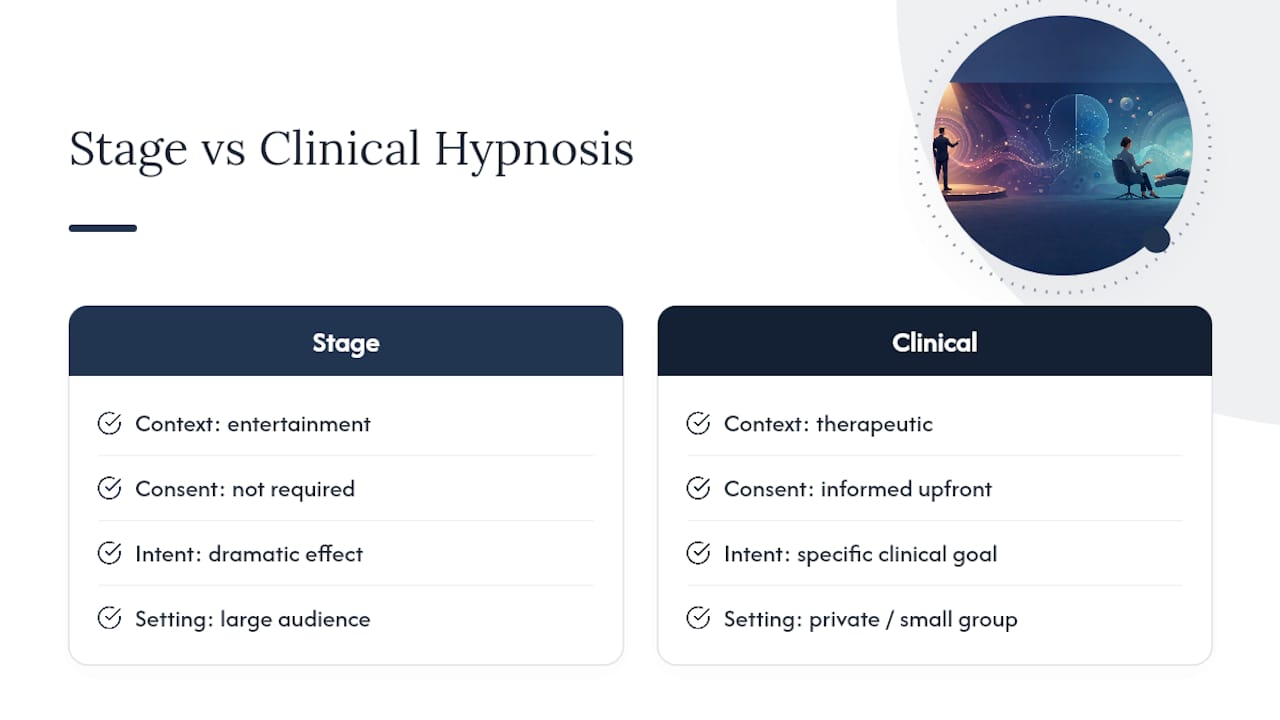
This distinction explains a lot of the fear that keeps people from trying hypnotherapy for anxiety. Most of what people picture when they hear the word "hypnosis" comes from the stage version, not the clinical one. Understanding the actual difference between the two often removes the biggest barrier before a client even books a first session.
How Does Hypnosis Actually Work?
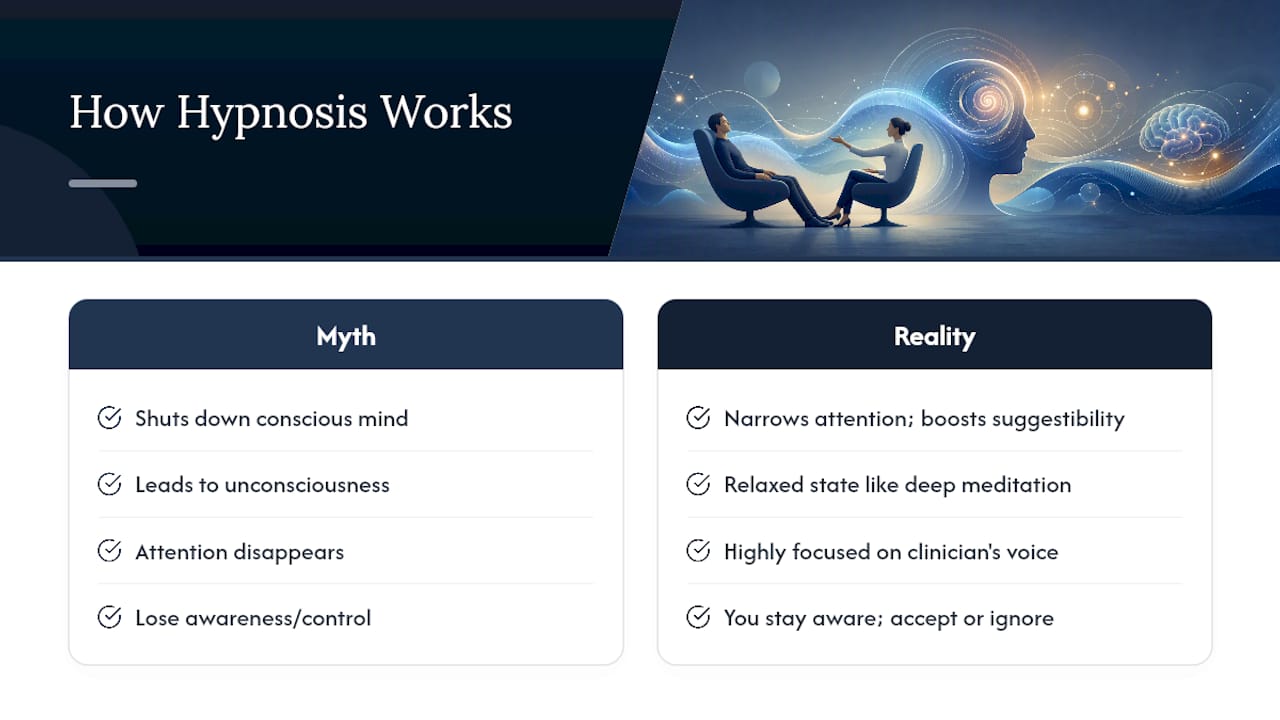
Hypnosis works by narrowing attention and increasing responsiveness to suggestion, not by shutting down the conscious mind. During a session, your body typically shifts into a more relaxed physiological state, similar to what happens during deep meditation, while your attention stays highly focused on the clinician's voice and the images or ideas they describe.
This matters because anxiety and fear responses live largely in the nervous system's fight-or-flight circuitry, not in conscious willpower alone. When a person's mind is calm and focused, it becomes more receptive to new associations and easier to work with when replacing an old automatic reaction, like panic at the sight of a needle, with a calmer one.
Current research frames hypnotic responding as tied closely to individual suggestibility and attitude toward the process, rather than a mysterious altered state a clinician imposes from outside. That reframes the whole interaction: you are an active participant supplying the responsiveness, and the clinician is guiding attention and offering suggestions your mind is free to accept or ignore. Nothing about the mechanism requires giving up awareness or control, and nothing about it resembles the loss of consciousness people often expect walking into a first appointment.
Does Hypnosis Work Better Than Placebo or Talk Therapy?
Hypnosis outperforms simple placebo conditions in a meaningful share of controlled trials, particularly for pain and procedure-related anxiety, where the meta-analytic evidence shows medium to large effects beyond what expectation alone would produce. That doesn't mean expectation plays no role. Belief and rapport shape outcomes in nearly every therapeutic approach, hypnosis included.
Compared with other established therapies, hypnosis tends to work best as a complement rather than a total replacement, particularly for anxiety and phobias where cognitive behavioral approaches already have a strong track record. Many clinicians combine hypnotic techniques with other evidence-based methods rather than treating hypnosis as a standalone cure. The honest comparison isn't hypnosis versus everything else. It's what specific tool fits a specific problem, and for anxiety tied to a clear trigger, focused hypnotic suggestion often gets results faster than talk therapy alone because it works directly with the nervous system's learned response rather than only the conscious narrative around it.
Why the Loudest Myths Miss the Real Story
The biggest gap in how people talk about hypnosis isn't between believers and skeptics. It's between people describing a stage act and people describing a clinical tool. Once you separate those two things, most of the fear evaporates on its own.
What gets underestimated is how much the client drives the outcome. Change doesn't happen because a clinician says the right words in the right order. It happens because a person's nervous system learns a new, calmer response to a trigger it used to treat as a threat. That's a collaborative process, not a performance done to you.
Where conventional advice falls short is treating hypnosis as either magic or nonsense, with nothing in between. The honest middle ground, backed by decades of clinical research, is more useful and less dramatic: a focused-attention technique with real, measurable results for specific problems, delivered by someone trained to screen for what it can't fix. If you're anxious about a first session, that anxiety usually says more about the myths you've absorbed than about the actual process waiting for you.
— Kirk
Ready to Address Anxiety at the Root, Not Just the Symptoms
If the myths were the only thing standing between you and relief, this article would be enough. But knowing hypnosis is safe doesn't change a racing heart at 2 AM or the dread before a work presentation. Online hypnotherapy can work directly with subconscious patterns feeding the fight-or-flight response, using sessions built around specific triggers rather than a generic script.
Sessions are typically led by a certified clinical hypnotherapist over Zoom, offering flexibility without waiting rooms or commute scheduling. The approach targets the pattern driving anxiety rather than just managing symptoms week to week. If you're interested in experiencing a focused, evidence-informed session, you can book a consultation through the services page and ask about your specific situation before committing.
This article is general information, not a substitute for advice from a qualified doctor. Consult a qualified healthcare professional about your own circumstances before acting on anything here.
Sources
- Hypnosis and adverse events: analysis of clinical trials (PubMed entry)
- Meta-analytic evidence on the efficacy of hypnosis for mental and somatic health issues: a 20-year perspective (Frontiers, 2024)
- Review: mechanisms and characteristics of hypnosis (PMC article)
- Myths and misconceptions about hypnosis and suggestion: separating fact and fiction (Lynn, Kirsch, Terhune et al., 2020)
FAQ
Is There Any Evidence That Hypnosis Is Real?
Yes. Hypnotic responding is measurable and reproducible in controlled research, and meta-analyses show medium to large effects for pain and procedure-related anxiety specifically.
What Is Not True About Hypnosis?
The idea that hypnosis puts you to sleep, erases your memory, or lets someone control your actions is not supported by research. Reviews consistently find participants retain full agency and clear awareness throughout a session.
Is It Possible to Be Truly Hypnotized?
Yes, most people can experience a genuine hypnotic state of focused attention, though the depth of response varies from person to person. Very few people show zero response, and very few show extreme response. Most fall somewhere in between.
Does the Bible Say Anything Against Hypnosis?
Views on this vary by faith tradition and individual interpretation, and no single verse directly addresses clinical hypnotherapy as practiced today. If this matters to you personally, it's worth discussing directly with your religious advisor alongside a qualified clinician.
Can Anxiety and Phobias Actually Improve With Hypnotherapy?
Clinical evidence supports hypnosis as a useful tool for anxiety and procedure-related fear, often used alongside other treatments rather than as a total replacement. Services like online hypnotherapy for anxiety focus specifically on this application.