
Trauma hypnotherapy is a clinically supported approach that uses guided hypnosis to calm your nervous system, reduce PTSD symptoms, and help you safely reprocess traumatic memories. If you've been searching for hypnosis for trauma near me, the short answer is this: it works, the research backs it, and qualified practitioners are available across the United States, including online.
Here's what trauma-informed hypnotherapy targets:
- Intrusive flashbacks and nightmares that replay without warning
- Hyperarousal and startle responses driven by a stuck fight-or-flight system
- Emotional numbness or avoidance that keeps you disconnected from daily life
- Anxiety and depression that often accompany unresolved trauma
- Somatic symptoms like tension, chronic pain, and sleep disruption
Techniques used in this work include Ericksonian hypnotherapy, Cognitive Processing Therapy (CPT), and EMDR, often combined to strengthen outcomes.
Why does trauma leave such a lasting impact?
Traumatic events don't just fade with time. They alter how your brain and nervous system store and respond to experience. The amygdala, your brain's threat detector, stays on high alert long after the danger has passed. Traumatic memories get encoded differently from ordinary ones, often without a clear timeline or context, which is why a smell, a sound, or a facial expression can trigger a full-body fear response years later.

Hypnotherapy addresses this at the subconscious level, where those memory networks live. Rather than talking around the trauma, it works with the brain's own capacity for focused attention and neurological change.
Key physiological and psychological effects that trauma-informed hypnosis addresses:
- Chronic activation of the sympathetic nervous system
- Fragmented or intrusive traumatic memory storage
- Conditioned fear responses tied to sensory triggers
- Difficulty with emotional regulation and self-soothing
- Dissociation and disconnection from the present moment
What techniques do trauma-informed hypnotherapists actually use?
Trauma-informed hypnosis differs from general hypnosis in one critical way: safety comes first, always. A skilled practitioner never pushes you into traumatic material before your nervous system is stable enough to handle it. The work is paced, structured, and grounded in clinical principles.
Core techniques include:
- Ericksonian hypnotherapy: Uses indirect suggestion and metaphor to bypass conscious resistance and communicate directly with the subconscious mind
- Ego-state therapy: Addresses different "parts" of the self that carry trauma, helping integrate fragmented emotional responses
- Symptom-cluster targeting: Focuses hypnotic suggestions on specific PTSD symptom groups, such as intrusion, avoidance, or hyperarousal
- Ego-strengthening: Builds internal resources and emotional stability before any trauma processing begins
- Nervous system stabilization: Uses trance states to activate the parasympathetic response, reducing baseline anxiety
Pro Tip: Hypnosis magnifies the effects of CBT by first calming the nervous system, which makes cognitive restructuring far more accessible. If you're already in CBT or EMDR, adding hypnosis to the protocol can deepen and accelerate the work.

What actually happens during a trauma hypnotherapy session?
The first session is almost always an intake. Your therapist gathers your history, explains the process, and assesses where you are emotionally. No trauma processing happens on day one. That matters, because rushing into traumatic content without preparation can retraumatize rather than heal.
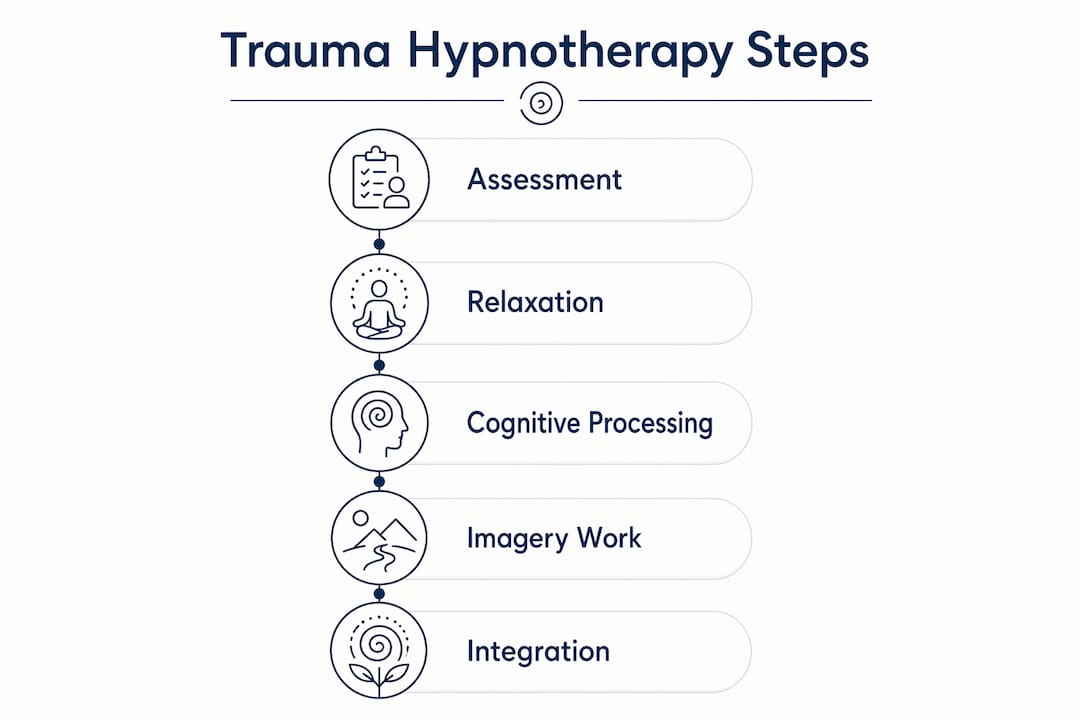
A typical session after that follows this structure:
- Grounding and induction: You're guided into a relaxed, focused state using breathing, imagery, or progressive relaxation
- Resource building: The therapist reinforces internal strengths and safe mental spaces before approaching difficult material
- Targeted suggestion or processing: Hypnotic language addresses specific symptoms, memories, or emotional patterns
- Reorientation: You're gently brought back to full alertness, and the therapist checks in on how you feel
Sessions typically run about an hour, and trauma recovery often involves multiple weekly sessions, with longer courses needed for complex PTSD or childhood trauma. You may feel emotionally tired after a session, sometimes tearful, sometimes lighter. Both are normal. You remain in control throughout and can stop at any point.
How do you find and choose a qualified trauma hypnotherapist near you?
The credential landscape for hypnotherapy in the United States is not uniformly regulated, which means the burden of vetting falls on you. That's not a reason to avoid it. It's a reason to ask the right questions.
Qualifications to look for:
- Certified Clinical Hypnotherapist (CCHt) designation from a recognized body such as the American Council of Hypnotist Examiners (ACHE) or the National Guild of Hypnotists (NGH)
- Trauma-informed care training beyond basic hypnosis certification
- Experience specifically with PTSD, complex trauma, or childhood abuse
- Integration with evidence-based modalities like CBT, EMDR, or Cognitive Processing Therapy
Practical steps to find local trauma hypnosis options:
- Search psychology directories filtered by "hypnotherapy" and "trauma" in your state
- Ask your primary care provider or current therapist for a referral
- Contact professional associations like the American Society of Clinical Hypnosis (ASCH) for member directories
- Consider online providers, who often have broader specialization and faster availability
Questions to ask before your first appointment: How do you approach trauma processing? What happens if I feel overwhelmed during a session? How many sessions do you typically recommend for PTSD? What is your fee, and do you accept insurance or offer sliding scale?
What does the research say about hypnotherapy for PTSD?
The evidence is stronger than most people realize. A 2026 randomized clinical trial with 63 adults meeting DSM-5 criteria for PTSD found that Ericksonian hypnotherapy and trauma-focused CBT produced equally large reductions in PTSD symptoms, depression, and anxiety over 12 weekly sessions. Ericksonian hypnotherapy showed slightly greater reductions in intrusion and hyperarousal specifically.
"Both active interventions produced large and significant reductions in PTSD symptoms compared with waitlist, with no significant difference between the two therapies in total PCL-5 improvement." — Published in the International Journal of Clinical and Experimental Hypnosis, 2026
Meta-analytic data reinforces this. A meta-analysis of hypnotherapy for PTSD found a Cohen's d of 1.17 at post-treatment and 1.58 at the four-week follow-up, both large effect sizes by any clinical standard. Effects held at 12-month follow-up. A separate meta-analysis of hypnotherapeutic techniques across six studies and 391 participants reported an overall Cohen's d of 1.18, statistically significant at p < .001.
Key findings from the clinical literature:
- Hypnotherapy reduces intrusion, avoidance, and hyperarousal symptoms in PTSD
- Effects are maintained at follow-up assessments up to 12 months post-treatment
- Ericksonian hypnotherapy produces neurophysiological changes comparable to CBT, including normalized ERP components and reduced autonomic reactivity to trauma cues
- Hypnosis as an adjunct to Prolonged Exposure or Cognitive Processing Therapy boosts their clinical impact
How do integrative approaches combine hypnotherapy with other trauma treatments?
Hypnotherapy works best when it's part of a broader treatment plan. On its own, it addresses nervous system regulation and subconscious memory processing. Combined with CBT, it adds cognitive restructuring. Paired with EMDR, it deepens the calm state needed for bilateral stimulation to work effectively.
Cognitive Processing Therapy targets the distorted beliefs trauma creates, such as "I caused this" or "nowhere is safe." Hypnosis can reinforce the new beliefs CPT introduces by embedding them at the subconscious level during trance. EMDR uses eye movements or tapping to help the brain reprocess stuck memories. Hypnosis primes the nervous system beforehand, making that reprocessing less activating. The VA's clinical hypnosis resources recognize hypnosis as a mind-body tool suited to PTSD precisely because it bridges the physiological and psychological dimensions of trauma.
What does specialized PTSD and complex PTSD treatment look like?
Standard PTSD and complex PTSD (C-PTSD) require different pacing. C-PTSD, which develops from prolonged or repeated trauma such as childhood abuse, domestic violence, or captivity, involves deeper disruptions to identity, relationships, and emotional regulation. A trauma hypnotherapist working with C-PTSD will spend considerably more time on stabilization before any memory processing begins.
Ego-state therapy is particularly well-suited here. It works with the internal "parts" that developed as survival adaptations, helping them feel safe enough to integrate rather than conflict. Sessions may focus entirely on building internal resources for weeks before approaching traumatic content directly. This is not slow progress. It's the structure that makes lasting progress possible.
How does hypnosis help survivors of childhood abuse?
Childhood sexual abuse and physical abuse often leave trauma encoded before the brain's verbal and narrative systems were fully developed. That's why talk therapy alone frequently falls short. The memories aren't stored as coherent stories. They're stored as body sensations, emotional states, and fragmented images.
Hypnotherapy accesses those pre-verbal memory systems through imagery, metaphor, and somatic suggestion. A skilled therapist can help you process what happened without requiring you to narrate it in linear detail. The work focuses on releasing the nervous system's held response to the original event, not on reliving it. For survivors of early abuse, this distinction often makes treatment feel possible for the first time.
What people experience working with trauma hypnotherapists
Clients who complete trauma-focused hypnotherapy commonly report that flashbacks become less frequent and less intense within the first several sessions. Sleep often improves early, sometimes before the core trauma work begins, because nervous system regulation alone reduces hyperarousal at night. Emotional reactivity tends to decrease gradually, with people noticing they can stay present in situations that previously triggered them.
For those dealing with anxiety rooted in trauma, online hypnotherapy for anxiety offers the same clinical depth without requiring in-person access. The subconscious work happens just as effectively via a structured Zoom session with a qualified practitioner.
Key Takeaways
Trauma hypnotherapy is a clinically validated approach that reduces PTSD symptoms by calming the nervous system and reprocessing traumatic memories at the subconscious level, with effects that hold at 12-month follow-up.
| Point | Details |
|---|---|
| Clinical evidence is strong | A 2026 RCT found Ericksonian hypnotherapy as effective as trauma-focused CBT across 12 weekly sessions. |
| Effect sizes are large | Meta-analyses report Cohen's d of 1.17 to 1.58 for hypnosis-based PTSD treatment post-intervention and at follow-up. |
| Integrative use amplifies results | Combining hypnosis with CBT or EMDR boosts outcomes beyond either approach used alone. |
| Vetting credentials matters | Look for CCHt certification, trauma-informed training, and specific PTSD experience before starting treatment. |
| Online sessions are clinically equivalent | Trauma hypnotherapy delivered via Zoom reaches the same subconscious processes as in-person work. |
Work with a certified trauma-informed hypnotherapist online
Hypnotictransformations offers online clinical hypnotherapy sessions led by Kirk Hoffman, Certified Clinical Hypnotherapist. Sessions address trauma-related anxiety, PTSD symptoms, and the subconscious patterns that keep your nervous system stuck in fight-or-flight. You don't need to live near a specialist. You need a qualified one.
Explore clinical hypnotherapy services or book a free consultation to talk through what you're carrying and whether this approach fits where you are right now.