
Hypnosis can help many people reduce rumination, but it works best as an adjunctive tool rather than a stand-alone cure. It calms the nervous system's arousal response while training your attention to disengage from looping negative thoughts. The practical next step: work with a certified clinician who can teach you a self-hypnosis practice you can use between sessions.
TL;DR:
- Hypnosis is most effective as a complementary tool that enhances attention control and relaxation, rather than replacing other treatments for rumination.
- Key techniques include mindful thought detachment, imagery to weaken emotional charge, and boundary-setting suggestions for worry management.
- Continued self-hypnosis practice for five to ten minutes daily, especially before peak rumination times, is crucial for lasting benefits.
- Evidence suggests measurable improvements in sleep and worry frequency over one to two months, with a need for more rigorous studies to confirm long-term efficacy.
- Hypnosis is unsuitable for individuals with active psychosis, unmanaged bipolar disorder, or active suicidal thoughts, and should always be coordinated with healthcare providers.
Table of Contents
- How hypnosis for rumination works: attention, arousal, and reframing
- What the research says about hypnosis and rumination
- Common hypnotherapy techniques to interrupt rumination
- What a typical hypnosis session for rumination looks like
- Who benefits from hypnosis for rumination, and who should be cautious
- How Hypnotic Transformations approaches rumination in practice
- How to start online hypnotherapy sessions for rumination
- Sources
How hypnosis for rumination works: attention, arousal, and reframing
Rumination is not a character flaw. It is a specific attention pattern where your mind keeps returning to the same worry loop, often while your body sits in a low-grade fight-or-flight state. Hypnosis addresses both halves of that problem at once, which is part of why it shows up so often as a complement to attention-based and mindfulness-based therapies.
The attention piece matters most. Hypnotic states appear to shift activity in frontolimbic attention networks, the brain systems responsible for deciding what you focus on and what you let pass by. When those systems are functioning normally, an intrusive thought shows up, gets noticed, and fades. In chronic rumination, that same thought gets flagged as urgent and pulled back into focus again and again. A hypnotic induction gives you practice at redirecting attention on command, which is a skill most people have never deliberately trained.

The arousal piece is just as important. Rumination and anxiety feed each other. Your body reads a repetitive worry thought as a threat signal, the sympathetic nervous system ramps up, and that physical tension makes the thought feel more urgent, which pulls you back into it. Hypnosis interrupts that loop through deep relaxation, lowering heart rate and muscle tension enough that the nervous system stops treating the thought like an emergency. Once the body calms down, the thought itself often loses intensity.
Clinicians build on that calm state in a few specific ways:
- Attention redirection. Suggestions guide focus away from the worry loop and toward a neutral or pleasant point of concentration.
- Reduced physiological arousal. Progressive relaxation and breathing cues lower the stress response that keeps rumination active.
- Post-hypnotic suggestions. Phrases planted during the session (for example, associating a hand gesture with letting a thought go) continue working after the session ends.
- Imagery work. Visualizing a thought shrinking, floating away, or losing color weakens its emotional charge without requiring you to argue with the thought's content.
That last point separates hypnosis from pure cognitive debate. Traditional cognitive therapy often asks you to challenge a thought's accuracy. Hypnosis, especially when it draws on mindfulness principles, asks you to change your relationship to the thought instead. You are not trying to prove the worry wrong. You are training your mind to notice it and let it pass, the way you would notice a car driving by. That distinction is why hypnosis pairs so naturally with mindfulness-based approaches rather than replacing them.
What the research says about hypnosis and rumination
The evidence base here is smaller than for treatments like CBT, but it is not thin, and the direction of the findings is consistent. A 2010 review in the International Journal of Clinical and Experimental Hypnosis framed hypnosis as a catalyst for attention- and mindfulness-based treatments, arguing that hypnotic techniques can prime the kind of attentional flexibility that mindfulness and attention-training programs depend on. The review's core point is not that hypnosis replaces mindfulness work. It is that hypnosis can make someone more receptive to it, lowering resistance to practices that otherwise take weeks to take hold.
A more concrete clinical result comes from a 2017 study on chronic insomnia linked to rumination. Researchers tracked 42 patients through a hypnotherapeutic program combining relaxation and positive self-suggestion, and reported reductions in rumination alongside improved sleep quality at one and two month follow-ups. That is a meaningful detail for anyone whose overthinking peaks at night. The pre-sleep window is often when rumination is loudest, because there is nothing else competing for attention, and this study is one of the few to measure that specific pattern directly.
The pattern across these studies: benefits at one and two month follow-ups, not just immediately after treatment. That timeline matters because it suggests the changes are not purely a relaxation effect that fades once the session ends.
More recent work has focused on technique rather than outcome measurement. Case illustrations published in 2022 and 2023 describe how Buddhist meditation-informed hypnotic techniques (also available via PubMed) can be built into a hypnosis session to manage rumination specifically, giving clinicians two named tools: mindful thought detachment and mindful dereflection. A separate pilot randomized controlled trial found that mindful hypnotherapy reduced stress and increased mindfulness in participants, reinforcing the idea that combining the two approaches produces measurable change rather than just a pleasant feeling during the session.
Here is where honesty matters. These are useful findings, not proof of a universal fix.
- Sample sizes tend to be small. Forty two patients is a real result, not a landmark trial.
- Hypnosis in almost every study is studied as an add-on to another treatment, not a replacement for it.
- Researchers reviewing this literature have specifically called for more rigorous trials before hypnosis can be labeled a first-line treatment for rumination on its own.
None of that erases the signal. It just means the honest claim is "a coherent, growing body of evidence supports hypnosis as a complement to attention and mindfulness work," not "hypnosis cures overthinking." That is a claim worth taking seriously, and it is also a claim that should send you toward a trained clinician rather than a generic recording.
Common hypnotherapy techniques to interrupt rumination
Clinicians treating rumination tend to reach for a specific toolkit, and most of it traces back to the mindfulness-informed hypnosis literature described above. Knowing the names helps you evaluate whether a practitioner actually understands this problem or is running a generic relaxation script.
- Mindful thought detachment. You are guided to notice a worry thought the way you would notice a sound in another room, acknowledging it without engaging its content. The goal is not suppression. It is separation between "the thought exists" and "I must resolve the thought right now."
- Mindful dereflection. Attention is redirected away from self-focused analysis and toward a neutral sensory anchor, often breath or a specific physical sensation. This technique borrows directly from Buddhist meditation-informed approaches adapted for hypnotic suggestion.
- Guided imagery that shifts associative networks. Instead of confronting the worry directly, the session builds a new mental association, a specific place, object, or sensation, that competes with the trigger for the same mental space.
- Boundary-setting post-hypnotic suggestions. This is one of the most practical tools in the kit. The clinician plants a suggestion that separates "worry time" (a scheduled 10 minutes to think it through) from every other hour of the day, so the mind has permission to postpone rather than suppress.
Self-hypnosis homework is where most of the real change happens, not in the chair during the session itself. A typical protocol asks for five to ten minutes of practice once or twice daily, usually built around a short recorded induction and one or two specific suggestions tied to your particular thought pattern. Clinical practice protocols consistently include this kind of daily self-practice as a way to reinforce whatever happened during the live session, because a single hour a week cannot compete with a habit that runs for years.
Pro Tip: Pick one time of day to practice, not "whenever I remember." Rumination often spikes at a predictable hour, right before bed or during a commute, so anchor your self-hypnosis practice fifteen minutes before that window opens, not after the loop has already started.
If mindful eating or body-focused rumination is part of your pattern, the same detachment principle applies there too, and it is worth reading how mindful hypnosis techniques get adapted for anxiety-driven habits beyond just worry loops.
What a typical hypnosis session for rumination looks like
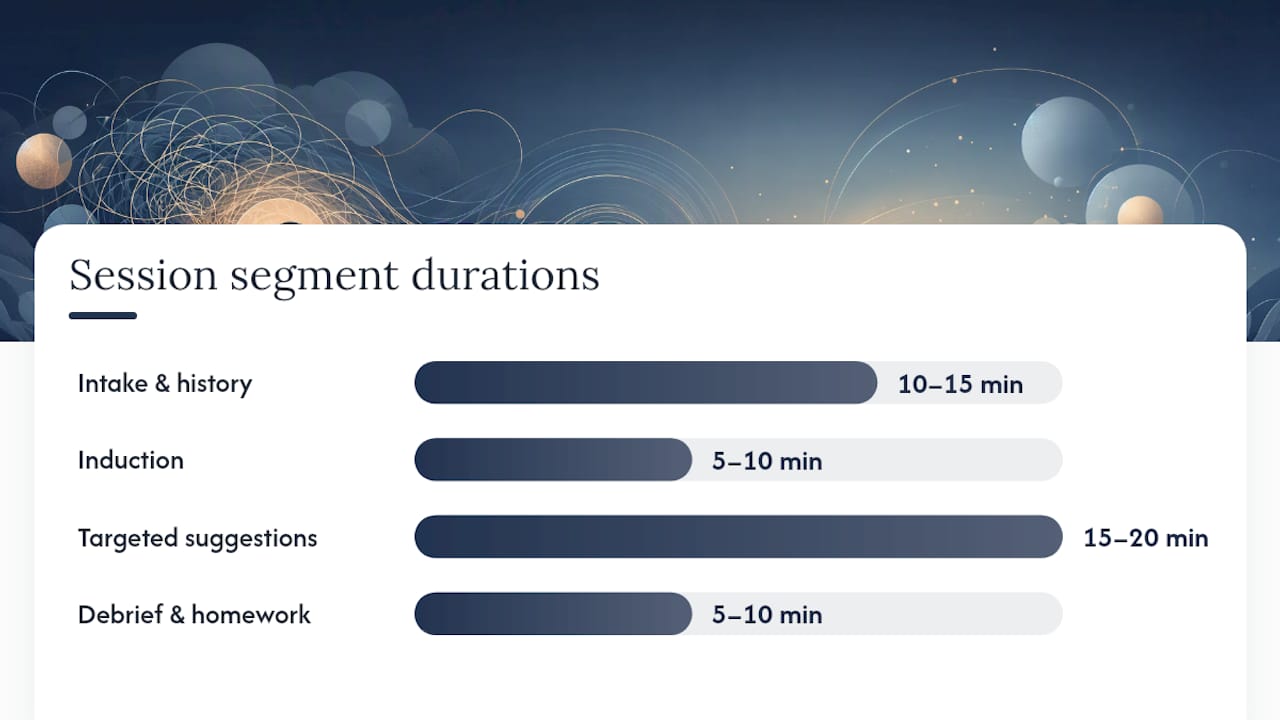
A first session runs longer than the ones that follow, usually because there is an intake conversation before any induction begins. Expect something close to this shape.
- Intake and history (10 to 15 minutes). The clinician asks what your rumination actually sounds like: is it mostly about the past, anticipatory worry about the future, or self-criticism? This detail changes which suggestions get used.
- Induction (5 to 10 minutes). A guided relaxation process brings you into a focused, receptive state. This is not sleep, and most clients remain fully aware of the room the entire time.
- Targeted suggestion work (15 to 20 minutes). This is where mindful detachment, dereflection, or imagery techniques get applied to your specific thought pattern, not a generic script.
- Debrief and homework assignment (5 to 10 minutes). You come out of the relaxed state gradually, and the clinician assigns a short self-hypnosis practice to run between sessions.
A full session typically lasts 45 to 60 minutes. Frequency matters more than most people expect: weekly sessions paired with daily five to ten minute self-hypnosis practice tend to outperform monthly sessions with no homework, largely because rumination is a habit and habits respond to repetition, not intensity.
On timeline, the 2017 insomnia study found measurable improvement in rumination and sleep quality at the one month mark, with continued benefit at two months. That is a reasonable expectation to set for yourself: some clients notice the worry loop losing its grip within the first two to three sessions, but the more durable change, the kind that holds up without conscious effort, tends to show up over four to eight weeks of consistent practice. A successful outcome usually looks like fewer intrusive episodes per day, less emotional intensity when a worry thought does show up, and, for many clients, noticeably better sleep.
Who benefits from hypnosis for rumination, and who should be cautious
Hypnosis for rumination tends to help two groups the most: people whose anxiety shows up mainly as repetitive analytical worry rather than panic, and people whose rumination is loudest at night and disrupting sleep. If your overthinking follows a predictable pattern (the same three worries on rotation, mostly triggered by quiet or downtime), that predictability actually makes hypnotic suggestion work more effectively, because the clinician can target something specific rather than a moving target.
There are real limits here, and a responsible clinician will name them upfront rather than promise a fix for everyone.
- Active psychosis or unmanaged bipolar disorder are contraindications for hypnosis without close coordination with a psychiatric provider, since altered attention states can interact unpredictably with these conditions.
- Active suicidal ideation requires immediate coordinated mental health care, not hypnosis as a first response. A responsible practitioner will screen for this and refer out when needed.
- Rumination tied to OCD-spectrum symptoms sometimes needs a different specialized approach; it is worth reading about the overlap between OCD and anxiety treatment before assuming standard rumination techniques will apply.
Watch for red flags in a practitioner: anyone promising a permanent cure in one session, refusing to discuss credentials, or claiming hypnosis can replace medication for a diagnosed condition is overstating what this tool does. Hypnosis works best sitting alongside CBT, medication management, or other established treatment for anxiety and depression, not instead of it.
How Hypnotic Transformations approaches rumination in practice
The way I structure this work follows a simple pattern: name the specific fear first, then explain what actually happens in the nervous system, then show the path out. That is closer to a direct-response framework than a typical wellness pitch, because clients dealing with chronic overthinking do not need to be sold on the idea that rumination is exhausting. They already know. What they need is a clear explanation of the mechanism and a realistic plan.
In practice, sessions happen over Zoom, and the first one always starts with a real conversation about what your specific loop sounds like, not a generic script. From there, most clients get a mix of mindful detachment work, targeted imagery, and boundary-setting suggestions that give the mind permission to postpone a worry instead of fighting it. Homework is not optional. It is a short daily practice, five to ten minutes, built around the same cues used in the live session, so the nervous system gets repeated exposure to the calm state rather than a once-a-week reset.
If you are evaluating any hypnotherapist for this work, ask three things directly: are they a Certified Clinical Hypnotherapist, do they have specific experience with rumination or anxiety-driven overthinking rather than general relaxation work, and will they coordinate with a physician or therapist if your case calls for it. Those three answers tell you more than any testimonial ever could.
— Kirk
How to start online hypnotherapy sessions for rumination
Hypnotic Transformations runs every session online through Zoom, which removes the drive, the waiting room, and the scheduling friction that keeps a lot of anxious overthinkers from ever booking that first appointment.
Sessions run individually or as part of a multi-session package, depending on how entrenched the rumination pattern is and whether sleep is affected. Each package includes homework between sessions, the same self-hypnosis practice described earlier in this article, so the work continues after the call ends rather than resetting every week. Booking starts with a free consultation, where Kirk Hoffman, a Certified Clinical Hypnotherapist, asks about your specific worry pattern before recommending a session plan. You can review the online hypnotherapy for anxiety page for session details, or check the full services list if weight management or smoking cessation are also on your mind. Because hypnosis works best alongside other care, Kirk coordinates with your physician or therapist when a case calls for it rather than working in isolation. If your overthinking gets louder at night, pairing this work with a wind-down routine can make the self-hypnosis practice land faster. Book your free consultation to find out what a session plan built around your specific thought pattern actually looks like.
This article is general information, not a substitute for advice from a qualified doctor. Consult a qualified healthcare professional about your own circumstances before acting on anything here.
Sources
- Hypnosis, Rumination, and Depression: Catalyzing Attention and Mindfulness-Based Treatments
- Clinical hypnosis in reducing chronic insomnia accompanied by rumination
- Mindful Hypnotherapy to Reduce Stress and Increase Mindfulness: A Randomized Controlled Pilot Study
- Using Buddhist Meditation-informed Hypnotic Techniques to Manage Rumination: Two Case Illustrations