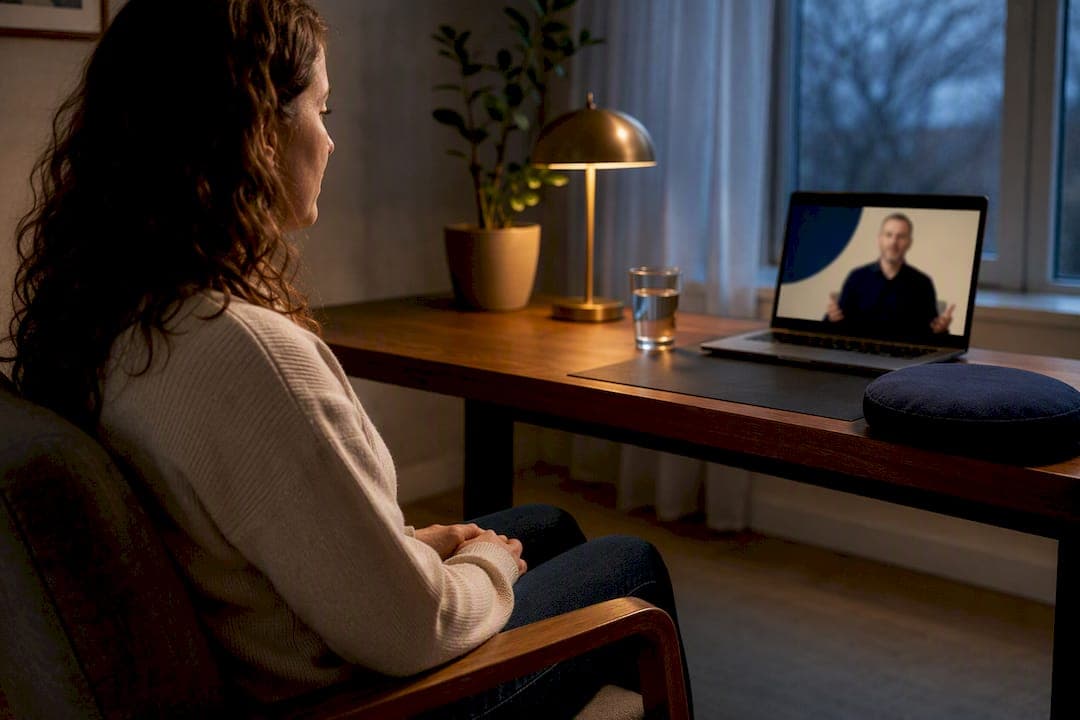
Clinician-led telehealth hypnotherapy can reduce procrastination when the delay is driven by anxiety, fear of failure, or perfectionism, not laziness. This differs from pre-recorded self-hypnosis audio because a certified clinician assesses your specific triggers and tailors the session to your nervous system's response. One published study on Ericksonian hypnosis found measurable drops in procrastination scores. The next step is a consult, not another app.
TL;DR:
- Clinical hypnotherapy can address anxiety-related procrastination by calming the nervous system's threat response and restoring access to decision-making areas of the brain.
- Most clients require between one and six sessions, with visible progress usually apparent within four to six weeks, depending on the length of the avoidance pattern.
- A peer-reviewed 2020 study found that Ericksonian hypnosis significantly reduced anxiety, stress, and procrastination scores in adults with generalized anxiety disorder.
- Effective telehealth hypnotherapy relies on a thorough intake, personalized techniques, real-time adjustments, and between-session self-hypnosis practice.
- It is essential to work with a fully certified clinician experienced in treating anxiety and avoidance behaviors to ensure safe and targeted treatment.
Table of Contents
- What Clinical Hypnotherapy for Procrastination Actually Does
- What Does the Research Say About Hypnosis and Procrastination?
- What Happens During a Telehealth Hypnotherapy Session?
- Who Is a Good Candidate for This Approach?
- How Do You Choose the Right Clinician?
- What Should You Practice Between Sessions?
- A Clinician's View on Fear-Based Procrastination
- Ready to Address the Fear Behind Your Procrastination?
- Sources
- FAQ
What Clinical Hypnotherapy for Procrastination Actually Does
Procrastination that comes from anxiety is not a scheduling problem. It is your body treating a task like a threat. When you sit down to write the report or make the call, your amygdala fires as if you were facing a real danger, and your prefrontal cortex, the part that plans and follows through, goes quiet. That is the freeze response, and it explains why willpower advice fails people who are actually avoiding fear, not managing laziness.

Clinical hypnotherapy for this problem works through telehealth, one-on-one, with a session built around your specific triggers rather than a generic script. A certified clinician uses Ericksonian techniques and guided imagery to lower the threat signal first, then rehearse the task while your nervous system stays calm.
That distinction matters practically:
- A clinician asks what the task represents to you (failure, judgment, exposure) before choosing a technique.
- Sessions adjust in real time based on your response, something a recording cannot do.
- The goal is restoring access to your prefrontal function during the exact moment you'd normally avoid the task, not just relaxation in general.
What Does the Research Say About Hypnosis and Procrastination?
A 2020 study on Ericksonian hypnosis and generalized anxiety disorder, catalogued as P-1136 in European Psychiatry, gives the clearest data point available on this exact question.
60 adults with generalized anxiety disorder saw measurable reductions in anxiety, stress, and procrastination scores after Ericksonian hypnosis, according to the study's pre and post comparisons.
Researchers tracked three separate measures:
- The State-Trait Anxiety Inventory, which scores momentary and long-term anxiety
- The Perceived Stress Scale, which captures how overwhelmed a person feels by daily demands
- The Lay Procrastination Scale, which quantifies task avoidance directly
All three scores dropped after the intervention. The study's own authors flagged the sample size and recommended caution before generalizing the results to every anxiety profile. That caveat is worth taking seriously. Sixty participants is a real finding, not proof that every case responds the same way. What it does establish is that a legitimate, peer-reviewed study measured procrastination as an outcome of clinical hypnosis and found it moved in the right direction, alongside anxiety and stress. Related work on hypnotherapy for OCD and anxiety shows a similar pattern: hypnosis affecting the anxiety layer tends to move the avoidance behavior sitting on top of it.
What Happens During a Telehealth Hypnotherapy Session?
Your first consult is not a hypnosis session. It is an intake conversation focused on when the avoidance shows up, what thoughts accompany it, and whether the pattern traces back to a specific fear (being judged, failing publicly, not being good enough) or a more general anxious baseline.
From there, a typical session follows a consistent structure:
- A brief pre-talk to check in on stress levels and set the session's target.
- Induction, guiding you into a relaxed, focused state.
- Targeted suggestions or imagery work aimed at the specific avoidance pattern discussed in intake.
- A debrief, where the clinician checks what came up and assigns a short between-session practice.
Most clients need somewhere between one and six sessions, with progress typically reviewed around the four to six week mark. That range depends on how long the avoidance pattern has been in place and whether other anxiety symptoms are involved.
Pro Tip: Track task starts, not just task completions, during the first few weeks. A faster start with less dread beforehand is often the first sign the work is landing, even before the whole task gets finished on time.
Who Is a Good Candidate for This Approach?
If your procrastination shows up alongside racing thoughts before you start a task, a fear of being judged on the outcome, or a pattern of redoing things until they feel "right," clinical hypnotherapy targets exactly that mechanism. Adults dealing with performance anxiety, perfectionism, or fear of failure tend to respond well because the sessions address the fear directly instead of managing the schedule around it.
Some situations call for medical or psychiatric evaluation before or alongside hypnotherapy:
- Severe, unmanaged depression that includes loss of function beyond procrastination
- Active suicidal ideation
- Unmanaged psychosis
- Active substance withdrawal
A responsible clinician screens for these during intake and will coordinate with your prescriber or therapist when your case calls for combined care, rather than treating hypnotherapy as a stand-alone fix for a condition it was never meant to address alone.
How Do You Choose the Right Clinician?
Not every practitioner offering "hypnosis for procrastination" online has clinical training. A few checks separate a legitimate telehealth clinician from someone running a script.
Look for these credentials and practice signals:
- A Certified Clinical Hypnotherapist designation, not just a weekend course certificate.
- Direct experience treating anxiety and performance avoidance, not only smoking or weight concerns.
- An established telehealth practice with a clear intake process.
Ask a prospective clinician these questions before booking:
- How do you identify the root cause behind my specific avoidance pattern?
- Roughly how many sessions should I expect, and how will we measure progress?
- How is my session data handled, and what does the telehealth setup look like on your end?
Walk away from anyone who guarantees a permanent cure after one session, gives a vague answer about methodology, or skips an intake conversation entirely. A clinician trained in fear of failure and self-sabotage patterns should be able to describe, in plain terms, how the work targets your specific trigger.
What Should You Practice Between Sessions?
The sessions do the primary work, but a few minutes of practice between appointments speeds things up. Clinicians commonly assign a short self-hypnosis routine built around the same imagery used in session, along with graded task starts: picking the smallest possible first step on the task you've been avoiding and doing only that.
A few practical notes on the telehealth side:
- Use a room with a door you can close so the session isn't interrupted mid-induction.
- Sit upright in a comfortable chair rather than lying down, which can tip you into sleep instead of the focused relaxed state hypnosis calls for.
- Check your internet connection before the session starts. A stable setup matters more than expensive audio gear for how deep and productive the session feels.
Pro Tip: Pair your self-hypnosis practice with a quick grounding technique, like a 60 to 90 second exposure or breathing reset, right before starting the task you've been avoiding. The combination tends to work better than either one alone.
A Clinician's View on Fear-Based Procrastination
Most people I work with think they have a motivation problem. They don't. They have a nervous system that treats a specific task like a threat, and no amount of willpower talks a threat response down. What actually moves the needle is calming that response first, then rehearsing the moment of starting while the body stays regulated.
Clients typically notice less dread before the task within the first few weeks, followed by more consistent starts. That second part matters more than the first. Anyone can feel briefly calmer after a session. What tells you the change is holding is whether you start the task on a normal Tuesday without the usual buildup. Sessions combined with short daily practice get there faster than sessions alone.
— Kirk
Ready to Address the Fear Behind Your Procrastination?
If anxiety, fear of failure, or perfectionism is what's actually running your procrastination, working directly with the fear beats managing your calendar around it. One-on-one telehealth hypnotherapy sessions are available, built around your specific triggers rather than a generic recording anyone could buy online.
An initial consult typically starts with a conversation about what your avoidance actually looks like and when it shows up, not a script. From there, sessions can be scheduled over Zoom at times that fit your week, with an estimate of how many sessions your case may need set early rather than left open-ended. If anxiety-driven procrastination has been running your schedule long enough, book a consult through the online hypnotherapy for anxiety page and get a clinician's read on your specific pattern.
This article is general information, not a substitute for advice from a qualified doctor. Consult a qualified healthcare professional about your own circumstances before acting on anything here.
Sources
- P-1136 - the Efficiency of Ericksonian Hypnosis in Diminishing Stress and Procrastination in Patients With Generalized Anxiety Disorder | European Psychiatry | Cambridge Core
- How to set up a teletherapy workspace at home | Konfidens
FAQ
Can Hypnosis Really Stop Procrastination?
Clinical hypnotherapy can reduce procrastination that's rooted in anxiety or fear of failure by lowering the nervous system's threat response to the task, and a 2020 study found measurable drops in procrastination scores after Ericksonian hypnosis sessions.
How Many Sessions Does Procrastination Hypnotherapy Take?
Most clients see clinicians for one to six sessions, with progress typically reviewed around four to six weeks in, though the exact number depends on how long the avoidance pattern has been established.
Is Hypnotherapy Better Than Self-Hypnosis Apps for Procrastination?
For persistent, emotionally charged procrastination, clinician-led sessions tend to outperform self-hypnosis recordings because a clinician assesses your specific root cause and adjusts the approach in real time.
What Happens if Hypnotherapy Alone Isn't Enough?
A responsible clinician screens for conditions like severe depression, active suicidal ideation, or unmanaged psychosis during intake and coordinates with a prescriber or therapist when combined care is appropriate.
What Should I Do Between Hypnotherapy Sessions?
Clinicians commonly assign short self-hypnosis rehearsals paired with graded task starts, picking the smallest first step on the avoided task, to reinforce the work done in session.