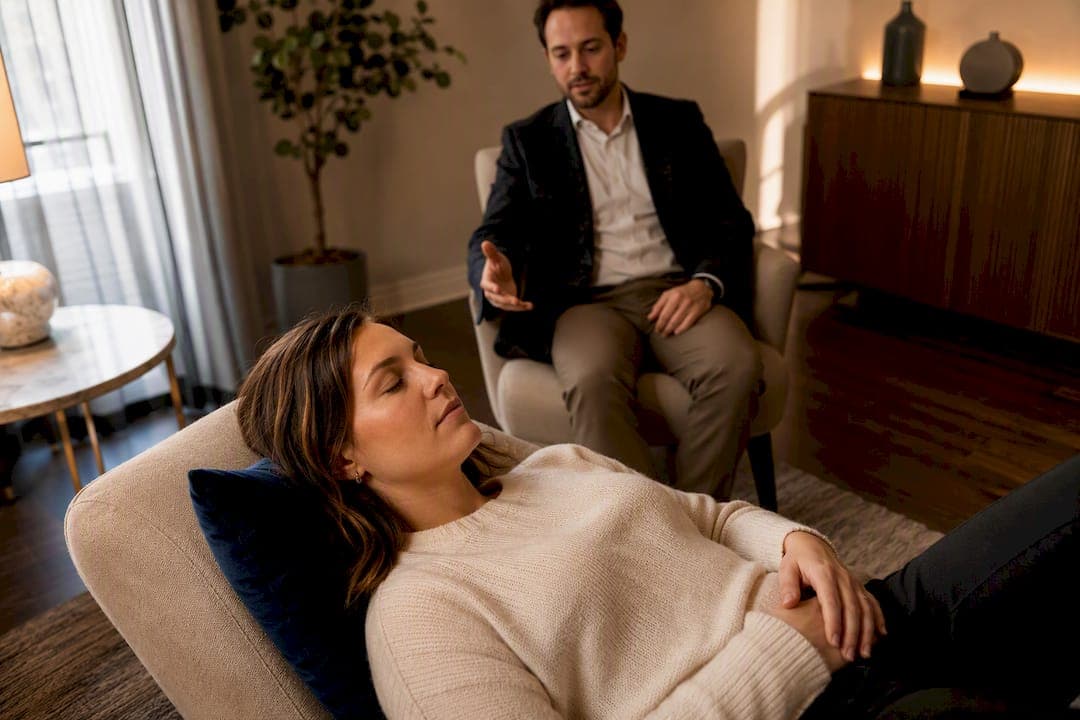
Clinical hypnotherapy can remove the subconscious blocks that keep anxiety in charge of your decisions, and that is usually what stands between you and the goals you keep failing to manifest. Clinical evidence shows hypnosis lowers sympathetic nervous system activity and calms the fear circuitry that hijacks your choices. This is not self-hypnosis or a law-of-attraction audio track. It's paid, one-on-one clinical work, and real shifts often require multiple sessions over time, commonly within a range of several sessions.
TL;DR:
- Clinical hypnotherapy typically requires four to eight sessions, with some clients noticing physical or emotional shifts after only one session.
- Sessions are personalized, focusing on identifying specific triggers through intake and adjusting suggestions based on measurable progress.
- Hypnotherapy benefits are strongest for individuals with clear, learned anxiety patterns, but it is not effective for active psychosis or unmanaged severe mental health conditions.
- The physiological effects include lowering sympathetic nervous system activity and increasing parasympathetic tone, which reduce fear responses linked to anxiety.
- Success depends on ongoing behavioral reinforcement and close collaboration with a licensed clinician who customizes the approach and tracks specific markers over time.
Table of Contents
- What Is Hypnosis for Manifestation, Clinically Speaking?
- Does the Research Actually Support This?
- What Happens in an Actual Session
- Who Benefits Most, and Who Should Be Careful
- How to Vet a Clinical Hypnotherapist
- Making the Change Stick Between Sessions
- Techniques Clinicians Use for Manifestation-Related Blocks
- Where Hypnosis and Law of Attraction Actually Meet
- Myths Worth Retiring
- Tracking Whether It's Actually Working
- A Clinician's View on Anxiety-Linked Blocks
- Book a Session With Hypnotic Transformations
- Sources
- FAQ
What Is Hypnosis for Manifestation, Clinically Speaking?
Here, hypnosis for manifestation means one specific thing: clinical hypnotherapy that identifies the subconscious beliefs and nervous-system patterns keeping you stuck, then works to change them. Not a recording you play before bed. Not a meditation app promising you can "manifest anything" in ten minutes. A licensed clinician guiding you through a structured process, session by session.
Here's what actually happens in your brain during a session. Hypnotic induction narrows your attention and quiets the part of your mind that argues with new ideas, the same part that tells you "you'll never actually get that job" the moment you picture it. With that critical filter turned down, a clinician can introduce new suggestions and work through what's called memory reconsolidation, essentially updating the emotional charge attached to an old memory or belief.
This matters because anxiety is a body state, not just a thought pattern, and Anxiety & Stress Treatment plays a key role in managing these symptoms Anxiety & Stress Treatment — Mental Wellness | Unity by MD Modesto. When your sympathetic nervous system stays activated, your body treats every goal like a threat. Research on hypnosis and autonomic nervous system modulation shows hypnosis can reduce that sympathetic arousal and increase parasympathetic tone, the "rest and digest" state where your body actually believes it's safe to try something new.
Three things separate clinical hypnotherapy from what you'll find in a free app:
- A trained clinician customizes suggestions to your specific fear pattern, not a generic script
- Sessions include intake work to find the actual trigger behind your resistance
- Progress gets measured and adjusted session to session, not left to a recording on repeat
Does the Research Actually Support This?
The evidence is real, but it's not uniform across every anxiety type. A Frontiers review found hypnosis reduces anxiety across multiple clinical settings and may increase parasympathetic activity while lowering sympathetic drive, the exact physiological pattern that makes fear-based blocking thoughts lose their grip.
The evidence pattern: Hypnosis shows the strongest support for procedural anxiety and certain phobias. Evidence for generalized and social anxiety is newer but growing, and outcomes tend to improve when hypnosis is paired with cognitive behavioral techniques rather than used alone.
One study worth knowing about tracked measurable brain markers, not just self-reported mood. A controlled trial found hypnotherapy reduced attention-bias markers called N170 and LPP in people with social anxiety disorder, and those changes tracked with actual symptom improvement. That's a nervous system change showing up on an EEG, not just a client saying they feel better.
Study quality varies across this field, and no clinician should promise you a guaranteed outcome. What the data does support is a consistent, measurable effect on anxiety symptoms, especially when hypnotherapy isn't working alone.
What Happens in an Actual Session
A session isn't someone waving a pocket watch. It starts with 15 to 20 minutes of intake, where your clinician asks what triggers your anxiety and what you're actually trying to achieve. This part matters more than people expect. A clinician can't reprogram a belief they haven't identified.
From there:
- Induction guides you into a focused, relaxed state, usually within a few minutes
- Targeted suggestion work addresses the specific fear or belief identified in intake
- Integration closes the session, often with a suggestion or image you can recall on your own later
Full sessions typically run 60 to 90 minutes. Practitioner reporting puts the common range at 4 to 8 sessions for anxiety-related work, though some clients notice an early shift, like less chest tightness before a trigger, after the first one.
Pro Tip: Track one specific physical sign between sessions, like how fast your heart rate settles after a stressful email. That small data point tells your clinician more than "I feel a little better" ever will.
Who Benefits Most, and Who Should Be Careful
Hypnotherapy tends to work best for people whose anxiety follows a learned pattern, something with an identifiable trigger and history, and who show up willing to engage rather than expecting a passive fix. Realistic expectations matter here too. This is not a one-session cure.
Some situations call for caution or a different first step:
- Active psychosis or unmanaged bipolar disorder generally requires psychiatric care before hypnotherapy is appropriate
- Severe suicidality needs immediate professional intervention, not hypnotherapy alone
- Hypnotherapy shouldn't replace medical treatment for complex conditions, only support it
If you're on medication or dealing with severe symptoms, loop in your prescribing provider before starting. A good clinician will ask about this during intake, not after.
How to Vet a Clinical Hypnotherapist
Certification alone doesn't tell you much. Look for someone with clinical training behind the hypnotherapy certification, and if you have a co-occurring condition like an anxiety disorder or trauma history, ask whether they hold a licensed mental health credential too.
Ask these directly in a consult:
- "How many clients have you treated with anxiety-driven blocks like mine?"
- "What does a typical session look like, and how do you track progress?"
- "What's your emergency protocol if something comes up between sessions?"
- "How do you handle client privacy, especially for online sessions?"
Watch for red flags. A clinician who guarantees a specific outcome, or one session, is overselling. Anyone who tells you to stop other effective treatment (therapy, medication) to "fully commit" to hypnosis is a problem. And if their entire model is selling you prerecorded audio tracks with no live session, that's not clinical hypnotherapy, no matter what it's called.
Pro Tip: A clinician who spends real time on intake before ever inducing trance is doing it right. Rushing to induction without understanding your specific trigger is a shortcut that rarely holds.
Making the Change Stick Between Sessions
One session rewires a belief. Daily life tests it. That's where self-hypnosis and repetition come in, not as a replacement for clinical work, but as reinforcement.
- Practice a short self-hypnosis routine daily, five to ten minutes, rehearsing the calm response you built in session
- Pair that mental rehearsal with one small, concrete action toward your actual goal each day, since your subconscious needs behavioral evidence, not just imagery, to accept a new belief
- If avoidance is still showing up in specific situations, ask your clinician about combining hypnosis with exposure-based work or CBT for that particular pattern
Techniques Clinicians Use for Manifestation-Related Blocks
Visualization in a clinical setting isn't the same as picturing a vision board. A clinician guides what's called guided imagery, walking you through a specific future scene in vivid sensory detail, what you'd see, hear, and feel in your body if the goal were already real. The point isn't wishful thinking. It's giving your nervous system a rehearsal so the actual moment feels familiar instead of threatening.
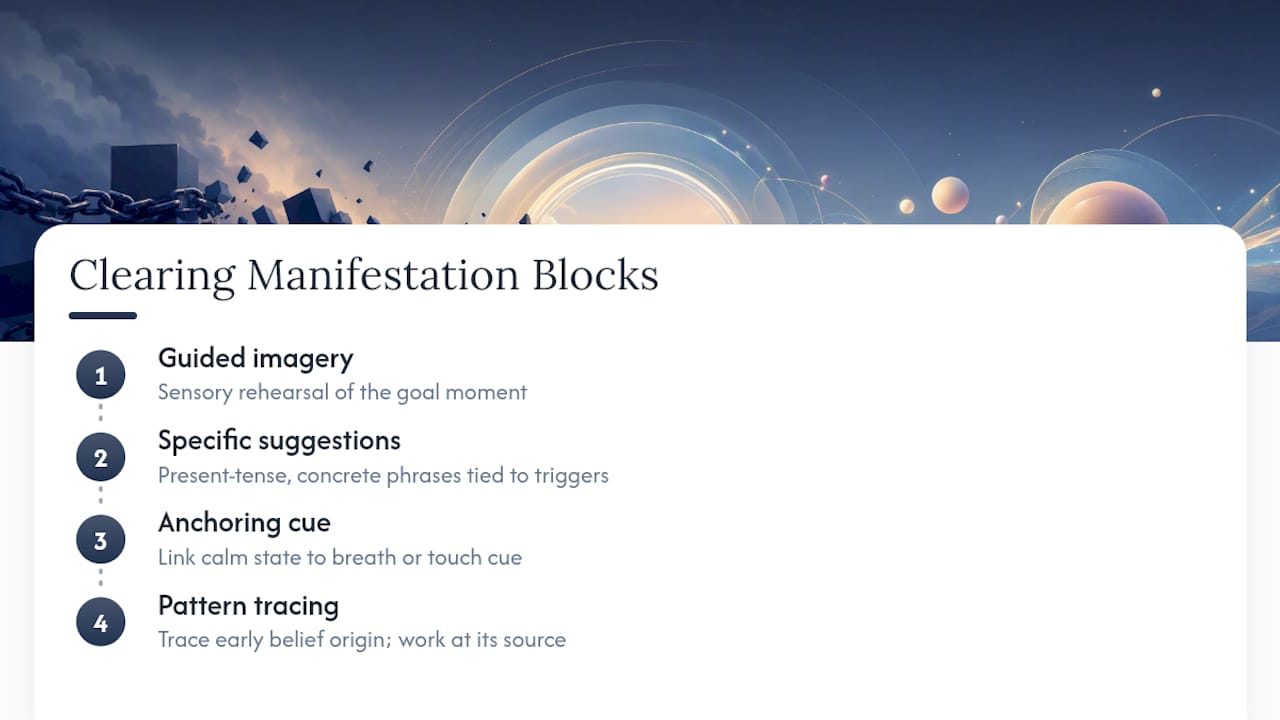
Suggestion phrasing matters more than most people realize. A clinician avoids vague language like "you will succeed" and instead builds specific, present-tense suggestions tied to your actual trigger, something like "when you walk into that room, your shoulders stay loose and your breath stays even." Specific phrasing gives the subconscious something concrete to hold onto, rather than an abstract wish.
Anchoring is another common tool. During a calm state in session, the clinician links that feeling to a small physical cue, a breath pattern, a touch of thumb to finger, so you can trigger a similar calm response later, outside the session, when anxiety starts creeping in before a goal-related moment.
Age regression or pattern-tracing work sometimes comes into play too, not to dig up trauma for its own sake, but to find where a limiting belief first took hold. If you learned at age nine that asking for what you want gets you rejected, that belief still runs quietly in the background every time you go for a promotion or a relationship. A clinician can trace that thread and work directly on the belief at its source rather than only managing the anxiety it produces today.
Where Hypnosis and Law of Attraction Actually Meet
Law of attraction thinking rests on a real psychological principle: what you focus on shapes what you notice and act on. The problem is that focus alone rarely overrides a nervous system stuck in a fear response. You can visualize a goal every morning and still sabotage it by afternoon if your body treats opportunity as danger.
This is where clinical hypnotherapy does something visualization alone can't. It works directly on the subconscious resistance underneath the goal, the fear of failure, the fear of being seen, the old belief that success invites punishment. Once that resistance eases, the same visualization and positive-focus habits that law of attraction practice teaches actually have room to work, because you're no longer fighting your own nervous system every time you try to act on them.
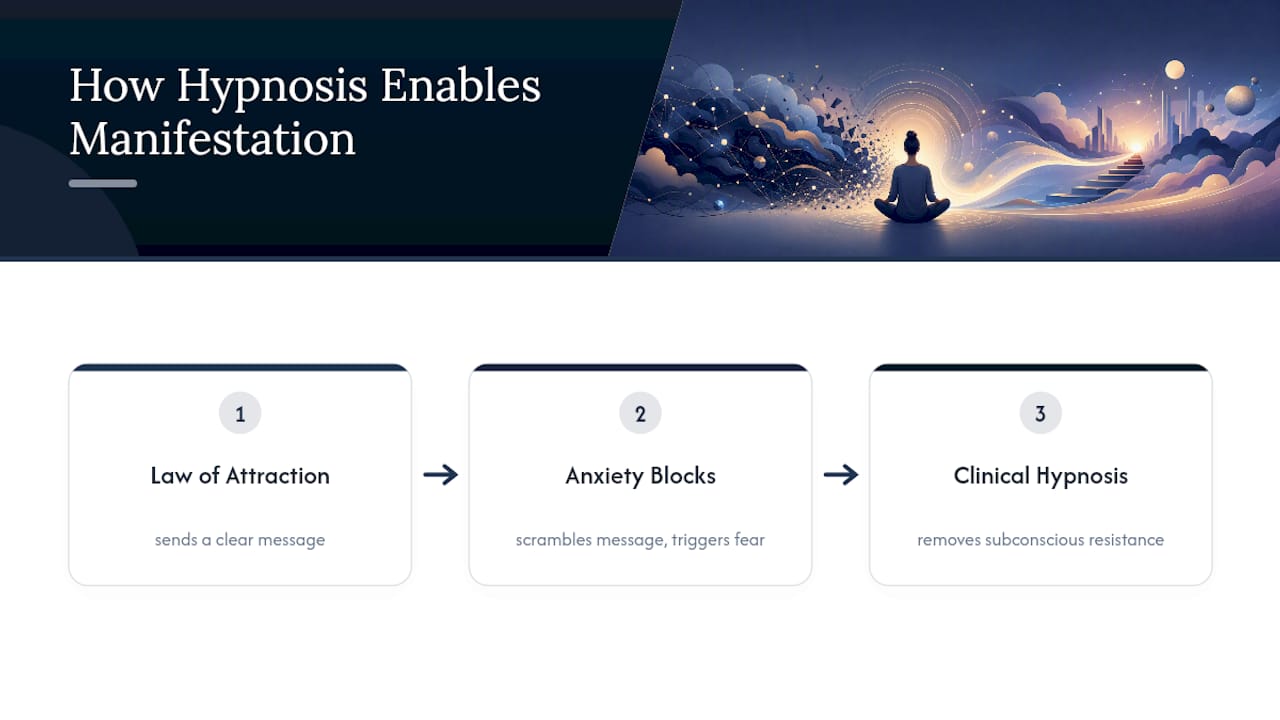
Think of it like clearing a signal jam. Law of attraction techniques send a clear message about what you want. Anxiety-driven subconscious blocks scramble that signal before it reaches your actual behavior. Clinical hypnotherapy addresses the scrambling, not the message.
That's a meaningfully different claim than "hypnosis manifests your desires." It doesn't. What it does is remove the fear-based static that keeps your actions out of sync with your stated goals, which is usually the real reason manifestation practices stall out for people dealing with anxiety in the first place.
Myths Worth Retiring
"Hypnosis makes you lose control." You stay aware and conscious throughout a session. Clinical descriptions from Mayo Clinic note that hypnosis produces a focused, relaxed state, not unconsciousness, and you can stop the process at any point.
"One session changes everything." Some clients notice an early shift, but sustained change generally takes multiple sessions, commonly in the 4 to 8 range.
"Hypnosis can make you manifest anything you want." It can't override reality, finances, or timing. What it can do is remove the anxiety-driven resistance that's been blocking action toward a realistic goal.
"It's the same as a guided meditation app." A clinician customizes suggestions to your specific trigger history and adjusts across sessions. A prerecorded track can't ask you a follow-up question or notice when a suggestion isn't landing.
"If it doesn't work, you're just not suggestible enough." Suggestibility varies person to person, and imaginative involvement and positive expectations do predict better outcomes for some people. But a skilled clinician adjusts technique to fit you rather than expecting you to fit the technique.
Tracking Whether It's Actually Working
Manifestation progress is easy to fake yourself out about, since "I feel more positive" can mean almost anything. Concrete markers work better. Track your physical response in a specific triggering situation, does your heart rate settle faster, does the tight chest feeling show up less often before you take the action you've been avoiding.
Behavioral evidence matters just as much as internal feeling. If your goal is a career change, track whether you're actually sending applications, not just feeling calmer about the idea of sending them. The subconscious mind responds to repeated action as proof a belief is safe, so the actions themselves become part of the measurement.
Ask your clinician to check in on specific trigger responses at each session rather than a vague "how are you feeling" recap. A clinician tracking real markers, sleep quality before a stressful event, willingness to take a specific action you'd previously avoided, can tell you honestly whether the work is landing or whether the approach needs to shift.
A Clinician's View on Anxiety-Linked Blocks
Most clients who come in for manifestation work aren't actually stuck on the goal itself. They're stuck on an old fear response that fires the moment they get close to it. Intake usually surfaces that within the first session, a specific memory or pattern that's been quietly running the show for years.
What changes first is rarely the goal. It's the body's response. Clients report a calmer stomach before a hard conversation, a slower heart rate before a trigger they used to avoid entirely. That shift tends to show up before any external result does, which is exactly what you'd expect if the nervous system, not the goal itself, was the real obstacle.
Pacing matters more than intensity. Rushing past intake to get to the "manifestation" part skips the actual work. If you're ready to look at what's really been blocking you, a consult is a reasonable next step.
— Kirk
Book a Session With Hypnotic Transformations
If anxiety has been quietly running the show every time you get close to a goal, working with a clinician can be more effective than relying on a recording alone. Hypnotictransformations offers online, one-on-one clinical hypnotherapy sessions with Kirk Hoffman, a Certified Clinical Hypnotherapist, conducted over Zoom so you can do the work from home without adding a commute to an already anxious week.
A free consult covers your specific triggers, what a realistic session plan looks like for you, and whether hypnotherapy fits your situation before you pay for anything. Sessions run fee-for-service, with multi-session packages available once you and Kirk map out a plan together. If your anxiety-driven blocks connect to a specific goal, whether that's a career move, a relationship pattern, or a belief you've been carrying since childhood, book a consult through the services page and get a real plan instead of another recording that never quite lands.
This article is general information, not a substitute for advice from a qualified doctor. Consult a qualified healthcare professional about your own circumstances before acting on anything here.
Sources
- PMC article on hypnosis and autonomic nervous system modulation
- Frontiers review on hypnosis in reducing anxiety and implications for cardiovascular health
- Mayo Clinic: Hypnosis overview
FAQ
Can Hypnosis Really Help You Manifest Goals?
Clinical hypnotherapy can remove anxiety-driven subconscious blocks that stop you from acting on your goals, but it works by changing your nervous system response, not by manifesting outcomes independent of your actions.
How Many Sessions Does Manifestation-Focused Hypnotherapy Take?
Most anxiety-related work runs 4 to 8 sessions, though some clients notice an early physical shift, like calmer breathing before a trigger, after the first session.
Is Hypnosis for Manifestation the Same as Law of Attraction Meditation?
No. Clinical hypnotherapy is paid, one-on-one work with a licensed clinician targeting specific subconscious triggers, while law of attraction audio programs are self-directed and not personalized to your history.
What Does a Hypnotherapy Session for Anxiety Actually Involve?
A session starts with 15 to 20 minutes of intake to identify your specific triggers, followed by induction and targeted suggestion work, typically lasting 60 to 90 minutes total.
Who Should Avoid Hypnotherapy for Manifestation Blocks?
People with active psychosis, unmanaged bipolar disorder, or severe suicidality should seek psychiatric care first, and anyone on medication should coordinate with their prescribing provider before starting.