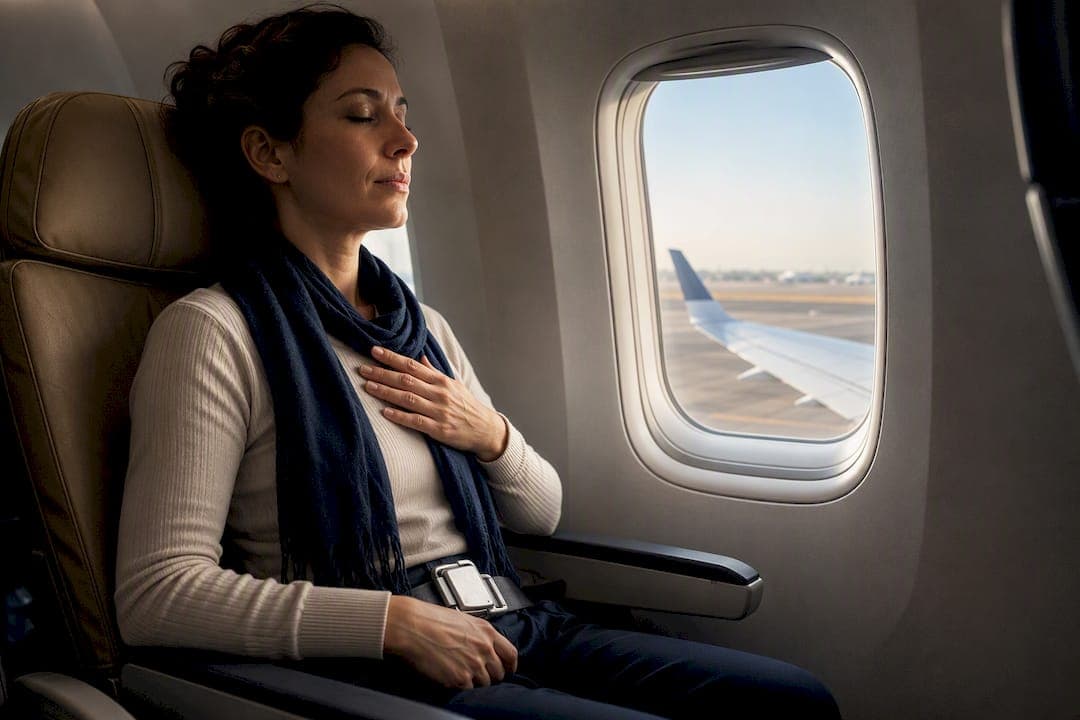
Hypnosis for flying anxiety works for many people by calming the automatic panic response before it takes over, and it comes in two useful forms: a self-hypnosis routine you can start today, or a clinician-led program that typically runs 4 to 8 sessions. If your hands sweat at the gate or you white-knuckle every bit of turbulence, start with a 5 to 10 minute self-hypnosis practice tonight, and book a free consultation with a clinical hypnotherapist if the fear has kept you from booking a trip at all.
TL;DR:
- Self-hypnosis routines take 5 to 10 minutes and can help manage turbulence and anxiety spikes during flights.
- Clinician-led hypnotherapy typically involves 4 to 8 weekly sessions focused on addressing underlying fear patterns.
- Success varies based on suggestibility, with meaningful reductions observed in some cases, especially when paired with practice flights and preparation.
- A qualified therapist should have a certification like CCHt and tailor treatments to your specific triggers and psychological profile.
- Combining clinician treatment with self-hypnosis practice offers the best chance to reduce fear and improve flying confidence.
Table of Contents
- How Does Hypnosis for Flying Anxiety Actually Work?
- Does Hypnosis Really Help With Fear of Flying?
- What Happens in a Flying Anxiety Hypnotherapy Program?
- How Do You Practice Self-Hypnosis Before and During a Flight?
- How Do You Choose a Safe, Qualified Hypnotherapist?
- A Clinician's View on Realistic Timelines
- Ready to Work Through Flight Anxiety With a Clinician?
- Sources
- FAQ
How Does Hypnosis for Flying Anxiety Actually Work?
Clinical hypnotherapy uses a focused, relaxed state to change how your subconscious reacts to flying cues, things like the sound of the engine, the seatbelt sign, or the feeling of the plane leaving the ground. Self-hypnosis is the same mechanism, minus the clinician. You guide yourself into that relaxed focus using breathing and a rehearsed script, then plant a calming suggestion or image where panic used to live.
Here's the nervous system piece most articles skip. When you're afraid of flying, your amygdala treats ordinary flight sensations (a dip in altitude, a shift in engine pitch) as threats and fires off a fight-or-flight response before your logical brain gets a vote. Hypnosis works by rehearsing new associations in a state where the subconscious is more open to input, so the amygdala stops flagging turbulence as danger. Practitioner descriptions of this process cover desensitization in trance, relaxation installation, and cognitive restructuring as the core moving parts.
The two approaches serve different needs:
- Self-hypnosis gives you a portable tool you control in the moment, no appointment required, useful the second turbulence starts.
- Clinician-led hypnotherapy goes deeper, addressing the root pattern behind the fear rather than just managing the spike, often with lasting results after the sessions end.
Most people benefit from both: clinician work to unwind the underlying association, self-hypnosis to manage the day of travel.
Does Hypnosis Really Help With Fear of Flying?
The most cited real-world evidence is a single-documented case: a patient with an obsessive personality style and a long-standing airplane phobia went through 12 sessions of hypnosis-based treatment and showed a significant, measurable increase in self-reported readiness to fly. The patient then completed a practice flight, something that had been unthinkable before treatment.
That's a strong result, but it's one case study, not a large trial, and it involved a client with a specific psychological profile (a rigid need for control). The clinician in that case pivoted away from standard exposure work toward teaching self-hypnosis, because the patient adhered better to a method that gave them more autonomy. That detail matters: hypnosis isn't one fixed protocol applied the same way to everyone.
Broader reporting backs this pattern of variability rather than a universal fix. Journalist and clinician accounts describe meaningful anxiety reduction for some people, with responsiveness varying by suggestibility and readiness. A good hypnotherapist adjusts to that instead of running a one-size script.
What Happens in a Flying Anxiety Hypnotherapy Program?
Most clinicians structure fear of flying work around 4 to 8 weekly sessions, though intensive single-day formats exist for people who need faster results before a booked trip. Session count depends on how long the fear has been reinforced and how it shows up (a general anxiety pattern versus a specific traumatic memory tied to flying).
A typical program moves through these stages:
- Assessment and history. The clinician maps when the fear started, what triggers it, and whether it's really about flying or about control, enclosed spaces, or panic attacks in general.
- Relaxation and trance training. You learn to enter a calm, focused state reliably, usually within the first one or two sessions.
- Guided imagery and anchoring. The clinician walks you through flight scenarios in trance while installing a physical or verbal anchor that triggers calm on command.
- Self-hypnosis training. You practice reproducing that calm state on your own, since you won't have a clinician on the plane with you.
- Rehearsal and integration. Sessions often blend in cognitive restructuring, similar to CBT, so the new response holds up under real conditions like a practice flight or layered exposure work with pilot-level explanations of turbulence and noise.
Clinicians track progress with readiness-to-fly self-ratings, completion of a practice flight, and observable drops in physical symptoms like heart rate or shallow breathing during imagined flight scenarios.
Pro Tip: Before your first session, write down the exact moment your fear peaks (boarding, takeoff, turbulence, landing). That specificity lets your hypnotherapist target the real trigger instead of guessing. This clinician-recommended prep list covers what else to bring to a first appointment.
How Do You Practice Self-Hypnosis Before and During a Flight?
You don't need a clinician in the room to get real value from self-hypnosis. A short, rehearsed routine gives your nervous system a different script to run when panic starts building.
The 5 to 10 minute pre-flight routine:
- Sit or lie down somewhere quiet and slow your breathing to a 4 count inhale, 6 count exhale, for about a minute.
- Create a physical anchor, pressing your thumb and forefinger together while you feel the calm settle in.
- Picture the flight from boarding to landing in vivid, ordinary detail, adding your anchor at each step.
- Repeat a short reinforcement phrase silently, something concrete like "my body is safe, my breathing is steady," not a vague mantra.
- Count yourself back to full alertness slowly, opening your eyes on a count of five.
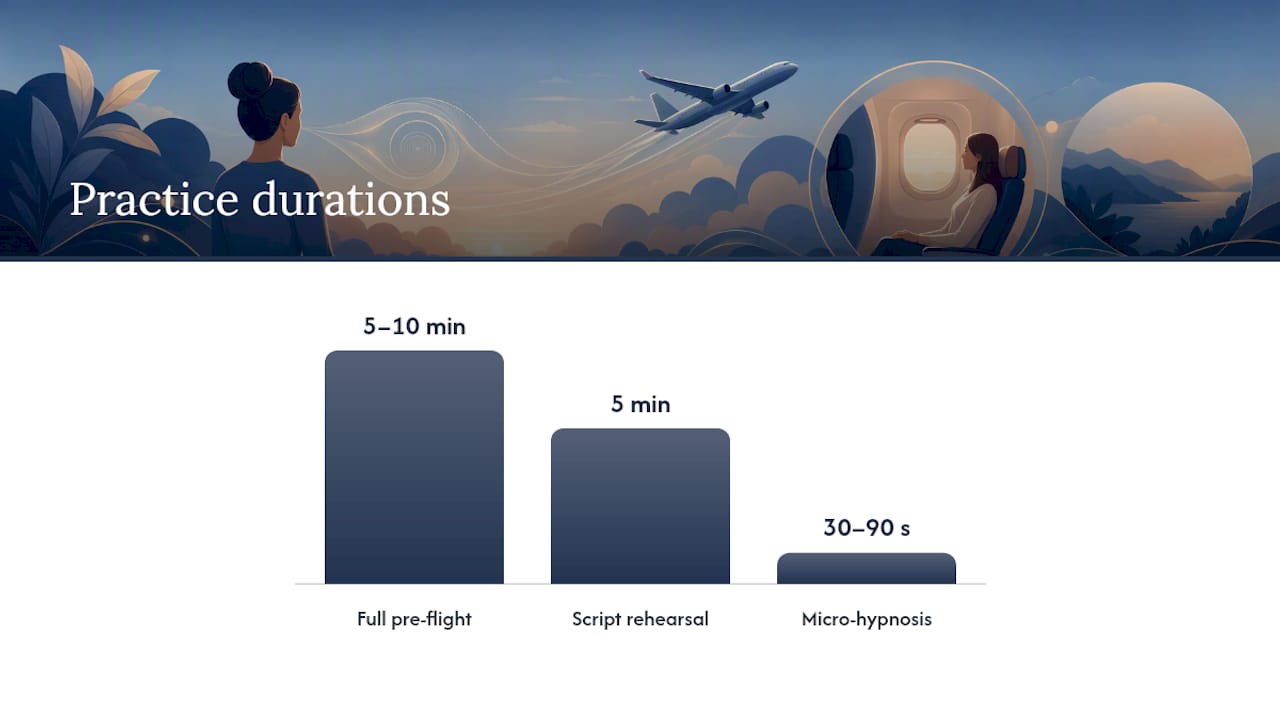
For in-flight moments, use a 30 to 90 second version: the anchor gesture, three slow breaths, and the reinforcement phrase. This is what practitioner scripts describe as micro-hypnosis, a fast reset for turbulence or the moment the engines change pitch on descent.
| Practice element | When to use it | Time needed |
|---|---|---|
| Full pre-flight routine | Night before or morning of travel | 5 to 10 minutes |
| Micro-hypnosis anchor | Turbulence, takeoff, descent | 30 to 90 seconds |
| Script rehearsal | Daily for 1 to 2 weeks before flying | 5 minutes |
Rehearse the script daily for a week or two before you fly so it's automatic under stress, not something you're learning for the first time at 30,000 feet. If a full week of daily practice still leaves you unable to picture boarding without a panic spike, that's the signal to stop doing this alone and bring in a clinician.
How Do You Choose a Safe, Qualified Hypnotherapist?
Look for a Certified Clinical Hypnotherapist (CCHt) with specific experience treating anxiety and phobias, not just a general wellness certificate. Ask direct questions in your free consultation:
- What does a typical session plan look like for flight anxiety specifically?
- How will we measure progress, and what does success look like by session 4 or session 8?
- What homework or self-hypnosis practice will I do between sessions?
- What's the plan if I have a panic attack mid-treatment?
- What's your stance on medication, and would you ever advise stopping a prescription?
That last question matters more than it sounds. A qualified clinician never tells you to stop psychiatric medication without your doctor's input.
Watch for red flags: anyone promising a guaranteed cure in one session, anyone pushing regression work into unrelated childhood memories without a clear clinical reason, or anyone dismissive when you ask about their training. Reputable regression work has clear evidence and clear limits, and a good clinician will explain both before ever suggesting it.
A Clinician's View on Realistic Timelines
Most clients who commit to 4 to 8 sessions see a real shift, not because hypnosis is magic, but because that's roughly how long it takes to retrain a subconscious pattern that's been reinforced for years. The milestones worth tracking are concrete: can you run the self-hypnosis routine without prompting, have you completed or scheduled a practice flight, and has your anticipatory anxiety in the weeks before travel measurably dropped.,.
— Kirk
Ready to Work Through Flight Anxiety With a Clinician?
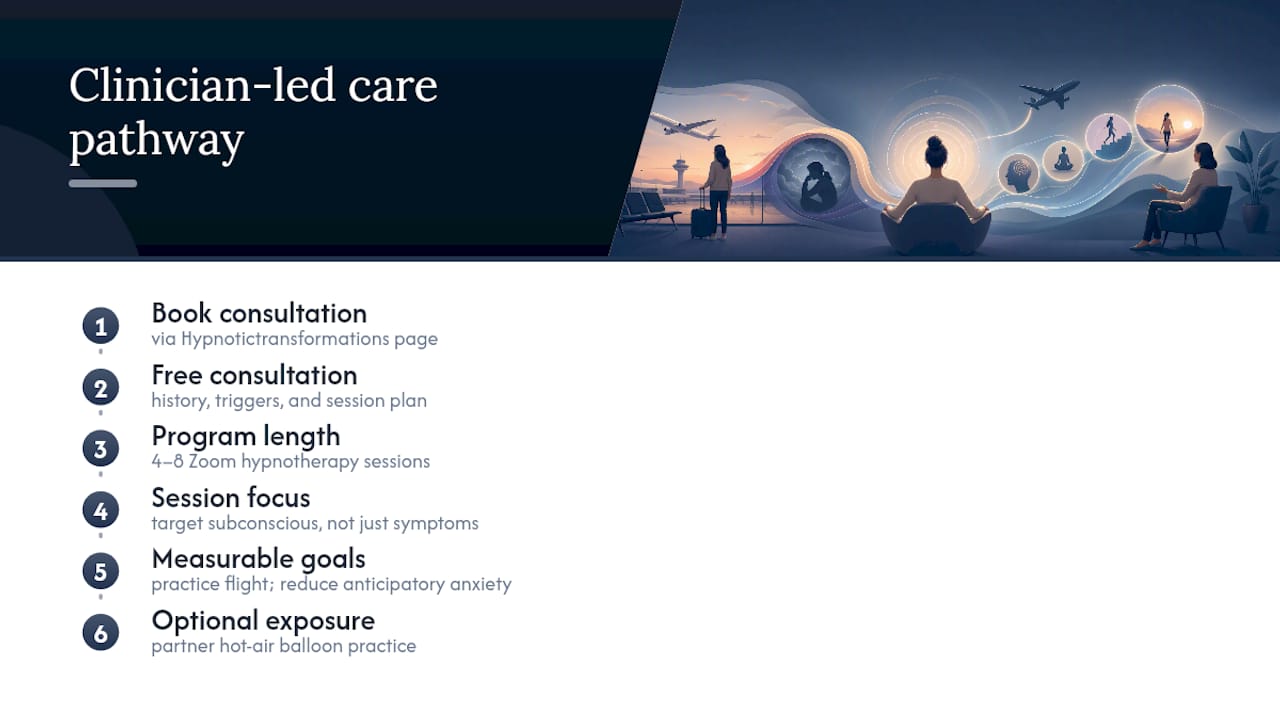
If the self-hypnosis routine above helps but doesn't fully take the edge off, that's exactly the gap a structured program is built to close. Online hypnotherapy for anxiety, delivered via Zoom, is often structured around 4 to 8 sessions with measurable goals such as completing a practice flight or reducing anticipatory anxiety before travel.
Sessions target the subconscious root of the fear rather than just teaching you to manage symptoms in the moment, which is the difference between white-knuckling every flight for years and actually feeling calm at the gate. A free consultation covers your history with flying, what's triggering the fear now, and what a realistic session plan looks like for your situation. If you're weighing a shorter exposure trip first, a partner experience like a hot air balloon flight over Teotihuacan can double as a low-stakes practice run before a commercial flight.
Start by booking your free consultation through the Hypnotictransformations services page, or go straight to the online anxiety program details to see how sessions are structured before you commit.
This article is general information, not a substitute for advice from a qualified doctor. Consult a qualified healthcare professional about your own circumstances before acting on anything here.
Sources
- The Use of Hypnosis for Airplane Phobia With an Obsessive Character: A Case Study
- Hypnosis for Fear of Flying: Overcome Aviophobia and Travel Freely | Drift Inward
- Can Hypnotherapy Fix A Fear Of Flying? I Found Out | Escapism
FAQ
How Can I Reduce Flying Anxiety on My Own?
Start with a short self-hypnosis routine: slow breathing, a physical anchor, and a rehearsed image of a calm flight, done for 5 to 10 minutes before travel. Practicing it daily for a week or two beforehand builds the habit so it works under real stress, not just in a quiet room.
Can Hypnosis Help With Fear of Flying on Long-Haul Trips?
Yes, the same techniques apply, though long-haul flights often call for more in-flight micro-hypnosis moments to manage anxiety spikes during multiple turbulence patches or overnight legs. A clinician-led program that includes practice flights and self-hypnosis training, like the 4 to 8 session model many clinicians use for related phobias, tends to hold up better over longer flight durations than a single self-taught script.
Is There a Class or Program That Treats Fear of Flying?
Yes, clinical hypnotherapy programs exist specifically for flight anxiety, usually structured as weekly sessions over several weeks. Hypnotictransformations offers an online hypnotherapy program for anxiety, and pricing details are listed on the site rather than published in general guides.
Is It Normal to Feel Nervous Before Flying?
Yes, mild pre-flight nerves are common and usually pass once the flight is underway. It becomes worth addressing with hypnosis or another treatment when the fear stops you from booking trips, causes panic symptoms, or lingers for days beforehand instead of fading at takeoff.
How Does Hypnosis Compare to CBT or Medication for Flight Anxiety?
Hypnosis, cognitive behavioral therapy, and situational medication all reduce flight anxiety through different routes, and many programs blend hypnosis with CBT-style reframing rather than picking one exclusively. One documented case even showed a patient using self-hypnosis instead of anti-anxiety medication on a return flight after training, though any change involving medication should go through a doctor, not a hypnotherapist alone.