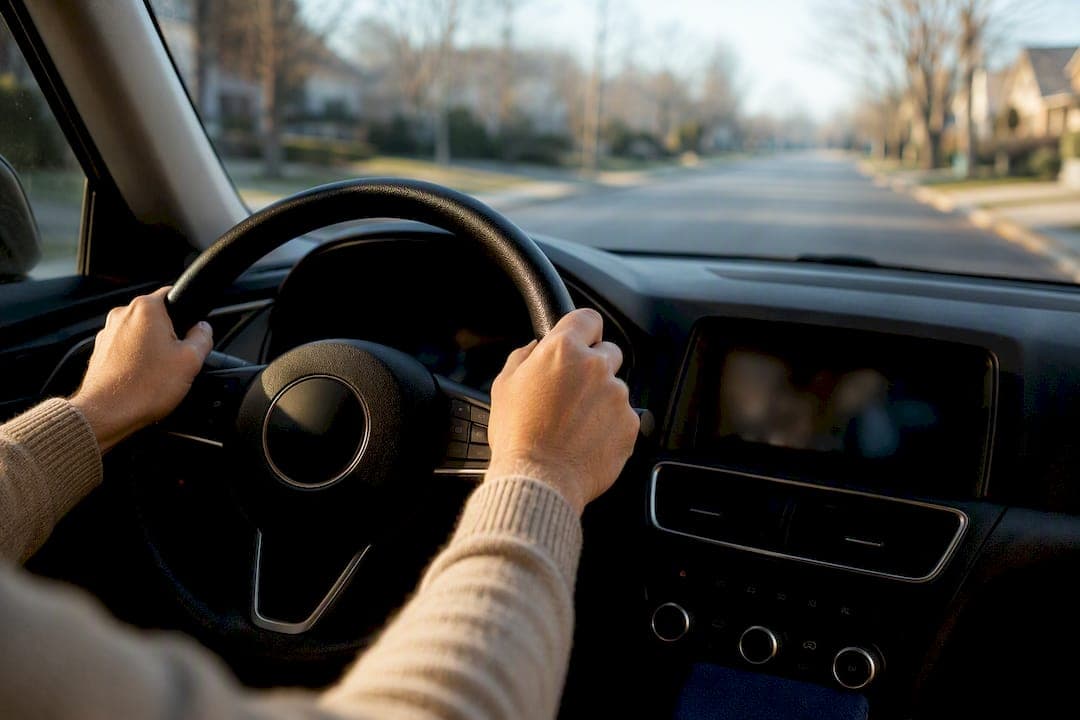
Clinical hypnotherapy can reduce driving anxiety for many people, especially when combined with exposure work or CBT. It works by addressing the subconscious threat response your nervous system built around driving, not just the surface-level thoughts. If you're dealing with panic on the highway or avoidance of driving altogether, the next step is straightforward: get screened by a qualified clinician before starting hypnosis, or use a clinician-recommended recording only after that screening confirms its safe for you.
TL;DR:
- Hypnotherapy for driving anxiety is most effective when combined with exposure therapy or cognitive behavioral therapy and conducted by a qualified clinician.
- It targets subconscious fear responses grounded in past incidents, underlying anxiety conditions, or specific situational triggers, requiring tailored approaches.
- Recognizing early panic attack signs like racing heart and shallow breathing allows quick calming techniques, but symptoms like chest pain warrant immediate medical attention.
- Professional hypnotherapy involves guided imagery, suggestive re-scripting, cue-stacking, and graded exposure, often with subsequent real driving practice to reinforce new associations.
- Online hypnotherapy offers a convenient option, especially when paired with proper screening, but recordings are only supplementary and not suitable for severe or trauma-linked fears.
Table of Contents
- What Is Driving Anxiety and Does This Apply to You?
- What Causes Fear While Driving?
- What Does a Panic Attack Look Like Behind the Wheel?
- How Does Hypnotherapy Work for Driving Anxiety?
- Does Hypnosis for Anxiety Actually Work?
- What Happens in a Session, and How Should You Prepare?
- Can Self-Help Recordings and Apps Help?
- How Do You Find a Qualified Hypnotherapist?
- How Hypnotic Transformations Approaches Driving Anxiety
- Clinician Perspective: When to Choose Hypnotherapy Now
- Ready to Address Your Driving Anxiety?
- Sources
- FAQ
What Is Driving Anxiety and Does This Apply to You?
Driving anxiety is a fear response triggered specifically by operating a vehicle or being a passenger, ranging from mild nervousness to full driving phobia (sometimes called vehophobia). Your nervous system treats driving, or a specific driving condition, as a threat and triggers the fight-or-flight response even when there's no real danger present.
This shows up differently for different people:
- Avoiding highways, bridges, tunnels, or long trips entirely
- Only feeling safe with a passenger, or refusing to drive at night
- Full panic attacks behind the wheel, sometimes leading to pulling over or refusing to continue
If your anxiety causes you to lose consciousness, causes chest pain that doesn't resolve, or leads to thoughts of self-harm, that's a medical emergency, not a hypnotherapy case. Everyone else on this spectrum is a reasonable candidate for the approaches covered below.
What Causes Fear While Driving?
Most driving anxiety traces back to one of three sources, and knowing which one applies to you shapes the entire treatment plan.
- A specific incident. An accident, a near-miss, or witnessing a crash can wire a single memory into your nervous system as a permanent threat marker, so your body reacts to driving cues the same way it reacted in that moment.
- An underlying anxiety condition. Panic disorder, generalized anxiety disorder, or health anxiety (fear of a medical event happening while driving) can attach itself to driving simply because you're in a confined space with limited control.
- Situational triggers. Highways, bridges, night driving, heavy traffic, or bad weather can each carry their own trigger profile, meaning a person can drive comfortably around town but panic on an interstate on ramp.
A hypnotherapist worth working with will ask which of these applies before designing any intervention, because a trauma-linked fear needs different pacing than a generalized anxiety pattern.
What Does a Panic Attack Look Like Behind the Wheel?
Recognizing the physical signs early gives you a chance to respond before the panic escalates. The pattern usually unfolds in stages:
- Physical onset. Racing heart, shallow or rapid breathing, lightheadedness, sweating, or shaking hands on the wheel.
- Cognitive spiral. Catastrophic thoughts ("I'm going to crash," "I can't breathe," "I have to get out now") or a dissociative, foggy feeling of detachment from the road.
- Behavioral urge. A strong impulse to pull over immediately, exit the highway, or hand control to a passenger.
If you feel any of this coming on, put your hazard lights on, pull over safely when you can, and focus on slow exhales longer than your inhales. That single technique calms the nervous system faster than trying to think your way out of it. If symptoms include chest pain, numbness, or don't ease after several minutes of rest, treat it as a medical issue and seek help.
How Does Hypnotherapy Work for Driving Anxiety?
Hypnosis puts you into a state of focused, relaxed attention where your conscious mind steps back just enough for a clinician to work directly with the subconscious associations driving your fear response. You stay aware and in control the entire time. This isn't a loss of consciousness or willpower. It's closer to the absorbed state you get lost in during a good book, just guided with a clinical purpose.
Clinicians working with driving anxiety typically use a mix of these techniques:
- Guided imagery, walking you through a calm, successful driving experience while your body is in a down regulated state, so the nervous system rehearses safety instead of threat.
- Suggestive re-scripting, replacing the catastrophic association tied to a specific trigger (a bridge, a merge lane) with a neutral or confident one.
- Cue-stacking, linking a physical anchor (a breath pattern, a hand position) to the calm state so you can trigger it in real driving situations.
- Graded exposure integration, pairing hypnotic work with small, real-world driving steps immediately after a session while the nervous system is still settled.
Online sessions often help specifically with driving anxiety because you stay in your own home, a familiar low-threat environment, which lets your body settle into the relaxed state faster than it might in an unfamiliar office.
Pro Tip: Ask your clinician whether they pair hypnotic re-scripting with a short, real driving task right after the session. Practicing a new association while your nervous system is still calm tends to make it stick.
Does Hypnosis for Anxiety Actually Work?
A 2019 meta-analysis of 17 trials found hypnosis reduced anxiety more than control conditions, with a mean weighted effect size of 0.99 at longest follow-up. That means participants treated with hypnosis improved more than roughly 84% of people in control groups.
That's a solid signal, not a guarantee. The Mayo Clinic notes that hypnosis works best when integrated with therapies like CBT or exposure therapy, rather than used alone. The studies behind that effect size also varied in quality and follow-up length, which is why delivery by a qualified clinician, and consistent follow-up practice, matters as much as the technique itself.
What Happens in a Session, and How Should You Prepare?
A responsible first session follows a predictable sequence, whether it happens online or in an office.
- Intake and screening. Expect questions about seizure history, dissociative episodes, trauma background, and current medications before any hypnotic work begins.
- Goal mapping. You and the clinician identify the specific trigger (bridges, highways, night driving) and what a successful outcome looks like.
- The hypnotic session itself. Guided relaxation, re-scripting, or imagery work tailored to your trigger profile.
- Homework. A small, real-world driving step to practice within a day or two, while the new association is fresh.
If you're doing this online, pick a quiet room where you won't be interrupted and won't need to drive immediately afterward. If you're on anxiety medication or have a diagnosed panic disorder, your hypnotherapist should coordinate with your physician or treating mental health provider rather than working in isolation. The screening process itself matters more than people expect for anyone with a complex psychiatric history.
Can Self-Help Recordings and Apps Help?
Recordings and apps have a real place, but they're a supplement, not a replacement for clinical work in most cases.
- Good use cases: relaxation practice between sessions, rehearsing a calm cue before a drive, or general stress reduction.
- Poor fit: severe panic attacks, trauma-linked driving phobia following an accident, or any history of dissociation.
- Safety tips: keep sessions short, stop immediately if you feel disconnected from your body or surroundings, and never listen to a hypnosis recording while actually driving.
If a recording brings up more distress than it resolves, that's your signal to bring in a clinician who can screen for what's underneath it rather than pushing through alone.
How Do You Find a Qualified Hypnotherapist?
Credentials and process separate a legitimate clinician from someone selling a quick fix.
- Look for a Certified Clinical Hypnotherapist (CCHt) credential and specific experience treating anxiety, not just general wellness coaching.
- A qualified practitioner uses a written intake and informed consent process before your first hypnotic session.
- Screening should cover seizure history, dissociative disorders, medication interactions, and unresolved trauma, the same items a safety-focused hypnotherapy resource outlines.
Red flags to walk away from: anyone promising a guaranteed cure in one session, high-pressure sales tactics, or a practitioner who skips screening entirely.
Pro Tip: Ask directly how many driving anxiety cases the clinician has worked and what percentage combine hypnosis with exposure steps. A clinician who can't answer specifically hasn't built a real protocol for this.
How Hypnotic Transformations Approaches Driving Anxiety
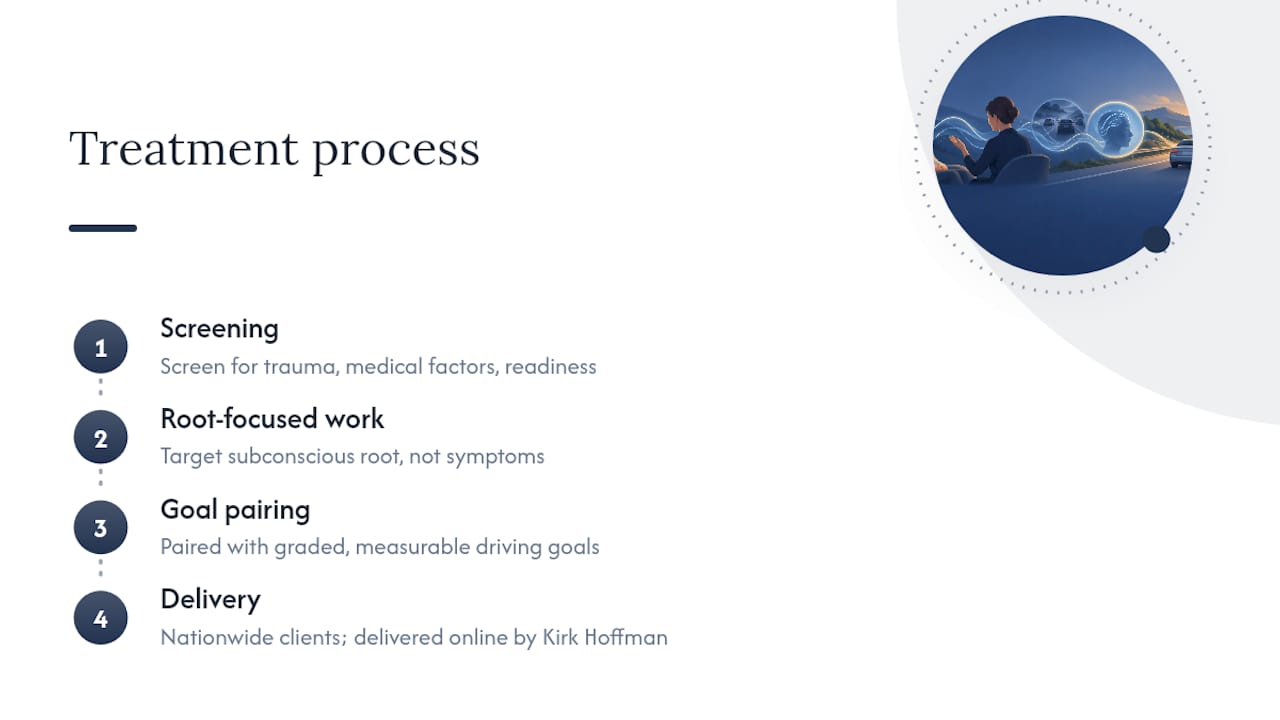
Hypnotic Transformations is led by Kirk Hoffman, a Certified Clinical Hypnotherapist working with clients nationwide through online sessions. The approach targets the subconscious root of a driving fear rather than managing symptoms day to day, pairing individualized hypnotic work with graded, measurable driving goals. Every case starts with screening for trauma history, medical factors, and readiness before any hypnotic session is scheduled.
Clinician Perspective: When to Choose Hypnotherapy Now
Hypnosis makes sense as a next step once you've ruled out an active medical emergency and you're ready to pair it with real driving practice. It's not a substitute for medication management if you're on it, and it works better alongside CBT than in place of it for severe cases. Readiness usually shows up as one thing: willingness to drive a short, low-stakes route within days of a session. If that sounds doable, a screening consult is the right starting point.
— Kirk
Ready to Address Your Driving Anxiety?
Most people who avoid driving have already tried talking themselves out of it, and it hasn't worked because the fear isn't sitting in logical thought. It's sitting in the nervous system. Online Hypnotherapy for Anxiety with Hypnotic Transformations works directly with that subconscious threat response instead of asking you to white knuckle through it, and every session happens over Zoom from wherever you already feel safe.
A first booking starts with a screening conversation covering your specific triggers, any medical or trauma history, and what a realistic timeline looks like for your case. From there, sessions combine hypnotic re-scripting with small, real driving steps you practice between appointments. If you're ready to stop planning your life around avoiding certain roads, schedule a consultation and get a plan built around your specific fear.
Sources
- The Efficacy of Hypnosis as a Treatment for Anxiety: A Meta-Analysis
- Hypnosis: What to expect from Mayo Clinic
FAQ
Does Hypnotherapy for Driving Anxiety Actually Work?
Yes, for many people, particularly when combined with exposure practice or CBT rather than used as a standalone fix. The 2019 meta-analysis found a mean weighted effect size of 0.99 for hypnosis versus control conditions at longest follow-up, a meaningful reduction in anxiety symptoms.
What Is the Best Treatment for Driving Anxiety?
There's no single best treatment; the strongest results tend to come from combining approaches rather than picking one. Clinical hypnotherapy paired with graded exposure, and sometimes CBT, addresses both the subconscious fear response and the behavioral avoidance pattern that keeps the fear alive.
How Do You Get Over a Fear of Driving Alone?
Start with a screened clinician who can identify whether your fear traces to a specific incident, an anxiety condition, or situational triggers like highways or night driving. From there, small graded exposure steps, ideally practiced right after a hypnotherapy session while your nervous system is calm, rebuild confidence faster than avoidance ever will.
What Causes Anxiety Attacks While Driving?
The most common causes are a past accident or near-miss, an underlying condition like panic disorder or generalized anxiety, or specific situational triggers such as bridges, heavy traffic, or driving at night. Each of these creates a different subconscious threat pattern, which is why identifying the root cause matters before starting treatment.
Is Hypnotherapy for Driving Anxiety Available Online?
Yes, and many clinicians find online sessions help because clients stay in a familiar, low-threat environment during the work. Hypnotic Transformations offers online hypnotherapy for anxiety nationwide through Zoom, with pricing available directly on the site.