
Hypnosis builds practical confidence through two connected routes: short daily self-hypnosis practices that install calmer responses to specific triggers, and clinician-led hypnotherapy that works directly on the subconscious beliefs behind chronic self-doubt. Self-practice can shift how you feel walking into a room within days. Deeper, longer-standing patterns like impostor syndrome or social anxiety usually take several weeks of focused sessions to loosen.
TL;DR:
- Self-hypnosis can create quick shifts in confidence by replacing old beliefs, practicing confidence cues, and anchoring calm responses to physical triggers.
- Building confidence through daily exercises over two to three weeks is more effective than infrequent long sessions, especially for persistent social anxiety or impostor syndrome.
- Clinical hypnotherapy typically requires several sessions focused on assessment, belief replacement, and visualizing successful outcomes, with homework to reinforce change.
- Effectiveness of hypnosis for confidence is supported by practitioner reports and app data, but the evidence base for long-term impacts remains limited apart from smaller case studies.
- Combining hypnosis with cognitive behavioral therapy improves results, especially for deep-rooted fears, while avoiding self-hypnosis while operating machinery or driving is essential for safety.
Table of Contents
- What Self-Hypnosis for Confidence Actually Changes
- Practical Self-Hypnosis Techniques You Can Use Today
- What Happens in a Clinical Hypnotherapy Session for Confidence?
- Does the Research Actually Back This Up?
- Using Hypnosis for Presentations, Interviews, and Body Confidence
- How to Choose a Hypnotherapist for Confidence Work
- Is Hypnosis Safe, and When Should You Combine It With Other Treatment?
- A Clinician's Note on Where People Get Stuck
- How Hypnotic Transformations Approaches Confidence Work
- Sources
- FAQ
What Self-Hypnosis for Confidence Actually Changes
Confidence problems rarely start as a thinking problem. They start as a nervous system problem. Your body reads a job interview or a crowded room as a threat, triggers a fight-or-flight response, and your rational brain gets flooded with cortisol and adrenaline before you say a word. Hypnosis works by talking directly to the part of your brain that fires that alarm, the subconscious, rather than arguing with your conscious thoughts about it.
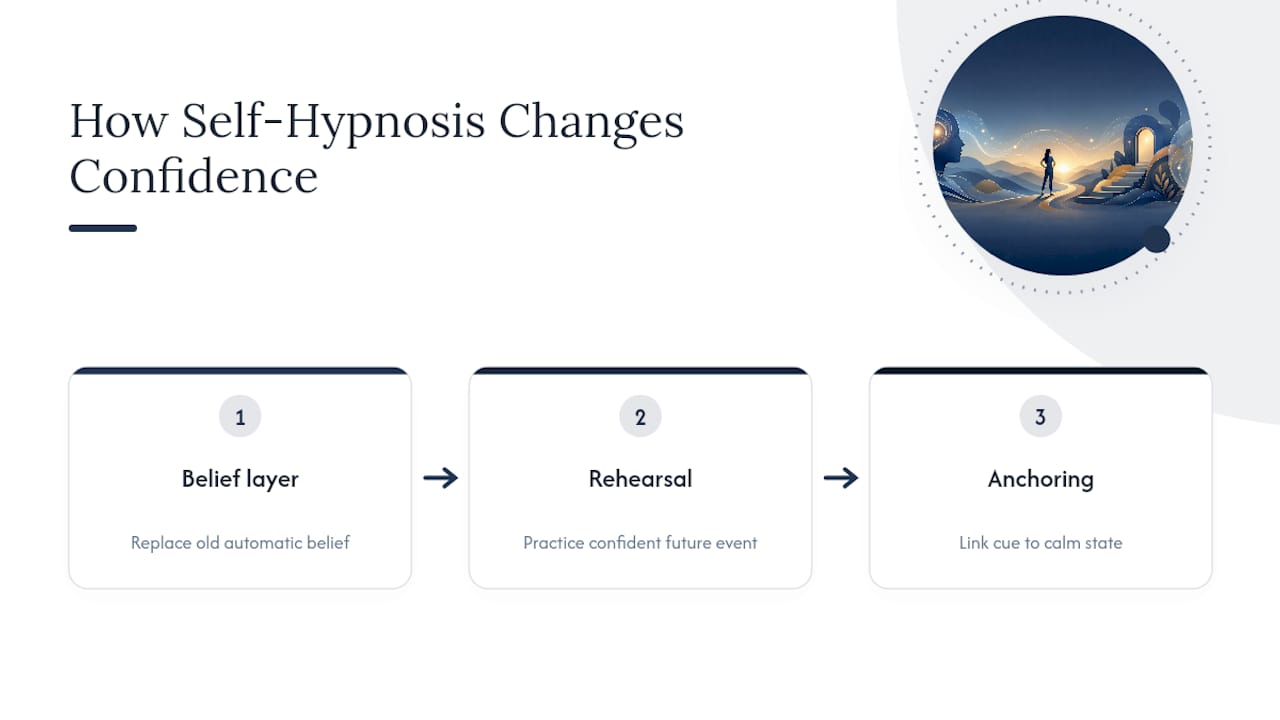
Three things change when hypnosis for confidence works. First, the belief layer: the automatic, often decades-old assumption ("I always freeze up," "people can tell I'm nervous") gets replaced with a more accurate, specific alternative. Second, rehearsal: your brain practices the confident version of the event before it happens, so the nervous system has a template to draw on. Third, anchoring: a physical cue, a breath pattern, a word, gets linked to the calm state so you can trigger it on demand later. Self-hypnosis techniques built around this rehearsal and anchoring model are the backbone of most confidence-focused scripts you'll find online, and they're the same mechanisms a hypnotherapist uses in session, just guided by someone else's voice instead of your own recording.
Practical Self-Hypnosis Techniques You Can Use Today
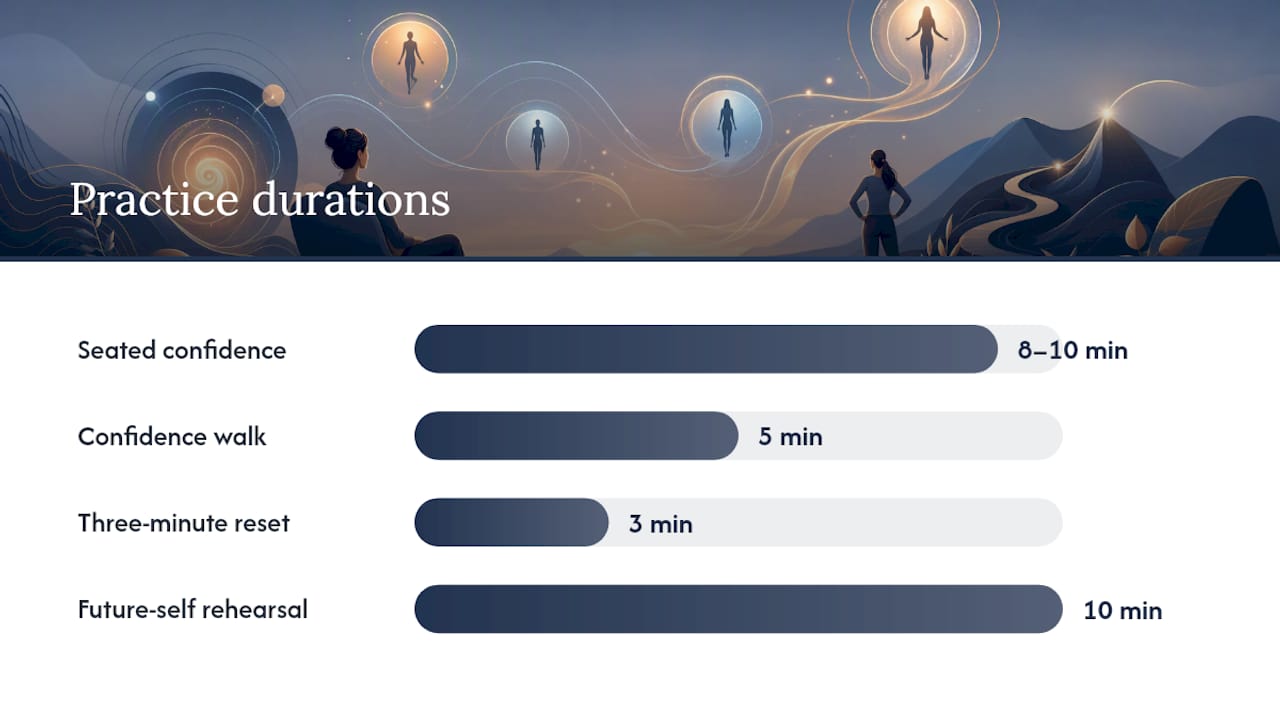
You don't need a therapist in the room to start. These four practices take between three and ten minutes and use standard hypnotic principles: relaxation, focused suggestion, and rehearsal.
- The seated confidence script (8 to 10 minutes). Sit somewhere quiet, close your eyes, and count backward from 20 while imagining your body getting heavier with each number. Once relaxed, mentally repeat three short, present-tense statements tied to a specific situation, not a vague trait. "I speak clearly when I present" beats "I am confident."
- Active-alert self-hypnosis, the confidence walk (5 minutes). Walk at a steady pace, eyes open, and silently repeat a short phrase in rhythm with your steps. This movement-based version couples posture and repetition, which makes the confident state easier to access later because your body already knows what it feels like standing up and moving.
- The three-minute reset. For moments before something stressful, like an elevator ride up to an interview: breathe in for four counts, hold for four, exhale for six, and picture yourself already past the hard part, calm and done. Three rounds is usually enough to bring your heart rate down.
- Future-self rehearsal for interviews or presentations (10 minutes). Relax using the seated method above, then run the entire event forward in your mind from start to finish, in as much sensory detail as you can manage: what the room looks like, what your voice sounds like when it's steady, how you feel shaking hands afterward. This is not daydreaming. It's mental rehearsal, and it works the same neural pathways as physical practice.
Building a personal anchor makes all four scripts more useful outside of practice time. While relaxed and picturing a moment you felt genuinely capable, press your thumb and index finger together and hold it for ten seconds. Repeat that pairing for a week and the touch alone starts to trigger a calmer state, even standing in a doorway before a meeting.
Practice once a day for two to three weeks before judging results. Track it simply: a notes app entry with a 1 to 10 confidence rating before and after each session tells you more than trying to remember how you felt.
Pro Tip: Record your own voice reading the future-self script and play it back at night. Hearing your own voice deliver the suggestion tends to bypass the skepticism a stranger's recording can trigger.
Consistent short practice, paired with self-esteem hypnosis exercises that target a specific area of doubt, tends to outperform occasional long sessions. Five minutes daily beats forty-five minutes once a month.
What Happens in a Clinical Hypnotherapy Session for Confidence?
A first session usually runs 60 to 90 minutes, longer than follow-ups, because most of that time goes to assessment before any trance work begins. A hypnotherapist typically asks where your confidence drops out (public speaking, dating, job performance), when the pattern started, and what a realistic outcome looks like, then sets a specific goal rather than a vague one like "feel better."
From there, a session generally moves through a consistent structure:
- Induction. Guided relaxation brings you into a focused, receptive state, not sleep, more like the absorption you feel watching a good movie.
- Suggestion therapy. The therapist offers new beliefs framed around your specific goal, replacing the old automatic response.
- Anchoring. A cue, often a touch or breath pattern, gets linked to the new calm, capable state so you can access it later without guided help.
- Visualization and future pacing. You mentally rehearse the target situation, the same principle as the future-self script above, but guided.
- Limited regression, when relevant. For some clients, briefly identifying where a belief originated (a specific memory, not childhood in general) helps the new suggestion stick.
Homework matters as much as the session itself. Most hypnotherapists send clients home with a short recording or script to practice daily, which is why pairing clinical work with self-hypnosis homework tends to produce faster, more durable change than sessions alone.
Timeline expectations vary by what you're treating. Situational nerves, like a single upcoming presentation, can respond in a handful of sessions. Deeper, longer-running patterns, chronic social anxiety or years of impostor thinking, generally need sustained work over weeks, not a single visit.
Does the Research Actually Back This Up?
The honest answer: the evidence is encouraging but not exhaustive. Hypnosis has a real, mechanism-based rationale, and clinical and app-based reports both point in the same direction, but the research base for confidence specifically is thinner than for pain or smoking cessation, where clinical trials are more common.
What we do have:
- Clinical hypnotherapy techniques like anchoring, memory reevaluation, and future pacing show up consistently across practitioner-reported case outcomes, with some clients reporting meaningful shifts in a few sessions.
- App-based self-hypnosis platforms report high user-reported confidence gains after brief interactive sessions, though these numbers come from the vendor's own users and should be read as self-reported outcomes, not independent trial results.
- Clinic-level work, including EEG-backed hypnosis targeting social anxiety, gives a practical clinical signal that hypnosis can reduce the anxiety symptoms that sit underneath most confidence problems, since social anxiety and low confidence overlap heavily in how they show up day to day.
Weigh these two categories differently. A controlled study measures an effect against a comparison group and controls for expectation. A clinic case or an app's user statistics tell you something real happened for real people, but not how much of that improvement came from the hypnosis itself versus attention, structure, or simply committing to practice something daily. Both are useful. Neither should be oversold.
A reasonable time horizon: expect small, noticeable shifts in specific situations within one to two weeks of consistent self-practice, and expect broader, more stable change from clinical work to unfold over four to eight sessions for anything beyond a single upcoming event.
Using Hypnosis for Presentations, Interviews, and Body Confidence
Different situations call for different timing, not different techniques. The scripts stay mostly the same. What changes is when you use them.
- Public speaking or presentations. Run the future-self rehearsal script the night before and again the morning of. Backstage or in the hallway, use the three-minute reset, then trigger your anchor once before walking in.
- Job interviews. Rehearse the specific opening exchange, the handshake, the first question, in detail during your future-self session two or three days out. Interview-specific rehearsal works because your nervous system stops treating the first thirty seconds as unknown territory.
- Social gatherings. Use the active-alert confidence walk on your way in the door. Arriving already in a steady state changes how the first five minutes go, and first impressions tend to set the tone for the rest of the event.
- Body-image challenges. These usually respond better to the seated script done over several weeks than a single pre-event routine, since body confidence tends to be a standing belief rather than a one-time trigger. Suggestion work here focuses on how you talk to yourself in the mirror, not just how you feel at one party.
If a single event carries real weight, a job offer, a wedding speech, a court appearance, book a clinician session at least a week ahead rather than relying only on self-practice the night before. A guided session can address the specific belief driving the fear, not just calm the moment.
Pro Tip: Use the same anchor gesture across every situation. A single thumb-and-finger press that means "I've done this before" works better than a different cue for each scenario, since your brain doesn't have to relearn the signal.
How to Choose a Hypnotherapist for Confidence Work
A first phone call should tell you most of what you need to know. Ask directly what approach they use, whether it's suggestion therapy, NLP-based reframing, or a blend, and ask them to describe what a typical session looks like from start to finish. A hypnotherapist who can't explain their process in plain language in two minutes is a hypnotherapist you should keep looking past.
Favor these signals:
- A Certified Clinical Hypnotherapist (CCHt) credential or equivalent recognized certification.
- A clear, specific goal-setting conversation before any session, not a generic intake form.
- Willingness to give you a realistic session estimate instead of a vague promise.
- Homework or recordings provided between sessions.
Watch for red flags too:
- Guarantees of a fixed number of sessions before they've heard your specific situation.
- Pressure to buy a large package before a first consultation.
- Vague answers when you ask what technique they'll actually use.
- No clear cancellation or refund policy in writing.
Before booking, confirm privacy practices for any recordings made during sessions, the cancellation window, and whether a free consultation is available so you can gauge fit before paying for a full package. Preparing a short list of goals before that first call makes the conversation far more productive on both sides.
Is Hypnosis Safe, and When Should You Combine It With Other Treatment?
Hypnosis for confidence is low risk for most healthy adults, but it isn't a fit for every situation. Talk to a physician or mental health provider first if you have a history of psychosis, dissociative disorders, or severe untreated PTSD, since trance states can occasionally intensify symptoms without specialist supervision.
Hypnotherapy pairs well with cognitive behavioral therapy or medication rather than replacing either. CBT gives you conscious tools to catch and challenge a thought in the moment; hypnosis works on the automatic response underneath it, so combining the two often moves faster than either alone.
Basic self-practice rules: stop a session immediately if you feel worse, more anxious, or disoriented rather than pushing through. Never practice self-hypnosis while driving or operating machinery, since the relaxed, focused state is not compatible with tasks requiring full alertness.
A Clinician's Note on Where People Get Stuck
The fear I hear most often isn't public speaking or interviews specifically. It's the fear of being caught not knowing what they're doing, in a meeting, on a date, in front of a boss. That fear predates the situation. It's usually years old by the time someone books a session.
The clients who see the most durable change are the ones who keep practicing between sessions, not the ones who wait for the next appointment to feel different. Five minutes a day of a short script does more than a single intense hour once a month. Case work involving EEG-backed measurement of social anxiety reduction has shown this pattern consistently: the belief shift starts in session, but the follow-through happens at home.
— Kirk
How Hypnotic Transformations Approaches Confidence Work
If self-hypnosis scripts get you partway there but a specific fear keeps resurfacing, that's usually a sign the belief driving it needs direct attention, not just management. Hypnotic Transformations offers online hypnotherapy sessions via Zoom built around finding that root belief and replacing it, rather than teaching you to cope with anxiety indefinitely.
A first consultation covers your specific situation, whether that's interview nerves, chronic social anxiety, or a pattern of self-doubt that's followed you for years, and sets a realistic session plan from there. Sessions integrate with the kind of daily self-hypnosis practice covered above, so the work you do between appointments reinforces what happens during them. If you're ready to talk through what a plan would look like for your situation, book an appointment with Kirk Hoffman, CCHt, and start with a conversation about what's actually driving the fear.
Sources
- Improve Self-Esteem Naturally with Self-Hypnosis - Adam Eason
- Hypnosis for Confidence: How It Works, Examples, & Effectiveness - ChoosingTherapy
- Self-hypnosis App for Confidence & Motivation | Hypnotherapy for self-confidence - Reveri
FAQ
Does Hypnosis for Confidence Actually Work?
Yes, for most people, though results depend on consistency and what's driving the low confidence in the first place. Self-hypnosis scripts can shift how you feel in a specific situation within one to two weeks of daily practice, while clinical hypnotherapy targeting deeper beliefs typically needs several sessions to produce lasting change.
What Is the Best Therapy for Low Confidence?
There isn't a single best therapy since it depends on what's causing the doubt, but hypnotherapy and cognitive behavioral therapy are often used together for stronger results. Hypnotherapy works on the automatic subconscious response while CBT gives you conscious tools to challenge the thought in real time.
How Can I Boost Self-Confidence Quickly?
Short, repeatable practices work fastest: a three-minute breathing reset before a stressful moment, or a physical anchor built during a relaxed self-hypnosis session and triggered on demand later. Consistent daily practice for two to three weeks produces more durable results than a single long session.
What Is the Best Treatment for Confidence Issues That Won't Go Away?
If self-practice hasn't shifted a long-standing pattern, clinician-led hypnotherapy is worth considering, since it can address the specific belief or memory behind the fear rather than just the symptom. Hypnotic Transformations offers online sessions built around identifying that root cause and replacing it with a workable alternative over a series of sessions.