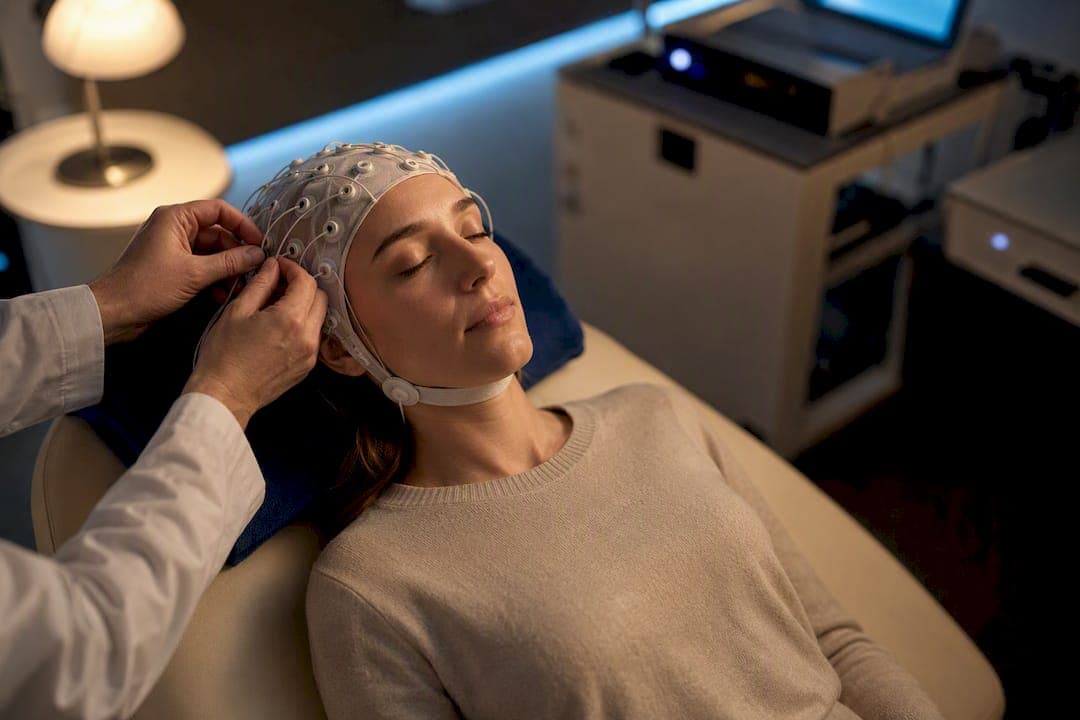
Hypnosis measurably changes how the brain processes attention, self-monitoring, and bodily sensation. A systematic review, fMRI functional connectivity studies, and EEG research converge on one pattern: hypnosis quiets the brain regions that monitor and narrate your own experience, while strengthening the connection between focused attention and bodily control. The changes are real, measurable, and mostly temporary. They also explain why hypnosis works better for some problems, like acute pain and anxiety, than others.
TL;DR:
- Hypnosis primarily reduces activity in internal conflict monitoring regions and increases coupling between focus and bodily sensation areas, especially in highly hypnotizable individuals.
- EEG studies show a consistent increase in theta brainwave activity during hypnosis, reflecting deep absorption and focus, which correlates with hypnotic responsiveness.
- Physiological markers, such as slowed respiration and increased parasympathetic activity, are measurable during hypnosis and are linked to relaxation and anxiety reduction.
- Hypnotizability varies widely and predicts how strongly a person will respond to suggestions, with high responders showing more pronounced neural changes.
- Most brain changes during hypnosis are temporary, but repeated sessions can reinforce neural pathways associated with behavioral and symptom improvements over time.
Table of Contents
- What Happens to Brain Activity During Hypnosis?
- What Do Brainwave Patterns Reveal About Hypnosis?
- What Chemical and Physical Changes Occur During Hypnosis?
- Why Do Some People Respond More Strongly to Hypnosis?
- How Do These Brain Changes Translate Into Clinical Results?
- What Does This Mean for an Actual Hypnotherapy Session?
- How Does Hypnosis Change Brain Circuitry During Induction?
- Do the Brain Changes From Hypnosis Last Over Time?
- How Does Hypnosis Compare to Meditation or Placebo?
- How Do These Brain Changes Affect What You Actually Experience?
- What Are the Real Limits of Hypnosis Brain Research?
- Do Different Induction Methods Change the Brain Differently?
- A Clinician's Read on the Evidence
- How Hypnotic Transformations Puts This Research Into Practice
- Sources
- FAQ
What Happens to Brain Activity During Hypnosis?
Three large-scale brain networks do most of the work in ordinary waking life: the Default Mode Network (DMN), the Executive Control Network (ECN), and the Salience Network (SN). The DMN runs when your mind wanders and when you're thinking about yourself, your history, and your worries. The ECN handles focused attention and task control. The SN flags what's important and worth reacting to, which is a big part of why anxiety feels so consuming when it's active.
Under hypnosis, these networks stop talking to each other the way they normally do. fMRI research on hypnosis and functional connectivity found reduced activity in the dorsal anterior cingulate cortex (dACC), a region that acts like an internal alarm system, comparing what's happening to what's expected and flagging conflict or threat. When dACC activity drops, that constant background checking quiets down.
At the same time, researchers observed a decoupling between the ECN and the DMN, meaning the brain's focus-and-control system stops being pulled back into self-referential thinking. In people who score high on standardized hypnotizability scales, the same study found increased coupling between the dorsolateral prefrontal cortex (DLPFC) and the insula, the region that tracks internal bodily sensations like pain, temperature, and gut feeling.
Here's what that combination produces in plain terms:
- Reduced dACC activity means less internal conflict monitoring, which shows up subjectively as less second-guessing and less mental static.
- ECN-DMN decoupling means the part of the brain doing the focusing is no longer anchored to the part of the brain doing the worrying.
- Increased DLPFC-insula coupling in highly hypnotizable subjects means the executive brain gets more direct access to bodily sensation, which is likely why hypnotic suggestion can shift how pain or discomfort is perceived.
- Absorption and reduced self-consciousness follow from this whole pattern, not from any single region acting alone.
A broader systematic review of imaging studies across different labs and hypnosis protocols corroborates the general direction of these findings, showing consistent involvement of frontal regions, the insula, and occipital and parietal areas, though the exact regions activated vary somewhat by study design and induction script.
The methodological catch is real. Most of these studies use small samples, often fewer than 30 participants, and different labs use different induction scripts, different hypnotizability screens, and different comparison conditions (some compare hypnosis to rest, others to a "waking imagination" control). That variability doesn't erase the pattern, but it means no single study should be read as the final word on how hypnosis works in the brain.
What Do Brainwave Patterns Reveal About Hypnosis?
If fMRI shows you which regions talk to each other, EEG shows you the rhythm they're talking in. The most consistent finding in electrophysiology research on hypnosis is an increase in theta band activity, a slower brainwave frequency (roughly 4 to 8 Hz) associated with deep absorption, internally directed attention, and the kind of focus you get right before falling asleep or during deep meditation.
A review of brain functional correlates of hypnosis and hypnotizability found that theta power tends to rise during hypnotic induction, and that people who score higher on hypnotizability scales often show elevated theta activity even at rest, before any induction begins. That's an important detail: it suggests part of hypnotic responsiveness might be a trait showing up in baseline brain rhythm, not something created entirely by the hypnosis session itself.
Alpha band activity, the frequency linked to relaxed wakefulness, also shifts during hypnosis, though findings here are less uniform across studies. Some report hemispheric differences, with certain individuals showing asymmetric alpha shifts between the left and right hemisphere during hypnotic states, though the practical meaning of these hemispheric patterns is still debated.
Key electrophysiology patterns reported across studies include:
- Increased theta power during active hypnotic induction and deepening.
- Higher resting theta baseline in individuals who test as highly hypnotizable.
- Alpha activity changes that correlate loosely with subjective depth of the hypnotic state.
- Inconsistent hemispheric asymmetry findings that vary by study protocol.
Statistic Callout: Theta power increases during hypnosis appear across multiple independent EEG studies, making it one of the more replicated markers in the field. Even so, the size of the increase and its correlation with subjective hypnotic depth varies meaningfully from study to study, so treat theta as a consistent signal, not a precise dial you can read hypnotic depth off of.
What does this mean practically? Theta and attention are closely linked in ordinary cognition. Rising theta during hypnosis lines up with the subjective sense of narrowed, absorbed focus that most people report, and it may partly explain why suggestions land differently depending on how deep someone drops into that state.
What Chemical and Physical Changes Occur During Hypnosis?
Brainwaves and blood flow tell part of the story. Magnetic Resonance Spectroscopy (MRS), a technique that measures actual chemical concentrations in brain tissue, adds another layer. A study using MRS during two different hypnotic states found small but statistically significant increases in myo-Inositol, a metabolite linked to glial cell activity and osmotic regulation, in the parieto-occipital region of the brain during deeper hypnosis.
The average change was a small but statistically significant shift. Researchers interpret it cautiously as a possible marker of reduced local neuronal activity in that region, consistent with the broader pattern of quieted self-monitoring seen in the fMRI data. It is not proof of a specific mechanism, and the researchers themselves flag the need for replication before drawing firm conclusions.
The same study tracked physiological markers alongside the brain chemistry, and those findings were more consistent:
- Respiration slowed measurably during hypnotic induction and deepened further during hypnosis itself.
- Heart rate variability (HRV) shifted toward patterns associated with parasympathetic dominance, the "rest and digest" branch of the nervous system that counters the fight-or-flight response.
- These physiological shifts tracked with subjective hypnotic depth, meaning people who reported going "deeper" also showed more pronounced respiration and HRV changes.
This matters for anxiety in particular. The fight-or-flight response runs on sympathetic nervous system activation: faster breathing, elevated heart rate, and a body braced for threat. Slower respiration and increased parasympathetic tone are the physiological opposite of that state. Whatever else is happening in the cortex during hypnosis, the body is measurably shifting out of an alarmed state and into a calmer one.
Small effect sizes deserve one more mention here. The honest picture is several small, coordinated shifts across brain chemistry and body physiology, not one dominant switch.
Why Do Some People Respond More Strongly to Hypnosis?
Hypnotizability is the measurable trait describing how responsive a person is to hypnotic suggestion, and it varies widely across the population. Researchers typically measure it using standardized scales such as the Stanford Hypnotic Susceptibility Scale or the Harvard Group Scale of Hypnotic Susceptibility, both of which ask a person to respond to a series of suggestions (arm levitation, eye catalepsy, hallucination tasks) and score how many they successfully experience.
This isn't just a personality quirk. It predicts the size of the neural effects researchers can measure. High hypnotizables show more pronounced ECN-SN coupling changes and larger theta power shifts during induction than low hypnotizables, according to the review of hypnosis and hypnotizability correlates. In other words, the same induction script produces a bigger, more measurable brain response in someone who scores high on these scales.
That distinction shows up in clinical data too. A 20-year meta-analytic overview covering 49 separate meta-analyses treats hypnotizability as a moderator variable, meaning it changes how big the treatment effect looks depending on who's in the sample. Studies that screen for or report hypnotizability tend to show cleaner, more consistent effect sizes than studies that don't.
A few practical points worth knowing:
- Hypnotizability sits on a spectrum. Roughly a small percentage of people score very high, a similar percentage score very low, and most people fall somewhere in the middle.
- It is relatively stable across a person's lifetime once measured in adulthood.
- It is not the same thing as gullibility, suggestibility in daily life, or a weak-willed personality. It's a specific, measurable cognitive trait.
- Low hypnotizability doesn't mean hypnosis won't help at all. It usually means the response curve is flatter, not that the response is zero.
How Do These Brain Changes Translate Into Clinical Results?
The strongest clinical evidence for hypnosis sits in acute pain, not chronic pain, and the neural mechanisms line up with that split. A 2025 systematic review and meta-analysis of randomized controlled trials found a medium effect size for hypnosis reducing acute pain, along with a measurable reduction in opioid use in perioperative settings. Chronic pain outcomes, by contrast, showed no statistically significant effect across the pooled trials.
That gap makes sense given what the brain imaging shows. Acute pain runs heavily through midcingulate and insula connectivity, the same circuits where hypnosis alters activity most reliably. Chronic pain involves broader, more entrenched changes across the nervous system, sensitization, altered baseline processing, sometimes structural changes in the spinal cord and brain that build up over months or years. A single session that shifts acute network coupling has a plausible, direct route to reducing pain in the moment. Undoing years of chronic sensitization is a different, harder problem, and the data reflects that honestly.
Statistic Callout: The acute pain meta-analysis reported a medium effect size (p = 0.0024) for pain reduction and a statistically significant drop in oral morphine equivalents (p = 0.03), while chronic pain showed a Hedges' g of just 0.07 (p = 0.518), a result with no real statistical support.
Anxiety reduction follows a related logic. If the DMN drives self-referential worry and the SN drives threat-flagging, then quieting both during and after hypnotic work gives a plausible neural route to feeling less anxious, not just believing you feel less anxious. The broader efficacy meta-analysis found effect sizes ranging from d = -0.04 to d = 2.72 across mental and somatic outcomes, with over half the reported effects landing at medium or large size.
A short list of where the evidence is strongest versus weakest:
- Strongest evidence: acute procedural pain, opioid reduction in perioperative settings, anxiety symptoms tied to specific situations or phobias.
- Mixed evidence: chronic pain conditions, weight management outcomes measured over long periods.
- Key limiting factors: small sample sizes in individual trials, wide variation in induction protocols between studies, and inconsistent screening for hypnotizability, which likely dilutes pooled effect sizes when high and low responders get averaged together.
Readers dealing with generalized anxiety or specific phobias, like a fear of needles, tend to see the clearest, most repeatable neural and symptom changes precisely because those targets map well onto the acute, state-dependent shifts hypnosis reliably produces.
What Does This Mean for an Actual Hypnotherapy Session?
Induction is the practical bridge between the lab findings and the therapy room. When a hypnotherapist walks a client through a slow, focused induction, narrowing attention, guiding breath, directing focus inward, the goal at a neural level is straightforward: narrow external monitoring long enough for the ECN and SN to loosen their grip on threat-scanning, and let targeted suggestion work while the DMN's self-narrating chatter is quieter than usual.
That's not a metaphor. It's the same decoupling pattern described in the connectivity research above, deliberately induced through verbal pacing and attentional focus rather than through anything mystical.
Three clinical takeaways follow from the research for practitioners:
- Screen for hypnotizability informally before treatment. Clients who respond quickly to simple suggestion tasks (like eye catalepsy or arm heaviness) during an initial session tend to show the network changes most associated with strong clinical outcomes.
- Match protocol length to the target. Acute, situational anxiety and phobias respond to shorter, more direct suggestion work. Long-standing patterns, like chronic weight struggles or deeply conditioned smoking triggers, benefit from multiple sessions that reinforce new subconscious associations over time.
- Track physiological markers where practical. Slower breathing and a calmer resting heart rate during and after sessions are the observable, low-tech proxy for the parasympathetic shift documented in the MRS research above.
For clients coming in for the first time, three honest expectations matter more than any dramatic promise:
- You will likely feel relaxed, focused, and mentally quieter during the session itself, not unconscious or "out."
- Progress on anxiety and fear-based patterns is usually measured across a few sessions, not one, because reinforcement strengthens the new subconscious association each time.
- Mild tiredness or a foggy feeling afterward is common and typically resolves within a few hours, similar to how you feel after a deep, focused nap.
Pro Tip: If you're evaluating a hypnotherapist, ask whether they informally assess your responsiveness in the first session. A practitioner who tailors pacing and suggestion style based on how you respond, rather than running the exact same script for every client, is applying the hypnotizability research directly instead of ignoring it.
Sessions build around the logic of narrowing focus first, then applying suggestion work matched to the specific fear, habit, or pattern a client wants to change, rather than a one-size-fits-all script.
How Does Hypnosis Change Brain Circuitry During Induction?
The mechanism isn't a single switch. It's a sequence. Focused attention during induction first engages the ECN, pulling processing resources toward the hypnotherapist's voice and away from ambient distraction. As that focus deepens, the SN's threat-scanning activity drops, since there's less bandwidth left over for scanning the environment for danger.
That drop in salience monitoring appears to be what allows the DMN to partially disengage from its usual self-referential loop, the running commentary about your day, your worries, your history. With that internal narration quieter, suggestion content delivered by the practitioner has a more direct route to influence how the brain interprets sensation, emotion, or memory, without the DMN's usual editorializing getting in the way.
This sequence, attention narrows, salience monitoring drops, self-referential processing decouples, lines up with the connectivity findings described earlier and with the framing from hypnosis researchers that this is network modulation, not a single uniform state. It's a coordinated shift across systems that normally compete for control of attention, not one region flipping on or off.

Do the Brain Changes From Hypnosis Last Over Time?
Most neuroimaging research on hypnosis captures a single session, meaning what gets measured is the acute, state-dependent shift while someone is actually under hypnosis, not a lasting structural change to brain wiring. That's an important distinction. A quieter dACC or a decoupled DMN during hypnosis tells you what the state looks like, not necessarily what happens to that person's baseline brain function a month later.
Clinically, though, repeated sessions clearly produce durable behavior change, which is the entire premise behind multi-session hypnotherapy packages for smoking cessation or anxiety. The likely explanation, though it's not yet mapped in fine neural detail across long-term studies, is repetition and reinforcement: each session that successfully narrows attention and delivers a suggestion strengthens the associative pathway being targeted, similar to how repeated practice strengthens any learned skill through ordinary neuroplasticity.
The honest gap in the evidence is that few studies have tracked the same subjects across multiple sessions with repeated imaging to directly show that strengthening process in the brain. What exists instead is indirect: consistent symptom improvement across multi-session clinical trials, paired with single-session imaging data showing the acute mechanism. Connecting those two data sets more rigorously is one of the clearer open questions in the field.
How Does Hypnosis Compare to Meditation or Placebo?
Hypnosis, meditation, and relaxation share some surface features, slower breathing, quieted DMN activity, a subjective sense of calm, but they aren't neurologically identical.
Meditation research, particularly on experienced practitioners, also shows DMN modulation, but typically through sustained, self-directed attention training built over months or years of practice. Hypnosis achieves a comparable DMN effect more quickly, often within a single guided induction, because an external practitioner is actively directing the attentional narrowing rather than the individual training that skill alone over time.
Placebo response, the improvement someone experiences from a treatment they simply believe will work, does overlap with hypnosis in some pain research, since expectation plays a role in both. But the fMRI and MRS data on hypnosis show fairly specific network and metabolite signatures (ECN-DMN decoupling, dACC changes, myo-Inositol shifts) that go beyond generic expectation effects, suggesting hypnosis isn't simply an elaborate placebo delivery mechanism, even though expectation likely contributes to part of the total effect.
Plain relaxation, sitting quietly, slow breathing without guided suggestion, produces some of the same parasympathetic shifts in HRV and respiration, but lacks the targeted DLPFC-insula coupling and dACC changes that appear specifically tied to hypnotic suggestion in highly hypnotizable subjects. The calm-down effect overlaps. The suggestion-driven cognitive and behavioral change appears more specific to hypnosis.
How Do These Brain Changes Affect What You Actually Experience?
The network shifts described throughout this article aren't abstract. They show up as specific, describable experiences during a session.
Reduced self-referential DMN activity often shows up as a loosened grip on repetitive, anxious thought patterns, the mental loop that keeps replaying a worry or a feared scenario. Increased DLPFC-insula coupling in responsive subjects can shift how bodily sensations get interpreted, which is part of why hypnotic suggestion can change the perceived intensity of pain or discomfort without eliminating the underlying physical signal.
Reduced dACC activity, the quieter internal conflict monitor, often shows up subjectively as reduced second-guessing during the session itself, a sense of accepting a suggestion rather than mentally arguing with it. That's a specific, describable shift, not a vague sense of relaxation.
Behaviorally, this combination is what makes hypnosis useful for targeted habit change. When self-monitoring and threat-scanning are both quieter, a suggestion aimed at reducing a craving response, or reframing a phobic trigger, has more room to actually take hold, rather than getting filtered through the usual layer of internal resistance and doubt.
What Are the Real Limits of Hypnosis Brain Research?
Small samples are the most persistent problem across this entire body of research. Many of the fMRI and MRS studies cited here run with fewer than 30 participants, which limits how confidently any single finding generalizes to the broader population.
Induction scripts also vary substantially between labs, and there's no single, universally standardized hypnosis protocol used across all neuroimaging studies. That makes direct comparison between studies harder than it looks on paper, since "hypnosis" in one lab's protocol may differ meaningfully in pacing, suggestion content, and depth from "hypnosis" in another lab's protocol.
Control conditions raise a related issue. Some studies compare hypnosis to simple rest, others to a "waking imagination" task designed to mimic the suggestion content without the induction, and the choice of comparison condition changes what a given finding can actually claim to show.
Finally, hypnotizability screening isn't consistent across studies. Some researchers pre-screen and only include high hypnotizables, which can inflate observed effects; others include a broader, unscreened sample, which can dilute or mask real effects by mixing strong and weak responders together. Readers evaluating any single hypnosis brain study should check which of these choices the researchers made before treating the result as definitive.
Do Different Induction Methods Change the Brain Differently?
Traditional verbal induction, the slow, paced "relax and focus on my voice" approach, is the most studied method and the one behind most of the fMRI and EEG findings described above. It relies heavily on sustained auditory attention and progressive relaxation cues.
Rapid induction techniques, which compress the attentional narrowing into a much shorter window using confusion or surprise, are less studied in neuroimaging settings, so direct brain-based comparisons against traditional induction are limited in the current research.
Guided imagery-based inductions, which lean on visualization rather than physical relaxation cues, likely engage visual and parietal processing regions somewhat more heavily during the induction phase itself, given how strongly imagery tasks recruit those areas in unrelated cognitive research, though hypnosis-specific imaging comparing induction styles head-to-head remains sparse.
What the current evidence supports clearly is that the downstream pattern, reduced dACC activity, ECN-DMN decoupling, increased theta, looks broadly similar across studies regardless of the specific induction style used to get there. The destination looks consistent even though the research hasn't fully mapped every route.
A Clinician's Read on the Evidence
The neuroscience here is genuinely encouraging, but I'd push back on anyone who treats a single fMRI study as proof that hypnosis works the same way for every person and every problem. It doesn't. The hypnotizability research makes that clear: response size varies person to person, and a good practitioner treats that as clinical information, not a footnote.
What I care about most in a first session isn't drama. It's whether a client's nervous system actually shifts, slower breathing, a calmer baseline, less mental noise, and whether that shift holds up and builds session over session. That's why individualized screening and clear tracking of what's actually changing matter more than any single technique's reputation.
If you're weighing whether hypnotherapy fits your situation, a short consultation through the services page is a reasonable first step before committing to a full course of sessions.
— Kirk
How Hypnotic Transformations Puts This Research Into Practice
Every mechanism covered above, quieted self-monitoring, calmer nervous system response, stronger executive control over bodily sensation, maps directly onto the services offered through Hypnotictransformations. Sessions for anxiety focus on interrupting the fight-or-flight pattern at the point where the SN and DMN keep the threat-scanning loop running. Sessions built around quitting smoking or vaping target the subconscious craving association directly, rather than relying on willpower to override it in the moment. Weight-focused sessions work the same way, addressing the subconscious root of eating patterns instead of managing symptoms week to week.
What makes this approach different from working through a script on your own is direct, individualized attention: the practitioner adjusts pacing, suggestion content, and session structure based on how you respond, the same principle the hypnotizability research points to as the strongest predictor of results. Sessions run over Zoom, so location isn't a barrier to getting tailored support instead of a generic recording.
If anxiety, a specific fear, a smoking habit, or a stuck eating pattern is the reason you're reading this, the next step is straightforward: visit the services page to see current session options, or book a consultation directly to talk through what you're dealing with before committing to a plan.
This article is general information, not a substitute for advice from a qualified doctor. Consult a qualified healthcare professional about your own circumstances before acting on anything here.
FAQ
What Happens to Your Brain During Hypnosis?
Activity drops in the dorsal anterior cingulate cortex, the region that monitors internal conflict, while connectivity between attention and body-sensing regions increases, especially in highly hypnotizable people. EEG recordings typically show increased theta wave activity, the brainwave pattern linked to deep, absorbed focus.
Can Hypnosis Cause Anxiety?
Hypnosis itself is designed to reduce the network activity tied to anxious self-monitoring, not increase it, and most clinical trials report calming rather than activating effects. In rare cases, surfacing a suppressed memory or emotion during a session can trigger short-term discomfort, which is one reason screening before treatment matters.
Is It Normal to Feel Exhausted After Hypnotherapy?
Yes, mild tiredness or mental fog after a session is common and usually temporary. It reflects the same kind of fatigue you feel after a deep, focused nap, tied to the shift toward parasympathetic, "rest and digest" nervous system activity documented during hypnotic states.
What Are the Potential Risks of Hypnotherapy?
For most people, hypnotherapy carries low risk when conducted by a trained practitioner, with the most common side effect being temporary tiredness or grogginess. Working with someone who screens for your specific concerns and monitors your response, rather than running a generic script, reduces the small remaining risk of unexpected emotional reactions.
Does Hypnotictransformations Offer Sessions Based on This Research?
Yes. Hypnotictransformations offers online hypnotherapy for anxiety, quitting smoking and vaping, weight management, and law of attraction work, each structured around the attention and nervous system mechanisms described in this article. Current details are available on the services page, and pricing is available on request through that page.