
How hypnosis can help in relationships
Hypnosis works on relationships by reaching the subconscious patterns that drive how you connect, react, and attach to other people. Most relationship problems are not about a lack of love or effort. They are about automatic responses, encoded in the nervous system long before you had any say in the matter.
Hypnotherapy addresses those responses at the source. A qualified hypnotherapist guides you into a focused, relaxed state where the conscious mind steps back and the subconscious becomes accessible. That is where the real work happens: rewriting the patterns that keep you stuck in the same arguments, the same emotional shutdowns, or the same relationships that hurt you.
Here is what hypnosis can specifically address in a relationship context:
- Self-confidence and self-worth — building the internal foundation that healthy relationships require
- Trust issues — tracing distrust back to its original source and updating the nervous system's response
- Emotional reactivity — reducing fight-or-flight triggers that cause defensiveness or withdrawal
- Childhood wounds — healing attachment injuries that replay in adult partnerships
- Intimacy blocks — removing subconscious resistance to closeness and vulnerability
- Relationship closure — supporting a clean, conscious ending of unhealthy relationships
What hypnosis actually is, and how it operates in relationships
Hypnosis is a state of focused attention and heightened suggestibility. You are not asleep. You are not under anyone's control. Your conscious mind quiets down enough that the subconscious, where emotional memories and behavioral patterns live, becomes reachable.

In a relationship context, that matters because most of what drives conflict, avoidance, or emotional shutdown is not conscious. You do not choose to freeze when your partner raises their voice. Your nervous system does it automatically, based on what it learned years ago. Hypnotherapy shifts the nervous system out of those chronic fight-or-flight states that underlie defensive or avoidant relationship behaviors.
Self-hypnosis vs. guided hypnosis — both have a place in relationship work, but they serve different purposes:
- Guided hypnosis with a trained hypnotherapist reaches deeper material, including trauma, attachment wounds, and complex emotional patterns. A skilled practitioner adapts the session in real time based on what surfaces.
- Self-hypnosis is better suited for reinforcing positive suggestions, reducing daily anxiety, and maintaining progress between sessions. It is not a substitute for professional work on serious relational trauma.
A few common misconceptions worth clearing up: hypnosis cannot make you do anything against your will, it does not erase memories, and it does not require a deep trance to be effective. Results are tied to focus and receptivity, not to "going under."
Pro Tip: If you have an insecure attachment style, anxious or avoidant, expect more internal chatter during early hypnosis sessions. Research published in Frontiers in Psychology found that insecure attachment increases internal dialogue and reduces absorption during hypnosis. A good therapist will address this directly before going deeper.
How hypnosis builds love, trust, and healthier dynamics
The most persistent relationship problems tend to share a common root: a nervous system that learned, early on, that closeness is dangerous. Hypnotherapy reaches that root directly.
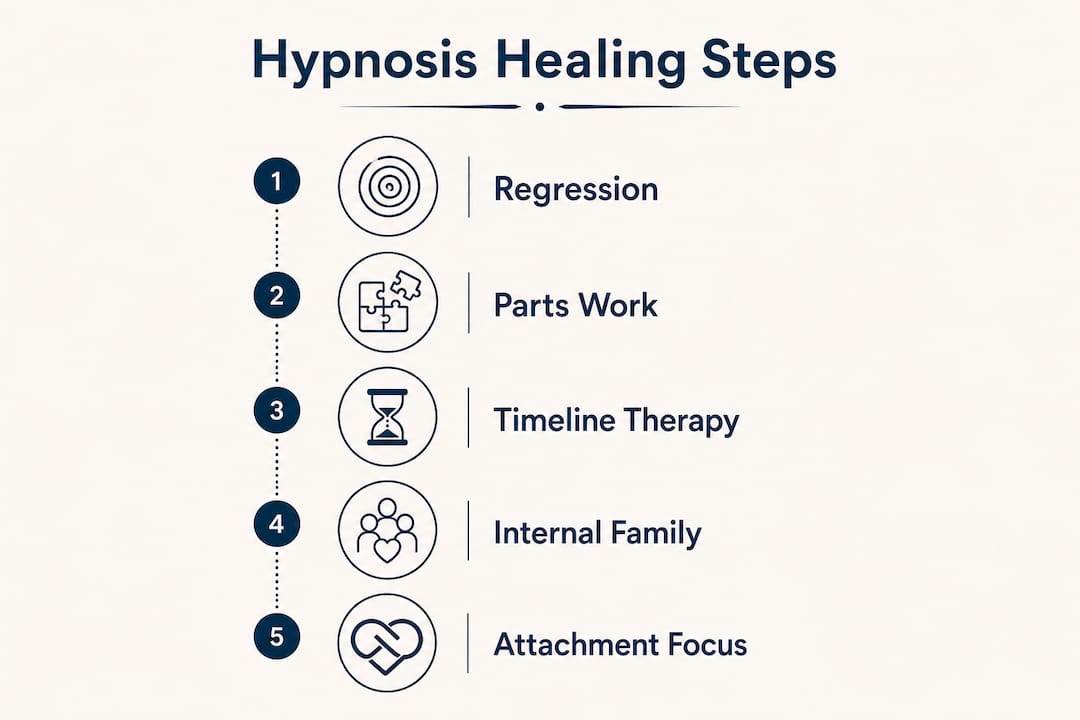
Regression and timeline techniques access implicit memories, the kind stored in the body and subconscious rather than in conscious recall. A therapist using regression therapy can guide you back to the original wound, not to relive it, but to update how your nervous system holds it. That is how repeating patterns finally stop repeating.
Parts work, drawn from Internal Family Systems, is another approach used in relationship hypnotherapy. Different parts of you want different things: the part that craves closeness, the part that pulls away to stay safe, the part that tests people before trusting them. Hypnosis creates a space where those parts can be heard and reconciled, rather than fighting each other in the middle of an argument with your partner.
The Gottman Institute's research on healthy couples found a positive-to-negative interaction ratio of 20:1 in everyday moments and 5:1 during conflict. Hypnosis supports that ratio by reducing the automatic negative reactivity that pulls couples below it.
Practical steps for using hypnosis to strengthen love and trust:
- Identify the specific pattern causing damage (withdrawal, jealousy, criticism, avoidance)
- Work with a hypnotherapist to trace that pattern to its subconscious origin
- Use regression or timeline work to update the emotional memory at its source
- Install new behavioral responses through hypnotic suggestion and rehearsal
- Reinforce with intimacy-building practices between sessions
| Approach | What it targets | Best for |
|---|---|---|
| Regression therapy | Original childhood wounds | Repeating relationship patterns |
| Timeline work | Past experiences shaping current behavior | Fear of commitment, trust issues |
| Parts work (IFS) | Internal conflicts about closeness | Push-pull dynamics, ambivalence |
| Hypnotic rehearsal | Future relationship behaviors | Building new communication habits |
| Attachment-based hypnotherapy | Nervous system regulation | Anxious or avoidant attachment styles |
How to use hypnosis to consciously end an unhealthy relationship
Leaving a relationship that is hurting you sounds simple from the outside. From the inside, it often feels impossible. The subconscious mind holds emotional bonds, fear of being alone, guilt, and sometimes a deep-seated belief that you do not deserve better. Those are not character flaws. They are subconscious programs, and hypnosis can address them directly.
Hypnotherapy helps with relationship closure by working on the emotional blocks that keep people trapped. That includes the fear response that activates when you imagine being on your own, the guilt that fires when you think about disappointing someone, and the low self-worth that makes staying feel safer than leaving.
Steps for using hypnosis to support a healthy relationship ending:
- Clarify your values and boundaries in a hypnotic state, where external pressure quiets and your own needs become clearer
- Build self-worth through direct suggestion work targeting the subconscious belief that you are not enough without this relationship
- Process grief and guilt by accessing and releasing the emotional charge attached to the relationship
- Rehearse the future using timeline techniques to experience yourself as whole, stable, and capable after the relationship ends
- Reduce trauma bonding by working with a therapist to identify and interrupt the nervous system cycles that create compulsive attachment to harmful partners
Ethical considerations matter here. Hypnosis is not a tool for manipulating another person's feelings or decisions. It works on your own subconscious, not someone else's. For relationships involving abuse, coercive control, or significant trauma, professional guidance from a licensed hypnotherapist is not optional. Self-treatment in those situations can reinforce rather than resolve the patterns.
Why hypnotherapy works in relationship therapy: research and clinical insights
The neuroscience behind this is straightforward. Relational trauma, the kind that shapes how you attach and respond in adult relationships, is stored in implicit memory. That is the part of the brain that operates below conscious awareness. Cognitive therapy works at the conscious level. Hypnotherapy engages the brain states where those relational patterns were first encoded, which is why clients often report that insights from hypnosis feel more integrated and lasting than insights from talk therapy alone.
Research on attachment styles adds another layer. A 2024 study published in Frontiers in Psychology found that secure attachment predicts better absorption during hypnosis, while anxious attachment correlates with higher internal dialogue and avoidant attachment correlates with reduced absorption and increased negative affect. That does not mean hypnosis does not work for people with insecure attachment. It means the approach needs to be adapted, with grounding and safety established before deeper work begins.
"Healing relationship wounds through hypnotherapy offers a pathway to transformation that goes beyond symptom relief to fundamental pattern change. Every client who walks through your door seeking relationship healing is taking a courageous step toward love." — International Hypnosis Association
Clinically, the advantage of hypnotherapy over purely cognitive approaches is that it targets the root cause rather than managing symptoms. Chronic defensiveness in relationships is not a communication problem. It is a nervous system problem. When hypnotherapy reduces the underlying anxiety driving that defensiveness, the communication often improves on its own.
Pro Tip: Ask any hypnotherapist you consider working with whether they adapt their approach for attachment style. A practitioner who uses the same protocol for every client regardless of attachment history is skipping a clinically significant variable.
Hypnotictransformations offers online clinical hypnotherapy sessions led by Kirk Hoffman, a Certified Clinical Hypnotherapist. Sessions address the subconscious patterns behind anxiety, avoidance, and emotional reactivity that damage relationships. Work happens via Zoom, nationwide, with free consultations available. If you are ready to address what is actually driving your relationship patterns, book a session and start there.
Key Takeaways
Hypnotherapy reaches the subconscious patterns driving relationship dysfunction, producing changes that cognitive approaches alone often cannot sustain.
| Point | Details |
|---|---|
| Subconscious access | Hypnosis bypasses conscious defenses to reach emotional patterns encoded in implicit memory. |
| Attachment style matters | Secure attachment predicts better absorption in hypnosis; insecure styles need grounding work first. |
| Gottman's interaction ratio | Healthy couples maintain a 20:1 positive-to-negative ratio outside conflict and 5:1 during it. |
| Guided beats self-hypnosis | Professional sessions reach trauma and attachment wounds that self-hypnosis cannot safely address alone. |
| Ethics of closure work | Hypnosis works on your own subconscious only; professional support is required when abuse or trauma is involved. |