
You can make real, measurable progress on mental and emotional health with daily, evidence-based actions. When anxiety, panic attacks, or phobias persist despite self-help, clinical hypnotherapy offers a faster route by reprogramming subconscious patterns that conscious effort alone rarely reaches.
The short version:
- Slow your breathing right now: inhale for 4 counts, hold for 1, exhale for 5. This directly interrupts fight-or-flight signaling.
- Name what you feel precisely, not just "anxious" but "my chest is tight and I feel like something bad is about to happen." Specificity reduces escalation.
- Build one predictable daily anchor: same wake time, morning light, consistent meals. Your nervous system reads routine as safety.
- If anxiety is frequent, functional, or has lasted more than two weeks, book a free consult with a Certified Clinical Hypnotherapist.
Kirk Hoffman, CCHt, at Hypnotictransformations provides online hypnotherapy for anxiety via Zoom for adults across the United States dealing with anxiety, panic, and phobias.
Table of Contents
- Who benefits most, and when is self-help not enough?
- How to heal yourself mentally and emotionally, starting today
- How does clinical hypnotherapy actually change the subconscious?
- What does a hypnotherapy session look like, and how long does it take?
- Costs, insurance, and how to prepare for your first session
- How do you choose a qualified hypnotherapist safely?
- Client outcome examples from Hypnotictransformations
- Key Takeaways
- A clinician's perspective on what actually moves the needle
- Ready to work with Hypnotictransformations?
- Useful sources and further reading
Who benefits most, and when is self-help not enough?
Self-directed mental wellness practices work well for mild, recent stress. If you had a hard month and your sleep and mood have slipped, a consistent routine, breathing practice, and structured journaling will likely move the needle.
The picture changes when anxiety is chronic, frequent, or interfering with daily function. Adults with recurring panic attacks, specific phobias that drive avoidance, or fear-based thinking that has persisted for months rarely find durable relief from self-help alone. Professional clinical support provides assessment, safety planning, and tools that go beyond what a routine can offer.
Seek immediate professional care if you notice: panic attacks occurring weekly or more, avoidance that has shrunk your daily life (skipping work, driving, social contact), emotional pain lasting more than two weeks with no improvement, or any thoughts of self-harm. Call or text the 988 Suicide and Crisis Lifeline at 988 if you or someone you know is in crisis.
How to heal yourself mentally and emotionally, starting today
(This section follows a PAS structure: Problem, Agitation, Solution.)
Anxiety keeps the nervous system in a low-grade state of threat. The goal of every practice below is to send the opposite signal: safety. These steps are ordered by immediacy.

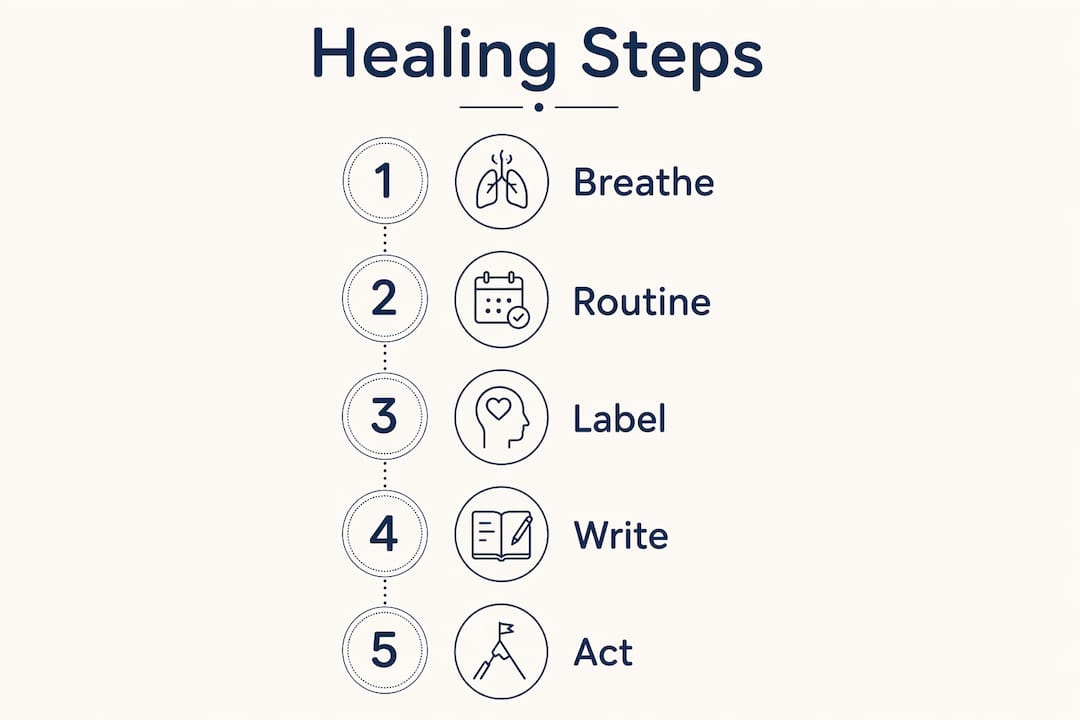
1. Interrupt fight-or-flight with one breathing pattern
The 4-1-5 breath (inhale 4, hold 1, exhale 5) is simple enough to use anywhere and reliably activates the relaxation response. Do three cycles before checking your phone in the morning. Do it again before any situation that typically triggers anxiety.
2. Anchor your nervous system with routine
A predictable daily schedule stabilizes circadian rhythms and reduces background anxiety by giving the nervous system reliable temporal cues. Wake at the same time, eat at consistent intervals, and get outside for morning light within an hour of rising. Adults need seven or more hours of sleep per night; irregular sleep is one of the fastest ways to erode emotional regulation. Incorporating daily ritual practices into your routine compounds these effects over time.
3. Name emotions precisely
Emotional granularity means labeling feelings with specificity and mapping them to physical sensations. "Anxious" is vague. "My shoulders are tight, my thoughts are racing, and I feel like I need to escape" gives you something to work with. This practice reduces escalation into panic by catching anxiety earlier in its cycle.
4. Write it out for 15–20 minutes
Structured expressive writing is a researched intervention for processing emotional distress. Write without editing. Describe what happened, how it felt in your body, and what you wish were different. Do this three times per week.
5. Schedule one small, values-aligned action per day
Action-focused tasks reduce rumination by moving the brain from emotional reactivity into goal-directed problem solving. Pick something small: a ten-minute walk, one phone call you have been avoiding, cooking a real meal. The activity matters less than the act of choosing it.
7-day starter plan:
| Day | Focus |
|---|---|
| 1 | Morning 4-1-5 breath, 3 cycles. Set a consistent wake time. |
| 2 | Expressive writing, 15 minutes. Name three emotions precisely. |
| 3 | One values-aligned activity. Evening: no screens 30 min before bed. |
| 4 | Repeat breathing practice. Add a short walk after lunch. |
| 5 | Expressive writing. Write one thing you are grateful for. |
| 6 | Social connection: reach out to one person. |
| 7 | Review the week. Note what reduced anxiety. Book a consult if needed. |
Pro Tip: Do the 4-1-5 breath for two minutes immediately before a hypnotherapy session. It lowers baseline arousal and helps the subconscious mind receive suggestions more readily.
How does clinical hypnotherapy actually change the subconscious?
Clinical hypnotherapy targets subconscious learning and implicit memory to change conditioned fear responses. That is the one-sentence answer.
Here is the mechanism. Anxiety and phobias are largely stored as implicit, automatic responses, not conscious beliefs. The subconscious mind learned at some point that a situation, sensation, or thought meant danger, and it has been running that program since. Conscious reasoning rarely overwrites it because the subconscious operates below the threshold of deliberate thought.
During a trance state, conscious resistance drops. The brain becomes more receptive to new associations. A Certified Clinical Hypnotherapist uses this window to introduce suggestions, guided imagery, and NLP techniques that pair the previously threatening stimulus with a calm, regulated nervous-system state. Over repeated sessions, the conditioned fear response weakens and a new, calmer response takes its place.
This is why clinical hypnotherapy addresses subconscious roots of anxiety that self-help alone seldom resolves. It complements, rather than replaces, approaches like ACT, CBT, and MBSR. The daily practices in the previous section prepare the nervous system; hypnotherapy does the deeper reprogramming.
Kirk Hoffman's approach at Hypnotictransformations is explained in detail on the how hypnotherapy works page.
What does a hypnotherapy session look like, and how long does it take?
Session flow:
- Intake and assessment: presenting problem, history, goals, contraindications
- Calming induction: guided relaxation to shift the nervous system into a receptive state
- Targeted suggestions: NLP, guided imagery, and advanced hypnotic techniques directed at the specific fear or anxiety pattern
- Post-session grounding: brief re-orientation, homework assignment, and next-session planning
Sessions typically run 60–90 minutes. For anxiety, panic, and phobias, most clients work through a multi-session package rather than a single appointment, because lasting subconscious change requires repetition and consolidation.
| Sessions | Typical interval | Observable outcomes |
|---|---|---|
| 1–2 | Week 1 | Reduced baseline arousal; initial shift in response to trigger |
| 3–4 | Weeks 2–4 | Fewer panic episodes; reduced avoidance behavior |
| 5–6 | Weeks 4–6 | Consolidated change; improved daily function |
| 7+ | Monthly maintenance | Relapse prevention; continued subconscious reinforcement |
Hypnotictransformations delivers all sessions via Zoom, which means no commute and no waiting room. Remote delivery does not reduce clinical effectiveness for anxiety and phobia work.
Costs, insurance, and how to prepare for your first session
Single hypnotherapy sessions in the United States typically range from $100 to $300 per session, with multi-session packages often priced at a lower per-session rate. Hypnotictransformations operates on a fee-for-service model with individual session bookings and packages; a free consultation is available to assess fit before committing.
Insurance reality: Hypnotherapy is frequently out-of-network with U.S. insurers. Check your benefits for "complementary and alternative medicine" coverage. If you have a Flexible Spending Account (FSA) or Health Savings Account (HSA), hypnotherapy for a diagnosed condition may be an eligible expense. Confirm with your plan administrator.
Preparation checklist for Zoom sessions:
- Private, quiet room where you will not be interrupted for 90 minutes
- Comfortable clothing; you will not need to move
- Headphones recommended for audio quality during induction
- Block 30 minutes after the session for rest; do not schedule demanding tasks immediately after
- Complete any intake forms sent before the appointment
- Do the 4-1-5 breathing practice for two minutes before logging on
Adults need seven or more hours of sleep the night before a session. Arriving tired reduces receptivity to hypnotic suggestion.
How do you choose a qualified hypnotherapist safely?
Verification checklist:
- Confirm the Certified Clinical Hypnotherapist (CCHt) credential from a recognized body such as the American Council of Hypnotist Examiners (ACHE) or the National Guild of Hypnotists (NGH)
- Ask specifically about clinical experience with anxiety, panic attacks, and phobias, not just general hypnotherapy
- Request outcome examples or anonymized case summaries
- Ask how contraindications are screened (psychosis, active substance dependence, and certain dissociative disorders are standard exclusions)
- Confirm the session structure, homework expectations, and what happens if you experience distress during a remote session
Questions to ask on a free consult:
- What assessment do you conduct before the first paid session?
- How do you measure progress?
- What is your protocol if I have a panic response during a session?
- How many sessions do you typically recommend for my presenting issue?
Red flags: vague success claims with no specifics, unwillingness to explain the method, no formal intake or assessment, and pressure to purchase large packages before any clinical work has begun.
For telehealth sessions, confirm the platform is HIPAA-compliant, that informed consent covers remote delivery, and that the clinician has an emergency protocol for acute distress during a Zoom session.
Client outcome examples from Hypnotictransformations
The following are anonymized summaries based on the types of cases Kirk Hoffman works with at Hypnotictransformations. They are illustrative of realistic outcomes, not guarantees.
Case A: Panic disorder with agoraphobic avoidance. Client presented with weekly panic attacks and had stopped driving on highways. Over six sessions using NLP and guided imagery targeting the conditioned threat response, panic frequency dropped significantly and highway driving resumed by session five. Homework included daily 4-1-5 breathing and expressive writing between sessions.
Case B: Social phobia. Client avoided professional networking events due to intense anticipatory anxiety. Four sessions using advanced hypnotic suggestion and cognitive defusion techniques reduced pre-event anxiety and the client attended two professional events within the treatment window.
Case C: Generalized anxiety with sleep disruption. Client reported chronic worry and waking at 3 AM. After five sessions focused on subconscious reframing of threat appraisal and sleep-onset suggestions, subjective anxiety ratings improved and sleep consolidation was reported by week six.
These examples reflect the range of presenting problems Kirk works with. Individual results vary based on presenting severity, engagement with homework, and session frequency. Confidentiality is maintained; no identifying details are included.
Also worth noting: trauma-focused approaches like EMDR can complement hypnotherapy for clients whose anxiety has roots in specific past events, and Kirk can discuss whether a combined approach fits your situation during a consult.
Key Takeaways
Clinical hypnotherapy, combined with daily nervous-system practices, offers adults with persistent anxiety and phobias a faster path to lasting subconscious change than self-help alone.
| Point | Details |
|---|---|
| Start with breathing | The 4-1-5 breath (inhale 4, hold 1, exhale 5) interrupts fight-or-flight signaling immediately. |
| Routine signals safety | Consistent wake time, meals, and sleep stabilize the nervous system and reduce background anxiety. |
| Name emotions precisely | Emotional granularity catches anxiety earlier and reduces escalation into panic. |
| Know when to get help | Panic attacks, functional avoidance, or symptoms lasting more than two weeks call for clinical support. |
| Hypnotictransformations | Kirk Hoffman, CCHt, offers online anxiety hypnotherapy via Zoom with a free consult to assess fit. |
A clinician's perspective on what actually moves the needle
Most adults who come to me have already tried the standard advice. They have the meditation app. They know about deep breathing. The anxiety is still there, sometimes worse, because the subconscious mind has not gotten the memo.
What I see consistently is this: self-directed mental wellness practices reduce the volume of anxiety. They are worth doing. But when a phobia or panic pattern is well-established, the subconscious has a strong, automatic program running. Breathing exercises do not rewrite that program. They manage it. That is a meaningful distinction.
The PAS structure driving this guide is deliberate. Problem: anxiety that persists despite effort. Agitation: the gap between what you know you should feel and what your nervous system actually does. Solution: targeted subconscious work that changes the conditioned response at its source, not just its surface expression.
What I prioritize in early sessions is assessment before suggestion. Understanding exactly when the pattern started, what triggers it, and how it shows up in the body gives the clinical work precision. Generic relaxation is not the goal. Specific, lasting change in how the nervous system responds to the trigger is.
Ready to work with Hypnotictransformations?
If anxiety, panic, or a specific phobia has been limiting your life, the free consultation at Hypnotictransformations is the practical next step. Kirk Hoffman, CCHt, conducts a brief intake to assess your presenting issue, explain the session structure, and confirm whether hypnotherapy is appropriate for your situation.
What happens when you book:
- Free 20-minute consult via Zoom to assess fit and answer your questions
- Intake form completed before your first paid session
- Session length: 60–90 minutes
- Platform: Zoom, from anywhere in the United States
- Progress reviewed at sessions 3 and 6 against your stated goals
Browse the full services and packages or go directly to the appointments page to schedule your consult.
Useful sources and further reading
- How to Improve Mental Health, MedlinePlus
- Caring for Your Mental Health, NIMH
- Improve Your Emotional Well-Being, CDC
- Emotional Wellness Toolkit, NIH
- Hypnotictransformations: Online Hypnotherapy for Anxiety
- How Hypnotherapy Works, Hypnotictransformations
This article is general information, not professional medical or psychological advice. Confirm current clinical guidelines with a qualified mental health professional for your specific situation.